Key Takeaways
- Indian private space companies are increasingly targeting funding opportunities related to lunar and Martian exploration, moving beyond Earth orbit.
- The Chandrayaan programme’s success and potential future missions to the Moon and Mars are creating a fertile ground for private sector involvement and investment.
- Companies are developing technologies for in-situ resource utilisation (ISRU), advanced propulsion, and autonomous systems critical for deep space missions.
- Government initiatives and international collaborations are crucial for de-risking these ambitious ventures and attracting significant private capital.
The Red Planet Beckons: Indian Startups Set Sights on Martian Exploration Funding
For years, India’s space narrative has been dominated by ISRO’s awe-inspiring achievements, from the Mars Orbiter Mission (Mangalyaan) to the Chandrayaan series. Now, a new chapter is unfolding, one written not just by government agencies, but by ambitious private players. Indian startups are no longer content with just launching satellites or serving Earth’s immediate needs; they are actively positioning themselves to be integral to humanity’s next giant leaps – missions to the Moon and, crucially, to Mars. The potential for lucrative contracts, groundbreaking technological development, and a significant slice of a rapidly expanding global space economy is drawing significant attention.
This shift isn’t happening in a vacuum. The proven capabilities of Indian space technology, demonstrated repeatedly on the international stage, have instilled confidence. Investors, too, are beginning to see the immense long-term value in supporting ventures that can contribute to deep space exploration. The challenges are monumental, requiring innovations in everything from life support and radiation shielding to autonomous navigation and resource extraction. Yet, the allure of contributing to humanity’s multi-planetary future, coupled with the promise of substantial returns, is proving to be a powerful catalyst for innovation and investment.
We are witnessing the birth of a new space ecosystem in India, one where private ingenuity is being harnessed to tackle the most complex engineering and scientific problems. The focus is moving beyond simply ‘getting there’ to ‘thriving there.’ This means developing the technologies that will enable sustained human presence, resource utilisation, and scientific discovery on other worlds. The ambition is palpable, and the groundwork is being laid for India to play a pivotal role in the coming era of interplanetary exploration.
Leveraging Lunar Success: The Chandrayaan Effect on Private Investment
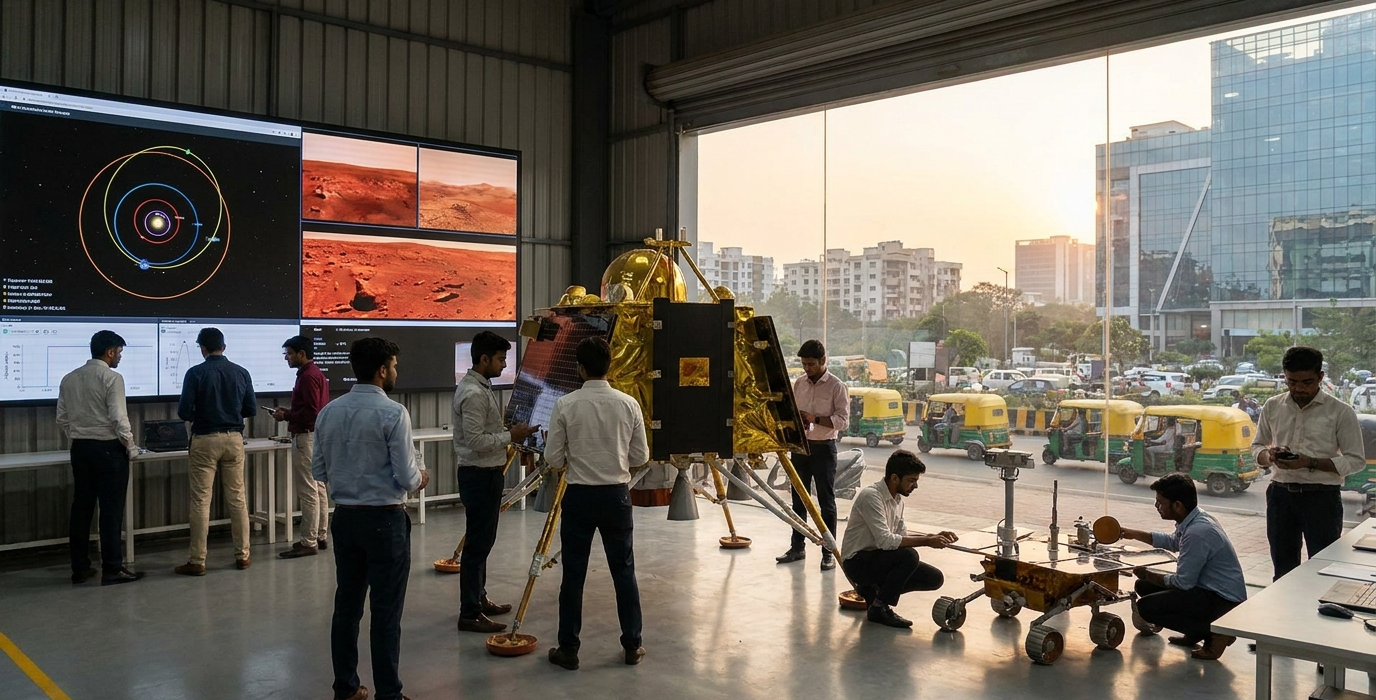
The resounding success of the Chandrayaan missions has undeniably served as a powerful springboard for private space enterprises in India. When ISRO successfully landed Vikram on the lunar south pole in 2026, it wasn’t just a scientific triumph; it was a potent demonstration of India’s growing prowess in complex space operations. This achievement has significantly boosted global confidence in India’s space capabilities, making it a more attractive destination for both domestic and international investment in the sector.
This confidence translates directly into funding opportunities for startups. Companies that can demonstrate an ability to contribute to future lunar missions – whether through payload development, landing systems, rovers, or even resource prospecting technologies – are finding a more receptive audience among venture capitalists and strategic investors. The lunar surface, with its potential for water ice and other resources, is increasingly viewed as a crucial stepping stone for more ambitious missions, including those to Mars. Startups focusing on in-situ resource utilisation (ISRU) are particularly in demand.
Consider the burgeoning field of lunar prospecting. Companies are developing advanced sensor suites and AI-driven analytical tools designed to identify and quantify valuable resources like water ice. This is not just about scientific curiosity; it’s about enabling future lunar bases and providing propellant for deep space journeys. The lessons learned from Chandrayaan, particularly regarding navigation and landing in challenging terrains, are invaluable for these nascent ventures. We’re also seeing a rise in companies offering specialised services, such as lunar dust mitigation solutions and advanced power generation systems tailored for the harsh lunar environment. The lunar dust, finer than talcum powder and highly abrasive, poses a significant engineering challenge for sensitive equipment, and innovative solutions are keenly sought.
The ISRU Advantage: Unlocking Lunar and Martian Resources
One of the most exciting frontiers for Indian space startups lies in In-Situ Resource Utilisation (ISRU). The ability to ‘live off the land’ on celestial bodies like the Moon and Mars is paramount for sustainable, long-term exploration and potential human settlement. This means extracting and processing local resources to produce essentials like water, oxygen, and even rocket propellant.
Companies are actively developing technologies for water ice extraction from lunar regolith, a crucial step for life support and fuel production. Prototypes of mobile drilling rigs and water purification systems are already undergoing testing. Similarly, for Mars, research is progressing on methods to extract oxygen from the Martian atmosphere, which is primarily carbon dioxide. This could be a game-changer for future human missions, significantly reducing the mass that needs to be launched from Earth.
The potential economic implications are vast. Establishing a lunar or Martian resource supply chain could dramatically reduce the cost of deep space missions. It opens up possibilities for commercial ventures beyond government-led exploration. For instance, a company developing an efficient electrolysis system to split lunar water into hydrogen and oxygen could find itself supplying fuel for future missions by multiple space agencies and private entities. This focus on ISRU is not merely about technological advancement; it’s about fundamentally changing the economics of space exploration and paving the way for a future where humanity is not confined to a single planet. A surprising fact: experiments on Earth have shown that certain types of bacteria, when exposed to simulated Martian soil, can metabolize key elements, hinting at future bio-regenerative life support systems.
Propulsion Innovation: The Engine of Interplanetary Dreams
Reaching Mars and beyond requires propulsion systems that are not only powerful but also highly efficient. This is an area where Indian startups are making significant strides, seeking to develop next-generation engines that can shorten journey times and reduce mission costs. The limitations of current chemical rockets for long-duration deep space travel are well-known, driving the search for more advanced solutions.
We are seeing considerable investment in electric propulsion systems, such as ion thrusters and Hall effect thrusters. These systems, while offering lower thrust, provide very high specific impulse, meaning they can achieve much greater velocities with less propellant. Companies are working on scaling these technologies for larger spacecraft and developing more robust and reliable components capable of operating for extended periods in the harsh vacuum of space.
Beyond electric propulsion, there’s a renewed interest in advanced chemical propellants and even novel concepts like nuclear thermal propulsion. While the latter is still in its nascent stages and faces significant regulatory and development hurdles, the potential for drastically reduced transit times to Mars is a powerful motivator. Indian startups are collaborating with research institutions to explore these possibilities, aiming to develop engines that can deliver the necessary thrust for rapid interplanetary transfers. The development of lightweight, high-strength materials for engine components is also a critical area of focus. Imagine engines that are not only more powerful but also significantly lighter, reducing the overall launch mass and cost of a mission. This relentless pursuit of propulsion innovation is what will truly unlock the doors to sustained human presence on other planets.
The Autonomous Edge: AI and Robotics for Martian Operations
Exploring Mars is an inherently challenging endeavor, often requiring missions to operate autonomously for extended periods due to communication delays. This is where artificial intelligence (AI) and advanced robotics play a critical role. Indian startups are at the forefront of developing intelligent systems that can enable spacecraft, landers, and rovers to make decisions, navigate complex terrains, and perform scientific tasks with minimal human intervention.
We are seeing the development of sophisticated AI algorithms for autonomous navigation and hazard avoidance. These systems can process sensor data in real-time to identify obstacles, plan optimal routes, and safely maneuver rovers across the Martian landscape, which is often littered with rocks, craters, and steep inclines. This is a far cry from earlier missions that relied on pre-programmed sequences and limited on-board intelligence.
Furthermore, AI is being integrated into scientific instruments to enable autonomous data collection and analysis. Imagine a rover equipped with AI that can identify promising geological formations, analyze their composition, and even prioritize samples for collection, all without constant human oversight. This significantly enhances the scientific return of a mission. The development of dexterous robotic arms with advanced manipulation capabilities, capable of performing intricate tasks like sample collection and equipment repair, is another key area. A surprising fact: some AI systems being developed can learn to identify specific mineral signatures from remote sensing data, a capability that could drastically speed up the search for signs of past or present life on Mars.
Funding the Frontier: Investor Confidence and Government Support
The journey to Mars is an expensive one, and attracting the necessary capital is paramount for Indian startups. Fortunately, the growing success of India’s space program, coupled with a global surge in private space investment, is creating a more favourable funding landscape. Venture capitalists, both domestic and international, are increasingly recognizing the long-term potential of the space tech sector, particularly in areas related to deep space exploration.
Government initiatives, such as the Indian National Space Promotion and Authorisation Centre (IN-SPACe), are playing a crucial role in de-risking private ventures. By providing regulatory support, access to ISRO’s facilities, and a clearer policy framework, IN-SPACe is making it easier for startups to operate and secure funding. This symbiotic relationship between government and private enterprise is essential for tackling the immense challenges of interplanetary missions.
We’re also seeing increased collaboration with international space agencies and private companies. Partnerships can provide access to cutting-edge technologies, launch opportunities, and valuable expertise. For instance, an Indian startup specializing in advanced life support systems might partner with a European company developing radiation shielding technologies for a joint bid on a lunar base module contract. The ability to demonstrate a clear path to market, coupled with robust technological innovation and strong partnerships, is key to attracting the significant investment required for these ambitious ventures. The potential for India to become a hub for deep space mission development is very real, and investors are keen to be part of this exciting future.
The Competitive Landscape: A Glimpse at Emerging Players
The Indian space startup scene is rapidly evolving, with a diverse range of companies vying for a piece of the interplanetary pie. While some are established players with a proven track record in satellite technology, others are emerging with highly specialized expertise in areas critical for Mars missions.
One category of startups is focused on developing advanced subsystems, such as high-performance sensors, robust communication modules, and miniaturized power systems. These components are essential for the resilience and functionality of any deep space probe or rover. Another group is concentrating on software and AI solutions, building the intelligent brains that will guide future missions through the vastness of space.
We also see companies venturing into areas like space debris removal technologies, which, while not directly related to Mars exploration, demonstrate a commitment to the sustainability of the space environment – a crucial consideration for any long-term space presence. The competitive landscape is dynamic, with constant innovation and strategic alliances shaping the future. For example, a startup developing novel heat shield materials might partner with a company specializing in reentry vehicle design to offer a comprehensive solution for Mars sample return missions. The sheer diversity of expertise being cultivated within India is a testament to the nation’s burgeoning capabilities in this sector.
Frequently Asked Questions
What are the biggest technological challenges for Mars missions that Indian startups are addressing?
Indian startups are focusing on critical areas like developing advanced propulsion systems for faster transit, robust AI for autonomous navigation and operations, efficient in-situ resource utilization (ISRU) technologies for life support and fuel production, and advanced radiation shielding and life support systems for human missions.
How is the Indian government supporting private companies in space exploration?
The government, through bodies like IN-SPACe, provides regulatory support, facilitates access to ISRO’s expertise and facilities, and encourages public-private partnerships. This framework aims to de-risk private ventures and foster innovation in the space sector.
What kind of funding is available for Indian space startups targeting Mars missions?
Funding comes from a mix of venture capital (both domestic and international), angel investors, government grants, and strategic investments from larger aerospace and technology corporations. The growing success of India’s space program is attracting more investor confidence.
Are there specific types of resources on Mars that startups are looking to utilize?
The primary focus for ISRU on Mars is on extracting water ice, which can be used for drinking water, oxygen production (through electrolysis), and as a component of rocket propellant. There is also interest in utilizing atmospheric carbon dioxide to produce oxygen and methane.