Key Takeaways
- Artificial intelligence is revolutionizing Indian healthcare, significantly improving diagnostic accuracy and speed, especially in underserved areas.
- AI-powered drug discovery platforms are accelerating the development of novel treatments, promising faster access to life-saving medications for Indian citizens.
- Personalized patient care is becoming a reality with AI, enabling tailored treatment plans and proactive health management, reducing the burden on hospitals.
- The integration of AI is creating new career opportunities within the Indian healthcare sector, demanding a workforce skilled in both medical and technological domains.
AI’s Precision Patrol: Revolutionizing Diagnostics Across India
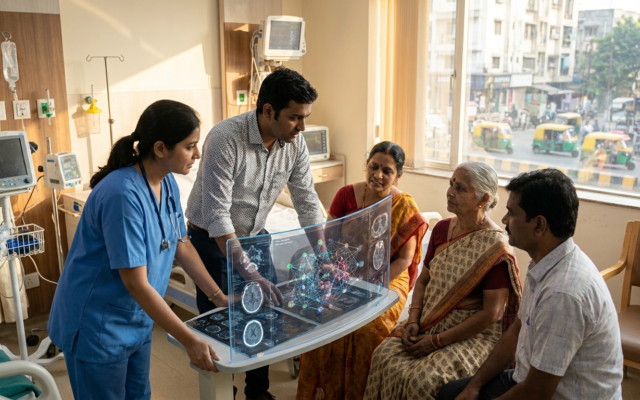
Imagine a world where critical diagnoses are made faster, more accurately, and reach even the remotest corners of India. This isn’t a futuristic dream; it’s the present reality being shaped by Artificial Intelligence (AI) in healthcare. In 2026, AI is no longer a buzzword but a tangible force, actively enhancing diagnostic capabilities across the nation.
AI algorithms are proving exceptionally adept at analyzing medical images, from X-rays and CT scans to MRIs and retinal photographs. They can detect subtle anomalies that might be missed by the human eye, especially during long shifts or in high-pressure environments. This enhanced precision is leading to earlier detection of diseases like cancer, tuberculosis, and diabetic retinopathy, significantly improving patient prognoses.
Bridging the Gap in Rural Healthcare
The sheer scale of India presents a monumental challenge for healthcare access, particularly in rural and Tier-3 cities. AI is emerging as a powerful tool to bridge this gap. Remote diagnostic centers, equipped with AI-powered analysis tools, can now provide specialist-level interpretations without requiring a doctor to be physically present. This democratizes access to quality diagnostics, ensuring that a villager in Rajasthan receives the same level of analysis as a patient in a metropolitan hospital in Mumbai.
Consider the impact on tuberculosis detection. AI models trained on vast datasets of chest X-rays can identify potential TB cases with remarkable accuracy. This allows healthcare workers in remote locations to flag individuals for further testing, expediting treatment and curbing the spread of the disease. It’s a proactive, scalable solution that was unimaginable just a few years ago.
The Speed of AI in Emergency Situations
In critical care and emergency medicine, every second counts. AI is stepping in to accelerate diagnostic processes. For instance, AI systems can triage scans in emergency departments, flagging urgent cases for immediate review by radiologists. This reduces waiting times and ensures that patients with life-threatening conditions receive prompt attention.
A surprising fact: some AI systems are now being developed to analyze not just images but also patient vitals and electronic health records simultaneously, flagging potential sepsis or cardiac arrest risks hours before they might be clinically apparent. This predictive capability is a game-changer, shifting healthcare from reactive to proactive. The speed and accuracy of these AI tools are empowering doctors and saving lives across India.
Accelerating the Pace of Drug Discovery and Development
The journey from a promising molecule to a life-saving drug is notoriously long, expensive, and fraught with failure. For decades, pharmaceutical research has relied on traditional, often serendipitous, methods. However, in 2026, AI is dramatically reshaping this landscape, accelerating drug discovery and development at an unprecedented pace, particularly within India’s burgeoning pharmaceutical sector.
AI algorithms can sift through vast libraries of chemical compounds, predict their potential efficacy against specific diseases, and even design novel molecules with desired properties. This computational power dramatically reduces the time and resources required for the initial stages of drug discovery, moving from millions of possibilities to a handful of promising candidates much faster.
From Bench to Bedside: A Faster Pathway
Traditionally, identifying a potential drug candidate could take years. AI platforms, however, can analyze genomic data, protein structures, and existing pharmacological knowledge to pinpoint targets and design molecules in a fraction of that time. This is crucial for addressing unmet medical needs, such as rare diseases or emerging infectious threats that require rapid therapeutic solutions.
Indian pharmaceutical companies, already global leaders in generic drug manufacturing, are now leveraging AI to innovate and develop novel drugs. This dual approach allows them to continue providing affordable medicines while also pushing the boundaries of therapeutic innovation. We are witnessing the rise of ‘AI-driven drug discovery hubs’ in cities like Hyderabad and Bengaluru, attracting global talent and investment.
Predicting Efficacy and Minimizing Risk
Beyond initial discovery, AI plays a vital role in predicting how a drug will behave within the human body. Algorithms can simulate drug interactions, forecast potential side effects, and identify patient subgroups most likely to respond positively to a treatment. This predictive power helps researchers prioritize the most promising candidates for clinical trials, thereby reducing the number of costly failures in later stages.
A truly remarkable development is AI’s ability to repurpose existing drugs. By analyzing vast datasets of drug properties and disease mechanisms, AI can identify approved medications that might be effective against entirely different conditions. This can significantly shorten the development timeline, as safety profiles are already established. This is a critical advantage, especially in responding to public health emergencies.
Personalized Medicine: Tailoring Treatments for Every Indian
The one-size-fits-all approach to medicine is rapidly becoming obsolete. In 2026, Artificial Intelligence is ushering in an era of personalized medicine, where treatments are precisely tailored to an individual’s unique genetic makeup, lifestyle, and medical history. This patient-centric approach promises not only better outcomes but also a more efficient and less wasteful healthcare system.
AI excels at analyzing complex, multi-dimensional patient data – from genomic sequences and biomarker levels to wearable device data and electronic health records. By identifying patterns and correlations invisible to human analysis, AI can predict an individual’s risk for certain diseases, their likely response to specific medications, and the optimal treatment pathways.
The Power of Predictive Health Analytics
Imagine receiving proactive health advice based on your personal genetic predispositions and real-time health monitoring. AI-powered platforms are making this a reality. They can alert individuals and their healthcare providers to potential health issues long before symptoms manifest, enabling early intervention and lifestyle modifications. This shift from treating illness to promoting wellness is a profound change.
For example, in managing chronic conditions like diabetes or heart disease, AI can continuously analyze a patient’s data – glucose levels, blood pressure, activity patterns – and provide personalized recommendations for diet, exercise, and medication adjustments. This empowers patients to take greater control of their health and reduces the frequency of acute exacerbations that strain hospital resources.
Optimizing Treatment Regimens
In oncology, AI is revolutionizing cancer treatment. By analyzing a tumor’s genetic profile, AI can help oncologists select the most effective chemotherapy or immunotherapy agents, minimizing exposure to treatments that are unlikely to work and reducing debilitating side effects. This precision in treatment selection leads to better patient outcomes and a more humane approach to fighting cancer.
A surprising application is AI’s role in predicting medication adherence. By analyzing patient behavior patterns and identifying potential barriers, AI can help healthcare providers develop targeted support strategies, ensuring patients take their prescribed medications correctly. This is particularly vital for long-term treatments where consistency is key to success. The focus is on empowering individuals with data-driven insights to manage their well-being.
AI’s Role in Enhancing Patient Care and Experience
Beyond diagnostics and drug discovery, Artificial Intelligence is fundamentally transforming the patient experience in Indian hospitals and clinics. In 2026, AI is not just about clinical outcomes; it’s about making healthcare more accessible, efficient, and empathetic for everyone. This encompasses everything from streamlining administrative tasks to providing continuous patient support.
AI-powered chatbots and virtual assistants are becoming the first point of contact for many patients. These tools can answer frequently asked questions, help schedule appointments, provide medication reminders, and even offer basic health advice. This frees up valuable time for human healthcare professionals to focus on more complex patient needs and direct care.
Streamlining Operations and Reducing Wait Times
Hospitals are complex ecosystems with numerous moving parts. AI is being deployed to optimize operational efficiency. Predictive analytics can forecast patient admissions, allowing for better staffing and resource allocation. This means shorter wait times in emergency rooms and outpatient departments, a significant improvement in patient satisfaction.
Consider appointment scheduling. AI can intelligently match patient needs with physician availability, factoring in urgency, specialty, and patient preferences. This reduces no-shows, optimizes physician schedules, and ensures patients see the right specialist at the right time. It’s a subtle but impactful change that eases the burden on both patients and providers.
Empowering Patients with Information and Support
AI is also enhancing how patients access and understand their health information. Patient portals are becoming more intuitive, with AI helping to translate complex medical jargon into understandable language. Furthermore, AI can provide personalized educational content based on a patient’s diagnosis, helping them to better manage their condition and make informed decisions.
A truly inspiring development is AI’s role in remote patient monitoring. Wearable devices and home sensors, analyzed by AI, allow healthcare providers to keep track of patients recovering from surgery or managing chronic illnesses from the comfort of their homes. This not only improves patient comfort and reduces hospital readmissions but also allows for timely intervention if any complications arise. The human touch is amplified, not replaced, by AI’s supportive capabilities.
The Evolving Healthcare Workforce: New Skills for an AI Era
The integration of Artificial Intelligence into healthcare is not just about technology; it’s fundamentally reshaping the roles and responsibilities of healthcare professionals in India. In 2026, the healthcare workforce is undergoing a significant evolution, demanding new skills and fostering new career paths. This is an exciting time of growth and adaptation.
Rather than replacing doctors and nurses, AI is augmenting their capabilities, freeing them from repetitive tasks and empowering them to focus on higher-level clinical decision-making and patient interaction. This partnership between human expertise and AI efficiency is the hallmark of modern healthcare.
AI as a Clinician’s Co-Pilot
Think of AI as an incredibly knowledgeable assistant. Radiologists, for instance, are using AI to pre-screen images, highlighting areas of concern and providing preliminary reports. This allows them to review more cases with greater accuracy and speed, focusing their expertise on the most complex findings. Similarly, AI can help general practitioners by flagging potential diagnoses based on patient symptoms and history.
The emphasis is shifting towards skills like critical thinking, complex problem-solving, and empathetic communication. While AI can analyze data, it cannot replicate the human capacity for compassion, trust, and nuanced patient care. These ‘soft skills’ are becoming even more valuable in an AI-augmented healthcare system.
Emerging Roles and Specializations
The rise of AI in healthcare has also created entirely new job categories. We are seeing a demand for ‘Clinical Data Scientists,’ who can bridge the gap between medical knowledge and AI algorithms, ensuring that AI tools are medically sound and ethically applied. ‘AI Ethicists in Healthcare’ are also becoming crucial, guiding the responsible deployment of AI technologies.
Furthermore, existing roles are evolving. Nurses are increasingly trained to operate and interpret data from AI-powered monitoring systems, and pharmacists are using AI to optimize drug regimens and identify potential interactions. A surprising new specialization is emerging: ‘AI-Assisted Surgical Planning,’ where AI helps surgeons map out complex procedures with enhanced precision before entering the operating room. The future of healthcare careers is dynamic and technologically integrated.
Navigating the Ethical Landscape and Ensuring Data Security
As AI becomes more deeply embedded in healthcare, especially in a nation as diverse and vast as India, addressing ethical considerations and ensuring robust data security are paramount. In 2026, these are not afterthoughts but foundational pillars for the responsible deployment of AI in medical settings. Trust and safety are non-negotiable.
The vast amounts of sensitive patient data required to train and operate AI systems raise significant privacy concerns. Robust data anonymization techniques, stringent access controls, and compliance with evolving data protection regulations are crucial. India’s digital health initiatives are increasingly incorporating these security measures.
Bias in AI Algorithms: A Persistent Challenge
One of the most critical ethical challenges is the potential for bias in AI algorithms. If AI models are trained on datasets that do not adequately represent India’s diverse population – varying in ethnicity, socioeconomic status, and geographic location – they can perpetuate and even amplify existing health disparities. For example, an AI trained primarily on data from urban populations might perform less effectively when diagnosing conditions in rural communities.
Active efforts are underway to create more inclusive and representative datasets. This involves data collection from a wider range of institutions and patient demographics across India. Continuous monitoring and auditing of AI performance across different population segments are essential to identify and mitigate bias. It’s an ongoing process of refinement.
Transparency and Accountability in AI-Driven Decisions
When an AI system contributes to a diagnosis or treatment recommendation, understanding how that decision was reached is crucial. The concept of ‘explainable AI’ (XAI) is gaining traction. XAI aims to make AI decision-making processes transparent, allowing clinicians to understand the reasoning behind an AI’s output and thus fostering trust and accountability.
Establishing clear lines of accountability is also vital. Who is responsible if an AI system makes an error that leads to patient harm – the AI developer, the hospital, or the clinician who relied on the AI’s recommendation? Legal and regulatory frameworks are evolving to address these complex questions, ensuring that patient safety remains the absolute priority. A surprising insight is that many AI systems are designed with ‘human-in-the-loop’ protocols, ensuring a clinician always has the final say, especially in critical decisions.
Frequently Asked Questions
What are the biggest benefits of AI in Indian healthcare today?
The key benefits include significantly improved diagnostic accuracy and speed, especially in remote areas, accelerated drug discovery, and the delivery of personalized patient care tailored to individual needs.
How is AI impacting the job market for healthcare professionals in India?
AI is augmenting rather than replacing healthcare professionals, leading to an evolution of roles. It creates demand for new skills in data science and AI ethics, while enhancing the capabilities of existing practitioners and focusing their roles on complex decision-making and patient empathy.
Are there specific regions in India leading in AI healthcare adoption?
While adoption is nationwide, major hubs for AI in healthcare innovation and application are emerging in cities like Bengaluru, Hyderabad, Pune, and parts of the National Capital Region, driven by research institutions and a growing tech ecosystem.
What are the main concerns regarding AI in Indian healthcare?
Primary concerns revolve around data privacy and security, the potential for algorithmic bias leading to health disparities, and the need for clear ethical guidelines and accountability frameworks for AI-driven medical decisions.