AI Advancements in Healthcare India Explored
Imagine a world where a doctor can spot a rare ailment from a patient’s X-ray with near-perfect accuracy, or where treatment plans are sketched out in minutes, tailored precisely to your unique genetic code. This isn’t a distant dream anymore. Here in India, a nation grappling with immense healthcare challenges, Artificial Intelligence (AI) is rapidly weaving its way into the very fabric of how we receive medical care, bringing tangible hope and improvements to millions. From the bustling streets of Mumbai to the quiet villages of Rajasthan, AI is promising a future that’s healthier, more accessible, and undeniably more efficient for everyone.
Key Takeaways:
- AI is revolutionizing disease detection and diagnosis in India, often surpassing human capabilities in speed and accuracy.
- It’s democratizing access to specialized medical expertise, reaching underserved rural populations.
- AI is personalizing treatment, making healthcare more effective and patient-centric.
- Predictive analytics powered by AI are shifting healthcare from reactive to proactive.
- Despite advancements, ethical considerations and data privacy remain crucial areas of focus.
The Dawn of AI-Powered Diagnostics in India
The sheer scale of India’s population presents an enormous challenge for its healthcare system. With millions seeking medical attention daily, timely and accurate diagnoses are paramount. This is where AI is making a profound impact. Picture this: a radiologist in a busy government hospital in Delhi, overwhelmed by a backlog of X-rays and CT scans. Traditionally, this could mean agonizing waits for patients, increasing the risk of complications. Now, AI algorithms are stepping in as powerful allies. These systems are trained on vast datasets of medical images, learning to identify subtle anomalies that might escape the human eye, especially under pressure. For instance, AI models are achieving remarkable success in detecting diabetic retinopathy, a leading cause of blindness in India, from retinal scans. Early detection is key to preventing vision loss, and AI’s ability to flag potential issues quickly and accurately is a game-changer.
Consider the work being done at the Indian Institute of Technology (IIT) Madras. Researchers there have been developing AI tools to analyze medical images for various conditions, from cardiovascular diseases to certain types of cancer. These tools aren’t meant to replace doctors but to augment their abilities. They act as an intelligent second opinion, flagging suspicious areas and reducing the cognitive load on medical professionals. This is particularly crucial in a country where the doctor-to-patient ratio is significantly lower than global recommendations. By automating parts of the diagnostic process, AI frees up doctors to focus on complex cases and patient interaction, enhancing the overall quality of care. We’re seeing AI not just in research labs but increasingly integrated into the workflows of leading hospitals and diagnostic centers across the nation. The accuracy rates for some AI-driven diagnostic tools are already reaching over 95%, a statistic that speaks volumes about their potential to improve patient outcomes across India.
Bridging the Gap: AI’s Role in Rural Healthcare Accessibility
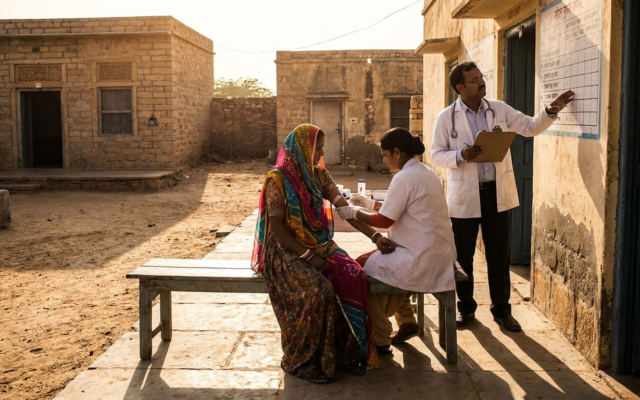
One of the most significant hurdles in India’s healthcare journey has been the disparity between urban and rural medical facilities. While metropolitan areas boast advanced hospitals and specialists, many rural communities struggle with basic medical infrastructure and a severe shortage of qualified doctors. AI is emerging as a powerful bridge to close this chasm. Imagine a health worker in a remote village in Bihar, equipped with a tablet running an AI-powered diagnostic application. This worker, with perhaps minimal formal medical training, can use the device to conduct initial screenings for common ailments, from skin infections to respiratory issues. The AI can analyze symptoms, ask follow-up questions, and provide a preliminary assessment, guiding the health worker on whether the patient needs to be referred to a higher center or can be treated locally.
This technology isn’t just a theoretical concept; it’s being piloted and implemented in various parts of India. Companies are developing mobile-friendly AI platforms that can work even with limited internet connectivity, a common reality in many remote areas. These platforms often incorporate local languages and cultural nuances, making them more user-friendly for both healthcare providers and patients. For example, an AI chatbot designed to assist with antenatal care can guide pregnant women in their regional dialect through crucial health advice, reminders for check-ups, and early warning signs of complications. This proactive approach, facilitated by AI, can significantly reduce maternal and infant mortality rates, which remain a critical concern in India. The potential for AI to empower community health workers and extend the reach of medical expertise is immense, offering a ray of hope for millions who have historically been underserved by the healthcare system.
Personalizing Treatment: The AI Prescription for Precision Medicine
The one-size-fits-all approach to medicine is rapidly becoming obsolete, and AI is at the forefront of this paradigm shift towards precision medicine. In India, where genetic diversity is vast and lifestyles vary dramatically, tailoring treatments to individual patients is no longer a luxury but a necessity for optimal outcomes. AI algorithms can analyze a patient’s genetic information, medical history, lifestyle factors, and even real-time data from wearable devices to create highly personalized treatment plans. This means that instead of a standard dosage of medication, an AI system might recommend a specific drug, at a precise dosage, combined with dietary and exercise recommendations, all calibrated to the individual’s unique biological profile.
Consider the field of oncology. Cancer treatment is notoriously complex, with different patients responding differently to various therapies. AI can sift through massive amounts of clinical trial data, genomic information, and patient outcomes to predict which treatment is most likely to be effective for a particular individual’s specific cancer type and genetic mutations. This not only improves the chances of successful treatment but also minimizes the risk of adverse side effects from ineffective therapies. Hospitals like Apollo Hospitals in Chennai are exploring AI-driven platforms that can assist oncologists in making these complex treatment decisions. The ability of AI to process and integrate such a vast array of data points far exceeds human capacity, leading to more informed and effective treatment strategies. This personalized approach isn’t limited to chronic diseases; it’s extending to infectious diseases, autoimmune disorders, and even mental health conditions, promising a future where every patient receives care designed uniquely for them.
Predictive Analytics: Shifting from Reactive to Proactive Healthcare
Historically, healthcare systems have operated on a reactive model – treating illnesses after they manifest. However, AI is enabling a significant shift towards a proactive and preventive healthcare model. By analyzing vast datasets that include patient demographics, environmental factors, public health trends, and even social media data (used ethically and anonymously), AI can predict disease outbreaks, identify individuals at high risk for certain conditions, and intervene before a problem escalates. Imagine public health officials in Pune using AI to predict the spread of dengue fever based on rainfall patterns, mosquito breeding sites, and population density. This allows them to deploy resources strategically, such as targeted mosquito control programs or public awareness campaigns, effectively mitigating the impact of the outbreak.
This predictive power extends to individual health as well. Wearable devices, now increasingly common in urban India, generate continuous streams of data on heart rate, sleep patterns, physical activity, and more. AI algorithms can monitor this data for subtle deviations that might indicate an impending health issue, such as an irregular heartbeat or the early stages of stress-related illness. The system can then alert the user and their healthcare provider, prompting an early check-up or lifestyle adjustment. This proactive intervention can prevent serious health events, reduce hospitalizations, and lower healthcare costs. A study conducted in the UK, but with relevance to India’s growing use of such tech, showed that AI-powered predictive models could identify patients at high risk of developing type 2 diabetes up to seven years in advance, allowing for timely lifestyle interventions. This foresight is transformative, moving us from a model of sickness to one of wellness, a crucial goal for a nation striving for better public health.
The Ethical Compass: Navigating AI in Indian Healthcare
As AI rapidly integrates into India’s healthcare ecosystem, it brings with it a set of complex ethical considerations that demand careful attention. Data privacy and security are paramount. The sensitive nature of health information means that robust safeguards must be in place to protect patient confidentiality. Who owns the data? How is it anonymized? How is it protected from breaches? These are questions that need clear answers and stringent regulations. The Indian government and regulatory bodies are actively working on these fronts, but continuous vigilance and adaptation are necessary as AI technology evolves. The Personal Data Protection Bill, when fully enacted, aims to provide a strong framework for data governance in India.
Another critical ethical dimension is algorithmic bias. If the datasets used to train AI models are not representative of India’s diverse population, the AI’s recommendations and diagnoses could be skewed, potentially disadvantaging certain groups. For example, an AI trained primarily on data from fair-skinned individuals might be less accurate in diagnosing skin conditions in people with darker complexions. Ensuring inclusivity and fairness in AI development is an ongoing challenge that requires diverse teams and rigorous testing across various demographic groups. Furthermore, the question of accountability arises. If an AI makes a diagnostic error or a treatment recommendation that leads to harm, who is responsible? Is it the developer, the healthcare provider who used the AI, or the institution that implemented it? Establishing clear lines of accountability is vital for building trust and ensuring patient safety. The conversation around these ethical challenges is as important as the technological advancements themselves, ensuring that AI serves humanity equitably and responsibly.
Looking Ahead: AI’s Enduring Promise for India’s Health
The journey of AI in Indian healthcare is still unfolding, but its trajectory is undeniably upward and filled with immense promise. We are witnessing a profound transformation, moving from a system often strained by resource limitations to one empowered by intelligent technology. The ability of AI to enhance diagnostic accuracy, democratize access to specialized care, personalize treatments, and shift the focus from reaction to prevention is set to reshape the health and well-being of millions. From sophisticated AI-driven robotic surgery systems being piloted in metropolitan hospitals to simple, yet life-saving AI diagnostic apps used by community health workers in remote villages, the impact is diverse and far-reaching. The integration of AI promises not just incremental improvements but a fundamental elevation of healthcare standards across the nation.
The continuous development of AI algorithms, coupled with India’s robust digital infrastructure and a growing pool of tech talent, positions the country to be a leader in healthcare innovation. However, this progress must be guided by a commitment to equity, ethics, and patient-centricity. The goal is not simply to adopt new technology but to ensure that it benefits all segments of society, especially the most vulnerable. As we continue to explore the vast potential of AI, we must remain grounded in the human element of care, ensuring that technology serves as a tool to amplify compassion and improve lives, making a healthier future not just a possibility, but a tangible reality for every Indian.