
The Indian film industry has moved beyond regional boundaries to command a massive, loyal global audience, but maintaining this momentum requires a delicate balance between cultural authenticity and international appeal. As we navigate late 2026, the question is no longer whether Indian cinema can travel, but how it will scale sustainably in a competitive global market.
Key Takeaways
- Indian cinema is shifting from high-budget spectacles to localized storytelling that resonates with global diaspora and international audiences alike.
- The rise of hybrid distribution models—balancing theatrical windows with digital platforms—has fundamentally altered revenue projections.
- Production houses are increasingly prioritizing international co-productions to mitigate risk and expand market access beyond traditional territories.
- Data-driven audience insights are replacing gut-feeling production decisions, leading to more predictable outcomes at the box office.
The Paradigm Shift in Narrative Strategy
The days of relying solely on the star-system to drive box office numbers in overseas territories are fading. Today, producers are realizing that content-led narratives—those rooted in the intricacies of small-town India—often perform better in markets like the UK and North America than formulaic big-budget actioners. This pivot is intentional. It acknowledges that modern audiences, whether in Mumbai or Manchester, crave authenticity.
We are seeing a move toward what industry experts call the “glocal” approach. This involves keeping the soul of the story rooted in Indian soil—perhaps set in the vibrant streets of Varanasi or the hills of Meghalaya—while employing global technical standards for sound design and cinematography. By partnering with international post-production houses, Indian studios ensure that their product meets the high-definition expectations of global cinema chains.
This transition is supported by the National Film Development Corporation of India, which has been actively facilitating co-production treaties. These agreements allow filmmakers to pool resources with international partners, reducing the financial burden while ensuring that the final output is culturally calibrated for a global palate. It is a strategic move that turns a localized story into a globally viable commodity.
Data Analytics and the New Box Office
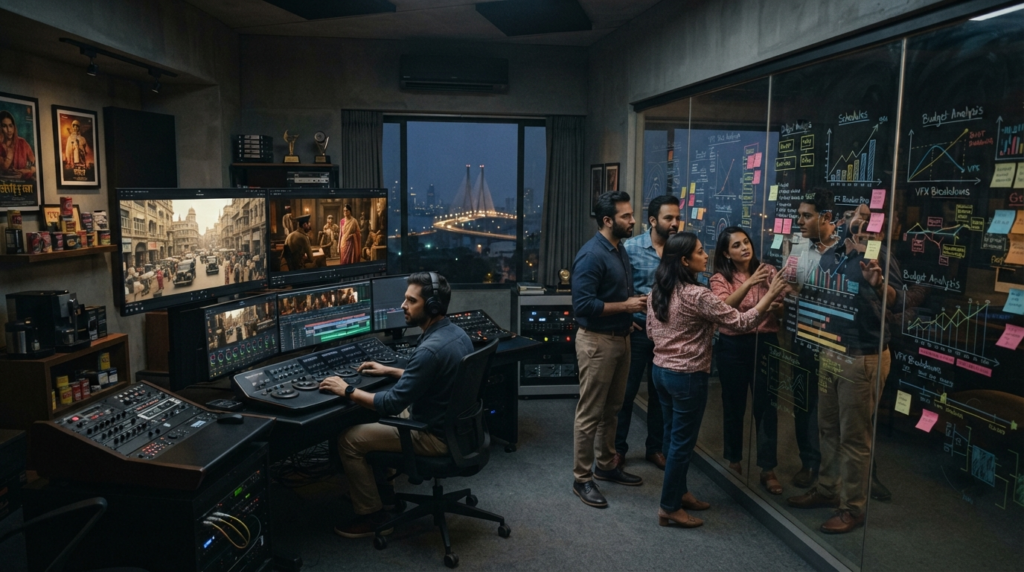
Historically, the success of an Indian film was a gamble on the “Friday opening.” Now, production houses are leaning heavily into predictive analytics to gauge market interest long before the first shot is fired. By tracking social media sentiment, search trends, and digital footprint data, studios can identify whether a film’s theme will resonate in specific international clusters.
For instance, the surge in interest for South Indian cinema in non-traditional markets like Japan and Eastern Europe is no accident. It is the result of focused, data-driven marketing campaigns that target niche demographics who appreciate the technical craft of these films. When a film hits the screen, it is already backed by a community that has been engaged for months.
According to the latest Federation of Indian Chambers of Commerce and Industry reports on the media and entertainment sector, the investment in data-backed pre-production has increased by nearly 30 percent since 2024. This ensures that resources are allocated to projects with a statistically higher probability of commercial success. It is a departure from the “hit-or-miss” era, signaling a maturation of the business side of Indian filmmaking.
Distribution Models: The Theatrical and Digital Tug-of-War
The 2026 landscape is defined by the hybrid release model. While the theatrical experience remains the gold standard for prestige, the role of OTT platforms has shifted from being a “backup” to an integral part of the release strategy. In markets like the Middle East and North America, a tiered release—where the theatrical run is followed by an exclusive digital window—maximizes the total revenue capture.
Surprisingly, the demand for Indian content in non-English speaking markets has surged. A fascinating fact: films dubbed in regional Indian languages are now seeing a 15 percent higher completion rate on global streaming platforms compared to their subtitled counterparts. This indicates that accessibility is the primary barrier to entry for the global audience, not the narrative itself.
The challenge, however, remains the “theatrical window.” Distributors are currently negotiating shorter gaps between the premiere and the digital drop to satisfy an increasingly impatient global audience. This requires a delicate touch; too short, and you cannibalize the cinema revenue; too long, and you risk losing the online conversation.
| Release Strategy | Theatrical Focus | Digital Integration | Primary Market |
|---|---|---|---|
| Blockbuster Epic | Global Imax/Large Screen | 8-Week Delay | Global Diaspora |
| Niche Drama | Limited Boutique Cinemas | 4-Week Delay | International Festivals |
| Genre-Specific | Direct-to-Platform | Immediate | Global Streaming |
The Financial Infrastructure of Modern Production
Funding a global-scale Indian film today requires a sophisticated financial ecosystem. We are seeing a move away from individual financiers toward corporate-backed production houses that function with the rigor of a multinational corporation. These entities prioritize insurance, completion bonds, and transparent accounting, which are essential for attracting foreign investment.
One interesting detail: India’s film insurance sector has expanded significantly to cover “post-production risks” related to AI-generated visual effects, which are becoming standard in big-budget projects. This level of risk management was unheard of a decade ago. It provides the stability needed for long-term planning, allowing directors to focus on their creative vision rather than financial insecurity.
Furthermore, the government’s Ministry of Electronics and Information Technology initiatives regarding digital infrastructure have also lowered the barrier for independent filmmakers. High-speed connectivity across Tier-2 cities allows crews to collaborate in real-time with global visual effects teams, ensuring that the “Make in India” tag stands for world-class technical quality.
The future of Indian cinema will not be defined by the size of its budget, but by the precision of its strategy and the universality of its human stories.
Challenges and Cultural Hurdles
Despite the success, the industry faces the challenge of cultural translation. As films cater to a wider audience, there is the risk of “homogenization,” where unique cultural markers are sanded down to make the story more palatable for a Western audience. Maintaining that distinct Indian “flavor”—the music, the vibrant colors, the complex family dynamics—is what keeps the audience coming back.
There is also the matter of censorship and global compliance. As Indian films aim for a PG-13 or equivalent rating in markets like the US or Australia, filmmakers have to navigate varying cultural sensitivities. This has led to the rise of specialized global consultants who work during the script development phase to ensure the content is marketable without losing its soul.
Ultimately, the goal is to be globally relevant without becoming generic. The most successful films of the last year in India have been those that embraced their local identity so strongly that it became a curiosity for the rest of the world. That is the winning formula that sustainable global expansion relies upon.

The Road Ahead: Sustainability and Innovation
Looking forward to the remainder of 2026 and beyond, the Indian film industry is poised to become a central pillar of the global entertainment economy. The focus is shifting toward sustainability in production, both in terms of financial health and environmental impact. Studios are now auditing their carbon footprints, a change driven by the requirements of international co-production partners.
We are also likely to see a consolidation of talent. Actors, directors, and technicians are increasingly working across industries—Tamil, Telugu, Hindi, and Malayalam—to create a truly unified “Indian Cinema” brand. This fluidity is a major strength, allowing for a creative synergy that is difficult to replicate in more rigid, siloed industries elsewhere in the world.
The momentum is real, and the tools are sharper than ever. If the industry continues to leverage its data, embrace international partnerships, and hold fast to its unique storytelling identity, the global box office streak is not just sustainable—it is set to expand into entirely new territories.
Frequently Asked Questions
What is the biggest challenge for Indian films in global markets?
The biggest challenge is cultural translation—balancing the need to reach a global audience without losing the unique, authentic “Indian” elements that make the cinema compelling in the first place.
How does the hybrid release model affect cinema revenue?
It creates a tiered revenue stream. The theatrical window captures the premium, event-based audience, while the subsequent digital release targets the convenience-seeking global viewer, effectively maximizing the total lifecycle of the film.
Is Indian cinema becoming too reliant on digital platforms?
While digital platforms are essential for reach, they are not replacing the theatrical experience. Instead, they are complementing it, providing a broader base of data that helps producers understand which films justify a large-scale theatrical investment.
Why is data analytics important for film production now?
Data analytics reduces the risk of failure by identifying audience preferences and market trends before production begins, moving the industry away from speculative investment toward a more structured, predictable business model.