Key Takeaways
- AI is moving beyond laboratories, offering tangible benefits like precision irrigation and pest detection to Indian farmers today.
- New AI-powered tools are making crop management more efficient and less labor-intensive, a critical shift for rural India.
- Data-driven insights from AI are enabling farmers to anticipate weather patterns and market demands with greater accuracy.
- While adoption faces challenges, the long-term potential for increased yields and sustainability is immense.
Revolutionizing the Fields: AI’s On-the-Ground Impact
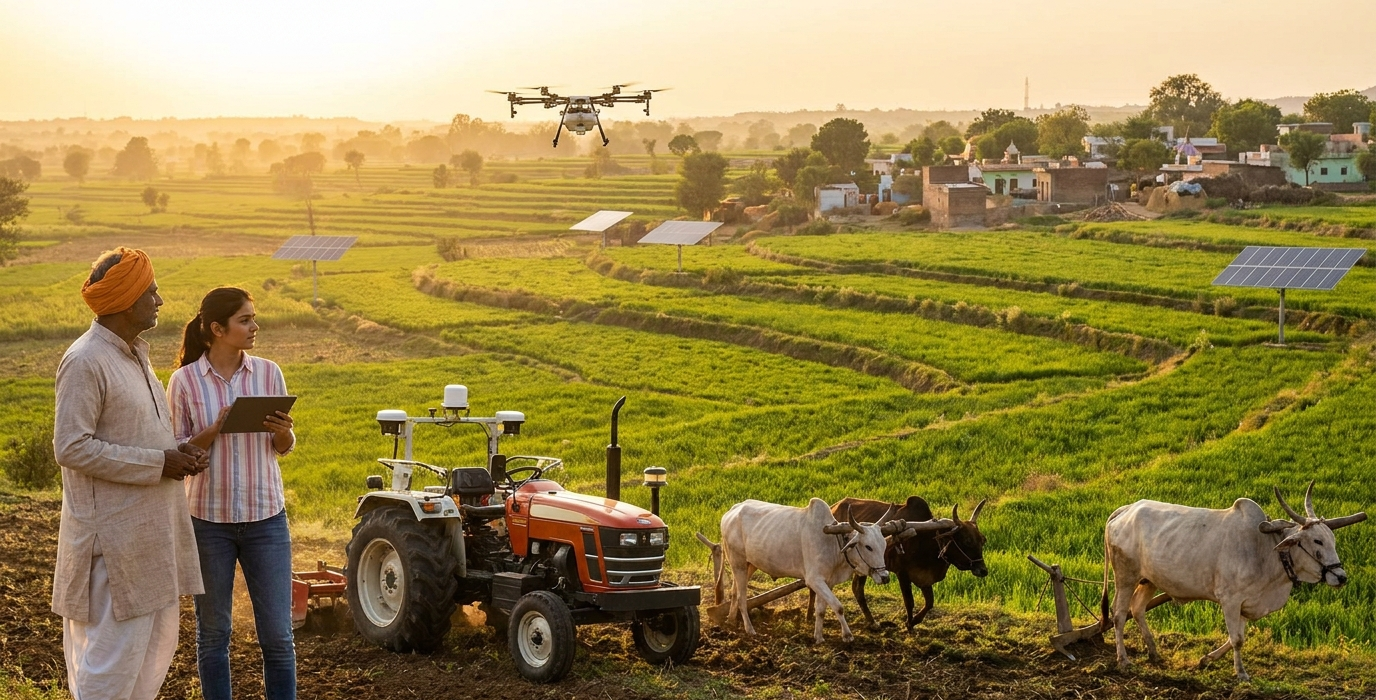
The image of Indian agriculture, often painted with broad strokes of tradition and manual labour, is rapidly evolving. This transformation is being driven by a powerful, unseen force: Artificial Intelligence. AI is no longer a futuristic concept; it’s a practical tool being deployed in fields across India, from the fertile plains of Punjab to the rain-fed regions of Maharashtra. We’re witnessing a genuine harvest of innovation, where algorithms and sensors are working hand-in-hand with farmers to optimize every stage of the agricultural cycle.
This isn’t about replacing the farmer, but empowering them with unprecedented levels of information and control. Think of AI as an intelligent assistant, capable of analyzing vast amounts of data – from soil composition and weather forecasts to satellite imagery and market prices – to provide actionable insights. This allows for a more precise and proactive approach to farming, moving away from generalized practices towards hyper-localized solutions. The result is a farm that’s not only more productive but also more resilient to the challenges of a changing climate and fluctuating markets.
Precision Irrigation: Saving Every Drop
One of the most impactful applications of AI in Indian agriculture is in precision irrigation. Traditional irrigation methods can be wasteful, with water often applied indiscriminately. AI-powered systems, however, use data from soil moisture sensors, weather stations, and even satellite imagery to determine the exact water needs of crops at specific locations within a field. This means water is delivered only when and where it’s needed, significantly reducing consumption.
Companies are developing smart irrigation controllers that integrate with these AI insights. These systems can automatically adjust watering schedules based on real-time conditions, ensuring crops receive optimal hydration without overwatering. This is particularly crucial in water-scarce regions of India, where every drop counts. The efficiency gains translate not only into cost savings for farmers but also contribute to sustainable water management practices for the entire community.
Sensing Danger: AI-Driven Pest and Disease Management
Pests and diseases pose a constant threat to crop yields, often leading to significant financial losses for farmers. Traditionally, identifying and combating these threats involved manual inspection, which can be time-consuming and prone to human error. AI is changing this by enabling early and accurate detection, allowing for targeted interventions.
AI algorithms can analyze images captured by drones or even smartphones to identify early signs of pest infestation or disease outbreaks. These systems are trained on massive datasets of plant images, allowing them to recognize subtle visual cues that might be missed by the human eye. Once a threat is identified, the AI can recommend specific treatments, along with the precise amount and application method, minimizing the use of pesticides and protecting the environment.
Early Warning Systems: Predicting the Unpredictable
The unpredictable nature of weather patterns is a perennial concern for Indian farmers, whose livelihoods are directly dependent on the monsoon and other climatic factors. AI is stepping in to provide more sophisticated and localized weather forecasting and early warning systems. By analyzing historical weather data, satellite imagery, and real-time atmospheric readings, AI models can predict weather events with greater accuracy and lead time.
This advanced forecasting allows farmers to make informed decisions regarding planting, harvesting, and crop protection. For instance, an AI system might predict an upcoming hailstorm in a specific district of Uttar Pradesh, prompting farmers in that area to take protective measures for their vulnerable crops. Similarly, AI can forecast prolonged dry spells or excessive rainfall, enabling farmers to adapt their strategies to mitigate potential damage and optimize resource allocation.
The Power of Data: Unlocking Market Insights and Yield Optimization
Beyond the immediate field operations, AI is also proving invaluable in helping farmers understand market dynamics and optimize their overall yield. By analyzing market trends, consumer demand, and historical price data, AI can offer insights into which crops are likely to be most profitable in the coming seasons. This data-driven approach can guide farmers in their crop selection and planting decisions, leading to better economic outcomes.
Furthermore, AI can analyze historical yield data in conjunction with various input factors (fertilizer, water, soil type) to identify patterns and recommend the optimal combination of inputs for maximum yield. This moves farming from an art based on experience to a science backed by data. For example, an AI might suggest a specific blend of nutrients for a particular patch of land in Tamil Nadu, based on its soil analysis and historical performance, leading to a demonstrably better harvest.
The Surprising Insight: AI and Crop Quality
It’s not just about quantity; AI is also making significant inroads into improving crop quality. For instance, AI algorithms are being used to assess the ripeness of fruits and vegetables remotely, allowing for more efficient harvesting and reducing post-harvest losses. In some specialized applications, AI can even help in identifying specific nutrient deficiencies in crops that affect quality, not just yield. This has profound implications for not only the farmer’s income but also for the quality of food reaching consumers across India and beyond.
Another surprising fact is the role of AI in predicting the optimal time for harvesting specific produce based on complex factors like market demand and even potential spoilage rates. This allows for a more strategic approach to logistics and distribution, ensuring fresher produce reaches consumers and reducing waste.
Bridging the Gap: AI Adoption and Future Prospects
While the potential of AI in Indian agriculture is immense, its widespread adoption is not without its challenges. Access to technology, digital literacy among farmers, and the initial cost of implementation are significant hurdles. Many farmers, particularly in remote areas, may not have access to smartphones, reliable internet connectivity, or the technical know-how to operate these advanced systems.
However, the narrative is changing. Government initiatives, private sector investments, and the development of more user-friendly, localized AI solutions are gradually bridging this gap. We’re seeing a rise in farmer-producer organizations (FPOs) that are collectively investing in AI-powered tools and training programs. The economic benefits, from increased yields and reduced input costs to improved market access, are becoming increasingly evident, incentivizing more farmers to embrace these technologies.
The Role of Startups and Innovation Hubs
A vibrant ecosystem of agri-tech startups is playing a pivotal role in democratizing AI for Indian farmers. These innovators are developing affordable, accessible solutions tailored to the specific needs of the Indian agricultural landscape. From mobile apps that offer AI-driven crop advice to affordable drone services for crop monitoring, these startups are making AI a tangible reality for the common farmer. Innovation hubs and incubation centers are further fostering this environment, providing crucial support and resources for these budding enterprises.
The future promises even more sophisticated AI applications, including AI-powered robotics for automated farming tasks, advanced genetic analysis for developing climate-resilient crops, and comprehensive supply chain management systems. As data becomes more abundant and algorithms more refined, AI will continue to be a cornerstone of India’s agricultural revolution, ensuring food security and prosperity for generations to come.
“AI is not just a technological upgrade; it’s a paradigm shift in how we approach farming in India, empowering us with knowledge to make smarter, more sustainable decisions on the ground.”
Frequently Asked Questions
What are the most common AI applications in Indian farming today?
The most common applications include precision irrigation to optimize water usage, AI-powered pest and disease detection using image analysis, and weather forecasting and early warning systems for better planning.
How are AI tools making farming more efficient?
AI tools increase efficiency by providing data-driven insights for precise application of water and fertilizers, enabling early identification and targeted treatment of crop issues, and helping farmers anticipate market demand to reduce waste and maximize profits.
Are AI solutions affordable for small Indian farmers?
While initial costs can be a barrier, a growing number of affordable, user-friendly AI solutions and services are becoming available, often through farmer cooperatives, government subsidies, and innovative startup models. The long-term savings in inputs and increased yields often justify the investment.
What is the biggest challenge to AI adoption in Indian agriculture?
The biggest challenges are limited access to technology and reliable internet connectivity in rural areas, coupled with the need for digital literacy and training among farmers to effectively utilize these advanced tools.