Key Takeaways
- India’s 5G rollout is accelerating, promising speeds up to 10x faster than 4G by late 2026.
- Beyond faster downloads, 5G will enable new applications in healthcare, education, and smart cities.
- Farmers in rural Rajasthan are already seeing benefits through precision agriculture powered by 5G.
- Consumers can expect enhanced gaming, streaming, and immersive experiences on 5G-enabled devices.
- Businesses can leverage 5G for improved operational efficiency, IoT deployments, and remote collaboration.
The Unfolding 5G Tapestry: Speeds, Services, and the 2026 Horizon
The hum of 5G is no longer a distant whisper; it’s a growing chorus across India. As we navigate through 2026, the nation’s 5G journey is rapidly evolving, moving beyond mere speed enhancements to unlock a spectrum of transformative services. We’re witnessing a significant leap in connectivity, with average download speeds projected to be at least 5 to 10 times faster than what we experienced with 4G. This isn’t just about streaming your favourite Bollywood blockbuster in stunning clarity, though that’s certainly a perk.
The true revolution lies in the applications 5G is set to enable. Think of real-time remote surgery, where a specialist in Mumbai can guide a procedure happening miles away in a smaller town, thanks to ultra-low latency. Imagine immersive educational experiences where students in a government school in Kerala can virtually explore the pyramids of Giza, or interact with complex scientific models. The foundation for these futuristic scenarios is being laid right now, with telecom operators aggressively expanding their 5G networks across Tier 1, Tier 2, and increasingly, Tier 3 cities.
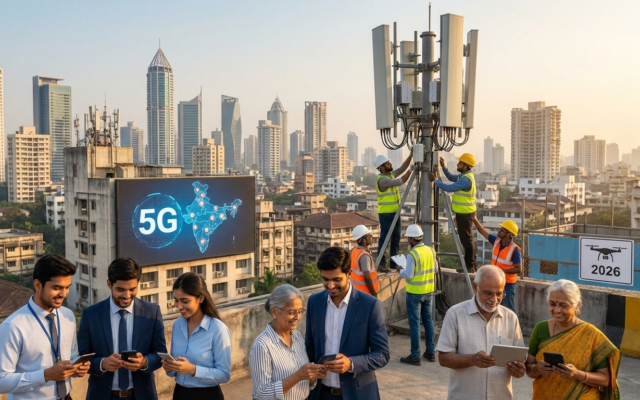
By the end of 2026, we can expect a more ubiquitous 5G presence, not just in urban centres but also reaching deeper into rural landscapes. This expansion is crucial for bridging the digital divide and ensuring that the benefits of this technological advancement are accessible to all corners of India. The focus is shifting from just launching the service to demonstrating its tangible impact on everyday lives and industries.
Beyond Speed: 5G’s Impact on Critical Sectors
While the headline figures often focus on download speeds, the true power of 5G lies in its ability to enable entirely new use cases across vital sectors. One of the most exciting areas is healthcare. The low latency and high bandwidth of 5G are paving the way for telemedicine advancements that go far beyond simple video calls. We’re talking about remote diagnostics, real-time monitoring of patients with chronic conditions using wearable devices, and even the aforementioned potential for remote robotic surgery.
Education is another sector poised for a dramatic upgrade. Imagine classrooms equipped with augmented reality (AR) and virtual reality (VR) tools, allowing students to engage with learning material in an unprecedented way. This could democratise access to high-quality educational content, regardless of a student’s geographical location. For instance, a student in a remote village in Ladakh could virtually attend a lecture at an IIT, experiencing the same level of engagement as their city counterparts.
Smart cities are also a major beneficiary. 5G is the backbone for a truly interconnected urban environment. This means intelligent traffic management systems that reduce congestion, smart grids that optimise energy consumption, and enhanced public safety through real-time surveillance and communication. The integration of IoT devices, powered by 5G, will create cities that are more efficient, sustainable, and responsive to the needs of their citizens. A surprising fact is that early 5G trials for smart city initiatives in places like Pune have already shown a significant reduction in response times for emergency services.
Rural Transformation: 5G Cultivating the Fields
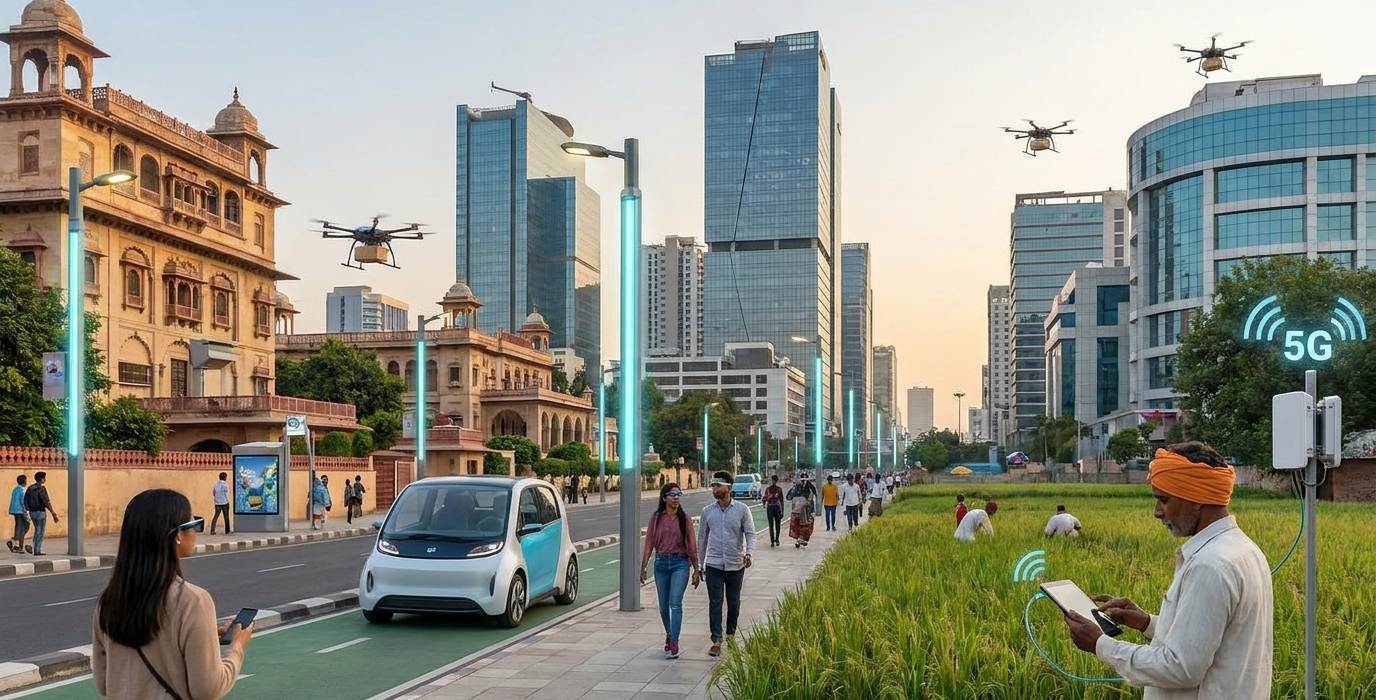
The narrative of 5G often gets confined to urban metropolises, but its potential to transform rural India is equally profound, and by 2026, we’ll see this potential materialise more concretely. A prime example is the agricultural sector, where 5G is becoming the enabler of precision farming. Farmers in regions like Punjab and Haryana, who are early adopters of technology, are already leveraging 5G-powered solutions to monitor soil conditions, predict weather patterns with greater accuracy, and optimise irrigation and fertiliser application.
This leads to increased crop yields, reduced waste of resources, and ultimately, improved livelihoods for farmers. For instance, sensors deployed across vast farmlands can transmit real-time data on moisture levels, nutrient content, and pest infestation directly to a farmer’s smartphone or a central dashboard. This data, analysed through AI algorithms, provides actionable insights that were previously impossible to obtain at this scale and speed.
Another exciting development is the use of drones equipped with 5G for crop monitoring and spraying. These drones can cover large areas quickly and efficiently, applying pesticides or fertilisers precisely where needed, minimising environmental impact and operational costs. We’re also seeing the emergence of 5G-enabled market linkage platforms, connecting farmers directly to buyers, cutting out intermediaries and ensuring fairer prices for their produce. This is particularly impactful for farmers in regions like the Sundarbans in West Bengal, where access to markets can be a significant challenge.
The Consumer Experience: Gaming, Entertainment, and Beyond
For the average Indian consumer, the most immediate and tangible benefit of 5G will be the dramatic enhancement of their digital experiences. By late 2026, expect a significant upgrade in how you consume entertainment and engage with online content. The days of buffering circles and grainy video playback will become a distant memory. Downloading high-definition movies or large app files will take mere seconds, not minutes.
Mobile gaming, in particular, is set to be revolutionised. The ultra-low latency of 5G drastically reduces lag, making competitive online gaming incredibly smooth and responsive. This opens the door for more complex and immersive mobile gaming experiences, blurring the lines between console and mobile gaming. Imagine playing graphics-intensive multiplayer games on your smartphone with the same fluidity as on a high-end PC.
Beyond gaming and streaming, 5G will power a new wave of immersive content. Augmented reality (AR) and virtual reality (VR) applications, which require substantial bandwidth and low latency, will become more mainstream. This could mean AR-powered shopping experiences where you can virtually try on clothes, or VR tours of historical sites. Even simple activities like video conferencing will feel more lifelike, with higher resolutions and smoother interactions, making remote work and virtual social gatherings more engaging.
Business and Industry: The 5G Catalyst for Growth
The business landscape in India is poised for a significant transformation driven by 5G connectivity by the end of 2026. For enterprises, 5G represents more than just faster internet; it’s a catalyst for operational efficiency, innovation, and new business models. Industries such as manufacturing, logistics, and retail will experience profound changes.
In manufacturing, 5G enables the widespread adoption of Industrial Internet of Things (IIoT) devices. This allows for real-time monitoring of machinery, predictive maintenance to prevent costly downtime, and enhanced automation through remote control of robots and equipment. Factories in industrial hubs like Coimbatore will become smarter and more agile, boosting productivity and reducing errors.
Logistics and supply chain management will also see substantial improvements. 5G can support advanced tracking systems, autonomous vehicles for warehouse operations, and real-time data analytics for optimising routes and inventory. This means faster deliveries, reduced spoilage, and greater transparency across the entire supply chain. A fascinating application we’re seeing early signs of is using 5G-enabled sensors in cargo containers to monitor temperature and humidity in real-time, crucial for perishable goods travelling from, say, the apple orchards of Himachal Pradesh.
Furthermore, 5G will empower businesses to implement robust remote work solutions, facilitating seamless collaboration among dispersed teams. It will also drive the development of new customer-facing applications, from personalised retail experiences powered by AI and AR to more efficient customer service through advanced chatbots and virtual assistants. The cost savings and revenue generation opportunities are immense.
Navigating the 5G Landscape: Device, Plans, and Adoption
As 5G networks expand across India, understanding how to leverage this technology for yourself is key. By 2026, the availability of 5G-compatible devices will be significantly wider and more affordable than it is today. While high-end smartphones were the initial gatekeepers, we’re now seeing mid-range and even budget-friendly devices offering 5G capabilities. This democratisation of hardware is crucial for widespread adoption.
When considering a new device, ensure it supports the 5G bands being deployed by major operators like Reliance Jio, Bharti Airtel, and Vodafone Idea. Most new smartphones launched in 2026 will likely come with 5G as a standard feature. The initial adoption curve for 5G plans has been driven by attractive introductory offers and bundled data packages. As the network matures, expect more nuanced plans tailored to different user needs, from heavy data users to those primarily seeking enhanced gaming or streaming experiences.
The transition from 4G to 5G is largely seamless for the end-user; your existing SIM card will likely work with a 5G-enabled phone on a 5G network, though you may need to activate a specific 5G plan with your provider. It’s advisable to check with your telecom operator for the most up-to-date information on their 5G network coverage in your area and the available plans. The pace of infrastructure development means that coverage is rapidly improving, making the upgrade increasingly worthwhile.
| Feature | 4G (Typical) | 5G (Projected 2026) |
|---|---|---|
| Download Speed | 20-50 Mbps | 200-500 Mbps (or higher) |
| Upload Speed | 5-15 Mbps | 50-100 Mbps (or higher) |
| Latency | 50-100 ms | 10-20 ms |
| Capacity | Lower | Significantly Higher (more devices connected) |
| Key Use Cases | Browsing, HD Streaming, Basic Gaming | 4K/8K Streaming, Cloud Gaming, AR/VR, IoT, Real-time Applications |
“5G in India by 2026 is not just an upgrade in speed; it’s the enabling technology for a digitally empowered nation, unlocking unprecedented opportunities in healthcare, agriculture, education, and industry.”
Frequently Asked Questions
Will I need a new phone to use 5G?
Yes, you will need a 5G-enabled smartphone to connect to 5G networks. However, by 2026, these devices will be much more common and affordable. Your existing 4G SIM card will likely work with a 5G phone and network, but you’ll need to ensure you have a 5G service plan activated.
When will 5G be available in my area?
5G rollout is accelerating rapidly across India. By the end of 2026, coverage is expected to be widespread in major cities and increasingly available in Tier 2 and Tier 3 towns. It’s best to check with your specific telecom provider for the most accurate coverage map for your locality.
Will 5G plans be more expensive?
Initially, 5G plans might be priced competitively, often bundled with attractive data offers. As the technology matures and adoption increases, expect a range of plans catering to different usage needs and budgets. The significant increase in data speeds and capabilities will offer greater value.
What are the biggest real-world benefits of 5G for India beyond faster downloads?
The transformative benefits extend far beyond speed. These include advancements in telemedicine, precision agriculture enabling higher crop yields, enhanced remote education with AR/VR, smarter urban infrastructure for traffic and utilities, and significant efficiency gains for businesses through IoT and automation.