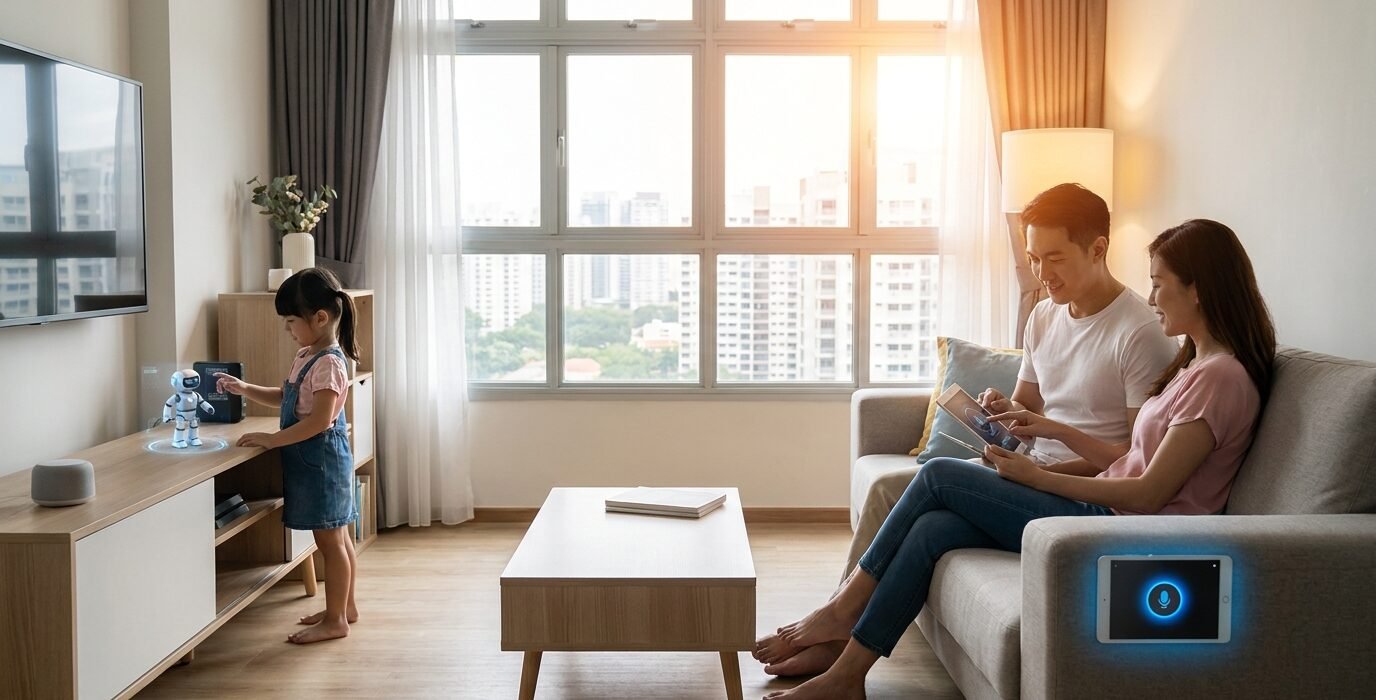
The hum of everyday life in Singapore is changing. It’s no longer just the distant rumble of the MRT or the lively chatter in hawker centres. There’s a new, subtle presence. An AI-powered voice, ready to dim your lights, order your kopi, or remind you about that important meeting. This isn’t science fiction anymore. It’s the reality of the modern Singaporean home. Smart devices are rapidly weaving themselves into our daily routines.
Key Takeaways:
- Singaporean homes are seeing a surge in AI-powered personal assistants, transforming daily tasks.
- Integration with local services like Grab and NTUC FairPrice is key to the success of these devices.
- Early adopters are experiencing a blend of convenience and a learning curve with new AI tech.
- Privacy and data security remain significant concerns for many households.
- The future points towards even deeper AI integration, personalizing our living spaces like never before.
The Echo in the Living Room: Early Adopters and Their Digital Companions
Walking into a home in, say, a Bishan housing estate, you might now hear a gentle “Hey Google” or “Alexa, what’s the weather like?” It’s a familiar sound for many who have embraced the wave of AI-powered personal assistants. Take the Tan family, for instance. They were among the first in their block to set up an Amazon Echo Dot a few years back. Initially, it was a novelty. Mrs. Tan, a retired teacher, remembers asking it to play old Mandopop tunes. This task used to involve fiddling with a remote or her phone. “It felt a bit strange at first, talking to a device,” she admitted during a recent chat at the Toa Payoh Central Community Club. “But then my grandson, Kai, showed me how it could set timers for his homework.” Her husband, Mr. Tan, started using it to check the latest news headlines while he had his breakfast. It quickly became part of their rhythm.
Their experience mirrors that of many early adopters across Singapore. The convenience factor is undeniable. Imagine this: you’re rushing out the door for a Grab to Jewel Changi Airport. Your hands are full with shopping bags from Orchard Road. You realise you forgot to turn off the living room lights. A quick voice command to your smart speaker can solve that problem. No need to fumble for switches or your phone. This seamless interaction, or at least the promise of it, is what draws people in. The devices, from Google Nest Minis to Apple HomePods, are becoming more than just speakers. They are becoming the central hubs of a connected home. The initial setup can sometimes be a hurdle. It involves Wi-Fi connections and app installations. But once that’s done, the magic starts to unfold. The devices learn your voice, your preferences, and even your daily schedule. For instance, my own experience setting up a Google Nest Hub in my Tampines apartment revealed how quickly it adapted. Within a week, it was proactively suggesting I order groceries from FairPrice Online at my usual time. This was based on my past purchasing habits. This level of predictive assistance, while impressive, also raises questions. How much of our lives are we comfortable sharing with our digital assistants? The data collected, from voice commands to smart home activity, is constantly being processed. This improves the service. It’s a fact that is both a boon for functionality and a concern for privacy.
Seamless Integration: Connecting Your AI to the Lion City’s Services
The true power of AI-powered personal assistants in Singapore, however, lies not just in controlling your lights. It’s in their ability to connect with the services we use every day. Gone are the days of needing multiple apps for different tasks. With the right setup, your voice can become your command centre. It controls a surprisingly vast array of local conveniences. Think about ordering your favourite chicken rice from a hawker stall. While direct voice ordering isn’t quite there yet for most local businesses, the integration with established platforms is already remarkably advanced. For instance, linking your Grab account to your smart assistant means you can book a ride simply by saying, “Hey Google, book a Grab to Marina Bay Sands.” The AI then prompts you for confirmation. Within moments, a car is on its way. This removes the need to unlock your phone, find the app, and navigate through menus. It’s especially useful when you’re hands-free or trying to multitask.
Another area where this integration shines is grocery shopping. Many Singaporean households rely on services like NTUC FairPrice or Cold Storage for their weekly provisions. By linking your FairPrice account to your Google Assistant or Alexa, you can add items to your shopping list by voice. “Alexa, add ‘bananas’ to my FairPrice shopping list,” becomes a simple, natural utterance. When you’re ready to check out, you can even ask your assistant to “show me my FairPrice shopping list.” This displays it on a smart display or sends it to your phone. It’s ready for online ordering or a quick trip to the supermarket in Jurong East. Singtel’s smart home offerings also provide a glimpse into deeper integration. They allow users to manage their broadband services, check for outages, or even get help with billing inquiries through voice commands. This level of connectivity transforms the personal assistant from a standalone gadget into an indispensable part of your digital life. It streamlines mundane tasks and frees up mental bandwidth. The data gathered from these interactions helps refine the AI’s understanding of your habits. This leads to more personalized suggestions. For example, if you consistently order a certain type of dim sum from a specific restaurant on Saturday mornings, your AI might eventually learn to prompt you: “It’s Saturday morning. Would you like to order your usual dim sum from Din Tai Fung?” This predictive capability is where the real value lies. It makes our lives not just easier, but also more intuitively managed.
Beyond the Novelty: Real-World Impact on Daily Routines
The initial excitement of a voice-controlled light switch or a quick weather update quickly fades. It’s replaced by a more profound shift in how we manage our homes and our lives. For busy professionals navigating the bustling city-state, the AI assistant has become an indispensable productivity tool. Consider a scenario familiar to many working in the Central Business District: a packed morning schedule. Before even leaving your apartment in the Tiong Bahru area, you might ask your assistant to read out your calendar appointments. You can check traffic conditions for your commute. You can even start your coffee maker if it’s connected to a smart plug. This might seem like a small convenience. But cumulatively, it can save precious minutes. These minutes can be reallocated to other tasks. Or simply to enjoy a more relaxed start to the day.
For families, the impact is equally significant, though often in different ways. Parents often find AI assistants helpful for managing household chores and children’s routines. “Hey Google, remind me to pick up Leo from football practice at 5 PM,” is a common utterance. Setting up educational games or asking trivia questions for homework help also becomes a seamless interaction. Mrs. Lim, a mother of two living in Pasir Ris, shared how her Google Nest Hub has become a central point for family communication. “We use it to leave voice messages for each other if we’re in different parts of the house.” Or to set family reminders for things like ‘dinner’s ready’ or ‘time to brush your teeth’,” she explained. “It’s surprisingly effective at getting the kids’ attention, often more so than shouting!” The data collected by these devices, when used responsibly, can offer insights into household patterns. For example, an AI might notice that a particular light is often left on in a certain room during specific hours. It might subtly suggest energy-saving routines. This goes beyond mere automation. It’s about intelligent assistance that adapts to and learns from your lifestyle. The sheer volume of data processed by these systems is staggering. One study indicated that voice assistants process billions of commands weekly. This is a testament to their growing ubiquity and the trust users are placing in them. This trust, however, is built on the understanding of how this data is used. This topic continues to be a significant point of discussion.
The Privacy Paradox: Trust, Data, and the Unseen Observer
As AI-powered personal assistants become more deeply embedded in our homes, the conversation inevitably turns to privacy and data security. This is a particularly sensitive topic in a society like Singapore, which values order and security. The convenience offered by these devices is undeniable. But it comes at the cost of constant listening. Every “Hey Google” or “Alexa” command is processed. Companies assure us that only the wake word triggers continuous recording. But the potential for misuse or data breaches remains a significant concern for many. Take the case of Sarah Tan, a cybersecurity analyst I spoke with in a cafe along Arab Street. She’s an early adopter of smart home tech but remains cautious. “I love the convenience, don’t get me wrong,” she said, sipping her iced kopi. “But the idea that there’s always a microphone active in my living room, even if it’s only listening for a specific phrase, gives me pause.” “What if there’s a glitch? What if my account is compromised?” “The sheer amount of personal data these devices collect – our conversations, our routines, even our purchase history – is immense.”
This sentiment is echoed by many. While companies like Google and Amazon have robust security measures in place, the history of data breaches across various industries serves as a constant reminder of the inherent risks. The data collected by these AI assistants is used not only to improve their performance. In some cases, it’s also used for targeted advertising. Users can often review and delete their voice recordings. But the sheer volume of data generated can make this a daunting task. Furthermore, the legal frameworks around data privacy are still evolving. This leaves some consumers feeling uncertain about their rights. A surprising statistic that often surfaces in these discussions is the percentage of users who admit to discussing sensitive topics in front of their smart speakers. Sometimes they forget, or downplay, the potential for that information to be accessed. For instance, a recent survey found that nearly 30% of smart speaker owners have had a conversation they wouldn’t want recorded in the presence of their device. This highlights a disconnect between the perceived safety and the actual risks. As AI becomes more sophisticated, so too will the methods of data collection and analysis. This makes it imperative for consumers to stay informed. It’s also crucial for companies to maintain transparency and robust security protocols. The balance between innovation and safeguarding personal information is a delicate one. In Singapore, where trust is paramount, it’s a challenge that developers and consumers alike must navigate carefully.
The Future is Listening: Evolving AI and the Smart Home of Tomorrow
The current generation of AI-powered personal assistants is just the beginning. The trajectory of innovation suggests a future where our homes will be even more intuitively connected and responsive to our needs. We’re moving beyond simple voice commands towards a more proactive and predictive AI. Imagine a home that anticipates your arrival. It adjusts the temperature and lighting to your preferred settings before you even step through the door. Or a kitchen assistant that not only suggests recipes based on the ingredients you have. It also orders missing items and schedules their delivery for when you’re most likely to be home. This evolution is driven by advancements in machine learning and natural language processing. This allows AI to understand context, intent, and even emotion with greater accuracy.
Companies are investing heavily in developing AI that can learn individual preferences and adapt its responses accordingly. For example, instead of just playing a song, an AI might learn that you prefer a particular artist’s more upbeat tracks during your morning workout. It might learn a mellower selection for winding down in the evening. This level of personalization promises a truly bespoke living experience. The integration with other emerging technologies, such as the Internet of Things (IoT) and augmented reality (AR), will further blur the lines between the digital and physical worlds within our homes. We might see AR overlays providing information about connected devices when you look at them. Or AI assistants facilitating virtual collaborations with friends and colleagues as if they were in the room with you. The data generated will become even more rich and complex. This will enable AI to provide increasingly sophisticated insights and support. For instance, an AI could analyze patterns in your sleep and activity data, collected from wearable devices and smart home sensors, to offer personalized wellness recommendations. However, this future also presents new challenges. The ethical implications of highly intelligent, pervasive AI in our private spaces will need careful consideration. This ensures that these technologies serve humanity rather than control it. The sheer computational power required will also necessitate advancements in energy efficiency and sustainable technology. The journey towards the truly intelligent home is ongoing. Singapore, with its forward-thinking approach to technology, is well-positioned to be a leader in this transformative era.
A Smarter Tomorrow, Today
The whispers of AI in our Singaporean homes are growing louder, transforming the mundane into the magical. From helping to manage our busy schedules to connecting us with essential local services, these digital companions are weaving themselves into the very fabric of our daily lives. The convenience is palpable, offering a glimpse into a future where technology seamlessly anticipates and responds to our needs. Yet, as we embrace this evolution, the questions surrounding privacy and data security remain paramount. Navigating this landscape requires a conscious effort to understand the technology, its implications, and to advocate for responsible innovation. The promise of a smarter, more connected living experience is here. It’s up to us to shape its ethical and beneficial integration into our homes and our society.