Key Takeaways
- AI tutors are no longer a futuristic concept; they are actively reshaping India’s education landscape in 2026, offering personalized learning paths for millions.
- These intelligent systems go beyond rote memorization, focusing on critical thinking, problem-solving, and adaptive skill development crucial for the modern workforce.
- The integration of AI is democratizing access to high-quality education, bridging geographical divides and economic barriers across India.
- Parents and students can leverage AI tools to identify learning gaps, receive targeted support, and prepare for an increasingly competitive global job market.
The Dawn of the AI Tutor: Personalized Learning Becomes Reality
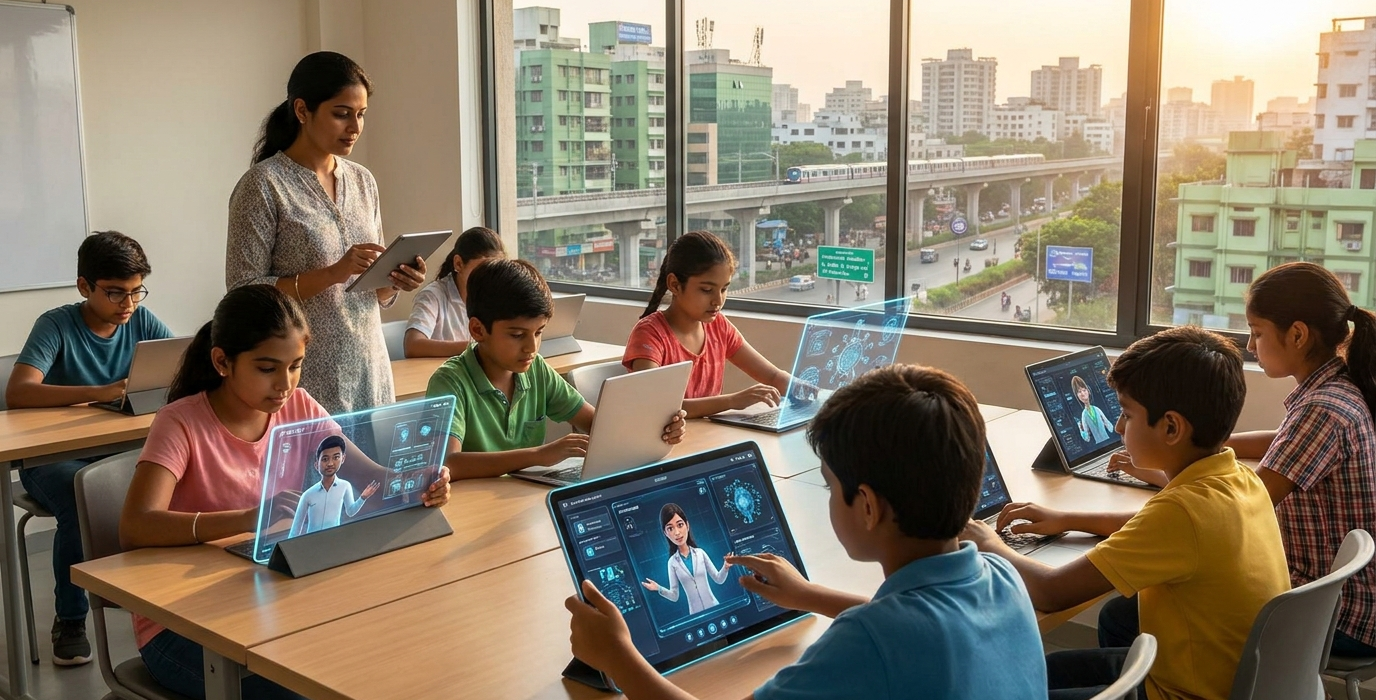
The year is 2026, and the whispers of artificial intelligence revolutionizing education have solidified into a resounding chorus across India. Gone are the days when a one-size-fits-all approach to learning was the norm, especially in our diverse and dynamic country. Today, AI-powered tutors are not just a technological marvel; they are becoming an indispensable part of how students across metropolitan hubs like Bengaluru and bustling tier-2 cities such as Indore engage with knowledge. These intelligent systems are meticulously designed to understand each student’s unique pace, learning style, and areas of difficulty.
Imagine a student struggling with complex physics concepts in a crowded classroom in Chennai. Instead of falling behind, an AI tutor can provide immediate, step-by-step explanations tailored to their specific confusion. It can rephrase explanations, offer alternative examples drawn from relatable Indian contexts – perhaps a concept explained through the mechanics of a local train or the principles of cricket fielding – and even generate practice problems that target precisely where the student needs reinforcement. This level of individualized attention, once the exclusive domain of expensive private tuitions, is now being scaled through AI, promising to unlock the potential of every learner, regardless of their background.
This shift signifies a profound move towards truly personalized education. AI tutors analyze vast amounts of data on a student’s performance – their speed of response, the types of errors they make, and the topics they revisit. Based on this, they construct dynamic learning pathways. If a student excels in algebra, the AI can accelerate them to more advanced topics or introduce challenging problem-solving scenarios. Conversely, if they falter in grammar, the AI will patiently guide them back, providing supplementary lessons and drills until mastery is achieved. This adaptive approach ensures that no student is left bored by repetition or overwhelmed by complexity.
Beyond Memorization: Cultivating 21st-Century Skills
The most significant impact of AI tutors in 2026 is their ability to move beyond traditional rote learning and foster crucial 21st-century skills. We are no longer just preparing students for exams; we are equipping them for a future where adaptability, critical thinking, and problem-solving are paramount. AI platforms are increasingly integrating modules that encourage students to analyze information, evaluate different perspectives, and devise innovative solutions. This is a stark departure from the textbook-centric methods that have long dominated educational paradigms.
Consider the burgeoning IT sector in Pune, where the demand for adaptable problem-solvers is at an all-time high. AI tutors can present students with simulated real-world challenges, asking them to debug code, design a more efficient process, or even brainstorm marketing strategies for a hypothetical product. These exercises go beyond simple Q&A; they require students to apply knowledge contextually, think creatively, and collaborate (even if simulated) to find optimal outcomes. The AI acts as a sophisticated mentor, providing feedback not just on the correctness of an answer, but on the student’s thought process and approach.
Furthermore, AI is proving invaluable in developing soft skills. Through interactive scenarios, AI tutors can guide students on effective communication, negotiation, and even empathy. For instance, a student might be presented with a role-playing exercise where they need to persuade a virtual client or resolve a conflict between simulated team members. The AI can analyze their dialogue, tone, and decision-making, offering constructive criticism on how to improve their interpersonal effectiveness. This holistic development, encompassing both technical acumen and essential human skills, is what makes AI tutors such a transformative force in Indian education today.
Democratizing Access: Bridging the Educational Divide
One of the most compelling narratives of AI in Indian education is its role in democratizing access. For decades, quality education has often been a privilege dictated by geography and socio-economic status. Students in remote villages of Rajasthan or the interiors of Tamil Nadu often faced significant disadvantages compared to their urban counterparts. AI tutors are actively dismantling these barriers, bringing world-class learning resources directly into homes and community centers, irrespective of location or financial constraints.
Think about a student in a small village near Leh, Ladakh, who previously had limited access to specialized teachers for subjects like advanced mathematics or science. With an internet connection, even a modest one, they can now access sophisticated AI tutoring platforms that offer the same quality of instruction as a student in Delhi or Mumbai. These platforms are often developed with affordability in mind, with many offering subsidized or freemium models for students from underprivileged backgrounds. This inclusivity ensures that talent is nurtured wherever it exists.
The proliferation of affordable smartphones and increasingly accessible data plans across India has been a critical enabler for this democratizing trend. AI tutors can be accessed on these devices, making learning portable and available on-demand. This has profound implications for lifelong learning and reskilling initiatives, allowing individuals to adapt to changing job markets without needing to relocate or enroll in expensive traditional courses. The AI tutor is becoming the ubiquitous companion for the ambitious Indian learner, breaking down the walls of traditional educational institutions and making knowledge truly a public good.
Parental Empowerment and Student Agency
The integration of AI tutors is not just benefiting students directly; it’s also profoundly empowering parents and enhancing student agency over their learning journeys. Parents can now gain unprecedented insights into their child’s academic progress, identifying strengths and weaknesses with a level of detail previously unavailable. This allows for more informed discussions about their child’s education and targeted support at home. Gone are the days of parental anxiety stemming from vague reports or a lack of understanding about where their child stands.
AI platforms provide detailed progress reports and analytics, breaking down performance by subject, topic, and even specific learning objectives. Parents can see exactly where their child is excelling and where they might need extra encouragement or help. This transparency fosters a more collaborative approach between home and school, allowing parents to actively participate in their child’s development. For busy parents in cities like Kolkata, this can mean understanding their child’s learning needs during their commute or over a short evening check-in.
Crucially, AI tutors are fostering student agency. Instead of passively receiving instruction, students are encouraged to interact with the AI, ask questions, and direct their learning. They can choose the pace, revisit challenging topics, and explore areas of interest beyond the prescribed curriculum. This cultivates a sense of ownership over their education, leading to increased motivation and a deeper, more intrinsic love for learning. The AI acts as a guide, not a dictator, empowering students to become active architects of their own intellectual growth.
“AI tutors are not replacing teachers; they are augmenting their capabilities, freeing them to focus on the human elements of education – mentorship, inspiration, and fostering creativity.” – Dr. Anya Sharma, Principal, Delhi Public School, R.K. Puram.
Navigating the Tech Landscape: Choosing the Right AI Tutor
With the burgeoning market, choosing the right AI tutor can feel overwhelming. It’s essential to approach this decision with a clear understanding of your needs and the capabilities of different platforms. We’ve seen a surge in offerings, from comprehensive K-12 solutions to specialized platforms for competitive exams like JEE and NEET, and even professional development courses. The key is to look beyond just the AI label and assess specific features that align with your educational goals.
When evaluating options, consider the subject coverage and depth. Does the platform offer the specific subjects your child needs? Is the content aligned with the Indian curriculum (CBSE, ICSE, state boards)? Look for platforms that offer diagnostic assessments to accurately pinpoint learning gaps. Equally important is the user interface and engagement factor. An intuitive and visually appealing design is crucial for keeping younger learners engaged. Gamification elements, interactive quizzes, and real-world problem-solving scenarios can make learning enjoyable and effective.
We’ve also seen significant advancements in feedback mechanisms. The best AI tutors provide not just right/wrong answers, but detailed explanations for errors, suggesting remedial exercises and offering tips for improvement. Consider the accessibility and pricing models. Many platforms offer free trials or freemium versions, allowing you to test them out. Look for flexible subscription plans that suit your budget and the duration of need. For example, a student preparing for a specific exam might opt for a short-term, intensive plan, while a younger child might benefit from a long-term, comprehensive subscription.
Here’s a comparative snapshot of popular AI tutoring approaches you might encounter in 2026:
| Feature | Comprehensive K-12 Platforms | Exam-Specific Specialists | Skill-Based AI Mentors |
|---|---|---|---|
| Target Audience | Students from Grade 1 to 12, covering all subjects. | Students preparing for competitive entrance exams (JEE, NEET, UPSC, etc.). | Individuals seeking to upskill in areas like coding, digital marketing, or data science. |
| Curriculum Focus | Aligned with national and regional school boards. | Intensive focus on exam syllabi, past papers, and test-taking strategies. | Industry-relevant skills, project-based learning, and practical application. |
| Personalization Depth | Adaptive learning paths, identifies learning gaps across subjects. | Personalized revision schedules, mock test analysis, and targeted topic drills. | Customizable learning modules, project guidance, and real-time coding assistance. |
| Engagement Methods | Interactive lessons, gamified quizzes, virtual labs. | Timed practice tests, performance analytics, and concept boosters. | Simulated projects, peer collaboration features, and expert Q&A forums. |
| Pricing Example (Illustrative) | ₹500 – ₹2,000 per month for comprehensive access. | ₹1,000 – ₹3,000 per month for focused exam preparation. | ₹750 – ₹2,500 per month, or per-course fees. |
The Future of Learning: AI and the Human Touch
As we look ahead, the role of AI tutors in India’s educational ecosystem is poised for even greater integration and sophistication. We are witnessing a paradigm shift where technology is not just a tool, but a partner in the learning process. However, it’s crucial to remember that AI is intended to augment, not replace, the invaluable role of human educators. Teachers will continue to be the vital catalysts for inspiration, critical thinking, and emotional development.
The future of learning in India will likely involve a harmonious blend of AI-driven personalization and human mentorship. AI tutors will handle the heavy lifting of personalized instruction, providing instant feedback and targeted practice. This will free up teachers to focus on higher-order thinking skills, facilitate collaborative projects, and nurture the socio-emotional growth of their students. Imagine a classroom where an AI tutor helps students master calculus basics, allowing the teacher to lead an engaging discussion on the philosophical implications of mathematical discovery.
One surprising fact is the emergence of AI tutors specifically designed to teach traditional Indian arts and crafts. Platforms are being developed that can guide students through the intricate steps of learning a classical dance form like Bharatanatyam, or the nuanced techniques of Madhubani painting. The AI analyzes student movements or brushstrokes, providing real-time corrective feedback and cultural context, ensuring that these rich traditions are passed down effectively to future generations. This demonstrates the immense versatility of AI in preserving and propagating cultural heritage.
Another fascinating development is the use of AI tutors in vocational training for sectors like agriculture and sustainable development. In rural India, AI platforms are being developed to help farmers understand optimal crop rotation, irrigation techniques, and pest management based on local weather patterns and soil conditions, all delivered through accessible vernacular languages. This practical, AI-guided knowledge transfer is proving critical in enhancing rural livelihoods and promoting sustainable practices across the country. The journey of AI in education is just beginning, promising a future where learning is more accessible, effective, and deeply human than ever before.
Frequently Asked Questions
What is an AI tutor?
An AI tutor is an intelligent software system designed to provide personalized instruction, feedback, and support to students. It uses artificial intelligence to adapt to individual learning paces, styles, and areas of difficulty, offering customized learning paths and resources.
How does AI help in identifying learning gaps?
AI tutors continuously analyze a student’s performance, tracking their responses, speed, and error patterns. This data allows the AI to pinpoint specific topics or concepts where the student struggles, creating detailed reports for students and parents, and then generating targeted exercises to address these gaps.
Can AI tutors replace human teachers?
No, AI tutors are designed to augment, not replace, human teachers. They handle personalized instruction and practice, freeing up teachers to focus on mentorship, fostering critical thinking, creativity, and socio-emotional development, aspects that require human interaction and empathy.
Are AI tutoring platforms affordable for Indian students?
Yes, many AI tutoring platforms offer a range of pricing models, including freemium options, subsidized plans for underprivileged students, and flexible monthly or annual subscriptions. The increasing accessibility of smartphones and data in India also makes these platforms more affordable and widely available.