Key Takeaways
- By 2026, AI is revolutionizing early disease detection, identifying subtle patterns invisible to the human eye, significantly improving patient outcomes.
- Machine learning models are achieving remarkable accuracy in diagnosing conditions like diabetic retinopathy and certain cancers from medical imaging, often surpassing human specialists.
- The integration of AI into diagnostic workflows promises to democratise access to advanced healthcare, particularly in remote Indian regions where specialist access is limited.
- While challenges remain in data privacy, regulatory approval, and clinician training, the trajectory for AI in early disease detection is overwhelmingly positive and rapidly advancing.
AI’s Unblinking Eye: Spotting Illness Before It Takes Hold
Imagine a future where a simple scan can alert you to a serious illness years before symptoms even manifest. That future is no longer science fiction; it’s rapidly becoming a reality thanks to the power of Artificial Intelligence (AI) in healthcare. By 2026, we’re witnessing unprecedented advancements in how AI can detect diseases at their nascent stages, often long before a human doctor might suspect a problem.
This isn’t about replacing doctors, but about augmenting their capabilities. AI algorithms, trained on vast datasets of medical images, patient records, and genetic information, can discern subtle patterns that are imperceptible to even the most experienced clinicians. This early detection is not just a matter of convenience; it’s a critical factor in improving treatment efficacy, reducing mortality rates, and ultimately, saving lives. We are entering an era where AI acts as an invaluable, unblinking eye, scanning for the earliest whispers of disease.
Beyond the Radiologist’s Gaze: Revolutionizing Medical Imaging
One of the most impactful areas where AI is making its mark is in medical imaging. Think about the painstaking work of radiologists analysing X-rays, CT scans, and MRIs. AI-powered tools are now capable of sifting through these images with remarkable speed and accuracy. For instance, AI algorithms are proving exceptionally adept at spotting the tell-tale signs of diabetic retinopathy, a leading cause of blindness, often detecting microaneurysms and hemorrhages that might be missed in a quick human review.
Consider the potential impact in a bustling city like Chennai, where the prevalence of diabetes is a significant public health concern. AI can act as a frontline screening tool, flagging individuals who require immediate attention from an ophthalmologist. Similarly, in the fight against cancer, AI is being trained to identify suspicious nodules in lung scans or abnormal cellular structures in mammograms, flagging them for further investigation. This allows specialists to focus their expertise on the most critical cases, significantly streamlining the diagnostic process and reducing the burden on healthcare professionals.
The Power of Predictive Analytics: Forecasting Future Health Risks
AI’s prowess extends beyond simply identifying existing disease markers; it’s increasingly being used for predictive analytics, forecasting an individual’s risk of developing certain conditions in the future. By analysing a complex web of data – including a person’s genetic predispositions, lifestyle choices (as recorded by wearable tech, for example), environmental factors, and past medical history – AI models can generate personalized risk scores for diseases like cardiovascular ailments or type 2 diabetes.
This proactive approach allows for targeted interventions. If an AI model predicts a high risk of heart disease for a person in their late 30s in a place like Pune, where lifestyle-related illnesses are on the rise, healthcare providers can work with that individual to implement preventative strategies much earlier. This might involve dietary changes, increased physical activity recommendations, or more frequent health check-ups. The shift from reactive treatment to proactive prevention, powered by AI, is a monumental step towards building a healthier society.
A Surprising Insight: AI’s Role in Rare Disease Diagnosis
While AI’s success in common diseases garners significant attention, its potential in diagnosing rare genetic disorders is equally profound. These conditions, often affecting a small number of people, can be notoriously difficult and time-consuming to diagnose, sometimes taking years and multiple specialist consultations. AI can analyse complex genomic data and patient symptoms, comparing them against databases of known rare diseases. This can drastically reduce the diagnostic odyssey for patients, offering them answers and access to appropriate care much sooner.
“AI isn’t about replacing the compassionate touch of a doctor; it’s about equipping them with an even sharper scalpel and a more discerning eye, allowing for earlier interventions and better patient journeys.”
Democratizing Healthcare Access: AI in Rural and Underserved Areas
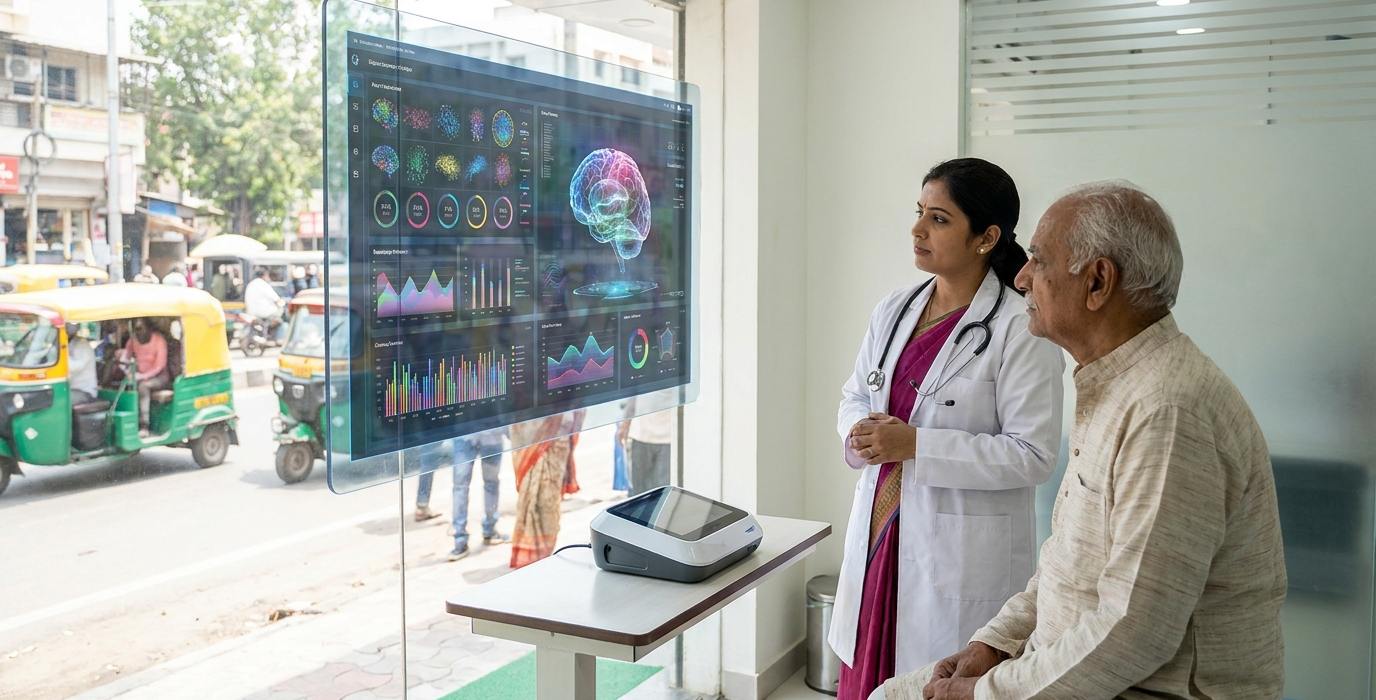
The geographical disparity in healthcare access is a persistent challenge in India and many parts of the world. Specialist doctors are often concentrated in major metropolitan centres, leaving rural and remote populations with limited options. AI offers a powerful solution to bridge this gap. AI-powered diagnostic tools, accessible via relatively simple hardware and internet connectivity, can bring sophisticated medical analysis to the doorstep of those who need it most.
Imagine a mobile health clinic equipped with an AI-enabled retinal scanner operating in a village in Rajasthan. This clinic could screen hundreds of individuals for diabetic retinopathy without them needing to travel to a city. Similarly, AI-driven chatbots and preliminary diagnostic platforms can offer initial health advice and triage patients in areas with a scarcity of primary care physicians. This democratisation of advanced healthcare is one of AI’s most promising contributions, ensuring that quality diagnostics are not a luxury, but a fundamental right, regardless of one’s location.
Navigating the Hurdles: Data, Ethics, and Integration
Despite the incredible promise, the widespread adoption of AI in healthcare by 2026 is not without its challenges. Data privacy and security are paramount. The sheer volume of sensitive patient data required to train and operate these AI models necessitates robust safeguards against breaches and misuse. Ensuring compliance with evolving data protection regulations, such as India’s Digital Personal Data Protection Act, is crucial.
Regulatory approval is another significant hurdle. Medical devices and diagnostic tools, whether AI-driven or not, must undergo rigorous testing and validation to ensure their safety and efficacy. The unique nature of AI algorithms, which can evolve over time, presents new challenges for traditional regulatory frameworks. Furthermore, clinician training and trust are vital. Healthcare professionals need to be educated on how to effectively use and interpret AI-generated insights, building confidence in these new technologies.
A Comparative Look: AI vs. Traditional Screening Methods
When we look at AI-powered screening, we see a clear advantage in speed and scalability compared to traditional methods. However, the cost-effectiveness can vary depending on the specific application and the existing infrastructure. Here’s a simplified comparison:
| Feature | Traditional Screening (e.g., Manual Image Review) | AI-Powered Screening (e.g., Automated Image Analysis) |
|---|---|---|
| Speed | Slow, requires human time and effort. | Extremely fast, can process large volumes rapidly. |
| Accuracy | Subject to human fatigue, experience levels, and potential bias. | Highly consistent, can detect subtle patterns beyond human perception. |
| Scalability | Limited by the number of trained professionals. | Highly scalable with sufficient computing power. |
| Cost (Initial) | Lower for basic equipment, higher for specialist personnel. | Higher for AI development, software, and specialized hardware. |
| Cost (Ongoing) | High due to personnel salaries and continuous training. | Lower operational costs for processing, but requires maintenance and updates. |
| Accessibility | Dependent on specialist availability. | Can be deployed remotely via cloud or edge computing. |
The Future is Now: Embracing AI for a Healthier Tomorrow
The advancements in AI for early disease detection are not just incremental; they represent a paradigm shift in how we approach health and wellness. By 2026, AI is actively transforming diagnostic capabilities, offering the potential for earlier, more accurate diagnoses, and ultimately, better patient outcomes. The ability of AI to analyse complex data sets, identify subtle patterns, and predict future health risks is a game-changer.
While ethical considerations, regulatory frameworks, and the need for clinician integration remain critical areas of focus, the momentum behind AI in healthcare is undeniable. We are on the cusp of an era where AI acts as a powerful ally to medical professionals, enhancing their abilities and extending the reach of quality healthcare. Embracing these technologies thoughtfully and strategically will be key to unlocking a healthier future for all, from the bustling streets of Mumbai to the quiet villages of the Himalayas.
Frequently Asked Questions
What are the biggest benefits of AI in early disease detection?
The primary benefits include earlier identification of diseases, leading to more effective treatments and better patient prognoses. AI also offers increased accuracy and consistency in diagnosis, and the potential to democratise healthcare access by bringing advanced diagnostic tools to underserved regions.
How is AI trained to detect diseases from medical images?
AI models, particularly deep learning neural networks, are trained on massive datasets of annotated medical images. These datasets consist of images labelled by expert clinicians, indicating whether a disease is present and where it is located. The AI learns to recognize the visual patterns associated with different conditions.
Will AI replace doctors in healthcare by 2026?
No, AI is not expected to replace doctors. Instead, it will act as a powerful assistive tool, augmenting their capabilities. AI can handle repetitive tasks, analyze vast amounts of data rapidly, and flag potential issues, allowing doctors to focus on complex decision-making, patient interaction, and compassionate care.
What are the ethical concerns surrounding AI in healthcare?
Key ethical concerns include data privacy and security, ensuring that sensitive patient information is protected. There are also issues around algorithmic bias, where AI models might perform differently for various demographic groups, and questions about accountability when an AI makes an incorrect diagnosis.
Can AI help diagnose rare diseases more effectively?
Yes, AI shows significant promise in diagnosing rare diseases. By analyzing complex genomic data and patient symptoms, AI can compare them against extensive databases of rare conditions, potentially reducing the long diagnostic journeys often experienced by patients with these illnesses.