Key Takeaways
- AI is revolutionising Indian agriculture in 2026, moving beyond pilot projects to widespread adoption across crucial areas like pest detection, soil health, and water management.
- Farmers are seeing tangible benefits: increased yields, reduced input costs (pesticides, fertilisers, water), and improved crop quality.
- Specialised AI-powered drones and satellite imagery are becoming essential tools, offering precision farming insights previously unavailable to many.
- The Indian government and private sector are actively promoting AI adoption through subsidies, training programs, and accessible technology platforms, making it more achievable for farmers of all scales.
AI’s Groundbreaking Entry into Indian Fields: 2026’s New Reality
Forget the hypothetical scenarios; Artificial Intelligence is no longer a distant dream for Indian agriculture. In 2026, AI has firmly planted its roots, transforming how our farmers cultivate the land. We’re witnessing a significant shift from niche experiments to practical, on-the-ground applications that are directly impacting yields and livelihoods. This isn’t about replacing the farmer; it’s about empowering them with unprecedented insights and tools.
From the fertile plains of Punjab to the diverse landscapes of Tamil Nadu, AI-driven solutions are becoming indispensable. These technologies are tackling age-old challenges with modern precision, promising a future where farming is not only more productive but also more sustainable. You’ll soon see how these advancements are making a real difference, crop by crop, field by field.
The integration of AI in 2026 signifies a leap forward, driven by accessible technology and a growing understanding of its potential. We’ll explore the core areas where AI is making the most impact, highlighting how it helps manage resources efficiently and protect crops from threats. This is the dawn of a smarter, more resilient agricultural sector for India.
Precision Pest and Disease Detection: AI as the Farmer’s Vigilant Eye
One of the most impactful applications of AI in Indian agriculture in 2026 is its role in early pest and disease detection. Traditional methods often rely on manual scouting, which can be time-consuming and prone to missing subtle signs of infestation. AI-powered systems, however, can analyse vast amounts of data from various sources to identify threats with remarkable accuracy and speed.
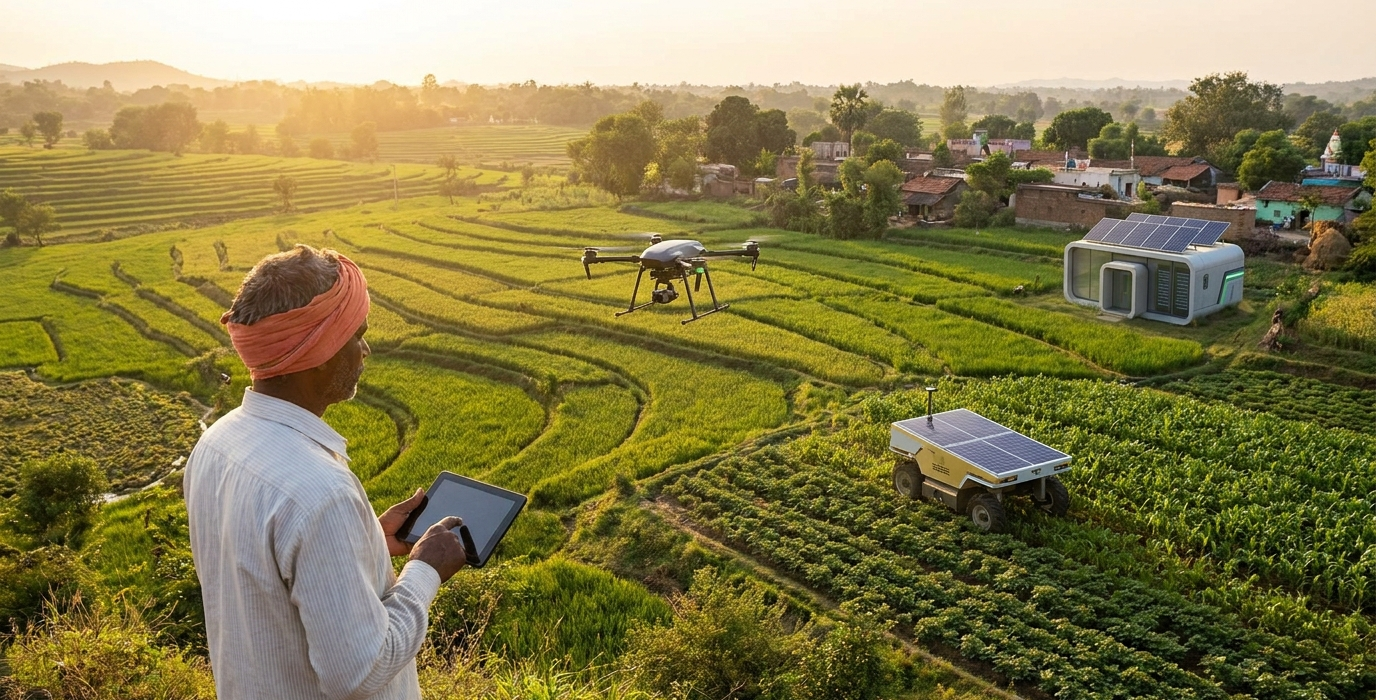
Drones equipped with high-resolution cameras and AI algorithms are becoming commonplace. These drones fly over fields, capturing images that are then processed by machine learning models trained to recognise specific patterns of disease or pest activity. This allows for targeted interventions, meaning farmers can apply pesticides or other treatments only where and when they are needed, significantly reducing chemical usage and costs.
Beyond drones, satellite imagery also plays a crucial role. AI algorithms analyse spectral data from satellites to detect subtle changes in plant health that might not be visible to the human eye. These changes can be early indicators of stress, nutrient deficiency, or incipient pest attacks. For instance, a specific spectral signature might reveal the early onset of a fungal infection in a wheat crop in Haryana, giving farmers critical time to act before it spreads widely.
The Power of Early Warning Systems
These AI-driven early warning systems are a game-changer. They shift the paradigm from reactive treatment to proactive prevention. Imagine receiving an alert on your phone about a potential outbreak of stem borer in your rice paddy in West Bengal, complete with a map highlighting the affected areas. This level of actionable intelligence was unimaginable just a few years ago.
Furthermore, AI can help predict the likelihood of outbreaks based on weather patterns, historical data, and the current stage of crop growth. This predictive capability allows farmers to implement preventative measures even before any visible signs appear, safeguarding their entire harvest. It’s a level of control and foresight that truly revolutionises farming practices.
Optimising Soil Health and Nutrient Management with AI
Healthy soil is the bedrock of productive agriculture, and in 2026, AI is providing farmers with unprecedented tools to understand and nurture it. Traditional soil testing can be expensive and time-consuming, often providing a snapshot that doesn’t capture the dynamic nature of soil health. AI-powered solutions are changing this by offering continuous monitoring and tailored recommendations.
These systems integrate data from various sources, including in-field sensors, drone-based spectral analysis, and even weather forecasts. AI algorithms analyse this information to assess soil moisture levels, nutrient content (like nitrogen, phosphorus, and potassium), pH, and organic matter. This comprehensive understanding allows for highly precise application of fertilisers and water, preventing both wastage and environmental pollution.
For example, an AI platform might analyse data from sensors in a sugarcane field in Maharashtra and determine that a specific section requires a targeted dose of nitrogen, while another area is adequately supplied. This precision application, often facilitated by AI-guided variable rate applicators, ensures that each part of the field receives exactly what it needs, leading to optimal growth and reduced input costs. This is a stark contrast to blanket applications that can lead to over-fertilisation in some areas and under-fertilisation in others.
Personalised Fertiliser and Water Strategies
The benefit extends to water management as well. AI can predict irrigation needs based on soil moisture, evapotranspiration rates, and upcoming weather. This ensures that crops receive the optimal amount of water at the right time, conserving a precious resource, especially in water-scarce regions of Rajasthan. Over-watering can lead to root diseases and nutrient leaching, while under-watering stunts growth.
A surprising fact is that AI-driven soil analysis can now identify micronutrient deficiencies with a high degree of accuracy, something often overlooked in conventional farming. These micronutrients, though needed in smaller quantities, are critical for plant development and can significantly impact crop quality and yield. By pinpointing these specific needs, AI empowers farmers to go beyond the NPK basics and achieve truly balanced crop nutrition.
AI in Crop Yield Prediction and Market Intelligence
Knowing what to grow, when to grow it, and where to sell it are critical decisions for any farmer. In 2026, AI is stepping in to provide data-driven insights that can significantly improve profitability. AI-powered crop yield prediction models are becoming increasingly sophisticated, offering farmers a clearer picture of their potential harvest.
These models analyse a multitude of factors, including historical yield data, current weather conditions, soil health reports, pest and disease prevalence, and even satellite imagery showing crop vigour. By processing this complex web of information, AI can provide remarkably accurate yield forecasts weeks, and sometimes months, in advance. This helps farmers in planning their logistics, storage, and labour requirements more effectively.
Beyond yield, AI is also revolutionising market intelligence. Platforms are emerging that can analyse market trends, price fluctuations for various commodities across different mandis, and even predict future demand based on consumer behaviour and economic indicators. This empowers farmers to make informed decisions about which crops to plant for maximum market return and when to sell their produce to achieve the best prices.
From Field to Fork: Smarter Sales Strategies
Consider a farmer in Gujarat growing groundnuts. An AI market intelligence tool could alert them to an upcoming surge in demand for groundnuts in a specific region due to a festival or increased export opportunities. This information allows the farmer to potentially hold onto their stock for a better price or to negotiate more favourable terms with buyers. It removes the element of guesswork that has often plagued agricultural marketing.
A particularly insightful application is AI’s ability to analyse granular market data. For instance, it can distinguish between demand for specific grades of a particular vegetable in different cities, helping farmers tailor their harvest and sales strategy. This level of detail ensures that produce reaches the right markets at the right time, minimising post-harvest losses and maximising farmer income.
The Rise of AI-Powered Farm Equipment and Automation
Automation is a cornerstone of modern agriculture, and AI is now infusing intelligence into farm machinery, taking efficiency and precision to new heights in 2026. We’re seeing a significant adoption of AI-driven tractors, harvesters, and other equipment that can operate with remarkable autonomy and accuracy.
Autonomous tractors, guided by GPS and AI, can perform tasks like ploughing, planting, and spraying with unparalleled precision. They can operate 24/7, even in challenging conditions, and can maintain exact row spacing and depth, optimising resource utilisation and minimising waste. This automation is particularly beneficial for large-scale farming operations, but increasingly accessible for cooperatives and smaller groups.
Robotics, powered by AI, are also entering the fray. From robotic weeders that can identify and remove weeds without harming crops, to automated harvesters that can delicately pick ripe fruits and vegetables, these technologies are reducing the reliance on manual labour and increasing the efficiency of harvests. This is especially relevant given the ongoing challenges with agricultural labour availability in many regions.
Smart Drones: More Than Just Aerial Photography
AI-powered drones are not just for surveillance; they are now integral to automated farm management. They can precisely apply fertilisers or pesticides only to targeted areas, significantly reducing chemical usage and environmental impact. These drones can also be programmed to perform tasks like aerial seeding or even to monitor livestock in remote pastures.
A surprising development is the use of AI-guided robotic systems for sorting and grading produce directly in the field or at collection centres. These systems can identify and categorise fruits and vegetables based on size, ripeness, and quality with a speed and consistency that is difficult for humans to match. This ensures that only high-quality produce reaches the market, improving the overall value chain.
Government and Private Sector Initiatives Fueling AI Adoption
The widespread adoption of AI in Indian agriculture in 2026 is not happening in a vacuum. It’s being actively supported by a synergistic push from both the government and the private sector. These initiatives are focused on making AI technologies accessible, affordable, and understandable for farmers across the country.
The Indian government, through various agricultural ministries and agencies, is investing heavily in research and development of AI solutions tailored for Indian farming conditions. They are also offering subsidies and grants to farmers and agricultural startups that are developing or implementing AI technologies. Schemes like the National Mission for Digital Agriculture are actively promoting the use of digital tools, including AI, to enhance productivity and sustainability.
Private sector companies are playing an equally vital role, developing user-friendly AI platforms, affordable hardware, and providing crucial training and support services. From drone manufacturers and sensor providers to software developers and agritech startups, a vibrant ecosystem is emerging. These companies are working to bridge the digital divide and ensure that AI benefits reach even remote farming communities.
Making AI Accessible: Training and Platforms
Crucially, there’s a strong emphasis on farmer education. Many initiatives now include comprehensive training programs, often delivered through regional language interfaces and local extension workers. These programs demystify AI, showing farmers practical applications and how these tools can directly improve their income and quality of life. The goal is to empower farmers, not overwhelm them with complex technology.
We are also seeing the development of integrated AI platforms that consolidate various functionalities – from soil analysis and pest detection to market price tracking – into a single, easy-to-use interface. These platforms are often designed with the needs of small and marginal farmers in mind, ensuring that the transformative power of AI is within reach for everyone. For example, a farmer in Odisha can access a consolidated app that provides weather forecasts, pest alerts, and market prices, all powered by AI.
Frequently Asked Questions
What are the biggest challenges in adopting AI in Indian agriculture?
The primary challenges include the digital literacy of farmers, the initial cost of technology, and ensuring reliable internet connectivity in rural areas. Overcoming these requires ongoing training, affordable solutions, and infrastructure development.
How does AI help in reducing the use of pesticides?
AI-powered systems enable precision pest and disease detection, allowing farmers to apply pesticides only where and when they are needed. This targeted approach significantly reduces overall chemical usage, saving costs and protecting the environment.
Can AI help small-scale farmers in India?
Yes, increasingly so. Initiatives are focusing on developing affordable, user-friendly AI tools and providing access through cooperatives and shared platforms. The aim is to democratise AI technology for farmers of all scales.
What kind of data does AI use in agriculture?
AI uses a variety of data, including satellite imagery, drone footage, in-field sensor data (soil moisture, temperature), weather patterns, historical crop yields, and market prices to provide actionable insights.