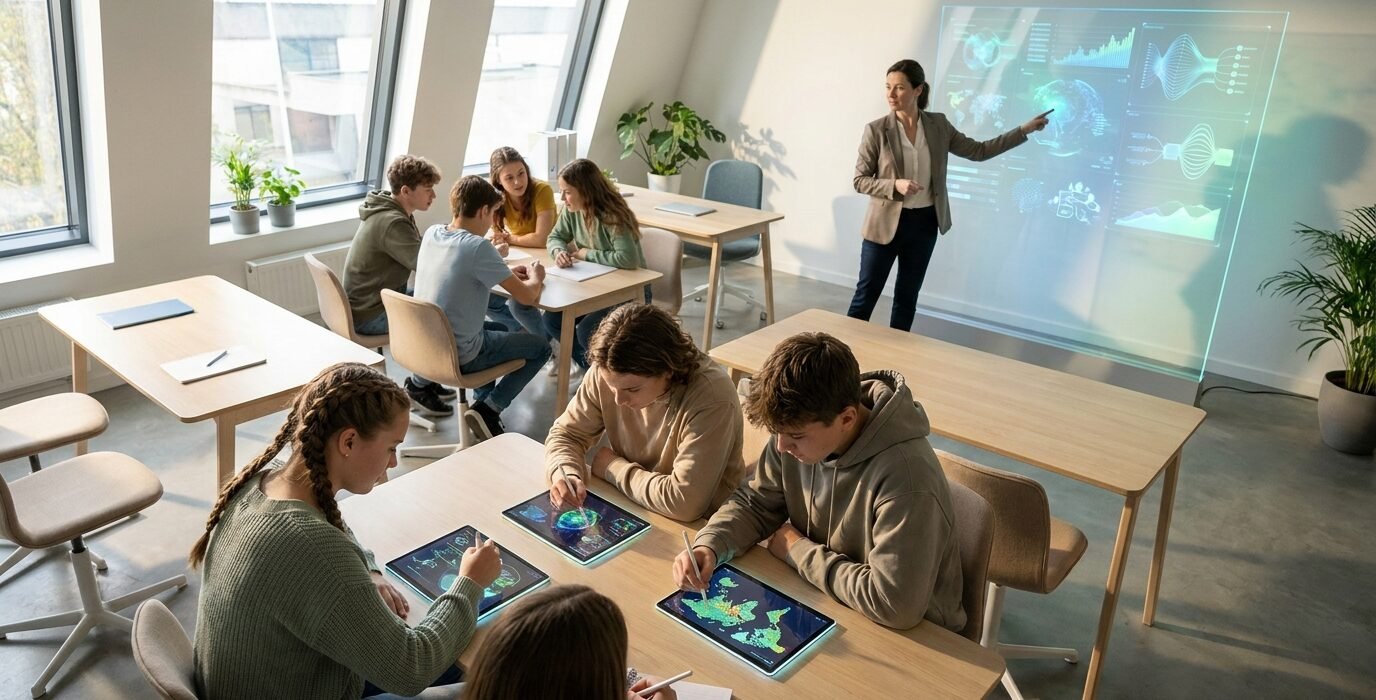
The familiar hum of fluorescent lights and the comforting scent of freshly sharpened pencils have long been the soundtrack of the American classroom. Now, a new sound is joining the chorus: the quiet whir of algorithms. Across the United States, from the bustling suburbs of Chicago to the sun-drenched schools of Phoenix, Artificial Intelligence is quietly, and sometimes not so quietly, making its way into K-12 education. We’re not talking about robot teachers, at least not yet. Instead, AI is powering personalized learning platforms, promising to tailor education to each student’s unique needs. But what does this mean for our kids? Is it a genuine leap forward, or just another shiny tech trend?
Key Takeaways:
- AI-powered platforms are adapting to individual student learning paces and styles.
- Teachers can gain valuable insights into student progress and areas needing support.
- Concerns exist regarding data privacy, algorithmic bias, and the potential for over-reliance on technology.
- Early evidence suggests positive impacts on engagement and test scores, but long-term effects require further study.
- The human element of teaching remains critical, with AI intended to augment, not replace, educators.
The promise is compelling. Imagine a math program that knows precisely when a student is struggling with fractions. It then offers targeted practice. Or a reading app that identifies a child’s specific phonetic challenges. It provides tailored exercises. This isn’t science fiction. It’s the reality for many students in the US today.
These platforms leverage AI to analyze vast amounts of data on student performance. They identify patterns and predict future learning needs. They adapt curriculum in real-time. They offer immediate feedback. They adjust difficulty levels on the fly. For a teacher managing a classroom of 25 or more students, each with their own strengths and weaknesses, this kind of individualized attention can feel like a superpower.
Take, for instance, the case of Sarah Chen. She’s a sixth-grade math teacher at a public school in Austin, Texas. For years, she’d felt the frustration of trying to reach every student. Some concepts clicked instantly. Others lingered as persistent roadblocks.
“You try to differentiate, you really do,” Sarah told me. She stirred her coffee during a rare planning period. “But with so many kids, it’s like juggling. You can’t be in five places at once, seeing exactly what each one needs every single minute.”
Her school district recently adopted an AI-driven math platform called “Quantify.” Sarah has seen a noticeable shift.
Quantify doesn’t just present problems. It observes how students solve them. Did they use the calculator immediately? Did they skip a step? Did they hesitate for a long time on a specific type of equation? The platform logs these interactions. It builds a detailed profile of each student’s cognitive process.
When a student, say, Emily, consistently falters on word problems involving percentages, Quantify doesn’t just give her more percentage problems. It might first offer a mini-lesson on translating text into mathematical expressions. Or it might present simpler examples to build confidence. Simultaneously, it flags this pattern for Sarah. She can then check in with Emily. Perhaps she offers a different explanation or a quick, in-person reinforcement.
This blend of automated support and human intervention is the core of the AI-powered educational movement. The platform’s ability to provide this granular, moment-by-moment insight is what sets it apart from static worksheets or even traditional educational software. It’s a dynamic, responsive learning environment.
This granular data allows teachers to move beyond generic lesson plans. Instead of teaching to the middle, educators can identify specific skill gaps. They can provide targeted interventions. The AI acts as a tireless assistant. It sifts through performance data to pinpoint where each student is excelling. It also identifies where they might need a gentle nudge.
For a teacher like Sarah, this translates into more informed instruction. It means less guesswork. She can spend less time grading endless worksheets. She can spend more time engaging with students who need her direct attention. The platform itself might even suggest resources for Sarah to use with Emily. Think of a visual aid or a hands-on activity that might resonate more effectively than another digital exercise.
This data-driven approach is revolutionizing how educators understand and respond to student learning needs. It’s moving towards a truly personalized educational experience. The sheer volume of data generated by these platforms is staggering. It offers unprecedented visibility into the learning process. It’s akin to having a diagnostic tool for the mind. It identifies subtle issues before they become significant barriers to progress.
The early results from districts adopting these platforms are indeed encouraging. Studies, though often funded by the platform developers themselves, point to increased student engagement. They show improved retention of material. Many cases see a noticeable bump in standardized test scores.
One such study, conducted in a consortium of schools across Ohio, found that students using an AI-powered reading comprehension tool showed an average improvement of 15% in their reading fluency scores over a single academic year. This is a significant leap. The platforms often employ gamified elements. They use adaptive challenges and immediate reward systems. All are designed to keep young minds actively involved. For students who might find traditional classroom settings unstimulating, these interactive elements can make learning feel less like a chore and more like an engaging game.
Moreover, the adaptive nature of these platforms means that students are consistently challenged without being overwhelmed. If a student masters a concept quickly, the AI moves them forward. This prevents boredom. It fosters a sense of accomplishment. Conversely, if a student struggles, the AI slows down. It provides additional explanations. It offers more practice until mastery is achieved. This personalized pacing ensures that no student is left behind or held back.
This level of individualized attention was once only achievable through expensive one-on-one tutoring. This makes AI-powered platforms a potentially democratizing force in education. The ability to scale this personalized approach across entire classrooms, districts, and even states is what makes AI so revolutionary in this field. It allows for a level of educational equity that was previously unimaginable. It ensures that every student has the opportunity to learn at their optimal pace.
The impact on student outcomes is a primary driver for the widespread adoption of AI in education. Parents and educators alike are looking for tangible proof that these technologies are making a difference. While the long-term effects are still being studied, the immediate feedback loop provided by AI platforms is invaluable. Students receive instant gratification or constructive correction. This can accelerate the learning process. This is a stark contrast to waiting days or even weeks for graded assignments to be returned. By then, the student’s focus may have shifted. The immediate feedback helps students to self-correct. It reinforces correct methods, building a stronger foundation of understanding. This iterative process is crucial for deep learning.
Consider a hypothetical student, let’s call him Alex, in a middle school in Denver, Colorado. Alex is bright but easily distracted. He often rushes through assignments, making careless errors. With a traditional approach, his teacher might mark his mistakes. But Alex might not fully grasp why he made them or how to avoid them next time.
An AI platform, however, can analyze Alex’s keystrokes. It can track his response times. It can identify the types of errors he makes. If Alex is consistently misapplying a mathematical formula, the AI might pause him. It could display a visual reminder of the correct steps. Then, it asks him to re-attempt the problem. This immediate, targeted intervention can prevent Alex from practicing and reinforcing incorrect methods. It’s a more active form of learning. The student is guided through their mistakes in real-time. This fosters a deeper understanding of the material. It also builds better study habits. This constant reinforcement loop, driven by AI analysis, is a powerful tool for student development.
The data generated by these platforms is also a goldmine for educators and administrators. It allows them to track not just individual student progress. It also tracks the effectiveness of different teaching strategies and curriculum materials. If a particular unit consistently proves challenging for students across the board, the data will highlight this. This prompts a review of the teaching methods or the curriculum itself. This systematic approach to educational improvement, informed by empirical data, is a significant advantage of AI integration. It moves education from a subjective art to a more data-driven science. This allows for continuous refinement and optimization. This ability to identify systemic issues and inform pedagogical decisions at scale is a game-changer for educational institutions. They seek to improve overall student success rates. The insights gleaned can lead to more effective professional development for teachers. It can also inform more evidence-based curriculum development.
Beyond academic performance, AI platforms can also play a role in fostering student engagement and motivation. Many of these tools incorporate elements of gamification. Think points, badges, and leaderboards. These make learning more enjoyable. This can be particularly effective for students who struggle with intrinsic motivation. For example, a student who finds history dry might be enticed to learn more about the Civil War. This happens if the learning platform presents the information in an interactive, narrative-driven format. It could include historical “quests” and virtual rewards. This gamified approach transforms passive consumption of information into active participation. It makes the learning experience more dynamic and memorable. The psychological principles behind gamification – immediate feedback, clear goals, and a sense of progress – are well-documented to boost engagement. AI platforms are adept at implementing these effectively.
The personalized nature of AI-driven learning also caters to different learning styles. Some students thrive with visual aids. Others prefer auditory explanations. Some benefit from hands-on activities. AI platforms can often adapt their presentation of material to suit these preferences. They can offer video explanations for visual learners. They provide narrated lessons for auditory learners. They present interactive simulations for kinesthetic learners. This multi-modal approach ensures that the learning experience is accessible and effective for a wider range of students. It breaks down traditional barriers to comprehension. It’s about meeting students where they are. It uses the tools and methods that best suit their individual cognitive makeup. This flexibility is a significant departure from the one-size-fits-all approach. That has often characterized traditional education. The ability to cater to diverse learning needs is a hallmark of truly modern educational technology.
However, the rise of AI in classrooms is not without its significant challenges and concerns. One of the most pressing is data privacy. These platforms collect a vast amount of sensitive information about students. This includes their academic performance, learning patterns, and even their behavioral interactions with the software. Ensuring that this data is protected from breaches, misuse, and unauthorized access is paramount. Many parents are understandably worried about who has access to their child’s educational footprint. They also worry about how it might be used in the future. The Children’s Online Privacy Protection Act (COPPA) provides some safeguards. But the landscape of data collection and usage is constantly evolving. It requires vigilant oversight and robust security measures. This is needed from both the platform providers and the school districts implementing them.
Another critical concern is the potential for algorithmic bias. AI systems are trained on data. If that data reflects existing societal biases, the AI can perpetuate and even amplify them. This could manifest in various ways. An AI system might inadvertently steer students from underrepresented backgrounds away from advanced courses. Or it might provide less effective feedback to certain demographic groups. For example, an AI trained on historical test data where certain groups performed poorly might, without careful recalibration, continue to offer less challenging material to students who share characteristics with those historically underperforming groups. This effectively limits their potential. Rigorous auditing and ongoing refinement of these algorithms are essential. This ensures fairness and equity in their application. The developers must actively work to de-bias their training data. They must regularly test their systems for disparate impacts across different student populations. This is not a trivial undertaking. It requires a deep understanding of both AI and educational equity.
The economic implications are also a factor. Implementing these advanced AI platforms can be expensive. This creates a potential digital divide between well-funded school districts and those with fewer resources. This raises questions about equitable access to cutting-edge educational technology. If only affluent schools can afford these sophisticated AI tools, the achievement gap between students in different socioeconomic brackets could widen. Many federal and state grants aim to bridge this gap. But the ongoing costs of licensing, maintenance, and teacher training can still be prohibitive for some districts. This disparity in access could exacerbate existing inequalities. It makes it even more crucial for policymakers and educational leaders to prioritize equitable distribution of these resources. The promise of personalized learning should not become a privilege of the wealthy.
Furthermore, there’s the debate about the role of technology versus the human touch in education. While AI can offer personalized instruction, it cannot replicate the empathy, mentorship, and social-emotional learning that a human teacher provides. Critics worry that an over-reliance on AI could diminish the crucial interpersonal connections. These are fundamental to a child’s development. A teacher can recognize when a student is having a bad day. They can offer a word of encouragement. They can facilitate a group discussion that builds critical thinking and collaboration skills. These are aspects of education that AI, at least in its current form, cannot fully address. The goal, many educators emphasize, should be to use AI as a tool to augment, not replace, the indispensable role of the teacher. It’s about creating a blended learning environment. This environment leverages the strengths of both artificial intelligence and human connection.
The question of how teachers are trained to effectively use these new tools is also a significant hurdle. Simply providing a platform isn’t enough. Educators need comprehensive professional development. They need to understand how to interpret the data, integrate the AI into their teaching practices, and troubleshoot any issues that arise. Without adequate training, the potential benefits of AI could remain unrealized. Worse, the technology could become a source of frustration rather than support. Many districts are investing in these training programs. They recognize that the success of AI implementation hinges on empowering their teaching staff. This professional development needs to be ongoing. AI technologies themselves are constantly evolving. It’s a continuous learning process for educators. It mirrors the adaptive nature of the AI systems they are using.
Despite these challenges, the undeniable reality is that AI-powered personalized learning platforms are becoming an increasingly integral part of the US K-12 educational landscape. Their ability to offer tailored instruction, provide immediate feedback, and generate actionable insights for teachers is transforming classrooms. The focus is shifting from a broad, generalized approach to education towards a hyper-individualized model. Here, each student’s learning journey is carefully mapped and supported. This represents a fundamental paradigm shift. It moves towards a system that can potentially cater to the unique needs of every learner, regardless of their starting point. The data analytics generated by these platforms offer an unprecedented level of transparency into the learning process. This allows for more informed decision-making at every level. This ranges from the individual classroom to the district-wide curriculum.
We’re still in the early days of this AI revolution in education. The long-term impacts on student creativity, critical thinking, and overall well-being are yet to be fully understood. However, the potential for AI to democratize access to high-quality, personalized education is immense. As these platforms continue to evolve, and as we learn more about best practices for their implementation, the hope is that they will serve as powerful allies to teachers. They will empower them to reach every student more effectively. The goal is to harness the power of AI. It’s to unlock each student’s unique potential. This fosters a generation of learners who are not only knowledgeable but also adaptable, resilient, and prepared for the complexities of the 21st century. The journey is ongoing. It’s marked by both excitement and caution. We navigate this new frontier in education.
The integration of AI into education is not a question of if, but how. The early adopters are already seeing promising results. But the path forward requires careful consideration of ethical implications, equitable access, and the enduring importance of human connection in the learning process. As a nation, we are at a critical juncture. Technology has the potential to either deepen existing divides or create more inclusive and effective learning environments for all. The choices we make now will shape the educational landscape for generations to come. They will determine whether AI becomes a true equalizer or a catalyst for further disparity. The conversation must continue. It must involve educators, parents, students, policymakers, and technologists. This ensures that AI in our classrooms serves the best interests of every child. It fosters a future where learning is truly personal, powerful, and profoundly human.
#