Key Takeaways
- Generative AI is moving beyond the hype, offering tangible solutions across sectors like healthcare, finance, and creative arts in 2026.
- Companies are leveraging AI for hyper-personalized customer experiences, efficient content creation, and sophisticated data analysis.
- Ethical considerations and the need for human oversight remain paramount as AI adoption accelerates.
- The rapid evolution means continuous learning and adaptation are crucial for individuals and businesses alike.
Healthcare: From Drug Discovery to Personalised Treatment Plans
The healthcare sector in 2026 is witnessing a profound shift thanks to generative AI. Imagine discovering new life-saving drugs not in years, but months. AI algorithms are now capable of simulating molecular interactions at an unprecedented scale, identifying promising drug candidates that human researchers might overlook. This drastically reduces the time and cost associated with traditional pharmaceutical research and development.
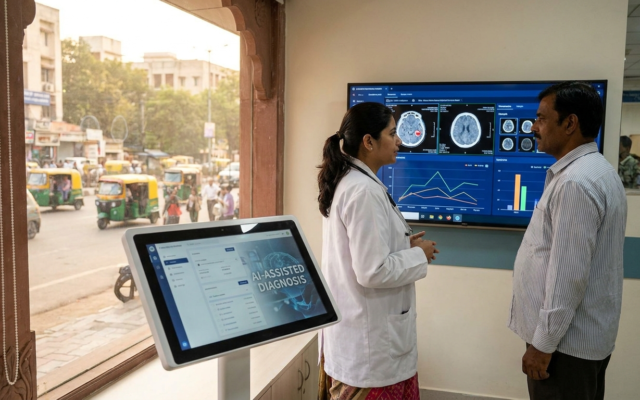
Beyond discovery, AI is revolutionizing patient care. In leading hospitals across India, such as the All India Institute of Medical Sciences (AIIMS) in Delhi, AI-powered tools are assisting doctors in diagnosing complex conditions from medical images like X-rays and MRIs with remarkable accuracy. These systems can flag subtle anomalies that might escape the human eye, leading to earlier and more effective interventions.
Furthermore, generative AI is enabling the creation of highly personalized treatment plans. By analyzing a patient’s unique genetic makeup, medical history, and lifestyle data, AI can suggest tailored therapies and dosages. This move towards precision medicine promises better outcomes and fewer side effects for patients. For instance, a patient undergoing chemotherapy might receive a treatment regimen optimized by AI to minimize nausea based on their specific genetic predispositions.
AI in Radiography and Pathology
Radiologists and pathologists are increasingly collaborating with AI tools. These systems can sift through vast archives of medical scans and tissue samples, identifying patterns and potential issues far faster than human experts. This frees up valuable time for clinicians, allowing them to focus on more complex cases and direct patient interaction. The accuracy and speed offered by these AI assistants are becoming indispensable in high-volume diagnostic environments.
Surprising Fact: AI-Generated Proteins
A truly astonishing development is the AI’s ability to design novel proteins from scratch. In 2026, researchers are actively developing AI-designed proteins for applications ranging from targeted drug delivery to creating new enzymes for industrial processes. This capability was largely theoretical just a few years ago, highlighting the exponential progress in generative AI’s biological applications.
Finance: Fraud Detection, Algorithmic Trading, and Customer Service
The financial industry, always at the forefront of technological adoption, is extensively using generative AI in 2026. One of the most impactful applications is in fraud detection. AI models can analyse millions of transactions in real-time, identifying suspicious patterns and anomalies that deviate from normal customer behaviour. This significantly enhances the security of financial systems, protecting both institutions and individuals from financial crime.
Algorithmic trading has also been supercharged by generative AI. These sophisticated AI systems can process vast amounts of market data, news sentiment, and economic indicators to predict market movements and execute trades at lightning speed. While human traders still play a crucial role in strategy and oversight, AI handles the high-frequency execution and complex pattern recognition. This has led to more dynamic and responsive trading strategies in global markets.
Customer service is another area experiencing a significant AI uplift. Banks and financial institutions are deploying advanced AI-powered chatbots and virtual assistants that can handle a wide range of customer queries, from balance inquiries and transaction history to loan applications and investment advice. These AI agents offer 24/7 support, reduce waiting times, and provide consistent, personalized assistance, improving overall customer satisfaction.
Personalized Financial Advice
Beyond basic queries, generative AI is enabling more sophisticated financial advisory services. AI can help individuals create personalised investment portfolios, retirement plans, and budgeting strategies based on their financial goals, risk tolerance, and current economic conditions. This democratizes access to financial planning, making it more accessible and affordable for a wider population. Many fintech platforms now offer AI-driven financial wellness tools integrated into their mobile apps.
Surprising Fact: AI-Driven Regulatory Compliance
Generative AI is also proving invaluable in navigating the complex landscape of financial regulations. AI systems can now scan and interpret evolving regulatory documents, identify potential compliance gaps in an organisation’s operations, and even assist in drafting compliance reports. This proactive approach to compliance is a game-changer for financial institutions, helping them avoid costly penalties and legal issues.
Creative Industries: Content Generation and Artistic Innovation
The world of art, music, and writing has been dramatically reshaped by generative AI in 2026. For content creators, AI tools are now indispensable for generating text, images, and even video snippets. Bloggers, marketers, and social media managers can use AI to brainstorm ideas, draft articles, create engaging visuals, and produce short promotional videos, significantly speeding up their workflow. This allows them to focus more on strategy and creative direction.
In graphic design, AI can generate a multitude of design options based on simple text prompts. Designers can iterate through countless visual styles and layouts in minutes, accelerating the design process and pushing creative boundaries. Tools that can generate photorealistic images or entirely new artistic styles are becoming commonplace, offering artists new avenues for expression.
Music composition is also being transformed. AI can generate original melodies, harmonies, and even complete musical pieces in various genres. Musicians are using these AI tools as collaborators, generating initial ideas or exploring new sonic landscapes. This doesn’t replace human creativity but rather augments it, offering a powerful new instrument for artists to play.
AI in Game Development
The gaming industry is a prime example of AI’s creative power. Generative AI is used to create vast and detailed game worlds, populate them with unique characters and non-player characters (NPCs), and even generate dynamic storylines that adapt to player choices. This leads to more immersive and replayable gaming experiences. We’re seeing AI-generated quests and dialogue that feel remarkably organic.
Surprising Fact: AI-Generated Feature Films
While still in its nascent stages, the first few AI-assisted feature-length films are beginning to emerge in 2026. These projects leverage AI for scriptwriting assistance, concept art generation, and even animating complex scenes. Though human directors and editors remain in charge, the AI’s contribution to the visual and narrative elements is substantial, hinting at a future where AI is a direct partner in filmmaking.
Manufacturing and Logistics: Optimizing Operations and Supply Chains
The manufacturing floor and the intricate web of logistics are far more efficient in 2026, thanks to generative AI. In factories across India, AI is being used for predictive maintenance. By analyzing sensor data from machinery, AI can predict when a component is likely to fail, allowing for proactive repairs before a breakdown occurs. This minimizes costly downtime and extends the lifespan of equipment, ensuring smoother production cycles.
Supply chain management has been revolutionized. AI can now predict demand fluctuations with greater accuracy, optimize inventory levels across multiple warehouses, and reroute shipments in real-time to avoid disruptions. This resilience is crucial in today’s dynamic global economy, ensuring that goods reach their destinations efficiently, even amidst unforeseen challenges.
Generative AI is also enhancing product design and prototyping. Engineers can use AI to generate numerous design iterations based on specified parameters, testing their feasibility and performance virtually before committing to physical prototypes. This accelerates the innovation cycle and leads to more optimized and cost-effective product development.
AI in Quality Control
Quality control processes are being elevated by AI. AI-powered vision systems can inspect manufactured goods for defects with unparalleled speed and precision. These systems can identify microscopic flaws that might be missed by human inspectors, ensuring higher product quality and reducing waste. This is particularly critical in industries like automotive and electronics where precision is paramount.
Surprising Fact: AI-Designed Factory Layouts
A less-discussed but highly impactful application is AI’s ability to design optimal factory layouts. By simulating material flow, worker movement, and machinery placement, AI can create layouts that maximize efficiency and safety. Some facilities are seeing up to a 15% increase in throughput simply by implementing AI-generated floor plans, a testament to the power of AI in optimizing physical spaces.
Education and Training: Personalized Learning and Skill Development
The educational landscape in 2026 is becoming more personalized and accessible due to generative AI. Students can now benefit from AI-powered tutors that adapt to their individual learning pace and style. These tutors can provide instant feedback, explain complex concepts in multiple ways, and identify areas where a student needs extra support, ensuring no one is left behind.
AI is also assisting educators in creating engaging learning materials. Teachers can use AI to generate quizzes, practice exercises, and even interactive simulations tailored to specific curriculum objectives. This frees up educators’ time to focus on teaching, mentoring, and fostering critical thinking skills among their students. The creation of diverse learning content, catering to various learning preferences, has never been easier.
For professional development, AI is enabling the creation of hyper-personalized upskilling programs. Individuals can identify skill gaps relevant to their career goals, and AI can then curate or even generate bespoke training modules. This ensures that learning is relevant, efficient, and directly contributes to career advancement in a rapidly evolving job market.
AI for Accessibility in Education
Generative AI is also playing a crucial role in making education more accessible. AI tools can translate educational content into different languages instantly, create audio descriptions for visual materials, and even generate sign language interpretations for lectures. This opens up learning opportunities for students with diverse needs and backgrounds, fostering a more inclusive educational environment.
Surprising Fact: AI-Generated Historical Simulations
In the realm of history and social studies, generative AI is creating immersive historical simulations. Students can virtually experience pivotal moments in history, interact with AI-generated historical figures, and explore the consequences of different decisions. This experiential learning approach offers a far deeper understanding and engagement with the past than traditional textbook methods.
Retail and E-commerce: Hyper-Personalization and Enhanced Shopping Experiences
The retail and e-commerce sectors in 2026 are leveraging generative AI to create incredibly personalized shopping experiences. Gone are the days of generic product recommendations. AI now analyzes individual browsing history, purchase patterns, and even inferred preferences to suggest products that are truly relevant to each shopper. This leads to higher conversion rates and greater customer loyalty.
AI-powered virtual try-on experiences are becoming a standard feature for online apparel retailers. Customers can upload a photo or use their webcam to see how clothes would look on them, significantly reducing the uncertainty of online shopping and minimizing returns. This technology, powered by generative AI’s ability to realistically render garments on different body types, is transforming the online fashion industry.
Customer service in retail is also seeing an AI revolution. AI chatbots can handle inquiries about order status, product details, and return policies with remarkable efficiency and a human-like touch. They can also assist with product discovery, guiding customers through vast online catalogues to find exactly what they’re looking for. This provides instant support and enhances the overall shopping journey.
AI-Generated Product Descriptions
For e-commerce businesses, writing compelling product descriptions for thousands of items can be a monumental task. Generative AI can now automatically create unique, engaging, and SEO-optimized product descriptions, saving businesses significant time and resources. These AI-generated descriptions can be tailored to highlight specific features and benefits, increasing their effectiveness.
Surprising Fact: AI-Curated Fashion Collections
A fascinating application is AI’s ability to curate entire fashion collections. Based on emerging trends, user preferences, and seasonal demands, AI can suggest complementary items, create mood boards, and even design entirely new apparel pieces. Some boutique online stores are now using AI to generate unique, limited-edition collections that are highly sought after by fashion-forward consumers.
Frequently Asked Questions
How is generative AI being used in daily life in 2026?
Generative AI is subtly woven into daily life through personalized content feeds on social media, intelligent virtual assistants like Siri and Google Assistant, AI-powered search results that anticipate your needs, and even creative tools that help you generate images or text for personal projects.
What are the biggest challenges in adopting generative AI?
Key challenges include ensuring data privacy and security, addressing potential biases in AI models, the significant cost of implementation and training, and the need for skilled professionals to manage and oversee AI systems. Ethical considerations also remain a major hurdle.
Can generative AI replace human jobs?
While generative AI can automate certain tasks and change job roles, it is more likely to augment human capabilities rather than fully replace jobs. New roles focused on AI management, ethics, and creative oversight are emerging. The focus is often on collaboration between humans and AI.
What is the future outlook for generative AI in the next five years?
We can expect generative AI to become even more sophisticated, capable of more complex reasoning and creative output. Advancements in multimodal AI (understanding and generating text, images, audio, and video simultaneously) will lead to entirely new applications, and ethical frameworks will continue to evolve alongside the technology.