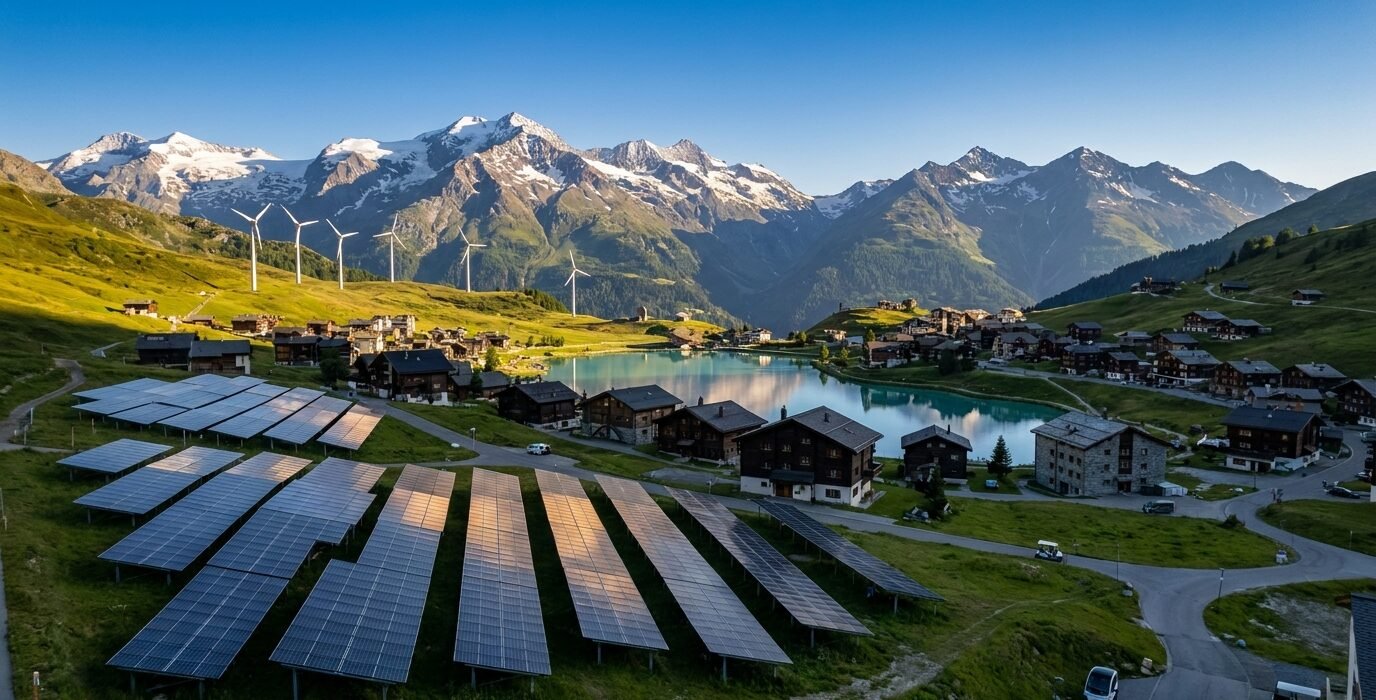
The whisper of snowmelt from the Alps and the quiet hum of innovation are synonymous with Switzerland. For generations, this nation has been a beacon of financial stability, a haven for wealth. But a new current is flowing through its storied banks and asset managers, a powerful tide of sustainability. This isn’t just about doing good; it’s about smart money. It’s about future-proofing portfolios. It’s about a generation of investors demanding more than just returns. We’re seeing a dramatic shift. ESG – Environmental, Social, and Governance – is no longer a niche offering. It’s a mainstream imperative. Switzerland is leading the charge.
Key Takeaways:
- Switzerland is rapidly becoming a global hub for sustainable investing, attracting significant international capital.
- Innovative ESG strategies are moving beyond mere compliance to drive genuine impact and financial performance.
- Swiss financial institutions are tailoring bespoke sustainable solutions for high-net-worth individuals and family offices.
- The country’s political stability and robust regulatory framework provide a fertile ground for long-term ESG growth.
- Understanding the nuances of Swiss ESG approaches can unlock new investment opportunities for global investors.
The Alpine Ascent of ESG
Imagine standing on a crisp morning overlooking Lake Geneva, the scent of pine in the air. This is the Switzerland many picture – serene, prosperous, and decidedly traditional. Yet, beneath this calm exterior, a revolution is brewing in its financial sector. The concept of “green investing,” or ESG investing, has moved from the fringes to the very heart of Swiss finance. It’s no longer a question of if. It’s about how to integrate sustainability into investment decisions.
This shift is driven by a confluence of factors. An increasingly aware global investor base is one. Growing regulatory pressures are another. And a deep-seated Swiss respect for long-term value and prudent stewardship plays a key role. For decades, Swiss banks were renowned for their discretion and wealth management prowess. Now, they are redefining that legacy. They are championing portfolios that benefit both people and the planet.
Take, for instance, the proactive stance of the Swiss government. While not always the first to enact sweeping mandates, Switzerland has a track record of fostering stable environments conducive to responsible business practices. The Federal Council’s “Sustainable Finance Strategy,” launched in 2018, signaled a clear commitment. It aimed to position Switzerland as a leading sustainable finance center.
This isn’t just about lofty goals; it translates into concrete actions. These include promoting transparency in ESG reporting. They also encourage financial institutions to develop innovative sustainable products. Cities like Zurich and Geneva, long-established financial powerhouses, are actively transforming their offerings. They cater to this burgeoning demand. They are seeing an influx of specialized asset managers and advisors. These focus exclusively on ESG. This creates a vibrant ecosystem. It attracts both talent and capital.
This deliberate, often quiet, but effective approach is characteristic of Swiss innovation. It builds robust frameworks that support sustainable growth. It does so without stifling market dynamism. The sheer volume of sustainable funds launched and assets under management in ESG strategies has seen a remarkable surge. It far outpaces many other mature financial markets. In 2022 alone, assets in Swiss sustainable funds grew by over 30%. This is a testament to the accelerating adoption.
Zurich’s Quiet Revolution: Beyond the Bottom Line
Zurich, the nation’s financial heart, is buzzing with a different kind of energy these days. It’s the energy of purpose-driven capital. We spoke with Anya Sharma, a senior portfolio manager at a prominent Zurich-based asset management firm. Her firm has been at the forefront of this green wave. Anya has over 15 years of experience in traditional finance. She recalls the early days. “It felt like we were talking to ourselves sometimes,” she said. “Clients were primarily focused on absolute returns.” ESG was seen as a philanthropic add-on. It was a nice-to-have rather than a must-have.
But the tide has turned. “Now,” she continues, a smile playing on her lips, “it’s the other way around. We have clients, often multi-generational family offices from Asia and the Middle East, specifically asking for portfolios aligned with their values.” They are not willing to compromise on returns. But they are also acutely aware of the long-term risks associated with unsustainable practices.
Anya’s firm has pioneered several innovative strategies. One of their flagship funds focuses on the circular economy. It invests in companies that are rethinking waste management. It looks at resource efficiency and product lifecycle design. “We identified that the linear ‘take-make-dispose’ model is inherently flawed and unsustainable,” Anya explained. “By investing in companies that are building closed-loop systems, we’re not just reducing environmental impact; we’re also tapping into a significant growth area.” These companies are often more resilient, more innovative, and better positioned for the future.
She shared an anecdote about a small, family-run Swiss company. It specialized in advanced recycling technologies for electronics. Initially, they struggled to attract mainstream investment. Anya’s firm saw their potential. It saw it not just for environmental impact but for a scalable business model. Today, that company is a leader in its field. The fund has delivered impressive returns. This proves that sustainability and profitability can indeed go hand-in-hand. This isn’t about ticking boxes. It’s about deep qualitative and quantitative analysis. It incorporates ESG factors as fundamental drivers of financial performance. The firm actively engages with its portfolio companies. It pushes for greater transparency and improved ESG practices. This embodies the active ownership that defines leading sustainable investors.
The Swiss Approach: Precision, Long-Termism, and Values
What sets the Swiss approach to ESG apart? It’s a blend of inherent characteristics. These have long defined the nation’s financial sector. Now, they are amplified by a commitment to sustainability. Precision, for one. Swiss financial institutions are meticulous in their due diligence. This rigor is now applied to ESG criteria. They don’t just accept a company’s self-reported sustainability metrics at face value. Instead, there’s a deep dive into data. There’s an examination of supply chains. There’s an assessment of actual impact. This is a crucial distinction from some markets. In those markets, ESG can sometimes be perceived as a marketing tool. Here, it’s about substance.
Furthermore, the Swiss ethos of long-termism aligns perfectly with the goals of sustainable investing. Unlike markets driven by short-term trading cycles, Switzerland has always favored patient capital. It prioritizes wealth preservation and intergenerational wealth transfer. This mindset naturally lends itself to investing in companies that are building enduring value. It’s not about chasing quarterly profits. Investors are thinking about their grandchildren’s inheritance. They’re not just focused on their immediate returns.
This long-term perspective allows investors to weather short-term market volatility. It lets them focus on the fundamental strength and sustainability of their investments. This philosophical alignment makes Switzerland an attractive destination for global wealth. It attracts those seeking stable, values-aligned growth over decades, not just months. The country’s stable political landscape and robust legal framework further bolster this long-term appeal. They provide a predictable and secure environment for capital. It’s this deep-seated understanding of enduring value that makes Swiss ESG strategies so compelling to sophisticated investors worldwide.
The concept of “values” is also deeply ingrained. While ESG is often framed in technical terms, for many Swiss investors and institutions, it’s about aligning financial decisions with a broader sense of responsibility. This isn’t to say that every Swiss banker is a saint. But there’s a cultural appreciation for stewardship. There’s a desire to leave things better than you found them. There’s respect for the environment. This cultural underpinning translates into a genuine commitment to responsible investing. This then permeates the development of investment products and advisory services. It’s this nuanced blend of analytical rigor, long-term vision, and ingrained values that forms the bedrock of Switzerland’s success in sustainable finance.
The Counter-Intuitive Appeal: Why Green is the New Gold
Here’s a surprising truth about Swiss green investing: it often outperforms traditional investments. For years, the prevailing wisdom was that sacrificing some return was the price of admission for ESG. However, a growing body of evidence suggests the opposite is often true. This is supported by the experience of firms like Anya’s in Zurich. Companies that prioritize environmental sustainability, fair labor practices, and strong corporate governance are frequently more resilient. They are more innovative. They are better managed. They are less prone to regulatory fines, supply chain disruptions, and reputational damage. This can translate directly into superior financial performance over the long haul.
Consider the impact of climate change. Companies that are not actively managing their carbon footprint, water usage, or waste generation are exposed to significant financial risks. These could manifest as carbon taxes. They could mean increased operational costs due to resource scarcity. They could even result in physical damage from extreme weather events. Swiss sustainable investment funds, by systematically screening out or actively engaging with companies that are lagging in these areas, are essentially hedging against these future risks. They are investing in the companies that are part of the solution, not part of the problem. This proactive risk management is a key driver of their long-term outperformance. It’s not just about feeling good. It’s about smart risk mitigation. It’s about identifying companies that are building sustainable competitive advantages.
Furthermore, the innovation spurred by ESG requirements is a significant alpha generator. Companies forced to innovate to reduce their environmental impact often discover new efficiencies. They find new markets. They develop new technologies. For instance, a drive to reduce plastic waste might lead a company to develop biodegradable alternatives. This opens up entirely new product lines and customer segments. Swiss investors are adept at identifying these innovative leaders. They understand that companies proactively embracing sustainability are often at the cutting edge of technological and business model evolution. This counter-intuitive reality—that embracing sustainability can enhance, rather than hinder, financial returns—is a key reason why global wealth is increasingly flowing into Swiss sustainable investment vehicles. This is particularly true for wealth from regions grappling with resource constraints or environmental challenges. It’s a pragmatic, data-driven approach. It recognizes the interconnectedness of ecological health and economic prosperity.
Expert Perspectives: Beyond the Buzzwords
To truly understand the depth of Switzerland’s commitment to sustainable investing, we need to look beyond the marketing buzzwords. We must examine the practical implementation. Dr. Lena Hoffmann, a leading academic researcher in sustainable finance at the University of St. Gallen, emphasizes the sophistication of the Swiss approach. “What distinguishes Switzerland is not just the volume of ESG assets, but the quality of the integration,” she states. “We see a move from simple exclusionary screening—simply avoiding ‘bad’ companies—to more proactive strategies like impact investing and thematic investing.” This involves actively seeking out companies that are generating measurable positive outcomes alongside financial returns.
Dr. Hoffmann highlights the growing trend of impact investing within Switzerland. This isn’t just about investing in companies with good ESG scores. It’s about investing in businesses whose core mission is to solve social or environmental problems. Think of investments in renewable energy infrastructure in developing nations. Consider affordable housing projects. Or companies developing innovative medical treatments. “The Swiss financial ecosystem is particularly well-suited for this,” she explains. “The ability to manage complex, long-term projects, coupled with a high degree of financial expertise, allows for the structuring of sophisticated impact funds.” These funds can attract substantial institutional and private capital. Family offices, in particular, are increasingly looking for investments that leave a tangible legacy.
Another key trend she points to is thematic investing. Instead of focusing on traditional sectors, investors are identifying macro trends driven by sustainability. This could include themes like clean water technology. It could involve sustainable agriculture. Or the future of mobility (electric vehicles, public transport). “This allows investors to align their portfolios with global megatrends that are reshaping the economy,” Dr. Hoffmann adds. “And Switzerland, with its strong research base and innovative companies, is a natural hub for identifying and nurturing these thematic leaders.” The Swiss National Bank, while primarily focused on monetary policy, has also been increasingly vocal about climate-related financial risks. This signals a broader awareness within the country’s financial establishment. This deep integration of ESG principles, backed by robust research and a forward-thinking regulatory environment, is what solidifies Switzerland’s position as a global leader in sustainable finance. It attracts sophisticated investors who seek both financial performance and meaningful impact.
A Legacy of Trust, A Future of Purpose
Switzerland’s enduring appeal as a global wealth management hub is built on a foundation of trust, stability, and discretion. Now, it’s weaving a new narrative. This is one where this trusted legacy is being infused with a profound sense of purpose. The nation’s financial institutions are not just managing wealth. They are cultivating it responsibly. They ensure that it contributes positively to the world. This evolution from a passive guardian of assets to an active proponent of sustainable growth is resonating deeply. It resonates with a new generation of investors. They are heirs to fortunes. They are acutely aware of the global challenges and opportunities presented by climate change and social inequality. They want their capital to be a force for good. They don’t want it to be just a passive accumulator of wealth.
The quiet efficiency and precision that have always characterized Swiss finance are now being directed towards the complex, yet vital, task of aligning economic prosperity with ecological and social well-being. This isn’t a fleeting trend. It’s a fundamental reshaping of how wealth is understood and deployed. For high-net-worth individuals and family offices around the world, Switzerland offers a unique proposition. It’s the security and expertise they have always relied upon. Now, it’s coupled with a forward-looking commitment to building a more sustainable future. This dual focus—preserving wealth while actively contributing to a better world—is a powerful draw. It’s about leaving a legacy that transcends financial figures. It’s a legacy of positive impact and enduring value. The snow-capped peaks may remain a symbol of natural beauty. But the financial valleys of Switzerland are now increasingly defined by their commitment to a greener, more equitable tomorrow.