Key Takeaways
- Artificial intelligence is revolutionising Indian healthcare by enabling highly personalised diagnostics and treatment plans.
- AI-powered tools are improving diagnostic accuracy, particularly in complex areas like oncology and radiology, leading to earlier detection and better outcomes.
- The integration of AI is making healthcare more accessible and affordable, especially in remote regions, through telemedicine and predictive analytics.
- While promising, widespread AI adoption in India faces challenges including data privacy, regulatory frameworks, and the need for skilled human oversight.
The Dawn of Hyper-Personalised Healthcare in India
Imagine a future where your medical treatment is as unique as your fingerprint, tailored precisely to your genetic makeup, lifestyle, and environment. This isn’t science fiction; it’s the rapidly unfolding reality of AI-driven personalised medicine in India. For decades, healthcare has largely followed a one-size-fits-all approach. However, the convergence of advanced Artificial Intelligence (AI) and India’s vast healthcare data is ushering in an era of hyper-personalisation. We’re moving beyond treating diseases to proactively managing individual health and well-being.
This shift is powered by AI’s ability to process and analyse enormous datasets that would overwhelm human capacity. From understanding complex genomic sequences to predicting individual responses to medications, AI algorithms are becoming indispensable tools for clinicians. This means earlier detection of diseases, more effective treatments with fewer side effects, and ultimately, a significant improvement in the quality of life for millions of Indians. The potential impact on public health, especially in a nation with diverse genetic predispositions and lifestyle factors, is immense.
Decoding Your Unique Health Blueprint
At its core, personalised medicine leverages the unique biological and environmental factors that define each individual. AI excels at sifting through this complexity. For instance, AI algorithms can analyse your genomic data to identify predispositions to certain conditions, such as specific types of cancer or cardiovascular diseases, long before symptoms manifest. This allows for early intervention strategies, including targeted lifestyle modifications or preventative screenings, which are far more effective than reactive treatments.
Consider the example of diabetes management. AI can integrate data from your continuous glucose monitor, dietary logs, and even local weather patterns (which can influence activity levels) to predict your blood sugar fluctuations. This allows for real-time adjustments to your diet and insulin dosage, preventing dangerous highs and lows. The goal is to move from generic advice to actionable, individualised insights that empower you to take control of your health.
AI’s Precision in Diagnostics: Spotting What the Human Eye Might Miss
One of the most significant impacts of AI in Indian healthcare is in the realm of diagnostics. AI-powered imaging analysis is proving to be a game-changer, especially in fields like radiology and pathology. These systems can detect subtle anomalies in X-rays, CT scans, and MRIs that might be missed by even the most experienced human eye, particularly under pressure or fatigue.
Take the case of early-stage cancer detection. AI algorithms trained on vast libraries of medical images can identify microscopic tumours or pre-cancerous lesions with remarkable accuracy. This is crucial in a country like India, where late diagnoses can often lead to poorer prognoses. For example, AI is being developed to screen mammograms for breast cancer and identify subtle indicators of lung nodules on chest X-rays, often flagging potential issues weeks or months earlier than traditional methods.
The Radiologist’s AI Co-pilot
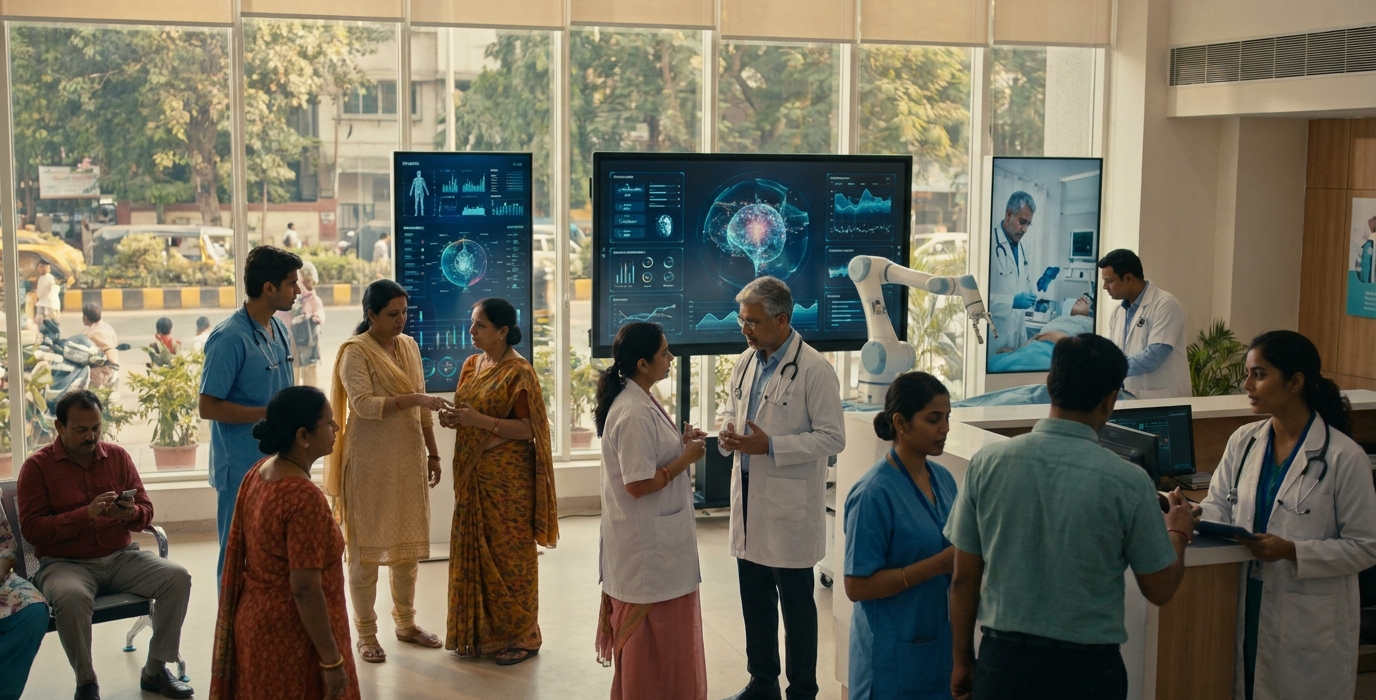
AI doesn’t aim to replace radiologists or pathologists; rather, it acts as a powerful co-pilot. It can pre-screen images, highlight areas of concern, and even quantify the likelihood of malignancy. This frees up clinicians to focus on more complex cases and provides a crucial second opinion, enhancing diagnostic confidence and reducing the risk of misdiagnosis. The speed at which AI can process these images also means that turnaround times for diagnostic reports can be significantly reduced, allowing for faster treatment initiation.
A surprising fact is that AI’s ability to analyse medical images extends beyond static pictures. It can also interpret dynamic imaging, such as cardiac ultrasounds, to detect subtle abnormalities in heart function. This level of detail and speed was previously unimaginable, promising to revolutionise the management of cardiovascular diseases across India.
Tailoring Treatments: Beyond Generic Prescriptions
Personalised medicine truly shines when it comes to treatment planning. AI can analyse a patient’s genetic profile, the specific molecular characteristics of their disease, and their past medical history to predict how they will respond to different drugs and therapies. This eliminates the need for trial-and-error prescribing, which can be costly, time-consuming, and lead to adverse side effects.
In oncology, for instance, AI is helping oncologists select the most effective chemotherapy or immunotherapy drugs for individual cancer patients. By analysing tumour DNA, AI can identify specific mutations that make a tumour susceptible to a particular targeted therapy. This precision approach not only improves treatment efficacy but also reduces exposure to unnecessary toxicities.
Pharmacogenomics: The AI Advantage
This field, known as pharmacogenomics, is seeing tremendous growth. AI algorithms can predict how an individual’s genetic makeup will affect their metabolism of certain drugs. For example, some people metabolise a common antidepressant much faster than others due to their genes. An AI system can flag this, allowing the doctor to adjust the dosage accordingly, preventing the drug from being ineffective or causing unwanted side effects.
We’re also seeing AI being used to optimise dosages for critical medications. For patients undergoing complex surgeries or those in intensive care, AI can continuously monitor vital signs and other physiological data to recommend precise, real-time adjustments to drug infusions. This level of dynamic, data-driven decision-making is vital for improving patient outcomes in critical care settings.
Bridging Gaps: AI’s Role in Accessible Healthcare
India’s vast geography and diverse socio-economic landscape present unique challenges for healthcare delivery. AI, particularly through telemedicine and predictive analytics, is emerging as a powerful tool to bridge these gaps and make quality healthcare more accessible and affordable.
Telemedicine platforms are being enhanced by AI to provide more sophisticated remote consultations. AI-powered chatbots can handle initial patient queries, gather symptoms, and even triage cases, directing patients to the appropriate level of care. This is particularly beneficial for individuals in Tier 2 and Tier 3 cities or remote villages who may have limited access to specialist doctors.
Predictive Analytics for Public Health
Beyond individual care, AI is revolutionising public health initiatives. By analysing demographic data, environmental factors, and historical disease patterns, AI can predict disease outbreaks with greater accuracy. This allows public health officials to proactively allocate resources, implement preventative measures, and respond more effectively to epidemics. For example, AI models are being used to forecast the spread of vector-borne diseases like dengue and malaria, enabling targeted vector control campaigns.
A surprising application of AI in this domain is its use in predicting drug shortages. By analysing manufacturing data, supply chain logistics, and demand patterns, AI can identify potential disruptions before they occur, allowing for timely intervention and ensuring the availability of essential medicines across the country. This proactive approach to supply chain management is crucial for maintaining healthcare continuity.
Navigating the Challenges: Data, Regulation, and Human Oversight
While the promise of AI in Indian healthcare is undeniable, its widespread adoption is not without its hurdles. Data privacy and security are paramount concerns. The sensitive nature of health data necessitates robust ethical frameworks and stringent regulations to prevent misuse. India is actively working on its data protection laws, and their effective implementation will be critical for building trust.
Another significant challenge is the development of appropriate regulatory frameworks. As AI diagnostic and treatment tools become more sophisticated, clear guidelines are needed for their validation, approval, and ongoing monitoring. This ensures that these technologies are safe, effective, and reliable. The Indian Council of Medical Research (ICMR) and other regulatory bodies are actively engaged in this process.
The Human Element Remains Crucial
Furthermore, while AI can augment human capabilities, it cannot replace the empathy, intuition, and ethical judgment of healthcare professionals. Training healthcare workers to effectively use and interpret AI-generated insights is essential. There’s a need for a skilled workforce that can collaborate with AI systems, understand their limitations, and make informed decisions.
The cost of implementing advanced AI systems also remains a barrier for some healthcare providers, particularly smaller clinics and hospitals. However, as the technology matures and becomes more widely adopted, we expect costs to decrease, making it more accessible to a broader range of institutions. The focus must remain on ensuring that AI benefits all segments of the Indian population, not just the affluent.
The Road Ahead: A Collaborative Future for Indian Healthcare
The integration of AI into Indian healthcare is not a distant dream but a present-day transformation that will profoundly shape the future of well-being for millions. From enhanced diagnostics in metropolitan hospitals to improved access in remote villages via AI-powered telemedicine, the impact is far-reaching. We are witnessing a paradigm shift where healthcare is becoming increasingly proactive, predictive, and personalised.
As AI technologies continue to evolve, we can anticipate even more groundbreaking applications. Imagine AI assisting in complex surgical procedures with enhanced precision, or AI predicting the onset of chronic diseases based on subtle changes in wearable device data. The potential for innovation is limitless, provided we navigate the associated challenges with foresight and responsibility.
“AI is not just a tool; it’s a catalyst for a more equitable and effective healthcare system, allowing us to move from a reactive approach to a truly preventative and personalised one for every Indian.”
The journey requires a concerted effort from technology developers, healthcare providers, policymakers, and the public. By fostering collaboration, investing in research and development, and prioritising ethical considerations, India can cement its position as a leader in AI-driven personalised medicine, offering a healthier future to its citizens and setting a global benchmark. The next decade promises to be transformative, making healthcare more intelligent, accessible, and, most importantly, profoundly human-centric.
Frequently Asked Questions
What is personalised medicine?
Personalised medicine, also known as precision medicine, is an approach to healthcare that tailors medical decisions, treatments, practices, and products to the individual patient. It considers variations in genes, environment, and lifestyle.
How is AI used in medical diagnostics?
AI is used to analyse medical images (like X-rays and CT scans) to detect anomalies, interpret pathology slides, and identify patterns in patient data that may indicate the presence of a disease, often with higher speed and accuracy than human interpretation alone.
Will AI replace doctors in India?
No, AI is intended to augment, not replace, doctors. It acts as a powerful tool to assist clinicians in diagnosis, treatment planning, and patient management, freeing them up to focus on complex cases and patient interaction.
What are the biggest challenges for AI in Indian healthcare?
Key challenges include ensuring data privacy and security, developing robust regulatory frameworks for AI medical devices, the cost of implementation, and the need to train healthcare professionals in using AI tools effectively.
Can AI help improve healthcare in rural India?
Yes, AI can significantly improve rural healthcare through enhanced telemedicine platforms, AI-powered diagnostic tools that can be used remotely, and predictive analytics for public health initiatives, extending the reach of medical expertise.