Key Takeaways
- Indian artists are increasingly integrating AI tools into their creative processes, moving beyond traditional mediums to explore novel artistic expressions.
- These AI-driven art forms are finding a global audience, challenging conventional notions of authorship and originality.
- The accessibility of AI platforms is democratizing art creation, empowering individuals with diverse backgrounds to contribute to the art world.
- Navigating copyright, ethical considerations, and the evolving definition of art are crucial challenges for this burgeoning movement.
The Algorithmic Muse: India’s New Generation of Digital Artisans
The canvas is no longer just linen or paper; it’s increasingly a digital screen, and the brushstroke is often a carefully crafted prompt. In India, a vibrant new wave of artists is emerging, not with traditional paints or clay, but with algorithms and artificial intelligence. These creators are pushing the boundaries of what art can be, leveraging AI tools to generate breathtaking visuals, complex narratives, and entirely new aesthetic experiences. From the bustling metropolises of Mumbai and Delhi to the serene backwaters of Kerala, a silent revolution is underway, where human creativity meets machine intelligence. We are witnessing the birth of a distinctly Indian AI artistry, one that blends ancient motifs with futuristic visions.
This isn’t about replacing human artists; it’s about augmenting their capabilities. Think of AI as an incredibly sophisticated assistant, capable of rendering complex scenes in seconds, exploring infinite stylistic variations, or even suggesting entirely unexpected visual pathways. For many, AI offers a bridge to artistic expression, lowering the technical barriers that might have previously deterred them. Whether it’s a young designer in Bangalore experimenting with generative adversarial networks (GANs) or a seasoned painter in Kolkata using AI to explore abstract forms, the impact is profound. We’re seeing a democratization of art creation, where the ability to conceptualize and direct the creative process is paramount. This shift is already reshaping galleries, online art platforms, and even public art installations across the nation.
From Prompt to Palette: The Tools of the Trade
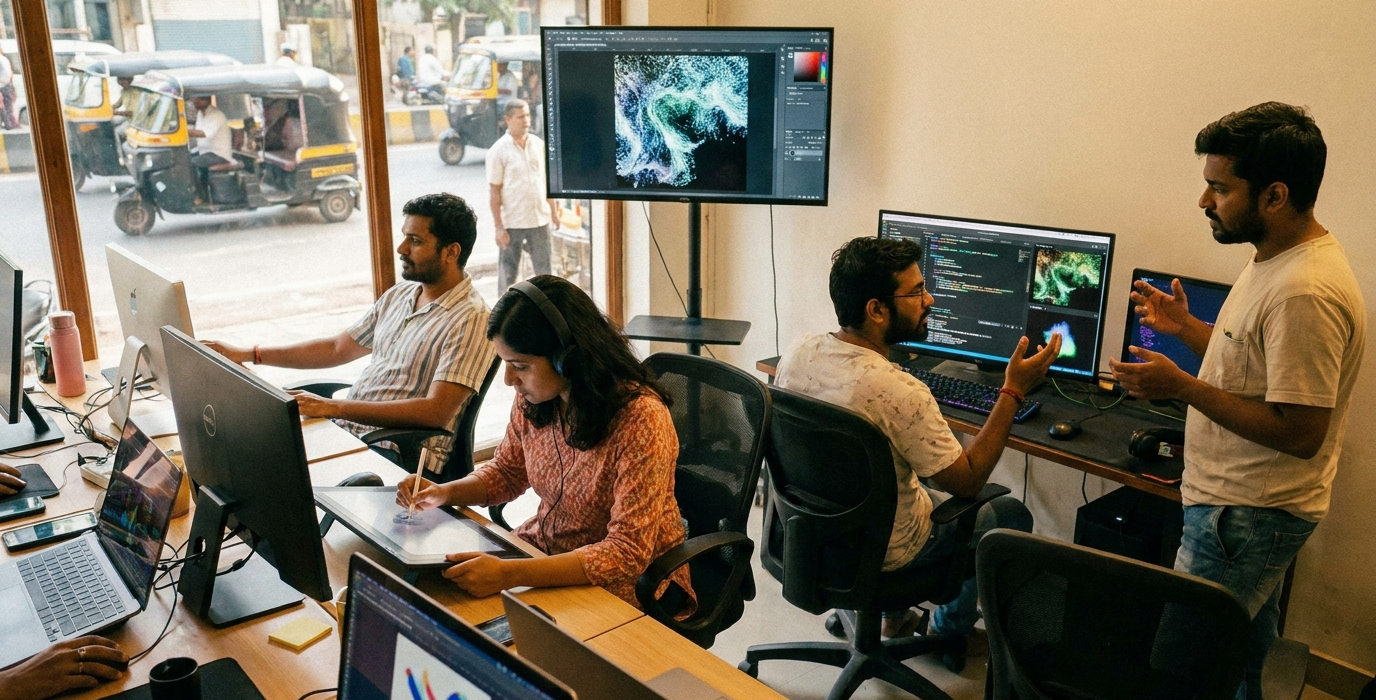
The arsenal of an AI artist is diverse and constantly evolving. Gone are the days of just Photoshop or Illustrator; today’s digital artisans are wielding tools that can conjure entire worlds from text descriptions. Platforms like Midjourney, Stable Diffusion, and DALL-E 3 have become indispensable, allowing artists to translate their imagination into vivid imagery with remarkable speed. These tools operate on the principle of diffusion models, trained on vast datasets of images and text, enabling them to understand and generate novel visual content. For instance, an artist might feed a prompt like “A Bharatanatyam dancer in a futuristic cityscape of a cyberpunk Kochi, inspired by Raja Ravi Varma’s palette” and watch as the AI constructs a unique interpretation.
Beyond image generation, AI is also being used for video synthesis, music composition, and even interactive installations. Artists are experimenting with AI-powered storytelling, where algorithms can generate plot points, character backstories, or dialogue. In the realm of animation, AI can assist in creating character models, animating complex movements, or even generating entire scenes. We’ve seen emerging artists in Pune using AI to generate concept art for independent films, significantly reducing pre-production time and costs. The key lies in the artist’s ability to iterate, refine prompts, and guide the AI towards their desired aesthetic. It’s a collaborative dance between human intent and machine capability, where the artist’s vision remains the guiding star.
A Global Canvas: Indian AI Art on the World Stage
The reach of Indian AI art is no longer confined to domestic exhibitions or online forums. It’s making significant waves on the international stage, captivating audiences and critics alike. Galleries in London, New York, and Tokyo are now featuring AI-generated works by Indian artists, often presented alongside traditional media. These pieces are not just curiosities; they are critically acclaimed for their originality, technical prowess, and unique cultural perspectives. Consider the work of an artist like Anya Sharma from Jaipur, whose AI-generated series depicting ancient Rajasthani folklore reimagined through a surreal, futuristic lens has garnered international attention.
This global recognition is a testament to the universal appeal of compelling visual narratives, regardless of their origin. What’s particularly fascinating is how Indian artists are embedding their cultural heritage into these AI creations. You’ll find intricate Gond art patterns rendered in digital form, Mughal miniatures reinterpreted with AI’s surreal touch, or even the vibrant chaos of a Durga Puja pandal visualized in an otherworldly style. This fusion of tradition and technology creates a dialogue that resonates across cultures. It proves that AI art is not a monolithic global style; rather, it’s a diverse tapestry woven with local threads. We are seeing a powerful assertion of Indian identity in the digital art space, proving that technology can amplify, not erase, cultural richness.
Challenging the Masters: Authorship, Copyright, and the Evolving Definition of Art
As AI art gains prominence, it inevitably brings forth complex questions about authorship, copyright, and the very definition of art. Who is the artist: the person who writes the prompt, the AI model that generates the image, or the developers who trained the model? These are not simple legal or philosophical conundrums; they are crucial considerations for the future of creative industries. In India, as in many parts of the world, copyright laws are still catching up with this rapidly evolving landscape. The debate centres on whether AI-generated works can be copyrighted and, if so, by whom.
Some argue that since AI lacks consciousness and intent, it cannot be an author in the traditional sense. Others contend that the human who conceives, curates, and refines the output is the true artist. For instance, a recent exhibition in Ahmedabad showcased AI-generated portraits that bore striking resemblances to historical figures. The artist, Ravi Kapoor, insisted that his careful selection of prompts and iterative refinement process made him the author. This raises questions about originality – if an AI is trained on millions of existing images, can its output truly be considered new? The legal and ethical frameworks are still being constructed, making this a dynamic and often contentious area. We are witnessing a fundamental re-evaluation of creative ownership, and India’s legal system, like others, is grappling with how to adapt.
The Democratic Brush: AI as an Enabler for New Voices
One of the most profound impacts of AI in the art world is its potential to democratize creation. Previously, mastering traditional art forms required years of dedicated training and often significant investment in materials. AI tools, however, have lowered these barriers, empowering individuals from diverse backgrounds to translate their ideas into compelling visual art. This is particularly significant in a country as vast and varied as India, where talent and creativity are abundant but opportunities may be limited. A young woman in a remote village in Odisha, with a smartphone and an internet connection, can now explore artistic concepts that were once the exclusive domain of trained professionals.
This accessibility is fostering a new generation of storytellers and visual artists who might never have picked up a paintbrush. They can experiment with complex visual styles, explore abstract concepts, and tell stories in ways previously unimaginable. For example, we’ve seen compelling personal narratives emerge from artists in the Northeast who are using AI to visualize their cultural traditions and lived experiences. This isn’t about devaluing traditional skills; it’s about expanding the creative landscape. It allows for a broader spectrum of voices and perspectives to enter the art discourse, enriching the cultural tapestry of India and beyond. The ease with which these tools can be used means that more people can engage with art creation, fostering a more inclusive and dynamic creative ecosystem.
Navigating the Future: Ethical AI and Sustainable Art Practices
As AI artistry flourishes, so too do the discussions around its ethical implications and the need for sustainable practices. The environmental footprint of training and running large AI models is a growing concern, especially in a world increasingly focused on climate action. Artists and developers are exploring ways to optimize AI processes, use more energy-efficient hardware, and develop models that require less computational power. Furthermore, the ethical use of AI extends to issues of bias in training data, which can perpetuate harmful stereotypes in generated art. Ensuring diversity and inclusivity in the datasets used to train these models is paramount.
We are seeing a growing movement among Indian AI artists to be transparent about their processes and the tools they use. This includes clearly labeling AI-generated works and engaging in open dialogue about the ethical considerations involved. Some artists are actively working to mitigate bias by curating their own datasets or using AI tools designed for ethical output. For instance, a collective in Chennai is developing an AI model trained specifically on South Indian classical art forms to ensure cultural accuracy and avoid misrepresentation. The future of AI artistry in India hinges on a commitment to responsible innovation, where creativity is balanced with ethical awareness and environmental consciousness. This proactive approach will ensure that AI serves as a force for good in the art world, fostering genuine creativity and cultural understanding.
Frequently Asked Questions
What are the most popular AI art generation tools for Indian artists?
Currently, Midjourney, Stable Diffusion, and DALL-E 3 are highly favoured by Indian artists due to their powerful capabilities and relative ease of use. Many also explore open-source alternatives and specialized AI models tailored for specific artistic styles.
How can I ensure my AI-generated art is original and not a copy?
Originality in AI art comes from the unique prompts you craft, the iterative refinement process, and the conceptual direction you provide. While AI is trained on existing data, your vision and manipulation of the tool are what make the output distinctly yours. Documenting your creative process can also help establish your authorship.
Are there specific Indian cultural elements that AI art tools can effectively represent?
Yes, AI tools can be remarkably effective at representing Indian cultural elements. Artists are successfully integrating traditional motifs, historical styles, architectural patterns, and even folk art into their AI creations, often with surprising and beautiful results. The key is in the specificity of your prompts and your understanding of the cultural context.
What are the copyright implications of using AI art in India as of 2026?
As of August 2026, the legal framework for AI-generated art copyright in India is still evolving. Generally, works created solely by AI without significant human creative input may face challenges in obtaining traditional copyright protection. However, works where AI is used as a tool under substantial human direction and creative control are more likely to be considered copyrightable, with the human user potentially being recognized as the author. It is advisable to consult with legal experts specializing in intellectual property law for specific guidance.
Where can I see AI art exhibitions in India?
AI art exhibitions are increasingly common in major Indian cities like Mumbai, Delhi, Bangalore, and Kolkata, often hosted by art galleries, cultural centres, and technology-focused events. Keep an eye on local art news, gallery websites, and social media for announcements of upcoming exhibitions featuring AI-generated works.