Key Takeaways
- AI is transforming Indian agriculture, moving beyond theoretical discussions to practical applications that are already boosting crop yields and farmer incomes.
- From precision farming in Punjab’s fields to disease detection in Kerala’s spice plantations, AI is offering tangible solutions to long-standing agricultural challenges.
- Early adopters of AI-driven tools are seeing significant returns, suggesting a future where technology is as essential as traditional farming knowledge.
- The integration of AI is not just about efficiency; it’s about building a more resilient and profitable agricultural sector for India’s future.
The Dawn of the Smart Farm: AI Takes Root Across India
The buzz around Artificial Intelligence (AI) is no longer confined to Silicon Valley boardrooms or urban tech hubs. Today, AI is quietly, yet powerfully, taking root in the very soil of India, promising to redefine agriculture as we know it. For millions of Indian farmers, grappling with unpredictable monsoons, rising input costs, and the constant quest for better yields, AI is emerging not as a futuristic dream, but as a practical, game-changing tool. We’re witnessing a paradigm shift, where data analytics, machine learning, and sensor technology are converging to create ‘smart farms’ that are more efficient, productive, and profitable.
This isn’t about replacing the farmer’s innate wisdom; it’s about augmenting it. Imagine having a digital companion that can predict pest outbreaks with uncanny accuracy, suggest the optimal time for irrigation based on hyper-local weather forecasts, or even identify nutrient deficiencies in your soil before they visibly impact your crops. This is the promise of AI in Indian agriculture, a promise that is rapidly becoming a reality from the wheat fields of Punjab to the paddy farms of Tamil Nadu. The potential to uplift farmer livelihoods and ensure food security for a growing nation is immense, and we are only just scratching the surface of what’s possible.
Precision Farming: Unlocking Higher Yields with Data-Driven Insights
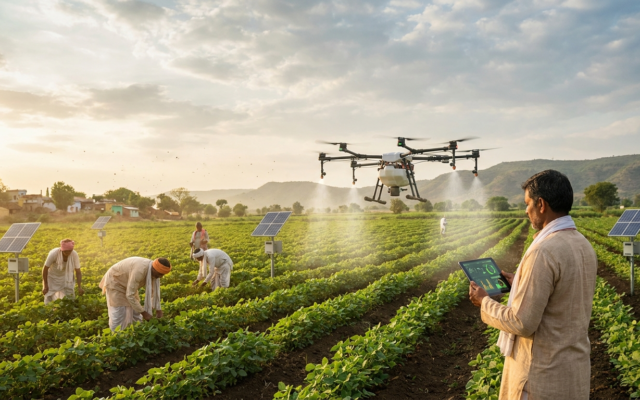
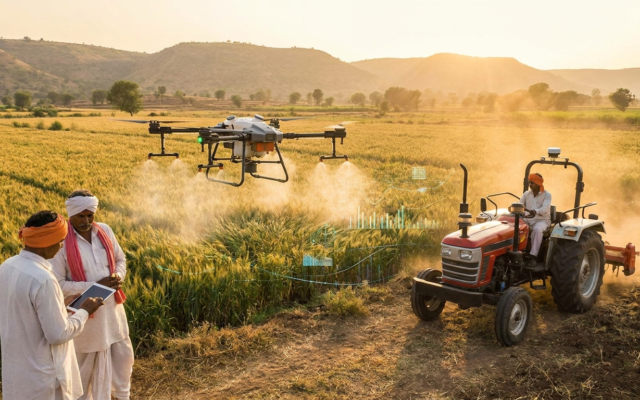
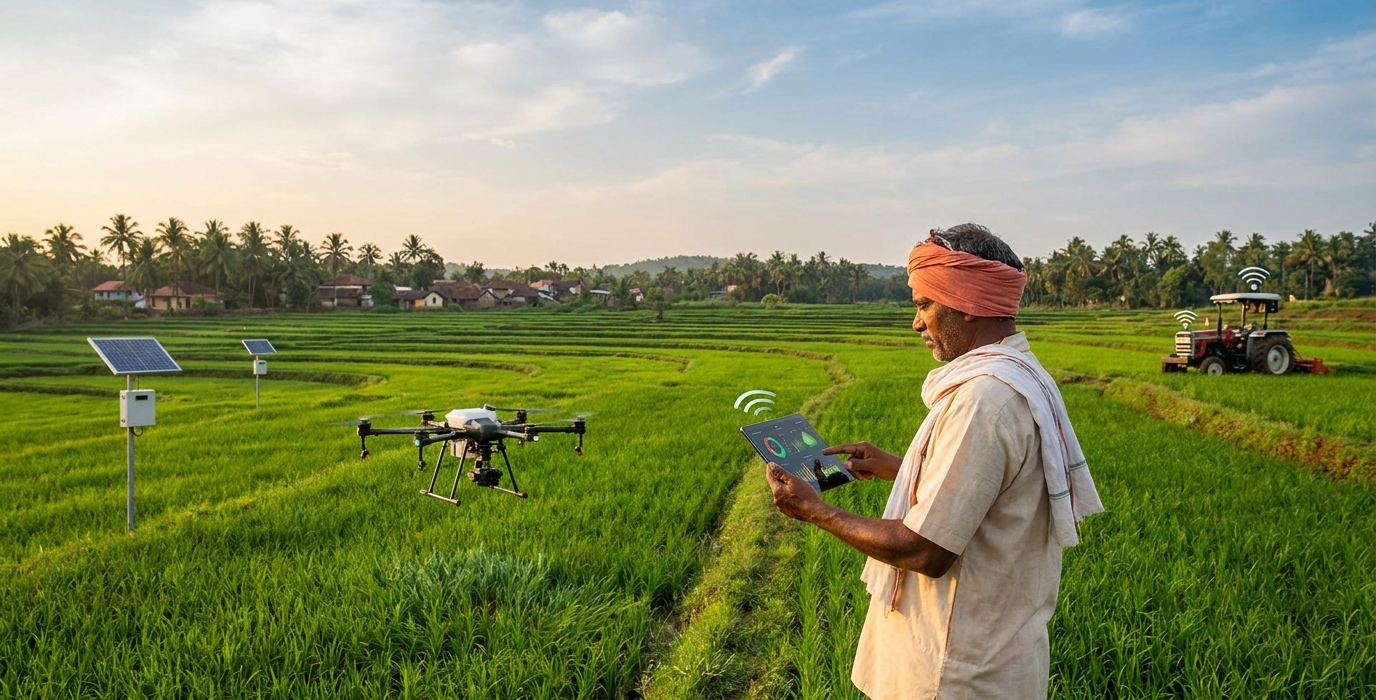
Precision farming, a concept gaining significant traction, is where AI truly shines. Instead of treating an entire field uniformly, AI-powered systems allow farmers to manage their land on a micro-level. Sensors deployed in the fields, often integrated with drones and satellite imagery, collect vast amounts of data on soil health, moisture levels, crop growth, and even pest infestations. AI algorithms then analyse this data to provide highly specific recommendations.
Consider a farmer in the fertile plains of Punjab. Traditionally, irrigation and fertilization might be applied uniformly across acres. With AI, however, the system can identify zones within a field that require more water or specific nutrients. This targeted approach not only conserves precious resources like water and expensive fertilizers but also ensures that each part of the crop receives exactly what it needs, when it needs it. This leads to healthier plants, reduced wastage, and, consequently, significantly higher yields. We’re seeing early adopters report yield increases of 15-20% for staple crops like wheat and rice, a substantial boost to their bottom line.
Variable Rate Application: The Future of Resource Management
A key component of AI-driven precision farming is Variable Rate Application (VRA). VRA technology, guided by AI analysis, allows for the precise application of fertilizers, pesticides, and water only where and when they are needed. This contrasts sharply with traditional broadcast methods, which can lead to over-application in some areas and under-application in others. The economic and environmental benefits are profound.
Early Detection and Prevention: Guarding Crops Against Pests and Diseases
One of the most devastating challenges for farmers is the sudden outbreak of pests and diseases. A single blight can wipe out an entire season’s harvest, leading to immense financial distress. AI is stepping in as a powerful ally in this constant battle. Image recognition algorithms, trained on millions of images of healthy and diseased plants, can now detect early signs of trouble with remarkable accuracy.
Farmers can use their smartphones to take pictures of suspicious-looking leaves or plants. The AI-powered app, often developed by Indian agri-tech startups, can then analyse the image and identify the specific pest or disease. More importantly, it can provide instant recommendations for the most effective and environmentally friendly treatment. This proactive approach allows farmers to intervene before the problem escalates, saving their crops and avoiding the need for broad-spectrum, potentially harmful, chemical treatments. This is particularly vital in regions like Kerala, known for its spice plantations, where specific blights can affect cardamom or pepper crops severely.
The Power of Predictive Analytics
Beyond immediate detection, AI’s predictive capabilities are a game-changer. By analysing historical weather patterns, soil conditions, and pest migration data, AI models can forecast the likelihood of certain outbreaks in specific regions. This allows farmers and agricultural authorities to prepare in advance, stocking up on necessary treatments and implementing preventative measures. It’s a move from reactive firefighting to proactive crop protection.
Optimizing Water Management: Conserving a Precious Resource
Water scarcity is a growing concern across many parts of India, making efficient water management in agriculture absolutely critical. AI is revolutionizing how farmers use water, moving away from guesswork to precise, data-driven irrigation schedules. Smart irrigation systems, powered by AI, integrate data from soil moisture sensors, local weather forecasts, and even evapotranspiration rates (the process of water movement through a plant and its evaporation).
These systems can determine the exact amount of water required by crops at different growth stages and at specific locations within a field. They can then automatically control irrigation equipment, delivering water precisely when and where it’s needed. This not only conserves vast amounts of water but also prevents over-watering, which can lead to root rot and other diseases, and under-watering, which stunts growth. A farmer in Rajasthan, where water is a particularly scarce commodity, can now maximise their output from every drop, transforming arid or semi-arid lands into more productive zones.
Smart Drip and Sprinkler Systems
AI seamlessly integrates with modern irrigation technologies like drip and sprinkler systems. Instead of timed watering, these systems become ‘smart’, adjusting their output based on real-time AI analysis. This ensures optimal hydration without any wastage, a stark contrast to traditional flood irrigation methods.
Market Linkages and Supply Chain Efficiency: Connecting Farmers to Consumers
The benefits of AI in agriculture extend beyond the farm gate. AI is also playing a crucial role in optimizing supply chains, reducing post-harvest losses, and improving market linkages for farmers. By analysing market trends, demand forecasts, and even consumer preferences, AI platforms can help farmers make informed decisions about what to grow and when to sell.
This can significantly reduce instances where farmers are forced to sell their produce at distress prices due to a glut in the market. AI-powered platforms can connect farmers directly with bulk buyers, food processors, and even retailers, cutting out intermediaries and ensuring a fairer price for their hard work. Furthermore, AI can help optimize logistics, ensuring that perishable goods reach markets faster and in better condition, thereby minimizing spoilage. Imagine a farmer in Nashik, known for its grapes, getting real-time price information and demand projections for different markets, allowing them to negotiate better deals.
Traceability and Quality Assurance
AI, coupled with blockchain technology, can also enhance traceability and quality assurance throughout the supply chain. This means consumers can be assured of the origin and quality of their food, while farmers gain recognition for producing high-quality, traceable produce. This builds trust and can command premium prices.
The Human Element: Empowering Farmers with Knowledge and Tools
While the technology is sophisticated, its ultimate success hinges on its accessibility and usability for the farmers themselves. Agri-tech companies and research institutions are working tirelessly to develop AI tools that are intuitive and easy to operate, often through simple mobile applications. Training programs are being rolled out in regional languages to ensure that farmers can effectively leverage these new technologies.
The goal is not to create a digital divide but to empower the farming community. Farmers who embrace these AI-driven tools are not just becoming more efficient; they are becoming more informed, more resilient, and more profitable. This shift is creating a new generation of technologically savvy farmers who are better equipped to face the challenges of modern agriculture and contribute to India’s food security and economic growth. The integration of AI is fostering a sense of empowerment, turning traditional farming practices into data-informed, future-ready operations.
“AI is not just about algorithms and data; it’s about giving the farmer the power of foresight and precision. It’s about transforming centuries-old wisdom with cutting-edge intelligence to secure a bountiful future.”
Frequently Asked Questions
How can a smallholder farmer in rural India access AI-powered agricultural tools?
Access is rapidly improving through government initiatives, agri-tech startups offering affordable mobile apps, and farmer cooperatives. Many platforms provide tiered services, with basic features available for free or at low cost. Look for local agricultural extension services and government schemes that promote technology adoption.
What are the biggest challenges in implementing AI in Indian agriculture?
Challenges include the digital literacy of farmers, the cost of initial investment in some technologies, inconsistent internet connectivity in remote areas, and the need for robust data infrastructure. However, solutions are emerging through user-friendly interfaces and subsidized programs.
Will AI replace farmers?
No, AI is designed to augment the farmer’s role, not replace it. It provides tools for better decision-making, increased efficiency, and higher yields. The farmer’s expertise, local knowledge, and management skills remain indispensable.
What specific crops are benefiting most from AI in India currently?
Currently, staple crops like wheat, rice, and maize, as well as high-value crops such as fruits (grapes, mangoes), vegetables, and spices, are seeing significant benefits. Precision farming techniques are adaptable to a wide range of agricultural produce.
Are there any surprising applications of AI in Indian farming?
Yes, one surprising application is AI-powered chatbots that provide instant pest and disease diagnosis in local languages, directly to a farmer’s phone. Another is the use of drones equipped with AI for targeted spraying of nutrients or pesticides, significantly reducing chemical usage and labour costs.