Key Takeaways
- Artificial intelligence is no longer a futuristic concept for Indian cinema; it’s actively shaping script development and pre-production processes in 2026.
- AI tools are proving invaluable for analysing audience preferences and predicting box office success, offering filmmakers data-driven insights.
- While AI assists in generating creative ideas and dialogue, the human touch of seasoned writers and directors remains paramount for emotional depth and cultural nuance.
- The integration of AI is streamlining workflows, from script polishing to creating realistic storyboards, potentially reducing production timelines and costs.
The Script Starts Here: AI as Your Co-Writer
The scent of chai and the buzz of Mumbai’s film industry have a new, almost imperceptible, companion: artificial intelligence. In 2026, AI is not just a buzzword in Bollywood; it’s a tangible tool being integrated into the very genesis of our cinematic stories. Imagine an AI that has devoured every successful Hindi film script from the last two decades, understanding the subtle nuances of romance in a Yash Raj film or the gritty realism of a Anurag Kashyap narrative. This isn’t science fiction anymore. Several production houses, particularly those experimenting with experimental genres and regional cinema, are leveraging AI platforms to analyse vast datasets of existing scripts.
These platforms can identify recurring plot structures, character archetypes, and even dialogue patterns that resonate most strongly with Indian audiences. Think of it as a hyper-intelligent script doctor, capable of flagging potential pacing issues or suggesting alternative plot resolutions based on historical success rates. We’ve spoken to producers who are using AI to generate multiple script variations from a single premise, allowing writers to explore different narrative paths before committing significant resources. It’s a way to de-risk creative decisions early on, ensuring that the stories we tell have a stronger foundation for audience connection.
AI’s Role in Audience Resonance
The real magic, however, lies in AI’s ability to predict what might connect. By analysing social media trends, online reviews, and even ticket sales data from past films, AI can offer insights into audience sentiment towards specific themes, actors, or even lyrical styles. This doesn’t mean AI is dictating creative choices; rather, it’s providing data-driven feedback loops to writers and directors. It’s like having a focus group of millions available 24/7. This proactive approach helps filmmakers anticipate potential audience reception, allowing for adjustments during the writing phase rather than during costly reshoots. It’s a subtle but powerful shift, moving the industry towards a more informed, audience-centric storytelling model.
Visualising the Vision: AI in Pre-Production
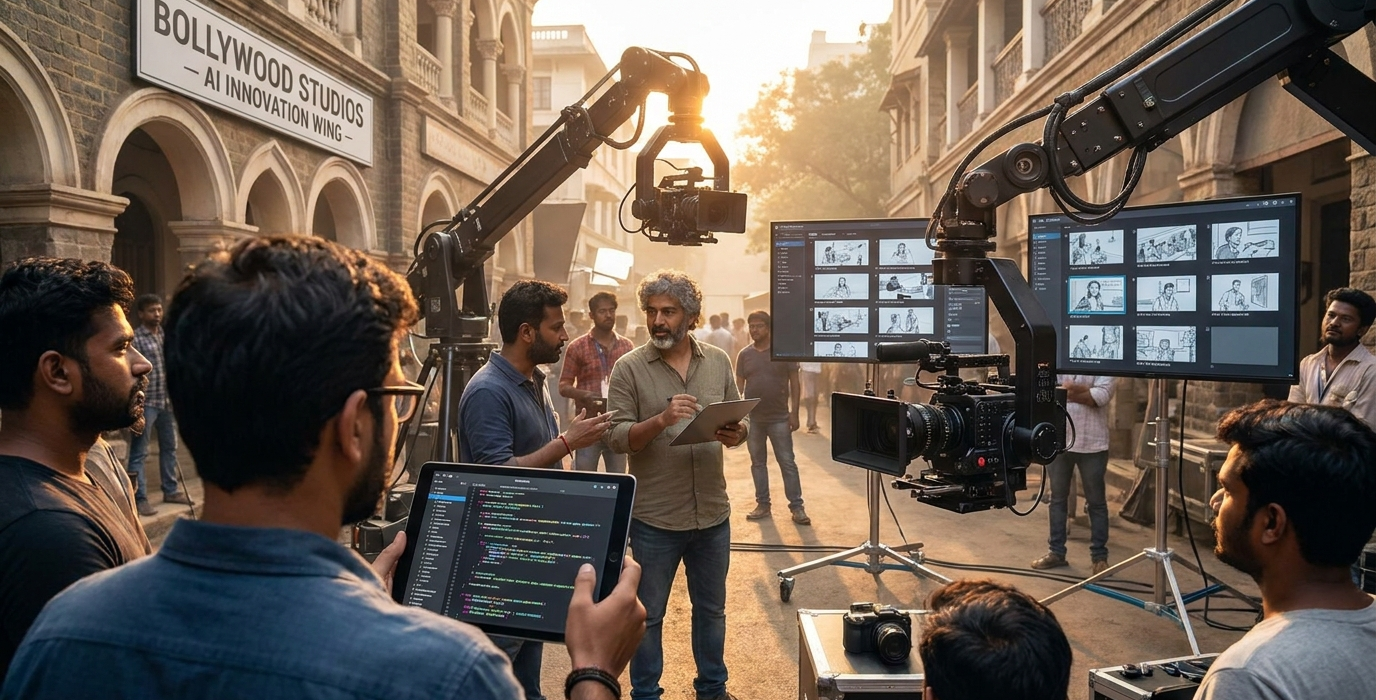
Beyond the written word, AI is revolutionising the visual blueprint of our films. Storyboarding, a crucial but often time-consuming aspect of pre-production, is being dramatically accelerated by AI-powered tools. Instead of artists painstakingly sketching every frame, AI can now generate detailed storyboards and animatics from script descriptions. You simply feed the AI the scene’s text, character actions, and desired camera angles, and it produces a visual sequence. This allows directors to visualise their scenes with unprecedented speed and detail, making it easier to communicate their vision to the entire crew.
We’ve seen early adopters use AI to create near-photorealistic concept art for sets and costumes. Imagine wanting to depict a bustling 1940s Lucknow marketplace; an AI can generate multiple visual interpretations, complete with period-accurate attire and architectural styles, based on historical data and artistic prompts. This not only speeds up the conceptualisation process but also enhances the creative exploration by presenting a wider range of visual possibilities than a human artist might conceive in the same timeframe. It’s about augmenting human creativity, not replacing it.
From Script to Screen: AI-Powered Animatics
The efficiency gains are substantial. A process that might have taken weeks of manual drawing can now be accomplished in days, or even hours. This means directors can iterate on their visual ideas much faster, refining camera movements, character blocking, and scene composition before the cameras even roll. This granular level of pre-visualisation is crucial for complex action sequences or intricate period dramas, ensuring that every shot is purposeful and contributes to the overall narrative impact. The goal is to reduce ambiguity on set, allowing actors and technicians to focus on performance and execution.
“AI is not about making films without humans; it’s about empowering human creativity with intelligent tools. It’s like giving our storytellers a supercharged paintbrush.”
Behind the Scenes: Streamlining Production with AI
The impact of AI extends deep into the logistical heart of filmmaking. Think about the sheer complexity of scheduling shoots, managing a vast crew, and coordinating multiple locations. AI algorithms are now being deployed to optimise production schedules with remarkable efficiency. By factoring in variables such as actor availability, crew working hours, weather forecasts (which are increasingly accurate thanks to AI-driven meteorological models), and even the time required for complex scene setups, AI can generate schedules that minimise downtime and maximise productivity. This is particularly impactful for large-scale productions, such as the ambitious historical epics that continue to draw crowds.
Furthermore, AI is proving its worth in budget management and resource allocation. By analysing past production costs for similar scenes or genres, AI can provide more accurate budget projections. It can also identify potential cost-saving opportunities, such as suggesting alternative shooting locations that offer similar aesthetics at a lower price point, or optimising equipment rental periods. This data-driven approach to production management helps producers make more informed financial decisions, ensuring that films are delivered on time and within budget – a perennial challenge in our industry.
AI in Logistics and Resource Management
Consider a film shooting across multiple cities, from the bustling streets of Chennai to the serene landscapes of Ladakh. Coordinating the movement of cast, crew, and equipment between these diverse locations is a monumental task. AI-powered logistics platforms can now automate and optimise these complex travel and accommodation plans. They can predict potential delays due to traffic or weather, reroute resources dynamically, and ensure that everyone arrives at the right place at the right time. This level of operational efficiency was unthinkable just a few years ago. It allows the creative team to focus on the art, while the AI handles the intricate choreography of the production itself.
The Future of Acting: AI and Performance
The influence of AI on the craft of acting is perhaps the most sensitive and intriguing aspect of its integration into cinema. While AI is not about creating artificial actors to replace human talent, it is offering new avenues for performance enhancement and character development. For instance, AI can be used to reconstruct historical figures or deceased actors for specific cameo roles or archival footage integration, ensuring historical accuracy and providing unique storytelling opportunities. This technology, when used ethically and with full creative control from living actors or estates, can open up fascinating narrative possibilities.
AI is also being used to analyse actor performances in real-time, providing directors with objective feedback on subtle nuances like emotional delivery or physical presence. Imagine an AI that can detect if a performer’s micro-expressions align with the intended emotion of a scene, offering suggestions for alternative deliveries. This is not about dictating performance, but rather about providing actors and directors with additional layers of insight to refine their craft. The goal is to deepen the authenticity and impact of the performances we see on screen.
AI for Digital Doubles and Historical Recreations
A surprising application we’ve encountered is the use of AI in creating highly realistic digital doubles for actors. This allows for the seamless execution of dangerous stunts without risking the lead actor’s safety. The digital double, animated and rendered with AI-powered motion capture data, can perform incredible feats while retaining the actor’s likeness. This technology has advanced significantly, making the distinction between the real and digital actor virtually imperceptible to the untrained eye. It’s a powerful tool for achieving ambitious visual storytelling while ensuring the well-being of our performers.
Ethical Considerations and the Human Element
As AI becomes more integrated into the creative process, the conversation around ethical considerations and the preservation of the human element is paramount. It’s crucial to acknowledge that AI is a tool, and like any tool, its impact depends on how we wield it. The fear of AI replacing human writers, directors, and actors is understandable, but the current trajectory suggests augmentation, not outright replacement. The cultural nuances, emotional depth, and lived experiences that make Indian cinema so unique are inherently human qualities that AI cannot replicate.
AI can generate dialogue, but it cannot imbue it with the raw emotion of a mother’s plea or the subtle irony of a village elder’s wisdom. It can suggest plot points, but it cannot capture the serendipitous magic of human interaction that often sparks the most compelling narratives. Our industry thrives on human connection, empathy, and shared cultural understanding. These are elements that AI, as it stands today and in the foreseeable future, cannot fully grasp or express. Therefore, the focus must remain on how AI can empower human creatives, allowing them to explore new frontiers without sacrificing the soul of storytelling.
The Irreplaceable Value of Human Creativity
We’ve seen instances where AI-generated scripts, while technically sound, lacked the genuine heart and soul that resonates with audiences. This underscores the irreplaceable value of human creativity, intuition, and lived experience. A seasoned writer brings their personal history, their understanding of societal complexities, and their unique voice to a script. A director infuses a film with their personal vision and emotional interpretation. These are the intangible elements that AI cannot replicate. The future lies in a synergistic partnership, where AI handles the data-driven analysis and repetitive tasks, freeing up human artists to focus on the art of storytelling, emotion, and cultural authenticity.
The Future of Bollywood: A Hybrid Landscape
Looking ahead to 2027 and beyond, the Indian film industry is poised to embrace a hybrid model of filmmaking, where human creativity and artificial intelligence work in tandem. This isn’t a distant prophecy; it’s the unfolding reality. AI will become an indispensable assistant for writers, helping them brainstorm ideas and refine plots. It will aid directors in visualising scenes and optimising production logistics. It will offer new possibilities for special effects and character creation. But at its core, the magic of cinema will continue to be driven by human passion, innovation, and the profound ability to connect with audiences on an emotional level.
The key to successful integration lies in responsible development and mindful application. We must ensure that AI tools are developed and used ethically, with transparency and a commitment to preserving the artistic integrity of filmmaking. The goal is not to automate creativity, but to enhance it, to push the boundaries of what is possible, and to tell stories that are more compelling, more resonant, and more impactful than ever before. The vibrant tapestry of Indian cinema, rich with its diverse languages, cultures, and emotions, will undoubtedly find new ways to flourish with these intelligent new collaborators. The 2026 festive season releases are already hinting at this exciting new era.
Navigating the AI Revolution in Entertainment
The transition will require adaptation and learning. Film schools will need to incorporate AI tools into their curricula, and industry professionals will need to upskill. We must foster an environment where experimentation with AI is encouraged, but where critical judgment and human oversight remain paramount. The stories we tell will continue to be shaped by human hands and human hearts, but the tools we use to tell them are evolving at an astonishing pace. The challenge, and the opportunity, is to harness this evolution for the betterment of our beloved art form.
Frequently Asked Questions
Will AI replace human screenwriters in Bollywood?
No, it is highly unlikely that AI will fully replace human screenwriters. AI can assist in generating ideas, analysing trends, and polishing scripts, but the emotional depth, cultural nuance, and unique voice of human writers are irreplaceable for creating truly compelling stories.
How is AI being used in film production right now?
Currently, AI is being used for tasks such as script analysis and generation, storyboarding, visual effects, optimising production schedules, budget prediction, and creating digital doubles for stunts. These tools aim to streamline processes and enhance creative possibilities.
What are the biggest ethical concerns regarding AI in filmmaking?
Key ethical concerns include job displacement for creative professionals, the potential for bias in AI algorithms leading to skewed creative output, issues of copyright and intellectual property for AI-generated content, and the responsible use of AI for digital reconstruction of actors.
Can AI help predict a film’s box office success?
Yes, AI can analyse vast amounts of data, including audience sentiment, social media trends, and past box office performance of similar films, to provide predictions and insights into a film’s potential commercial success. However, these are predictions, not guarantees, as audience reception can be unpredictable.
Is AI technology affordable for smaller Indian film production houses?
While high-end AI solutions can be expensive, the accessibility of AI tools is increasing. Cloud-based platforms and more user-friendly software are becoming available, making it more feasible for smaller production houses to leverage AI for specific tasks like script analysis or basic storyboarding within a reasonable budget.