Key Takeaways
- Virtual Reality (VR) is rapidly transforming India’s Ed-Tech landscape, offering immersive learning experiences previously unattainable online.
- Key sectors benefiting include STEM subjects, vocational training, and historical/cultural education, making complex concepts more accessible.
- While hardware costs remain a barrier, innovative software solutions and government initiatives are paving the way for wider adoption.
- The future of Ed-Tech in India hinges on integrating VR seamlessly with existing curricula and ensuring equitable access for all students.
The Dawn of Immersive Learning: VR Enters the Indian Classroom
For years, India’s Ed-Tech sector has been a dynamic force, adapting to the needs of millions of students. Now, we stand at the precipice of a new revolution, one powered by Virtual Reality (VR). Imagine dissecting a virtual frog without touching a scalpel, or walking through the ruins of Hampi as it stood centuries ago, all from your study desk. This isn’t science fiction; it’s the unfolding reality of VR in Indian education.
The limitations of traditional online learning – passive video lectures and static diagrams – are being shattered. VR offers a level of engagement that fosters deeper understanding and retention. This shift is particularly impactful for subjects that are traditionally difficult to visualize or require hands-on experience. We are moving beyond simply watching and listening, towards actively doing and experiencing.
Startups across India are aggressively investing in VR-based learning platforms. They recognize the immense potential to create a more effective, equitable, and engaging educational ecosystem. This isn’t just about novelty; it’s about fundamentally rethinking how knowledge is imparted and absorbed. The goal is to bridge the gap between theoretical learning and practical application, a challenge that has long plagued educational systems worldwide.
Unlocking STEM Potential with Virtual Labs
Science, Technology, Engineering, and Mathematics (STEM) subjects have always presented unique pedagogical challenges, especially in an online format. Explaining abstract concepts like atomic structure or the mechanics of a combustion engine can be incredibly difficult through textbooks or even 2D simulations. This is where VR is making a profound difference.
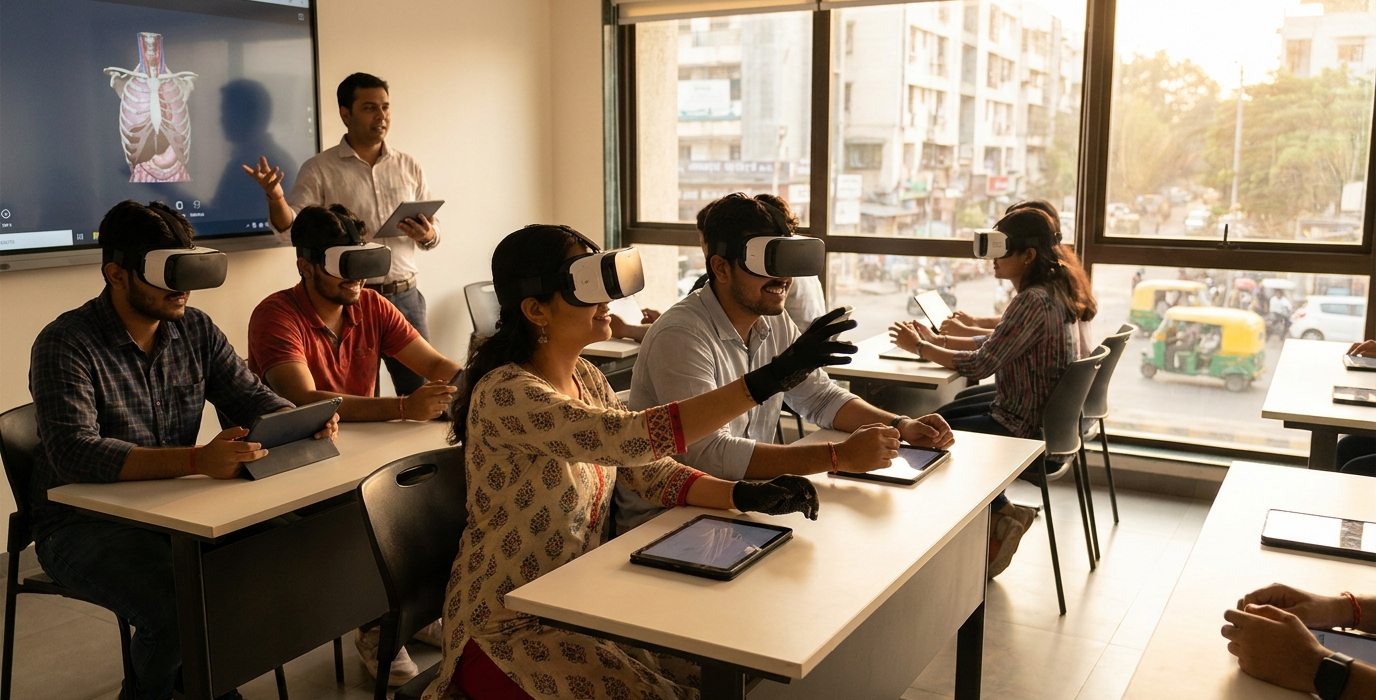
Students can now step inside a virtual laboratory, manipulate molecules to understand chemical reactions, or assemble complex machinery piece by piece. For instance, initiatives like those emerging from Bengaluru’s tech hubs are developing VR modules for physics that allow students to conduct experiments with gravity and electromagnetism without the need for expensive equipment or the risk of accidents. Similarly, medical students can practice intricate surgical procedures in a risk-free virtual environment, gaining invaluable experience before operating on real patients.
This immersive approach not only demystifies complex scientific principles but also cultivates critical thinking and problem-solving skills. It allows for repeated practice and exploration, empowering students to learn at their own pace. We are seeing a tangible increase in student confidence and a deeper grasp of subjects that were once considered daunting.
A Surprising Insight: The Rise of “Virtual Field Trips”
One of the most unexpected yet impactful uses of VR in Indian education is the creation of “virtual field trips.” Traditionally, visiting historical sites like the Ajanta Caves or the Mehrangarh Fort was an aspiration for many, limited by geography and cost. VR now allows students from a small village in Uttar Pradesh to explore the intricate carvings of Ellora or witness the grandeur of the Taj Mahal as if they were there.
These experiences are meticulously crafted, often incorporating historical context, narration, and interactive elements. This makes learning about history, geography, and culture an adventure rather than a chore. It fosters a sense of connection to India’s rich heritage and diverse landscapes, fostering national pride and a broader worldview. This is a powerful tool for cultural preservation and dissemination, reaching students who might never have the opportunity to travel.
Bridging the Skill Gap: Vocational Training in VR
India’s burgeoning economy demands a skilled workforce, and vocational training plays a crucial role. However, providing practical, hands-on training for trades like welding, plumbing, electrical work, or even complex manufacturing processes can be resource-intensive and sometimes hazardous. VR offers a safe, scalable, and cost-effective alternative for equipping individuals with these essential skills.
Imagine an aspiring mechanic learning to diagnose and repair an engine in a virtual workshop, safely manipulating tools and components. Or a welder practicing intricate techniques in a simulated environment, receiving immediate feedback on their technique. Companies in industrial hubs like Pune and Chennai are exploring VR simulations to train their new hires, reducing onboarding time and improving safety protocols.
This isn’t just about replicating physical tasks; VR can simulate scenarios that are rare or dangerous in the real world, such as emergency response protocols or operating heavy machinery under adverse conditions. This comprehensive training prepares individuals for the realities of the job market, making them more employable and confident. We are witnessing a significant shift towards competency-based training, where VR plays a central role.
A Practical Example: Simulating Factory Floor Operations
Consider a large-scale manufacturing plant. Training new operators on the assembly line can be disruptive and expensive, often requiring seasoned employees to pause their work. With VR, new recruits can experience the entire factory floor, learn the sequence of operations, understand safety procedures, and practice their tasks in a realistic 3D environment before ever setting foot on the actual production line. This drastically reduces errors, improves efficiency, and ensures a smoother transition into the workforce.
Addressing the Hurdles: Hardware, Access, and Affordability
Despite the immense potential, the widespread adoption of VR in Indian education faces several significant hurdles. The most immediate is the cost of VR hardware – headsets and powerful enough computers – which can be prohibitive for many individual students and even some institutions. While the prices are gradually coming down, they remain a substantial investment, especially for families in rural or lower-income urban areas.
Furthermore, ensuring equitable access is paramount. If VR becomes a tool exclusively for the affluent, it could exacerbate existing educational disparities. This is where collaborative efforts between the government, private sector, and Ed-Tech companies become crucial. Initiatives like government-backed grants for schools to acquire VR equipment or partnerships to develop affordable, lightweight VR solutions are vital.
We also need robust content creation ecosystems. Developing high-quality, curriculum-aligned VR modules requires significant investment and expertise. Ensuring that this content is engaging, pedagogically sound, and culturally relevant to Indian students is an ongoing challenge. The focus needs to be on creating experiences that genuinely enhance learning outcomes, not just on superficial technological adoption.
| Component | Estimated Cost Range (INR) | Notes |
|---|---|---|
| Entry-Level VR Headset (e.g., Meta Quest 3, Pico 4) | ₹30,000 – ₹50,000 | Requires a compatible PC or smartphone for some applications. |
| Mid-Range VR Headset (e.g., HTC VIVE Pro 2) | ₹80,000 – ₹1,50,000 | Offers higher fidelity and better tracking, often for professional use. |
| High-End VR System (e.g., Varjo, Pimax) | ₹2,00,000+ | For specialized applications requiring extreme visual clarity. |
| Powerful PC for VR | ₹70,000 – ₹1,50,000+ | Essential for demanding VR applications and high-resolution graphics. |
| Entry-Level VR-Ready Laptop | ₹90,000 – ₹1,20,000 | Offers portability but may have performance limitations compared to desktops. |
The Role of Content and Curriculum Integration
Technology is only as good as the content it delivers. The true potential of VR in Indian Ed-Tech will be realized when it is seamlessly integrated into existing curricula, rather than being treated as an add-on. This requires close collaboration between VR developers, educators, and curriculum designers.
We need VR experiences that are not just visually stunning but are also pedagogically sound, aligning with learning objectives set by educational boards. For example, a VR module on the Indian freedom struggle should not just show historical locations but also present key events, dialogues, and challenges faced by leaders, encouraging critical analysis. The goal is to use VR to deepen understanding of existing subjects, not to replace them entirely.
Furthermore, teacher training is a critical component. Educators need to be equipped with the skills and knowledge to effectively incorporate VR into their teaching methodologies. This includes understanding how to facilitate VR sessions, guide student exploration, and assess learning within these immersive environments. Without this crucial support, VR might remain an underutilized novelty.
A Surprising Fact: India’s Unique Contribution to VR Content
While global players dominate VR hardware, India is carving out a unique niche in creating culturally relevant VR content. Startups like those in Hyderabad are developing VR experiences that delve deep into Indian mythology, classical music appreciation, and even the intricacies of Ayurvedic medicine. These are areas where Western developers might lack the nuanced understanding, giving Indian Ed-Tech a distinct advantage in capturing the local market and beyond.
“VR isn’t just about adding a visual layer to education; it’s about fundamentally changing the student’s relationship with the subject matter, transforming passive recipients of information into active explorers of knowledge.”
The Future Outlook: A Hybrid Model for Learning
The trajectory of Ed-Tech in India, especially with the advent of VR, points towards a hybrid model of learning. This model will likely blend traditional classroom instruction, online learning platforms, and immersive VR experiences. The aim is to leverage the strengths of each modality to create a comprehensive and personalized educational journey for every student.
Imagine a student learning about the water cycle in a classroom, then reinforcing that knowledge through an interactive VR simulation where they can follow water molecules through evaporation, condensation, and precipitation. This multi-sensory approach caters to different learning styles and ensures that concepts are understood at a deeper, more intuitive level. The future is not about choosing between physical and digital, but about intelligently weaving them together.
As VR technology matures and becomes more accessible, we can expect to see its integration extend beyond core academic subjects. Think of VR for soft skills development, empathy training, and even mental well-being programs. The potential applications are vast, promising a future where education is more engaging, effective, and inclusive than ever before. The journey has just begun, and the possibilities are exhilarating.
Frequently Asked Questions
What are the main benefits of VR in education for Indian students?
VR offers immersive and engaging learning experiences, making complex subjects like STEM easier to understand. It enables virtual field trips to historical sites and provides safe, hands-on vocational training, thereby bridging skill gaps and improving knowledge retention.
Are VR headsets affordable for the average Indian student?
Currently, high-quality VR hardware can be expensive, posing a barrier for many. While prices are decreasing, government support and cost-effective solutions are crucial for wider accessibility.
How is VR being used in vocational training in India?
VR allows students to practice technical skills like welding, mechanics, or complex machinery operation in a risk-free virtual environment. This prepares them for real-world jobs, reduces training costs, and improves safety.
What challenges does VR in Indian Ed-Tech face?
Key challenges include the high cost of hardware, ensuring equitable access, developing quality curriculum-aligned content, and training educators to effectively use VR technology.
What does the future of VR in Indian education look like?
The future points towards a hybrid learning model, combining VR with traditional and online methods. VR will likely be integrated into a wider range of subjects and soft skills training, aiming for more personalized and effective education.