Key Takeaways
- India is making significant strides in quantum computing, aiming for global leadership in both research and application.
- The National Quantum Mission is driving investment and talent development across academia and industry.
- Early quantum applications are emerging in areas like drug discovery, financial modelling, and advanced materials science.
- Challenges remain in scaling quantum hardware, developing robust algorithms, and ensuring cybersecurity in a quantum era.
India’s Quantum Leap: A Strategic Imperative for 2026
The hum of innovation in India’s scientific community is reaching a new crescendo, and at its forefront is the ambitious pursuit of quantum computing. As of August 2026, India is not just observing the quantum revolution; it is actively shaping it. The National Quantum Mission (NQM), launched with substantial government backing, has moved beyond its foundational stages and is now yielding tangible results. This isn’t merely about academic curiosity; it’s a strategic imperative aimed at securing India’s technological sovereignty and driving economic growth in the decades to come. We are witnessing a concerted effort to build a robust quantum ecosystem, from fundamental research in cutting-edge physics to the development of practical applications that could redefine industries.
The NQM’s vision is clear: to establish India as a global leader in quantum technology. This involves fostering breakthroughs in quantum computing hardware, software, and communications, while simultaneously nurturing a skilled workforce capable of navigating this complex domain. The mission is fostering collaboration between premier research institutions like the Indian Institute of Science (IISc) in Bengaluru, IITs across the country, and emerging private sector players. These partnerships are crucial for accelerating the pace of discovery and translating theoretical advancements into real-world solutions. The government’s commitment is evident in the significant funding allocated, ensuring that our brightest minds have the resources they need to push the boundaries of what’s possible. This proactive approach positions India to not only benefit from the quantum era but to define its trajectory.
Building the Foundations: Quantum Hardware and Infrastructure
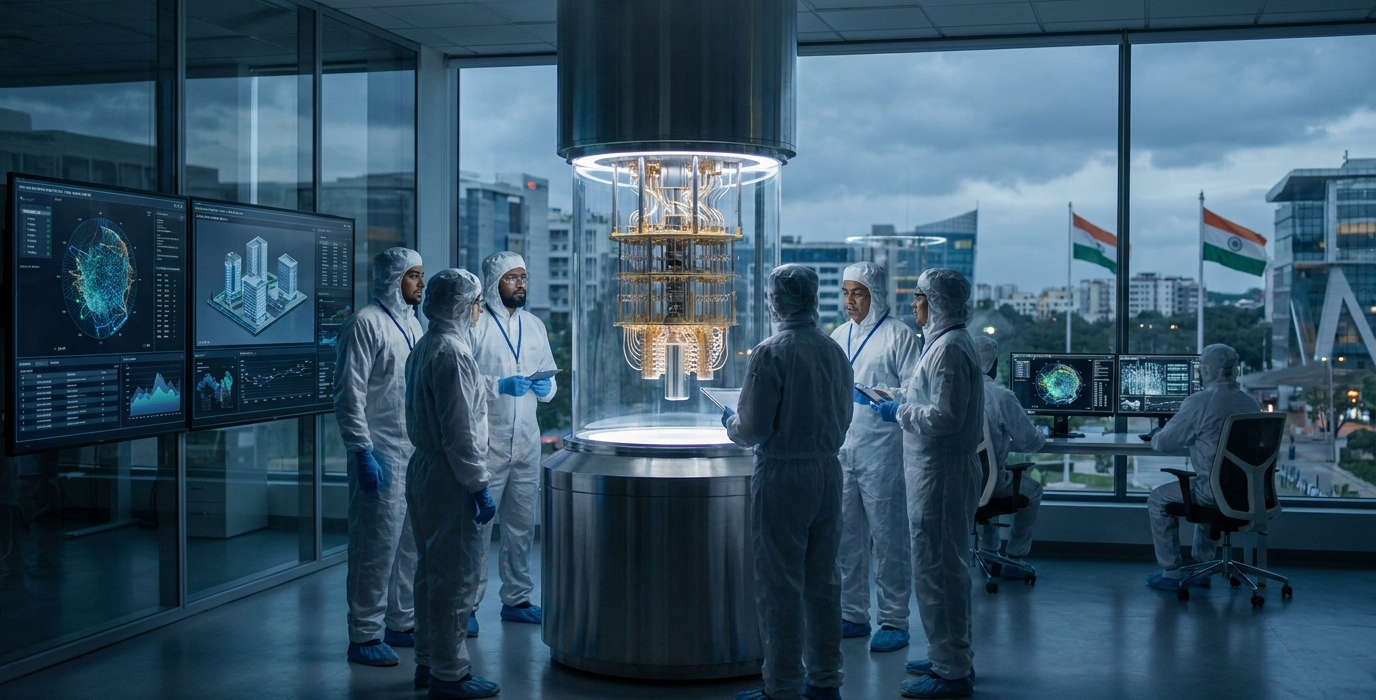
At the heart of India’s quantum ambitions lies the arduous but essential task of building reliable and scalable quantum hardware. While global giants are investing billions, India’s approach, driven by the NQM, is characterized by a focus on indigenous development and strategic international collaborations. Researchers are actively exploring various qubit modalities, including superconducting circuits, trapped ions, and photonic systems. The aim is to develop quantum processors that are not only powerful but also stable and error-resilient, crucial for tackling complex computational problems. We’re seeing promising developments in cryogenics and control electronics, essential components for maintaining the delicate quantum states of qubits.
Institutions like the Tata Institute of Fundamental Research (TIFR) in Mumbai and the Raman Research Institute (RRI) in Bengaluru are at the vanguard of this hardware development. They are not just experimenting with novel qubit designs but also focusing on the engineering challenges that come with miniaturization and mass production. A surprising fact is that despite the immense complexity, some Indian research groups are achieving remarkable coherence times for their qubits, rivaling those reported by leading international laboratories. This indicates a strong grasp of the fundamental physics and engineering principles involved. Furthermore, the NQM is promoting the establishment of dedicated quantum computing facilities and fabrication labs, providing researchers with the advanced infrastructure needed to conduct their experiments. This strategic investment in hardware is the bedrock upon which all future quantum applications will be built.
The Superconducting Frontier
Superconducting qubits, known for their fast gate operations, are a major focus for several Indian research groups. They are working on improving qubit connectivity and reducing error rates, which are paramount for building fault-tolerant quantum computers.
Trapped Ions and Photonics
Simultaneously, research into trapped ions and photonic quantum computing is gaining momentum. These modalities offer different advantages in terms of scalability and connectivity, and India is ensuring it explores diverse avenues to maximize its chances of success.
Unlocking Potential: Quantum Software and Algorithms
Building powerful quantum hardware is only half the battle; developing the software and algorithms to harness its capabilities is equally critical. India’s quantum mission recognizes this, with a significant emphasis on fostering quantum software development and algorithm research. This involves creating user-friendly programming languages, compilers, and simulation tools that will allow a broader range of scientists and engineers to interact with quantum computers. The goal is to democratize access to quantum computing power, moving beyond the realm of highly specialized physicists. We are seeing the emergence of quantum software startups and dedicated research cells within academic institutions.
The focus is on developing algorithms that can solve problems intractable for even the most powerful classical supercomputers. This includes areas like Shor’s algorithm for factoring large numbers (with significant implications for cryptography) and Grover’s algorithm for searching unstructured databases. Beyond these well-known examples, Indian researchers are actively exploring novel quantum algorithms for specific applications. This includes developing quantum machine learning models for pattern recognition, quantum simulations for chemical reactions, and optimization algorithms for complex logistical challenges. A fascinating development is the work being done on developing hybrid quantum-classical algorithms, which leverage the strengths of both types of computing to achieve faster and more efficient solutions for near-term quantum devices. This pragmatic approach acknowledges the current limitations of quantum hardware while still pushing the boundaries of what’s achievable.
Quantum Machine Learning
The intersection of quantum computing and artificial intelligence is a particularly exciting frontier. Indian researchers are developing quantum algorithms that could significantly accelerate machine learning tasks, leading to breakthroughs in areas like drug discovery and financial forecasting.
Optimization Problems
Many real-world challenges, from supply chain management to portfolio optimization, are complex computational problems. Quantum algorithms are being designed to find optimal solutions far more efficiently than classical methods.
Applications on the Horizon: Where Quantum Will Make an Impact
The true value of quantum computing lies in its potential to revolutionize industries that are currently constrained by the limitations of classical computation. As India’s quantum capabilities mature in 2026, we are beginning to see concrete applications emerging across diverse sectors. One of the most promising areas is drug discovery and materials science. Quantum simulations can model molecular interactions with unprecedented accuracy, allowing researchers to design new drugs and develop advanced materials with specific properties much faster and more cost-effectively. This could lead to breakthroughs in treating diseases and creating next-generation superconductors or catalysts.
Another significant area is financial modeling and risk analysis. The ability of quantum computers to process vast amounts of data and perform complex calculations could transform how financial institutions manage portfolios, detect fraud, and assess market risks. Imagine being able to simulate market fluctuations with far greater precision, leading to more stable and resilient financial systems. Furthermore, logistics and supply chain optimization stand to benefit immensely. Quantum algorithms can find the most efficient routes and resource allocations in incredibly complex networks, leading to substantial cost savings and reduced environmental impact. We are also seeing early exploration in cryptography and cybersecurity, where quantum computing poses both a threat and an opportunity. While quantum computers could break current encryption methods, they also offer the promise of quantum-resistant cryptography, a field India is actively investing in.
“The quantum era is not a distant dream; it’s a present reality that demands our focused attention and strategic investment. India has the intellectual capital and the national will to become a leader in this transformative technology.”
The Human Element: Nurturing India’s Quantum Workforce
The most critical component of India’s quantum computing strategy is its people. Without a skilled and adaptable workforce, even the most advanced hardware and software will remain underutilized. The NQM has placed a strong emphasis on talent development through various initiatives. This includes establishing specialized quantum information science programs at leading universities, offering scholarships and fellowships to attract top talent, and creating opportunities for researchers to gain hands-on experience with quantum computing platforms. We are witnessing a surge in postgraduate programs specifically designed to equip students with the theoretical knowledge and practical skills needed for a career in quantum technologies.
Beyond academic institutions, there’s a growing focus on upskilling the existing workforce in relevant industries. This involves creating training modules and workshops that introduce engineers, data scientists, and software developers to the fundamentals of quantum computing and its potential applications. The aim is to ensure that as quantum technology matures, India will have a readily available pool of professionals capable of developing, deploying, and managing quantum solutions. A surprising fact is the proactive engagement of some of India’s older, established industries, like the automotive and pharmaceutical sectors, in funding research and training programs for quantum applications relevant to their future. This broad-based approach to talent development is what will truly differentiate India’s quantum journey.
Academic Excellence
Top Indian universities are revamping their curricula to include quantum computing, ensuring that future generations of scientists and engineers are well-versed in this complex field.
Industry Collaboration
Partnerships between academia and industry are crucial for bridging the gap between theoretical research and practical application, creating a pipeline of skilled professionals ready for the quantum workforce.
Navigating the Challenges: Hurdles on the Quantum Path
Despite the remarkable progress and ambitious vision, India’s quantum computing journey is not without its challenges. One of the most significant hurdles is the scalability and stability of quantum hardware. Building quantum computers with a sufficient number of high-quality qubits, while minimizing errors (decoherence), remains a formidable engineering feat. The extreme sensitivity of qubits to environmental noise means that maintaining their quantum states requires incredibly sophisticated control systems and ultra-low temperatures, which are expensive and complex to maintain. We are still some distance away from the fault-tolerant quantum computers that will unlock the full potential of many quantum algorithms.
Another critical challenge is the development of robust quantum algorithms and software. While theoretical advancements are impressive, translating them into practical, user-friendly applications that can be readily adopted by industry requires significant effort. This includes creating efficient quantum compilers, error correction codes, and application-specific algorithms tailored to India’s industrial needs. The cybersecurity landscape also presents a dual challenge. The advent of quantum computers capable of breaking current encryption algorithms necessitates a rapid transition to quantum-resistant cryptography, a complex and costly undertaking. Furthermore, the high cost of research and development in quantum computing requires sustained, long-term investment from both government and private sectors. Despite these challenges, the proactive strategy and collaborative spirit evident in India’s quantum mission provide a strong foundation for overcoming them.
Hardware Limitations
The current generation of quantum computers, while improving, still faces limitations in terms of qubit count, error rates, and coherence times, which restrict the complexity of problems they can solve.
Algorithm Development
Translating theoretical quantum algorithms into practical, efficient software solutions that can be readily deployed across various industries requires significant ongoing research and development.
Frequently Asked Questions
What is the primary goal of India’s National Quantum Mission?
The primary goal of India’s National Quantum Mission is to establish the country as a global leader in quantum technology by fostering breakthroughs in quantum computing hardware, software, and communications, and by nurturing a skilled quantum workforce.
When can we expect quantum computers to be widely used in India?
While significant progress is being made, widespread adoption of quantum computers is still some years away. Initial applications are expected to emerge in niche areas like drug discovery and financial modeling within the next 5-10 years, with broader impact likely in the following decade.
What are the main industries in India that stand to benefit from quantum computing?
Key industries poised to benefit include pharmaceuticals and materials science (for R&D), finance (for modeling and risk analysis), logistics and supply chain management (for optimization), and cybersecurity (for developing new encryption methods).
How is India addressing the cybersecurity threat posed by quantum computers?
India is actively investing in research and development of quantum-resistant cryptography, also known as post-quantum cryptography, to develop new encryption standards that can withstand attacks from future quantum computers.