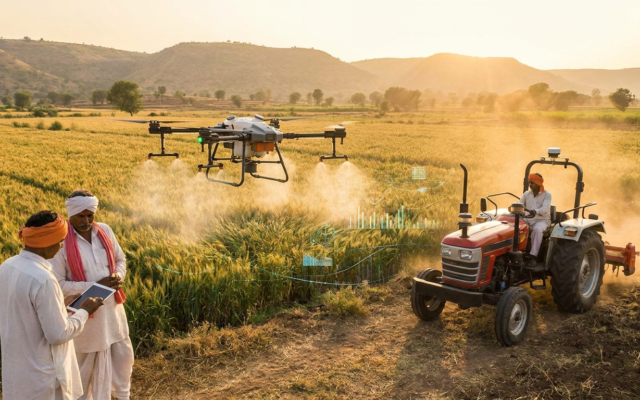
The rapid integration of generative AI across India’s industrial sectors is no longer a futuristic concept but a daily reality for millions. From rural farming cooperatives to the high-rise offices of Bengaluru, these tools are fundamentally shifting how we build, trade, and communicate in 2026.
Key Takeaways
- Generative AI is moving beyond simple chatbots to handle complex, domain-specific tasks in agriculture and regional language support.
- Indian startups are leveraging large language models to bridge the literacy and digital access gap for millions of citizens.
- Regulatory frameworks are evolving, with the Ministry of Electronics and Information Technology providing new guidelines for ethical AI deployment.
- Adopting these tools requires a shift from viewing AI as a toy to seeing it as a critical infrastructure component for business scale.
Revolutionizing Vernacular Communication
The most profound impact of generative AI in India is the breakdown of language barriers. For a country with 22 scheduled languages, the “English-first” internet has long been a hurdle for rural growth. Companies are now deploying Large Language Models (LLMs) tuned specifically for Hindi, Tamil, Telugu, and Bengali to provide seamless customer service and governance updates.
This is not just translation; it is localization. AI models now understand the cultural nuances and colloquialisms that standard translation software often mangled in the past. By enabling small business owners in markets like Lucknow or Coimbatore to interact with government portals or supply chain software in their native tongue, we are seeing a surge in digital participation.
Did you know that India’s Bhashini project, which utilizes AI to offer real-time speech-to-speech translation, is now serving millions of users across the country to democratize internet access? This initiative ensures that a farmer in Haryana can query agricultural data in his own dialect without needing an intermediary. It is a quiet revolution that is reshaping the socioeconomic landscape of the nation.
AI-Driven Precision Agriculture
Agriculture remains the backbone of the Indian economy, and generative AI is currently being used to solve the “information asymmetry” problem. Historically, farmers relied on word-of-mouth or outdated weather reports. Today, generative models synthesize satellite imagery, soil sensor data, and local weather forecasts to provide hyper-local advice.
These AI tools generate specific action plans for individual plots of land. For instance, an AI agent can advise a farmer in Maharashtra whether to apply a specific pesticide based on current humidity levels and local crop disease patterns reported by other farmers in the district. This drastically reduces input costs while maximizing yields.
It is a surprising fact that despite the rapid growth of urban tech, India’s AI-driven agricultural startups are currently the fastest-growing sector in terms of venture capital investment volume as of late 2026. By turning complex data into simple, actionable voice prompts, these systems are effectively putting a dedicated, expert agronomist in every farmer’s pocket.
Healthcare Diagnostics at Scale
The Indian healthcare system has long struggled with a shortage of specialists in rural areas. Generative AI is filling this gap by assisting primary health centers in basic diagnostics. By processing patient symptoms and medical history against vast databases of clinical research, these tools help frontline health workers suggest initial treatments.
Beyond simple triage, AI is now being used to generate detailed medical reports from X-rays and MRI scans. While the final diagnosis is always verified by a doctor, the AI acts as a “second pair of eyes” that works 24/7. This reduces the time a patient in a tier-two city has to wait for a specialist’s opinion.
The National Health Authority has been proactive in integrating these digital health stacks to ensure that patient data remains secure while allowing AI models to learn from clinical outcomes. This ensures that the AI becomes smarter and more accurate with every passing month, ultimately saving lives through early intervention and more precise treatment pathways.
Financial Inclusion and Credit Scoring
Traditional banking often excludes those without formal credit histories, such as gig workers or street vendors. Generative AI is changing this by analyzing alternative data points—utility bill payments, transaction patterns, and even social media activity—to generate creditworthiness scores.
These AI models can “read” thousands of pages of a user’s bank statement to identify spending habits that indicate financial stability. For a small shopkeeper in Delhi, this means the difference between being rejected by a legacy bank and receiving a micro-loan to expand their inventory. The speed of these decisions is unprecedented.
The Reserve Bank of India continues to monitor these fintech advancements closely to ensure consumer protection and systemic stability. By automating the underwriting process, financial institutions are lowering the cost of lending, which makes banking services profitable even for the most underserved segments of the population.
Optimizing Supply Chains and Logistics
Managing the movement of goods in India is a complex feat involving congested ports, unpredictable traffic, and fragmented retail networks. Generative AI is currently optimizing routes for logistics companies by predicting traffic patterns and warehouse capacity.
Unlike static algorithms of the past, these generative models simulate millions of “what-if” scenarios every hour. If a truck breaks down on the Mumbai-Pune Expressway, the AI instantly generates a new distribution plan for the entire fleet, ensuring that delivery timelines remain intact. This efficiency is critical for India’s burgeoning e-commerce sector.
The true power of AI in India is not in replacing human ingenuity, but in amplifying the reach of our talent to solve problems that were previously deemed too complex or expensive to address.
Educational Personalization for Students
The Indian education system faces the challenge of teaching large classrooms where individual attention is nearly impossible. Generative AI is being deployed as a personalized tutor for students from primary school through professional training.
These tutors adjust the difficulty of the curriculum based on the student’s performance in real-time. If a student is struggling with a concept in geometry, the AI does not just give the answer; it generates a new set of practice problems and explains the theory in a different, more intuitive way.
| Sector | Primary AI Use Case | Key Benefit |
|---|---|---|
| Agriculture | Hyper-local crop advice | Increased yield and lower costs |
| Healthcare | Diagnostic assistance | Faster, accessible medical care |
| Finance | Alternative credit scoring | Better access to micro-loans |
| Education | Adaptive tutoring | Individualized learning paths |
Frequently Asked Questions
Is my personal data safe when using AI in India?
Data privacy in India is governed by the Digital Personal Data Protection Act. Companies deploying AI are legally required to obtain informed consent and ensure that personal information is processed securely, with the government providing oversight through established regulatory bodies.
Can generative AI replace human workers in the Indian job market?
Most experts argue that AI is a tool for augmentation rather than total replacement. While it automates repetitive tasks, it creates a need for new roles focused on AI maintenance, data ethics, and high-level strategy, shifting the workforce toward higher-value activities.
Are these AI tools expensive to implement for small businesses?
Many generative AI solutions are now available via API or as part of existing SaaS platforms, making them highly affordable. You can often start using these tools with a pay-per-use model, which significantly lowers the barrier to entry for Indian startups and micro-enterprises.