Key Takeaways
- India’s 5G network is rapidly expanding, with widespread coverage now a reality in many Tier 1 and Tier 2 cities by mid-2026.
- This isn’t just about faster downloads; expect tangible improvements in smart city infrastructure, from traffic management to public safety.
- New service possibilities are emerging, offering enhanced experiences for entertainment, healthcare, and remote work.
- Understanding the nuances of 5G’s impact is crucial for individuals and businesses to leverage its full potential.
The Dawn of the Hyper-Connected City: 5G’s Transformative Reach in 2026
By mid-2026, the 5G revolution is no longer a distant promise; it’s a tangible reality reshaping urban landscapes across India. We’re witnessing an unprecedented acceleration in 5G network deployment, moving beyond initial metropolitan hubs to blanket many Tier 1 and Tier 2 cities with robust, high-speed connectivity. This isn’t merely an upgrade to your mobile data plan; it’s the foundational technology for a truly smart city, promising to redefine how we live, work, and interact with our surroundings.
The sheer scale of this rollout, driven by aggressive investment from telecom giants like Reliance Jio, Airtel, and Vodafone Idea, means that by the end of 2026, a significant portion of urban India will experience the full spectrum of 5G’s capabilities. From seamless streaming of 8K content to the real-time operation of complex city systems, the implications are profound. We are entering an era where the digital and physical worlds are inextricably linked, creating a more efficient, responsive, and intelligent urban environment for all.
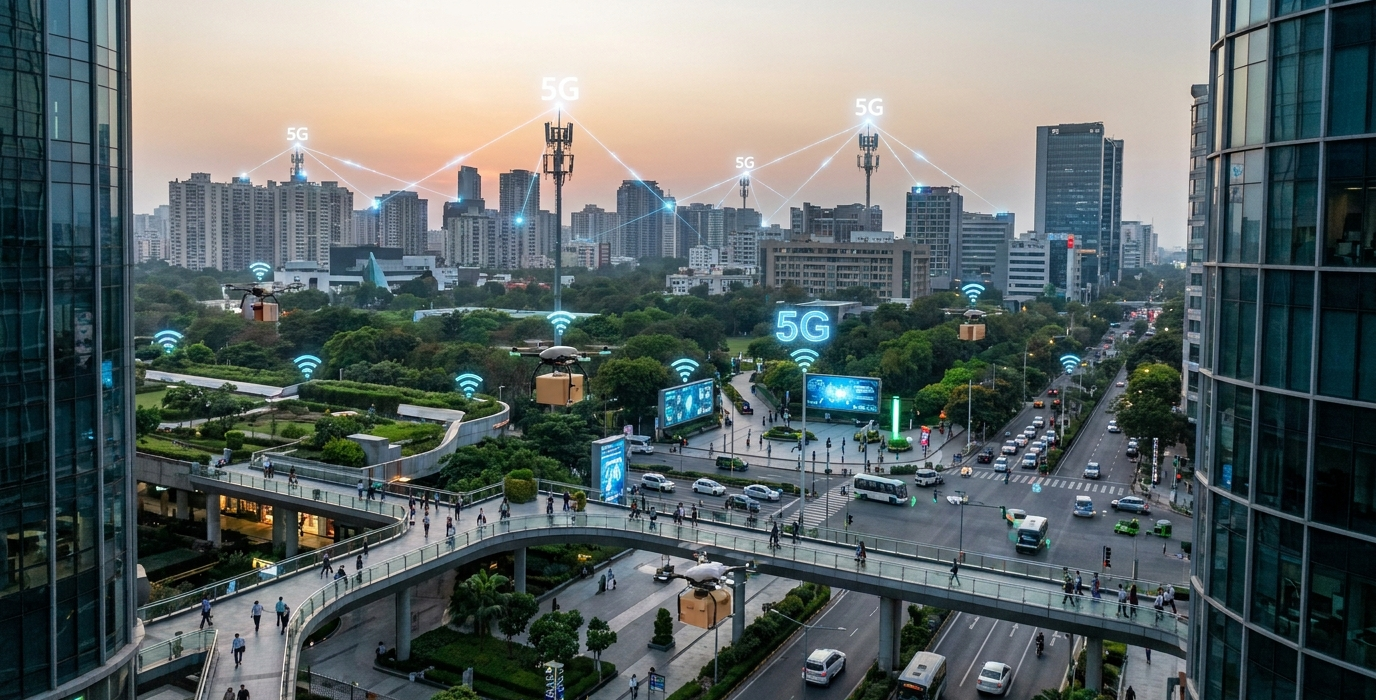
The benefits extend far beyond personal convenience. Imagine traffic lights that dynamically adjust to real-time traffic flow, dramatically reducing congestion. Think about emergency services that can pinpoint locations with centimetre-level accuracy, enabling faster response times. This is the tangible impact of 5G – it’s about building a smarter, safer, and more sustainable future for our cities, starting right now.
Smarter Streets: Revolutionizing Urban Mobility and Infrastructure
One of the most immediate and impactful applications of the widespread 5G rollout in 2026 is the transformation of urban mobility and infrastructure. Gone are the days of static traffic signals and inefficient public transport schedules. 5G’s ultra-low latency and high bandwidth are enabling the deployment of advanced Intelligent Transportation Systems (ITS) that promise to make our commutes smoother and safer.
Traffic management is at the forefront of this revolution. Connected traffic lights, powered by real-time data from sensors and vehicles, can now dynamically adjust their timings based on actual traffic density. This means less time stuck at red lights and more efficient flow through intersections, particularly in bustling metropolises like Mumbai and Delhi. Furthermore, Vehicle-to-Everything (V2X) communication is becoming a reality, allowing vehicles to communicate with each other and with surrounding infrastructure, enhancing safety by warning drivers of potential hazards like sudden braking or pedestrians crossing.
Public transport is also set to receive a significant upgrade. Real-time tracking of buses and trains, offering precise arrival times to passengers via mobile apps, is becoming standard. We’re also seeing the early stages of predictive maintenance for public transport fleets, where sensors transmit data on vehicle health, allowing for proactive repairs before breakdowns occur. This not only improves reliability but also reduces operational costs for transit authorities. The city of Bengaluru, known for its tech-savvy populace, is a prime example, actively piloting these advanced ITS solutions, which are poised for wider adoption across India by the end of 2026.
Beyond Traffic: Enhancing Public Services and Safety
The impact of 5G on urban infrastructure extends well beyond traffic management. Public safety is another critical area witnessing significant advancements. High-definition CCTV cameras, powered by 5G, can now transmit crystal-clear video feeds in real-time, enabling enhanced surveillance and quicker response to incidents. AI-powered analytics can process these feeds to detect anomalies, identify potential threats, and alert authorities instantly.
Emergency services are also benefiting immensely. With 5G, first responders can access real-time data streams, including live video from the scene, patient vital signs transmitted from ambulances, and detailed building schematics. This critical information allows for better-informed decision-making even before they arrive, significantly improving outcomes in critical situations. Imagine a scenario where firefighters can see inside a burning building through drone feeds transmitted over 5G, guiding their entry and rescue efforts more effectively. This level of real-time situational awareness is a game-changer.
Furthermore, smart waste management systems are being implemented in cities like Pune, utilizing sensors that monitor fill levels in bins. These sensors transmit data over 5G networks, allowing for optimized collection routes, reducing unnecessary trips and associated fuel consumption and emissions. It’s a small change with a significant cumulative impact on urban efficiency and environmental sustainability. The integration of these diverse smart city solutions paints a picture of an urban future that is more responsive, secure, and resource-efficient.
The 5G Entertainment & Work Revolution: Immersive Experiences and Remote Capabilities
For the average Indian consumer, the most immediately noticeable impact of the 5G rollout in 2026 will likely be in entertainment and how we approach work. The days of buffering and slow download speeds are rapidly becoming a relic of the past. 5G’s capacity to handle massive data streams simultaneously opens up a world of immersive entertainment experiences and significantly enhances remote work capabilities.
Streaming services are delivering content in higher resolutions than ever before. We’re talking about seamless 4K and even 8K video streaming on mobile devices, making your commute or a lazy afternoon at home a visually stunning experience. Cloud gaming, which was once a niche offering, is now becoming mainstream. With 5G, you can play high-end video games on your smartphone or tablet without needing powerful hardware, as the processing is done remotely and streamed directly to your device with minimal lag. This is transforming gaming from a dedicated console experience to something you can enjoy anywhere, anytime.
The implications for remote work are equally significant. High-definition video conferencing with multiple participants is now perfectly smooth, making virtual meetings feel almost as engaging as in-person ones. Large file transfers, crucial for many creative and technical professions, are now completed in seconds rather than minutes or hours. This enhanced connectivity is empowering individuals to work effectively from anywhere, reducing the need for daily commutes and fostering a more flexible work culture. Cities like Hyderabad, a major IT hub, are already seeing businesses leverage these capabilities to offer hybrid work models with greater efficiency and productivity.
Augmented and Virtual Realities Take Center Stage
Perhaps the most exciting frontier opened by 5G is the widespread adoption of Augmented Reality (AR) and Virtual Reality (VR). These technologies, once confined to specialized applications and enthusiast groups, are now poised for mainstream integration into our daily lives. The high bandwidth and low latency of 5G are the essential enablers for these data-intensive, real-time experiences.
Imagine walking through a historical monument in Hampi and, using your smartphone or AR glasses, seeing a live, interactive reconstruction of its past glory overlaid onto the ruins. Or consider retail experiences where you can virtually ‘try on’ clothes or see how furniture would look in your home before you buy it. Educational institutions are exploring AR for interactive learning modules, bringing complex scientific concepts to life in the classroom or at home.
VR, too, is moving beyond gaming. Immersive training simulations for professionals in fields like surgery or aviation are becoming more realistic and accessible. Virtual tourism allows you to explore distant lands from your living room, offering a level of detail and immersion previously impossible. The rapid expansion of 5G networks across India is creating the necessary infrastructure for these transformative AR and VR applications to flourish, offering entirely new ways to learn, shop, and experience the world.
Healthcare and Education: Bridging Gaps with 5G Innovation
The impact of the 2026 5G rollout is not limited to entertainment and urban infrastructure; it’s also poised to revolutionize critical sectors like healthcare and education, particularly in bridging the divide between urban centres and remote regions. These advancements promise to democratize access to high-quality services and opportunities for millions.
In healthcare, 5G is enabling the expansion of telemedicine to an unprecedented degree. Remote consultations with specialists are now not just feasible but highly effective, allowing patients in smaller towns and villages to receive expert medical advice without the need for arduous travel. High-definition video conferencing, coupled with the ability to transmit large medical imaging files like X-rays and MRIs quickly, means that doctors can diagnose and monitor patients with greater accuracy, regardless of geographical distance. We are also seeing the early deployment of remote patient monitoring systems, where wearable devices transmit real-time health data to healthcare providers, enabling proactive interventions and better management of chronic conditions.
The potential for remote surgeries, while still in its nascent stages, is a significant long-term prospect made possible by 5G’s ultra-low latency. This could allow a skilled surgeon in a metropolitan hospital to perform complex procedures on a patient in a remote location, guided by robotic arms controlled in real-time. While regulatory and ethical considerations are being addressed, the technological foundation is being laid now.
Transforming Learning: From Classrooms to Homes
Education is another sector set to benefit profoundly. 5G is facilitating the widespread adoption of e-learning platforms with rich multimedia content. Interactive virtual classrooms, where students and teachers can engage in real-time discussions and collaborative projects, are becoming more common. This is especially beneficial for students in areas with limited access to qualified teachers or specialized educational resources.
The use of AR and VR in education, as mentioned earlier, is particularly transformative. Imagine students in a rural school in Kerala being able to virtually dissect a frog or explore the human circulatory system in 3D, experiences that were once only available in well-equipped urban laboratories. This enhanced engagement and accessibility can significantly improve learning outcomes and inspire a new generation of curious minds. The integration of these technologies is making learning more dynamic, personalized, and accessible than ever before.
The Economic Ripple Effect: New Opportunities and Challenges
The widespread deployment of 5G across India in 2026 is not just a technological leap; it’s a significant economic catalyst. The enhanced connectivity and new service possibilities it unlocks are creating a fertile ground for innovation, entrepreneurship, and job creation. Businesses of all sizes are finding new avenues for growth and efficiency, while consumers are gaining access to a new ecosystem of services.
For businesses, the benefits are manifold. Enhanced operational efficiency through IoT devices and real-time data analytics is a major draw. Factories can implement predictive maintenance for machinery, reducing downtime and improving productivity. Supply chains are becoming more transparent and efficient, with real-time tracking of goods and inventory. Small and medium-sized enterprises (SMEs) in cities like Ahmedabad, historically reliant on cost-effective solutions, are finding that 5G-enabled cloud services and enhanced communication tools are leveling the playing field, allowing them to compete more effectively with larger corporations.
The emergence of new business models is a direct consequence of 5G’s capabilities. We’re seeing a surge in companies developing applications for smart cities, autonomous vehicles, and the metaverse. The demand for skilled professionals in areas like network engineering, data science, cybersecurity, and AR/VR development is skyrocketing. This creates significant employment opportunities, driving economic growth and fostering a more technologically advanced workforce. However, this rapid transformation also presents challenges, particularly concerning the digital divide and the need for reskilling and upskilling the existing workforce to adapt to these new demands.
Bridging the Digital Divide: Ensuring Inclusivity
While the benefits of 5G are immense, it’s crucial to address the potential for an exacerbation of the digital divide. The initial rollout often concentrates in urban areas, leaving rural and remote communities behind. Initiatives by the government and telecom operators are focusing on expanding coverage to these underserved regions, but it’s a complex and ongoing challenge. Ensuring affordable access to 5G-enabled devices and data plans is paramount to making these advancements truly inclusive.
Furthermore, the skills gap is a significant hurdle. As the economy shifts towards more technology-dependent roles, there’s a pressing need for robust skilling and reskilling programs. Educational institutions and industry bodies are collaborating to develop curricula that prepare individuals for the jobs of the future. The government’s ‘Digital India’ mission is increasingly focused on these aspects, aiming to equip citizens with the digital literacy and technical expertise needed to thrive in a 5G-powered world. The success of the 5G rollout hinges not just on infrastructure, but on empowering every citizen to participate in this digital transformation.
“The 5G rollout is not just about faster speeds; it’s about building a more responsive, efficient, and interconnected society. The true value lies in how we leverage this technology to solve real-world problems and enhance the quality of life for all citizens.”
Frequently Asked Questions
Will 5G be available everywhere in India by the end of 2026?
By the end of 2026, 5G coverage is expected to be widespread across most Tier 1 and Tier 2 cities, with significant progress in expanding to Tier 3 cities and some rural areas. However, complete pan-India coverage, especially in very remote locations, will likely take longer. You should check with your specific telecom provider for coverage maps in your locality.
What are the biggest immediate benefits of 5G for an average user?
For the average user, the most immediate benefits are significantly faster download and upload speeds, enabling seamless streaming of high-definition video (4K/8K), improved cloud gaming experiences with minimal lag, and faster downloads of large files. Video conferencing and online collaboration will also become much smoother.
Are 5G-enabled smartphones necessary to experience 5G?
Yes, you absolutely need a 5G-compatible smartphone or device to connect to a 5G network and experience its benefits. Older 4G-only devices will not be able to access 5G signals, even if the network is available in your area.
What are the security implications of increased 5G connectivity?
With more devices and systems connected, the potential attack surface for cyber threats increases. However, 5G networks are designed with enhanced security features, including better encryption and network segmentation. It remains crucial for users and organizations to practice good cyber hygiene, keep software updated, and be aware of phishing and other online threats.