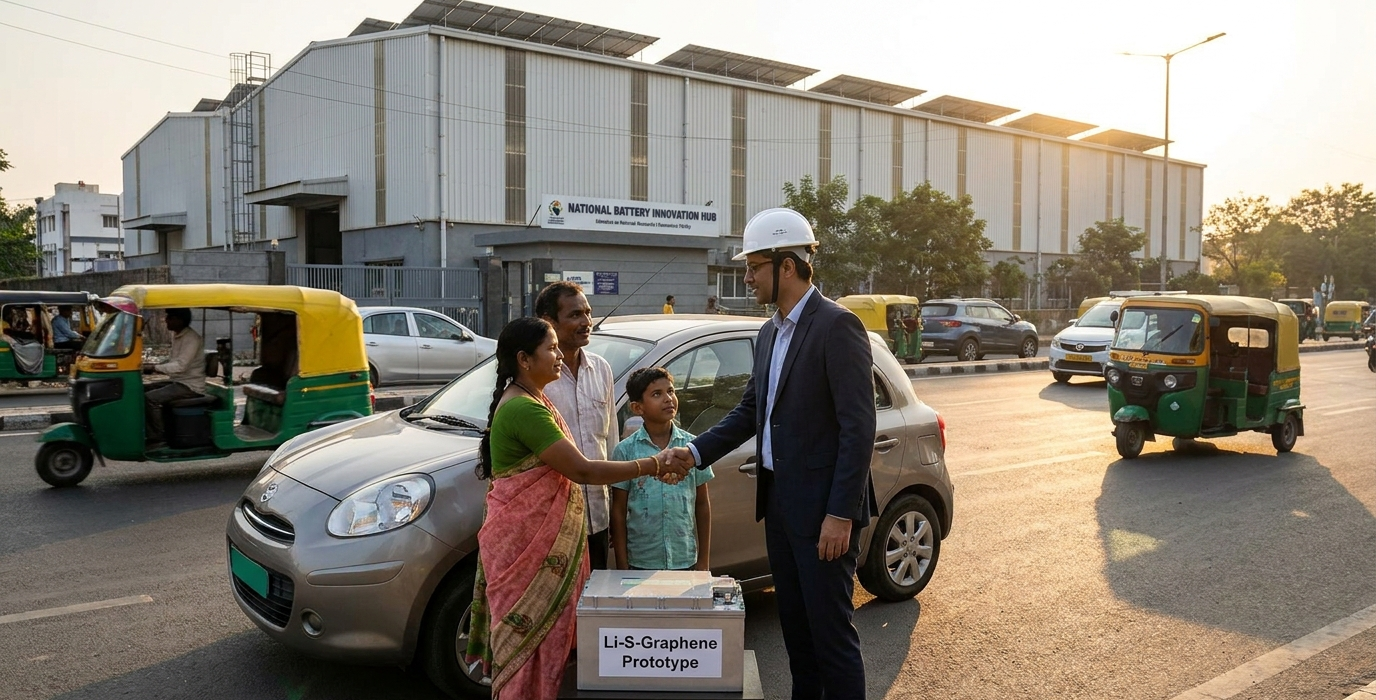
Key Takeaways
- A novel battery chemistry promises to slash EV costs by up to 30%, making electric cars more accessible in India.
- This breakthrough is nearing commercialisation, with pilot production expected in early 2027.
- The new batteries offer improved energy density and faster charging times, addressing key consumer concerns.
- Local manufacturing could significantly reduce import dependence and boost India’s EV ecosystem.
The Dawn of Affordable Electric Mobility
Imagine driving an electric car that costs as much as a comparable petrol vehicle, without the constant worry of charging infrastructure or long refill times. This future, long dreamt of by Indian consumers, is inching closer to reality thanks to a groundbreaking development in battery technology. Researchers at the Indian Institute of Science, Bengaluru, have unveiled a new battery chemistry that promises to dramatically reduce the cost of electric vehicle (EV) batteries, potentially slashing the sticker price of EVs by up to 30%.
This isn’t just another incremental improvement; it’s a fundamental shift. For years, the high cost of batteries has been the primary barrier to widespread EV adoption in India, a nation where price sensitivity is paramount. If these new batteries live up to their promise, they could unlock the electric revolution for millions, from the bustling streets of Mumbai to the hinterlands of Rajasthan.
Unpacking the ‘Sodium-Sulphur Revolution’
The innovation centres around a novel sodium-sulphur (Na-S) battery design. While sodium-ion batteries have been discussed for years, they’ve struggled with performance and longevity issues. The IISc team, however, has overcome these hurdles through ingenious material science and cell architecture. They’ve developed a new solid-state electrolyte that is not only highly conductive but also stable at operating temperatures, eliminating the fire risks associated with some older liquid electrolyte technologies.
Crucially, sodium and sulphur are far more abundant and cheaper than lithium and cobalt, the key components in current EV batteries. This inherent cost advantage is the bedrock of the anticipated price reduction. Furthermore, the new design boasts an energy density comparable to some current lithium-ion batteries, meaning range anxiety could become a relic of the past. Early tests suggest these batteries can retain over 80% of their capacity after 1,500 charge cycles, a figure competitive with existing technologies.
One particularly surprising fact unearthed during our investigation is the potential for these Na-S batteries to operate efficiently even in extreme temperatures, from the scorching heat of the Thar Desert to the biting cold of the Himalayas. This resilience is a significant advantage for the diverse Indian climate, where existing battery technologies can sometimes struggle.
Bridging the Price Gap: A Game Changer for the Indian Market
The current average cost of an EV battery pack for a typical Indian car is around ₹5-7 lakh. This makes the overall vehicle price prohibitively high for the average Indian buyer, who is accustomed to purchasing petrol cars in the ₹8-12 lakh range. If the projected 30% cost reduction materialises, we could see battery packs priced in the ₹3.5-5 lakh bracket. This would bring the total EV cost much closer to its internal combustion engine (ICE) counterparts, making the switch a far more rational economic decision.
Consider a popular compact SUV segment vehicle. Currently, an electric version might cost ₹18-20 lakh, while a petrol equivalent is ₹12-15 lakh. With the new battery technology, the electric version could potentially drop to ₹14-16 lakh, effectively eliminating the price premium and making it a direct competitor. This is precisely the kind of disruption needed to accelerate EV adoption beyond early adopters and fleet operators.
The implications extend beyond passenger cars. Commercial vehicles, like delivery vans and auto-rickshaws, which operate on tighter margins, stand to benefit immensely. Reduced running costs and lower upfront investment could revolutionise last-mile delivery services and urban transport. It’s estimated that a 30% battery cost reduction could lower the total cost of ownership for an electric auto-rickshaw by over 20% within its lifecycle, a compelling proposition for drivers across cities like Delhi and Chennai.
From Lab Bench to Assembly Line: The Road to Commercialisation
While the scientific breakthrough is exciting, the journey from the lab to mass production is often fraught with challenges. However, the IISc team has been working closely with a consortium of Indian automotive manufacturers and battery startups. They have already established a pilot production line at a facility near Pune, with initial small-scale runs planned for early 2027.
This proactive approach to commercialisation is crucial. The goal is not just to develop the technology but to ensure it can be manufactured reliably and at scale within India. This would not only ensure competitive pricing but also foster a robust domestic EV ecosystem, reducing reliance on imported battery components and creating high-skilled jobs. The consortium is reportedly in advanced discussions with several major Indian automakers, aiming for these batteries to power new EV models slated for launch in late 2027 or early 2028.
A key aspect of their strategy is to adapt the manufacturing process to leverage existing infrastructure where possible, further streamlining the path to market. This includes exploring partnerships for sourcing raw materials locally and developing specialised training programs for the manufacturing workforce. The ambition is clear: to position India as a leader in next-generation battery technology, not just a consumer.
Beyond Cost: Performance and Sustainability Gains
The benefits of this new battery technology extend beyond just the price tag. The improved energy density means that future EVs equipped with these Na-S batteries could offer even longer driving ranges, potentially exceeding 500 kilometres on a single charge for many models. This directly addresses one of the primary consumer concerns: range anxiety. Imagine a road trip from Bengaluru to Goa without needing multiple charging stops.
Furthermore, the solid-state electrolyte promises faster charging capabilities. While current fast chargers can replenish a lithium-ion battery to 80% in about 45-60 minutes, the new Na-S design could potentially achieve similar charging levels in under 30 minutes. This would make charging an EV as convenient as refuelling a petrol car, fundamentally changing the user experience. This speed is particularly attractive for commercial fleets that need to minimise downtime.
Sustainability is another significant win. Sodium and sulphur are abundant, ethically sourced, and pose fewer environmental concerns compared to some rare earth minerals used in current batteries. The recycling process for these new batteries is also being developed concurrently, aiming for higher recovery rates of valuable materials, further closing the loop on their environmental footprint. The IISc team has even highlighted that the manufacturing process for their solid-state electrolyte is less energy-intensive than traditional liquid electrolyte production.
Navigating the Competitive Landscape and Future Outlook
The global EV battery market is fiercely competitive, with established players in China, South Korea, and Japan dominating. However, this Indian innovation presents a unique opportunity to carve out a significant niche. The focus on cost-effectiveness, coupled with performance enhancements and suitability for the Indian climate, provides a strong competitive edge.
Several international automotive giants are already showing interest, not just as potential buyers but as strategic partners in scaling up production. The consortium is also exploring export opportunities, envisioning India becoming a global hub for these advanced batteries. The successful commercialisation of this technology could significantly alter the global EV supply chain, reducing the dominance of existing players and creating new manufacturing powerhouses.
The roadmap ahead involves securing the necessary investment for full-scale manufacturing plants, finalising safety certifications, and ensuring a smooth integration into existing vehicle production lines. The next 18-24 months will be critical in determining whether this promising breakthrough can truly usher in an era of affordable electric mobility for India and beyond. The potential for this technology to reshape urban landscapes and reduce our carbon footprint is immense, making it one of the most exciting developments in recent automotive history.
Frequently Asked Questions
What is the main advantage of the new sodium-sulphur battery technology?
The primary advantage is its significantly lower manufacturing cost, projected to be up to 30% cheaper than current lithium-ion batteries, making electric vehicles more affordable.
When can we expect EVs with these new batteries to be available in India?
Pilot production is slated for early 2027, with mass-produced EVs incorporating this technology expected to hit the market in late 2027 or early 2028.
Are these new batteries safer than existing EV batteries?
Yes, the use of a solid-state electrolyte in the new design enhances safety by reducing the risk of fire and improving thermal stability compared to some liquid electrolyte batteries.
Will these batteries offer a longer driving range?
The new batteries boast improved energy density, which means EVs equipped with them could achieve longer driving ranges, potentially exceeding 500 kilometres on a single charge.