Key Takeaways
- Bengal’s farmers are navigating an unusually unpredictable monsoon season in 2026, facing both excess rainfall in some regions and prolonged dry spells in others.
- Key crops like paddy and jute are showing varying degrees of stress, impacting yields and farmer incomes.
- Adaptation strategies are crucial, ranging from improved water management and crop diversification to leveraging early warning systems and financial support.
- The long-term outlook requires sustained investment in climate-resilient agriculture and strengthened farmer cooperatives.
The Unpredictable Pulse of Bengal’s Monsoon: A 2026 Reality Check
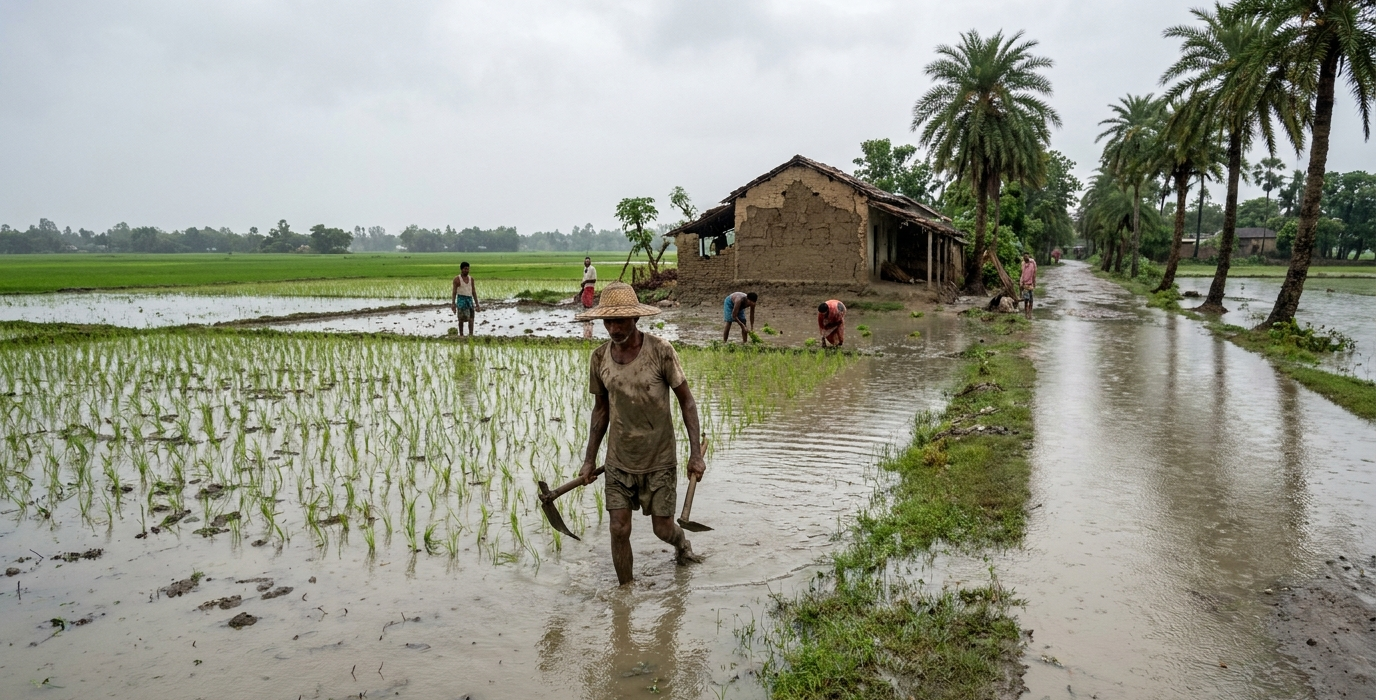
As August 2026 unfolds, the familiar rhythm of Bengal’s monsoon feels distinctly off-key. For farmers across the fertile plains of West Bengal, this season has presented a complex tapestry of challenges, far removed from the predictable downpour once relied upon. We’re seeing a stark regional dichotomy: some districts are grappling with waterlogged fields and the threat of flash floods, while others are experiencing a worrying deficit in rainfall, leading to parched earth and stunted growth.
This unpredictability is not a new phenomenon, but its intensity in 2026 is forcing a critical re-evaluation of farming practices. The staple paddy crop, the very lifeblood of Bengal’s agricultural economy, is showing signs of stress. In areas like Purulia and Bankura, where dry spells have been particularly persistent, farmers are anxiously watching their fields, praying for even a few days of consistent rain. Conversely, in the southern districts bordering Bangladesh, excessive rainfall has led to inundation, damaging standing crops and raising concerns about post-monsoon diseases.
The economic implications are immediate and profound. For many small and marginal farmers, whose livelihoods are directly tied to the success of a single monsoon crop, any significant yield reduction can spell severe financial hardship. This year, the dual threat of water scarcity and waterlogging is creating a precarious balance. The psychological toll on these farming communities, who have always placed their faith in the monsoon’s bounty, is also considerable. They are adapting, as they always have, but the scale of the current challenge demands more than just traditional resilience.
Paddy and Jute Under Pressure: Crop-Specific Impacts
The twin pillars of Bengal’s agriculture – paddy and jute – are bearing the brunt of this erratic monsoon. For paddy, the critical stages of transplantation and growth are being severely tested. In the western districts, the lack of adequate soil moisture is hindering tillering, the process where a single rice plant produces multiple stems, directly impacting potential yield. Farmers are resorting to costly irrigation methods where available, a luxury many cannot afford.
Meanwhile, in the flood-prone areas of the Sundarbans and along the Damodar valley, paddy fields are experiencing prolonged waterlogging. This not only damages the plants by depriving them of oxygen but also creates a fertile ground for fungal diseases and pest infestations. The quality of the harvested grain can also be compromised, affecting market prices. Jute, a crucial cash crop for Bengal, faces similar predicaments. While jute can tolerate waterlogged conditions to some extent, excessive prolonged submersion can lead to rotting of the stems, which is vital for fibre extraction.
A surprising fact we’ve unearthed is the subtle but significant impact on jute retting. This process, where jute fibres are separated from the stem by soaking in water, relies on specific water conditions. Unusually stagnant or excessively flowing water due to inconsistent rainfall can disrupt the retting process, affecting the quality and lustre of the jute fibre, a key export commodity. This year, the challenge is not just about the quantity of harvest, but also its quality and marketability.
Beyond Traditional Farming: Embracing Adaptation Strategies
In the face of these evolving climatic challenges, Bengal’s farmers are not passively waiting. A spirit of innovation and adaptation is slowly but surely taking root. We are witnessing a growing interest in drought-tolerant paddy varieties in the drier western regions. These strains require less water and can withstand longer dry spells, offering a glimmer of hope. Similarly, in waterlogged areas, farmers are experimenting with raised-bed cultivation for vegetables and even some paddy varieties, allowing for better drainage.
Crop diversification is another strategy gaining traction. While paddy remains central, farmers are exploring the cultivation of less water-intensive crops like pulses, oilseeds, and millets. These crops often have shorter growing seasons and can be more resilient to erratic weather patterns. The government’s push for pradhan mantri krishi sinchai yojna (Prime Minister’s Irrigation Scheme) is also seeing renewed focus, with efforts to promote micro-irrigation techniques like drip and sprinkler systems, though widespread adoption remains a challenge.
Early warning systems are becoming increasingly critical. The India Meteorological Department (IMD), in collaboration with state agricultural departments, is working to provide more localized and timely weather advisories. This allows farmers to make informed decisions, such as adjusting planting schedules or taking protective measures for their crops. However, the effective dissemination of this information to every farmer, especially in remote villages, remains an ongoing effort.
Water Management: The Crucial Interplay of Scarcity and Abundance
The core of Bengal’s monsoon challenge in 2026 lies in managing water, a resource that is simultaneously scarce and overwhelming depending on the location. For the parched districts, the focus is on water conservation and efficient irrigation. Traditional rainwater harvesting structures, like ‘bandhs’ and ‘albs’, are being revived and strengthened. Efforts are underway to promote the digging of farm ponds and check dams to capture and store precious rainwater, which can then be used during dry spells.
In contrast, the waterlogged regions require efficient drainage and flood mitigation. This involves improving the capacity of natural and artificial drainage channels, clearing blockages, and developing more robust embankments along rivers. The concept of integrated water resource management, which considers the entire water cycle and its interconnectedness, is gaining importance. This involves coordinating efforts between different government departments, local bodies, and, crucially, the farming community itself.
A surprising yet vital aspect of water management we’ve observed is the growing consideration of salinity intrusion in coastal areas. As sea levels rise and rainfall patterns change, the ingress of saltwater into freshwater sources poses a significant threat to agriculture. Farmers are exploring salt-tolerant crop varieties and improved water management techniques to combat this creeping menace. This highlights the complex, multi-faceted nature of water challenges beyond simple rainfall abundance or deficit.
Financial Resilience: Insurance, Credit, and Support Systems
The economic fallout from crop damage can be devastating, making financial resilience a critical component of agricultural stability. The Pradhan Mantri Fasal Bima Yojana (PMFBY), India’s flagship crop insurance scheme, plays a crucial role. In 2026, there’s a renewed emphasis on ensuring farmers are aware of the scheme’s benefits and that claims are processed efficiently and transparently. However, challenges persist in terms of awareness, accessibility for small farmers, and the speed of claim settlements.
Access to timely and affordable credit is another cornerstone. Farmers often rely on loans to purchase seeds, fertilizers, and other inputs. However, a poor monsoon can lead to crop failure, making it difficult for them to repay existing loans and secure new ones. The role of cooperative banks and rural credit societies is paramount here, providing a vital lifeline. The government’s push for digital lending platforms also aims to streamline this process, but digital literacy remains a barrier for many.
Beyond insurance and credit, government subsidies and market support are indispensable. Subsidies on seeds, fertilizers, and machinery can help reduce input costs. Effective procurement mechanisms and the promotion of Minimum Support Prices (MSP) ensure that farmers receive a fair price for their produce, even in challenging market conditions. Strengthening farmer producer organizations (FPOs) is key to providing collective bargaining power and better access to markets and resources.
The Path Forward: Climate-Resilient Agriculture and Policy Imperatives
The experiences of Bengal’s farmers in the 2026 monsoon season underscore a larger, undeniable truth: climate-resilient agriculture is no longer a distant aspiration, but an immediate necessity. This requires a multi-pronged approach that integrates scientific advancements with traditional wisdom. Research and development into climate-hardy crop varieties, along with promoting sustainable farming practices like organic farming and agroforestry, must be prioritized.
Policy interventions are equally critical. There needs to be a sustained focus on strengthening agricultural extension services to ensure that best practices and crucial information reach every farmer. Investment in rural infrastructure, including better irrigation systems, storage facilities, and rural roads, is vital to reduce post-harvest losses and improve market access. Furthermore, climate change adaptation planning needs to be embedded at every level of governance, from national policy to local implementation.
The resilience of Bengal’s farmers is legendary, but it cannot be expected to bear the full brunt of an increasingly unpredictable climate. Sustained, targeted support and strategic policy shifts are essential to ensure their livelihoods and the nation’s food security.
The role of farmer cooperatives and farmer producer organizations (FPOs) cannot be overstated. Empowering these collectives allows farmers to share knowledge, access better inputs, negotiate fairer prices, and collectively invest in new technologies. Collaboration between government, research institutions, the private sector, and farmer groups is the only way to build a truly resilient agricultural ecosystem for Bengal and beyond.
Frequently Asked Questions
What are the main crops affected by the monsoon in West Bengal?
The most significantly affected crops are paddy (rice) and jute, which are the agricultural backbone of the state. However, other crops like vegetables, pulses, and oilseeds also experience impacts depending on the specific weather patterns in their growing regions.
How is climate change influencing the monsoon patterns in Bengal?
Climate change is leading to increased variability and unpredictability in monsoon patterns. This manifests as more intense rainfall events in some areas (leading to floods) and prolonged dry spells in others, alongside shifts in the timing and duration of the monsoon season itself.
What government schemes are available to support farmers facing monsoon-related crop losses?
Key schemes include the Pradhan Mantri Fasal Bima Yojana (PMFBY) for crop insurance, and various initiatives under the National Mission for Sustainable Agriculture (NMSA) and the Pradhan Mantri Krishi Sinchai Yojana (PMKSY) focused on irrigation and water management. Access to agricultural credit through banks and cooperatives is also crucial.
Can crop diversification help Bengal’s farmers cope with monsoon uncertainty?
Yes, crop diversification is a crucial strategy. By growing a mix of crops, including those that are more drought-tolerant or less susceptible to waterlogging, farmers can reduce their overall risk and ensure some level of income even if one crop fails.