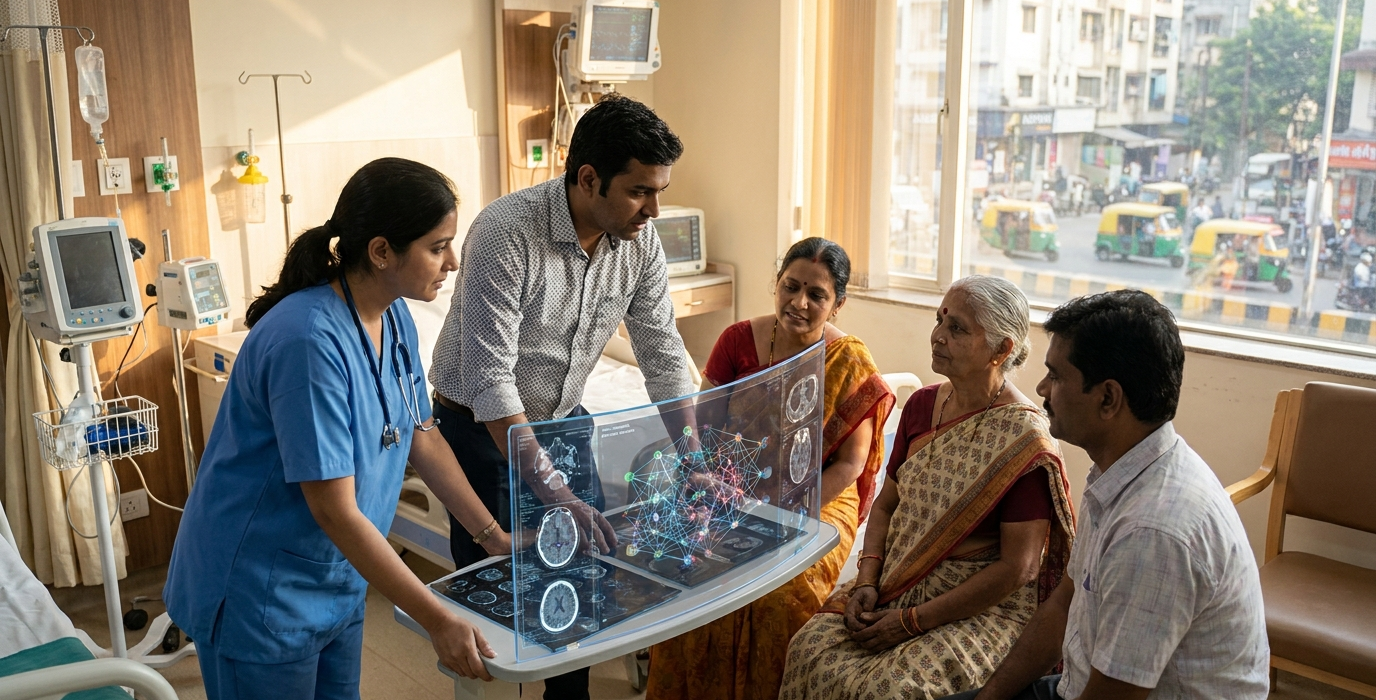
Key Takeaways
- AI-powered diagnostic tools are now identifying diseases like diabetic retinopathy and certain cancers with accuracy matching or exceeding human experts in Indian clinical settings.
- The integration of AI is reducing diagnostic turnaround times, allowing for earlier treatment and potentially saving lives, especially in remote areas where specialist access is limited.
- Expect a surge in AI-driven personalized treatment plans, leveraging patient data to predict drug efficacy and tailor therapies for better outcomes.
- While promising, data privacy, ethical considerations, and the need for robust regulatory frameworks remain critical areas for ongoing focus as AI adoption accelerates.
The Dawn of AI-Assisted Diagnosis: Accuracy You Can Trust
The hum of servers is increasingly becoming a familiar sound in Indian hospitals, not just for administrative tasks, but for life-saving diagnoses. Today, artificial intelligence isn’t a futuristic concept; it’s a present-day reality actively revolutionizing how we detect diseases. We’re seeing AI algorithms, trained on vast datasets of medical images and patient records, now capable of spotting subtle anomalies that even the most experienced human eye might miss. This is particularly impactful in fields like radiology and ophthalmology, where early detection is paramount.
Consider diabetic retinopathy, a leading cause of blindness that affects millions in India. AI systems are now being deployed in primary healthcare centers, even in tier-2 and tier-3 cities, to screen for this condition. These systems can analyze retinal fundus images with remarkable speed and accuracy, identifying early signs of damage long before a patient experiences vision loss. This proactive approach is crucial, as timely intervention can prevent irreversible blindness. Similarly, AI is making significant strides in detecting early-stage cancers from mammograms, CT scans, and even pathology slides, offering a crucial second opinion and speeding up the diagnostic pathway.
This isn’t about replacing our dedicated doctors and radiologists. Instead, it’s about empowering them with advanced tools that augment their capabilities. Think of it as a highly intelligent assistant, tirelessly sifting through data, flagging potential concerns, and allowing clinicians to focus their precious time on complex cases and direct patient interaction. The sheer volume of medical data generated daily is staggering, and AI provides the necessary processing power to make sense of it all efficiently and effectively. This shift promises a future where diagnostic accuracy is enhanced and patient outcomes are significantly improved.
Bridging the Gap: AI’s Role in Healthcare Accessibility
One of the most significant impacts of AI in India’s healthcare landscape is its ability to bridge the geographical and resource gaps that have long plagued accessibility. In a country as vast and diverse as India, reaching specialist medical care can be a formidable challenge for many, especially those living in remote villages or underserved rural areas. AI-powered diagnostic tools are changing this narrative by bringing sophisticated diagnostic capabilities closer to the patient, often directly to their local health center.
Imagine a scenario where a resident of a small village in Rajasthan doesn’t need to travel hundreds of kilometers to a major city for an eye screening. Instead, a trained technician at their local primary health clinic can capture a retinal image, which is then analyzed by an AI algorithm. The results, indicating potential diabetic retinopathy, are sent back almost instantaneously. This early warning system allows for timely referral to a nearby ophthalmologist, preventing the devastating progression to blindness. This democratization of diagnostics is a game-changer, ensuring that quality healthcare is not a privilege dictated by location.
Furthermore, AI can help alleviate the burden on overburdened medical professionals in these remote areas. By automating initial screening and flagging critical cases, AI frees up valuable time for doctors and nurses, allowing them to attend to more patients and provide more focused care. This intelligent triage system ensures that limited human resources are directed where they are most needed. The efficiency gained through AI means more patients can be screened and treated within shorter timeframes, significantly improving the overall public health infrastructure. This technological leap is not just about advanced algorithms; it’s about delivering equitable healthcare to every corner of India.
Personalized Medicine: Tailoring Treatments with AI Precision
The era of one-size-fits-all medicine is rapidly fading, thanks to the advent of AI-driven personalized treatment plans. Gone are the days when treatment protocols were based solely on broad patient demographics or generalised disease classifications. Today, AI algorithms are capable of analyzing an individual’s unique genetic makeup, lifestyle factors, medical history, and even real-time physiological data to predict the most effective treatment pathways. This level of personalization is a monumental leap forward in patient care.
Consider cancer treatment. AI can analyze a patient’s tumor genomics to identify specific mutations and then predict which chemotherapy drugs or targeted therapies are most likely to be effective, while minimizing adverse side effects. This precision oncology approach not only improves treatment efficacy but also enhances the patient’s quality of life by avoiding ineffective or toxic treatments. The ability to forecast a drug’s response based on individual biomarkers is a testament to AI’s analytical power.
Beyond cancer, AI is being used to optimize dosages for chronic conditions like diabetes and hypertension, taking into account a patient’s diet, activity levels, and co-existing health issues. This dynamic adjustment ensures that medications are fine-tuned for maximum benefit and minimal risk. The insights generated by AI can also guide preventative strategies, identifying individuals at higher risk for certain conditions and enabling early, personalized interventions. This proactive and tailored approach signifies a shift from reactive illness management to proactive health optimization, fundamentally changing how we approach well-being.
“AI is not a replacement for human empathy and clinical judgment, but rather an indispensable partner that amplifies our ability to deliver precise, personalized, and accessible care. Its true power lies in empowering clinicians and patients alike with insights that were previously unattainable.”
The AI Doctor’s Bag: Innovations Beyond Imaging
While AI’s impact on medical imaging has been profound and widely publicized, its reach extends far beyond the radiologist’s workstation. The AI revolution in healthcare is touching almost every facet of patient care, from drug discovery to mental health support and even surgical assistance. We’re witnessing the development of sophisticated AI tools that can accelerate the drug discovery pipeline, a process that has traditionally been notoriously long and expensive. By analyzing vast molecular databases and predicting drug interactions, AI can identify promising drug candidates much faster than traditional methods.
In the realm of mental health, AI-powered chatbots and virtual assistants are providing accessible and confidential support to individuals struggling with anxiety, depression, and other mental health challenges. These tools can offer coping strategies, track mood patterns, and even identify individuals who might require professional intervention, acting as a vital first line of support, especially where human therapists are scarce. This is a significant development for a country like India, where mental health awareness is growing but resources remain limited.
AI is also making waves in the operating room. Robotic-assisted surgery, guided by AI, offers enhanced precision, minimally invasive techniques, and faster recovery times for patients. AI algorithms can provide real-time feedback to surgeons, optimize instrument movements, and even predict potential complications during procedures. This synergy between human expertise and artificial intelligence is pushing the boundaries of surgical possibility. The integration of AI into the “doctor’s bag” is not just about adding new gadgets; it’s about reimagining the entire healthcare ecosystem for greater efficiency and better patient outcomes.
Navigating the Challenges: Ethics, Privacy, and the Human Touch
As AI continues its rapid integration into healthcare, it’s crucial that we address the accompanying challenges with equal rigor and foresight. The immense power of AI in diagnostics and treatment comes with significant responsibilities, particularly concerning data privacy and ethical considerations. Medical data is among the most sensitive personal information, and ensuring its secure storage, anonymization, and ethical use is paramount. Robust regulatory frameworks are essential to govern how AI algorithms are developed, validated, and deployed, preventing misuse and ensuring patient trust.
One of the key concerns is algorithmic bias. If AI models are trained on datasets that are not representative of the diverse Indian population, they may perform poorly or even inaccurately for certain demographic groups, exacerbating existing health inequities. Ensuring fairness and equity in AI development requires diverse training data and continuous monitoring for bias. We must also grapple with the question of accountability: when an AI makes a diagnostic error, who is responsible? The developer, the clinician who used the tool, or the institution? Clear guidelines and legal frameworks are needed to address these complex issues.
Moreover, the human element in healthcare cannot be overstated. While AI can process data and provide insights at an unprecedented scale, it cannot replicate the empathy, compassion, and nuanced understanding that a human caregiver provides. The goal of AI in healthcare should always be to augment, not replace, human interaction. Striking the right balance between technological advancement and the irreplaceable value of the doctor-patient relationship is key to ensuring that AI serves humanity’s best interests. Proactive engagement with these ethical dilemmas is crucial for building a responsible and trustworthy AI-powered healthcare future for India and beyond.
The Future of Diagnostics: AI as a Standard of Care
Looking ahead to 2026 and beyond, it’s clear that AI is not just an emerging technology in healthcare; it’s rapidly becoming a fundamental component of the standard of care. The advancements we’re witnessing today in AI-driven diagnostics and personalized medicine are just the beginning. We can anticipate even more sophisticated AI tools that can predict disease outbreaks, optimize hospital resource allocation, and even aid in the development of novel therapeutic interventions for rare diseases. The convergence of AI with other cutting-edge technologies like quantum computing and advanced genomics will unlock possibilities we can currently only imagine.
The ongoing development of AI is also fostering a new generation of healthcare professionals who are not only skilled in traditional medicine but also adept at leveraging these powerful technological tools. Continuous training and education will be critical to ensure that clinicians can effectively integrate AI into their daily practice and interpret its outputs with confidence. As AI systems become more intuitive and user-friendly, their adoption will accelerate, leading to a more efficient, accessible, and effective healthcare system for all.
The initial skepticism surrounding AI in healthcare is giving way to a growing appreciation for its transformative potential. From detecting subtle signs of cancer in its earliest stages to tailoring treatment plans with unparalleled precision, AI is enhancing diagnostic accuracy and improving patient outcomes across the board. The journey ahead involves careful navigation of ethical considerations and robust regulatory oversight, but the trajectory is undeniable. We are entering an era where AI-powered insights are becoming as integral to diagnosis as the stethoscope once was, promising a healthier future for millions.
Frequently Asked Questions
Will AI replace doctors?
No, AI is not designed to replace doctors. Instead, it acts as a powerful assistive tool, augmenting their capabilities. AI excels at processing vast amounts of data and identifying patterns, which can enhance diagnostic accuracy and efficiency. Doctors will continue to provide crucial human judgment, empathy, and complex decision-making.
How is AI being used for cancer detection in India?
In India, AI is being used to analyze medical images like mammograms, CT scans, and MRIs to detect early signs of various cancers, including breast, lung, and cervical cancer. These algorithms can identify subtle anomalies that might be missed by the human eye, leading to earlier diagnosis and treatment.
What are the biggest challenges in adopting AI in Indian healthcare?
Key challenges include ensuring data privacy and security, addressing potential algorithmic biases that could affect different population groups, establishing clear regulatory frameworks, and the need for significant investment in infrastructure and training for healthcare professionals. Building and maintaining trust among patients and clinicians is also vital.
Can AI help in remote or rural areas?
Yes, absolutely. AI-powered diagnostic tools can be deployed in remote health centers, bringing expert-level analysis closer to patients. This significantly reduces the need for patients to travel long distances for consultations and screenings, improving healthcare accessibility and equity.