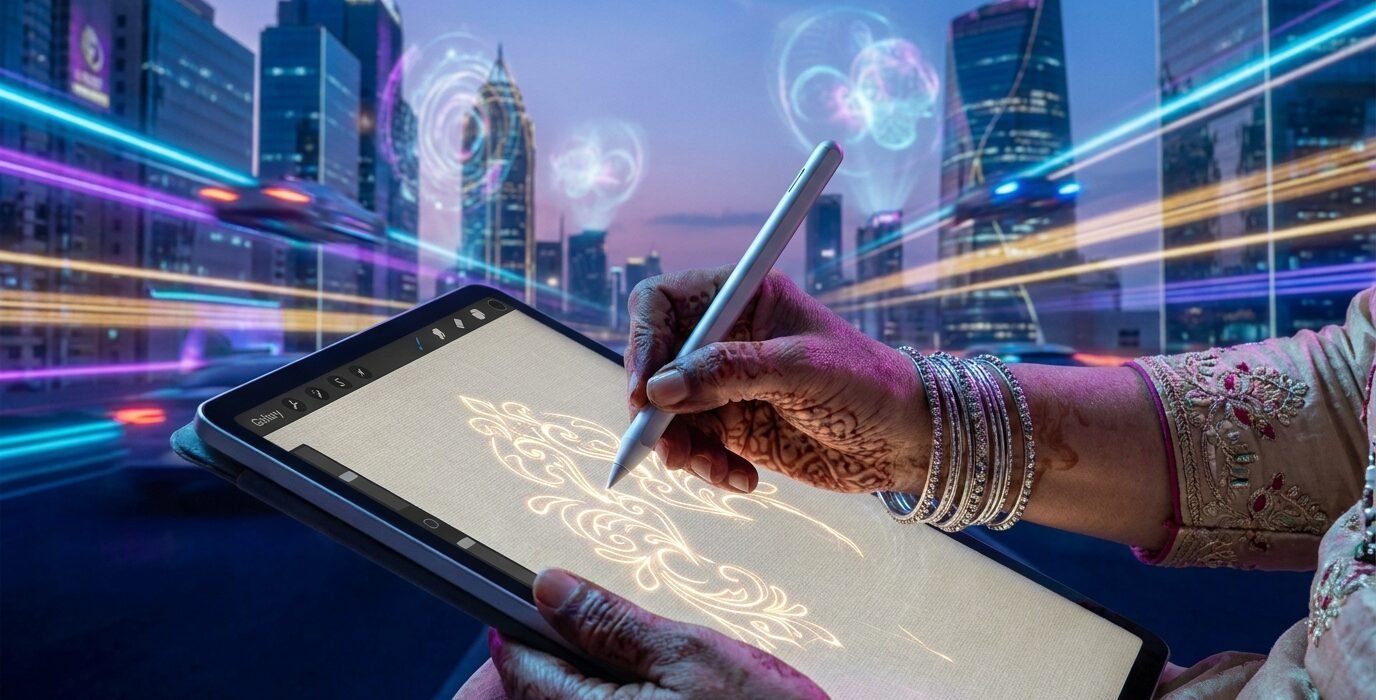
A kaleidoscope of colours, a symphony of digital brushstrokes, a new era of creativity is dawning in India. From the bustling streets of Mumbai to the serene backwaters of Kerala, artificial intelligence is not just entering the art scene; it’s igniting it. Imagine ancient Mughal miniatures rendered with futuristic flair, or the vibrant chaos of a Durga Puja pandal reimagined through a neural network’s lens. This isn’t science fiction; it’s happening now, transforming how Indian artists express themselves and how we experience art itself.
Key Takeaways:
- AI art tools are democratizing creativity, allowing individuals without traditional artistic skills to generate stunning visuals.
- Indian artists are blending AI with traditional techniques, creating unique hybrid art forms that reflect the nation’s rich cultural heritage.
- The emergence of AI art is sparking important conversations about authorship, originality, and the very definition of art.
- This technology offers new avenues for storytelling and cultural preservation, particularly for lesser-known folk art traditions.
- The accessibility of AI art generation is creating new economic opportunities for digital artists and designers across India.
The Digital Brush Strokes of Mumbai
Walk through any art gallery in Mumbai, and you’ll feel the pulse of innovation. But look closer, and you might notice something new. It’s the way a traditional Warli painting, usually etched with simple lines on mud walls, is now appearing in breathtaking digital detail, its tribal stories told with an uncanny vibrancy. This is the work of artists like Priya Sharma, a graphic designer from Bandra who discovered AI art generators a year ago. “I’d always loved the stories my grandmother told, the folk tales of Maharashtra,” Priya explains, her eyes alight with passion. “But I couldn’t draw. I mean, really draw. AI changed that. I can now visualize these stories. I input descriptions like ‘a young girl dancing under the banyan tree, with Warli motifs swirling around her,’ and the AI gives me something I could only dream of before.”
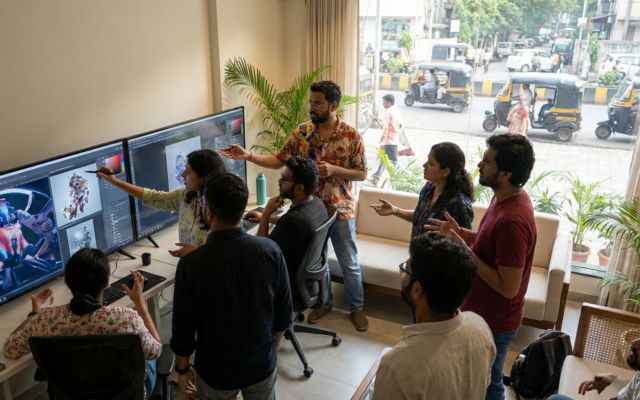
Priya’s process isn’t simply pressing a button. She spends hours crafting her prompts, refining keywords, and iterating through dozens of generated images until one truly captures the essence of her vision. She then often takes these AI-generated foundations and adds her own digital touches, layering textures, adjusting colours, and sometimes even incorporating elements from her own sketches. “It’s a collaboration,” she insists. “The AI is my incredibly talented, albeit non-sentient, assistant. It provides the raw material, the unexpected angles, the magical lighting. I provide the soul, the intention, the narrative.” This approach is becoming increasingly common across India. Artists are not abandoning their skills; they are augmenting them. A statistic from a recent Indian tech forum revealed that over 40% of digital artists surveyed reported using AI tools in their workflow, a figure that has doubled in the last eighteen months. The sheer speed at which these tools can produce variations is astounding. For a painter, achieving a dozen different compositions might take weeks. An AI can do it in minutes, offering a playground of possibilities that were previously unimaginable for many. The accessibility means that young creatives in cities like Pune and Nagpur, who might not have had access to expensive art schools or traditional training, can now experiment and create at a professional level.
Kerala’s Artisans Embrace the Algorithmic Muse
Down south, in the verdant landscapes of Kerala, the impact of AI art is equally profound, though perhaps more nuanced. Here, the focus is often on preserving and reinterpreting the region’s rich artistic heritage. Think of the intricate Kathakali face paint, the rhythmic strokes of Kalamezhuthu, or the delicate motifs found in traditional mural paintings. For generations, these art forms have been passed down through meticulous apprenticeship. Now, AI is offering a new way to engage with them. Consider Anand Menon, a cultural historian based in Kochi, who has been using AI to recreate lost or damaged murals from ancient temples. “Many of these murals are fading, some are completely gone due to time and the elements,” Anand shared during a recent workshop. “Using high-resolution photographs of the surviving fragments, combined with historical descriptions, I can prompt AI models to generate what these complete murals might have looked like. It’s like bringing history back to life, not just as a static image, but as a vibrant visual narrative.”
Anand’s work involves deep research, often consulting ancient palm-leaf manuscripts and local folklore to inform his AI prompts. He might describe a scene from the Ramayana as depicted in a specific temple style, specifying colours and compositions known to be prevalent in 17th-century Kerala art. The AI then generates a plausible reconstruction. This isn’t about replacing the original art or the painstaking work of conservators. Instead, it’s about offering a dynamic educational tool and a way for younger generations to connect with their heritage. A surprising discovery Anand made was how AI, when trained on specific regional styles, could sometimes generate details or colour palettes that experts hadn’t considered, sparking new avenues for research into historical artistic practices. This technology is also finding its way into contemporary Kerala art. Artists are using AI to generate patterns for textiles inspired by traditional motifs, or to create surreal digital landscapes that blend the iconic backwaters with futuristic elements. The speed and versatility of AI allow for rapid prototyping of designs, which is invaluable for artisans who need to adapt to changing market demands while staying true to their cultural roots. The economic implications are also significant, opening up new markets for digital art and design services rooted in Kerala’s unique aesthetic.
The Shifting Sands of Authorship and Authenticity
As AI art proliferates across India, it inevitably sparks a crucial debate: who is the artist? Is it the person who writes the text prompt, the AI model itself, or the engineers who developed the algorithm? This philosophical quandary is at the heart of the current revolution. In Delhi, artists are grappling with this question daily. Meera Kapoor, a conceptual artist, recently exhibited a series of AI-generated images titled “Echoes of the Indus.” Each piece depicted abstract interpretations of ancient seals, rendered with impossible textures and lighting. “I spent weeks crafting the prompts,” Meera stated, her voice steady. “I was trying to capture the mystery, the millennia of stories held within those small carvings. The AI interpreted my words, my intentions, and produced something beyond my direct manual skill. Does that make it less mine?”
This question of authorship is not just academic; it has real-world implications for copyright, intellectual property, and the value placed on human creativity. Some argue that AI-generated art devalues the years of practice and skill development required for traditional art forms. Others see it as a new medium, akin to photography when it first emerged, challenging existing norms. A fascinating aspect of this debate is how AI can sometimes produce art that is eerily similar to existing styles, raising concerns about plagiarism. However, the counter-argument is that human artists have always been inspired by, and learned from, the work of others. The key difference, many believe, lies in the intent and the conceptual framework provided by the human user. A surprising revelation in this space is how some AI models can “learn” and adapt styles so effectively that they can mimic the brushstrokes of a specific renowned Indian artist. This has led to calls for greater transparency and ethical guidelines in the development and use of these tools. For instance, the Indian Copyright Office is still formulating policies regarding AI-generated works, highlighting the novelty and complexity of the issue. The conversation extends beyond just the visual arts, impacting music, writing, and other creative fields, making it a national dialogue on the future of human expression in the age of intelligent machines.
AI as a Cultural Preserver and Storyteller
Beyond the debates, AI art is emerging as a powerful tool for cultural preservation and storytelling, especially for India’s vast array of folk art traditions. These art forms, often localized and passed down through generations, face the risk of fading into obscurity as younger generations migrate to urban centres or embrace newer forms of entertainment. AI offers a way to document, revitalize, and share these unique artistic expressions with a global audience. Consider the intricate Madhubani paintings from Bihar, known for their vibrant colours and complex geometric patterns. Traditionally, these were painted on walls and paper by women in the region. Now, AI can be used to generate new Madhubani-inspired designs for contemporary applications, from fashion to digital media, while preserving the essence of the traditional motifs. An artist like Sanjay Kumar from Madhubani village explained his experience: “My mother and grandmother taught me the old ways. It takes so much time, so much patience. With AI, I can show my children what these patterns look like in a landscape, or on a costume. It helps them appreciate our heritage in a new light.”
This technology allows for the creation of interactive experiences that bring these stories to life. Imagine a virtual gallery where you can not only see AI-generated Madhubani art but also learn about the mythology behind each pattern, with the AI narrating the stories in different regional dialects. This is particularly valuable for lesser-known art forms, such as Pattachitra from Odisha or Cheriyal scroll paintings from Telangana. These traditions often have rich oral histories and narratives associated with them, which can be visualized and disseminated through AI. A surprising aspect of this application is how AI can sometimes identify subtle patterns or thematic connections within a folk art tradition that might have been overlooked by human observers due to the sheer volume of detail. By analyzing vast datasets of these artworks, AI can highlight recurring symbols, colour palettes, and compositional structures, providing new insights for art historians and cultural researchers. This isn’t about replacing the human touch that gives these art forms their soul; it’s about providing a digital megaphone, amplifying their beauty and significance to reach audiences who might otherwise never encounter them. The potential for AI to act as a digital archivist and storyteller for India’s diverse cultural tapestry is immense.
New Horizons: AI Art and Economic Opportunity
The rise of AI art is not just an artistic phenomenon; it’s a significant economic driver, creating new opportunities for individuals and businesses across India. The accessibility of AI art generation tools means that individuals who may not have had formal art training can now enter the creative marketplace. This democratizes the field, allowing a wider pool of talent to flourish. Think of small businesses in smaller towns like Alwar or Trichy that can now afford high-quality graphic design and marketing materials without the hefty price tag of hiring traditional agencies. They can use AI to generate logos, social media graphics, and even product visualizations, giving them a competitive edge. Rohan Desai, a freelance digital artist from Ahmedabad, shared his perspective: “Before AI, my income was limited by how many hours I could physically spend creating. Now, I can take on more projects. I use AI to generate initial concepts, backgrounds, or even entire scenes, and then I refine them. It’s made me much more efficient and allowed me to scale my business.”
This efficiency translates into tangible economic benefits. The demand for AI art services is growing rapidly, from advertising agencies looking for unique campaign visuals to game developers seeking immersive environments. This has led to the emergence of specialized roles, such as “AI prompt engineers” or “AI art curators,” who possess the skills to effectively guide AI models and select the best outputs. Furthermore, AI art is opening up new avenues for e-commerce. Platforms are emerging where artists can sell AI-generated prints, digital assets, or even custom-designed merchandise. A surprising statistic in this domain is that many Indian artists are now earning a significant portion of their income by selling AI art on global marketplaces, demonstrating the international reach of this technology. This also has implications for the education sector, with more institutions offering courses and workshops on AI art generation and its applications. The ability to quickly generate diverse visual assets is crucial for fields like animation, film pre-production, and even architectural visualization. As AI art tools become more sophisticated and accessible, the economic landscape for creatives in India is set to undergo a significant transformation, fostering entrepreneurship and innovation at an unprecedented scale.
The Human Heartbeat in the Algorithmic Canvas
As we stand on the precipice of this AI-driven artistic revolution in India, it’s easy to get lost in the technical marvels and the sheer speed of innovation. Yet, at its core, this is still about human expression. The most compelling AI art doesn’t just showcase technical prowess; it resonates with emotion, tells a story, and reflects the unique cultural context of India. Whether it’s a digital interpretation of a classic Bharatanatyam pose, a futuristic take on a Diwali celebration, or a surreal landscape inspired by the Himalayas, the human element remains paramount. Artists are not merely commanding machines; they are infusing their own experiences, memories, and aspirations into the prompts that guide these algorithms. The surprising truth is that the more sophisticated AI becomes, the more we value the human intention and curation behind the art.
The future of AI artistry in India is not about replacing human creativity but augmenting it. It’s about providing new tools, new perspectives, and new avenues for expression. It’s about making art more accessible, more democratic, and more deeply connected to the nation’s rich cultural heritage. The digital brushstrokes of AI are painting a vibrant, dynamic, and ultimately, deeply human future for Indian art.
#