The first rains bring a smell the whole country knows: petrichor. It’s the scent of life, of hope, baked into the parched, waiting earth. For months, a billion people look to the skies. Then they break open. The monsoon arrives—a god of creation and, too often, a force of heartbreaking destruction. When the rivers forget their banks and turn streets into torrents, a different kind of force awakens. It’s not a government agency in a distant capital. It’s the quiet, unyielding power of a neighbour.
Key Takeaways:
- Discover the dual nature of the Indian monsoon, both as a life-giving season and a source of annual crisis for millions.
- Learn how local communities often self-organize relief efforts faster and more effectively than official aid can arrive.
- Meet the real faces of resilience through the story of a community volunteer group in Kerala’s backwaters.
- Understand the surprising and powerful role of women’s self-help groups in disaster management and recovery.
- Find out how you can meaningfully support these grassroots heroes and ensure your help reaches those who need it most.
The Roar of the River, The Quiet Act of Courage
Forget the gentle pitter-patter you see in films. This is a different sound. It’s a relentless, deafening drumming on a tin roof that goes on for days, a sound that gets inside your bones. Outside, the Brahmaputra, a river so wide it’s called a ‘moving ocean,’ has forgotten where it’s supposed to be. In the villages of Assam’s Majuli island, the world dissolves into a murky, swirling expanse of brown water. Homes, built on stilts with generations of hope, become tiny, precarious islands in a sudden, angry sea.
This is where the heroes appear. They don’t wear capes; they wear lungis hitched up to their knees and t-shirts worn thin by the sun. Their emergency vehicles aren’t wailing trucks, but the long, narrow country boats they use for their daily fishing. Long before the official alerts from the National Disaster Response Force (NDRF) are fully broadcast, these men are in motion. They know the currents like the lines on their hands. They know which home has an elderly grandmother who can’t move, which has a new mother, and which has the buffalo that is a family’s entire fortune. The Indian Meteorological Department notes that the monsoon provides over 70% of the country’s annual rain, a number that feels academic until you’re one of the 40 million people in a flood-prone zone, for whom this life-giving force is a yearly test of survival.
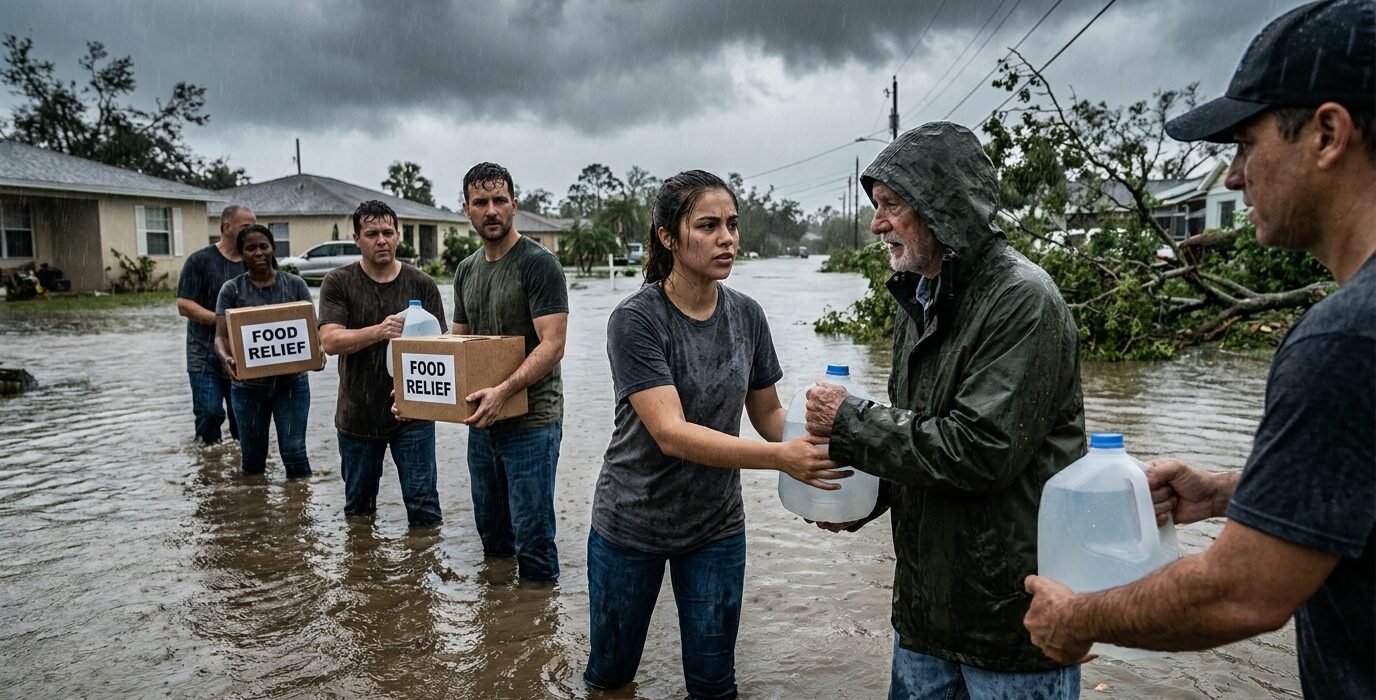
In these first, frantic hours, official systems feel distant, abstract. The only reality is the water inching up the walls. It’s the desperate calls hollered across the churning currents, the sight of a neighbour’s roof dipping dangerously low. This is where ‘community resilience’ stops being a buzzword and becomes a life-saving verb. It’s a shared pot of khichdi cooked on a hastily built stove on the one patch of high ground. It’s a human chain passing a child from a flooded hut to the safety of a boat. This is the raw, unfiltered truth of disaster response in much of India—it begins with the person next door.
One Boat, Twenty-Seven Lives
Suresh Kuttan is not a trained rescuer. He’s a 48-year-old fisherman from Kuttanad, a water-laced region in Kerala famous for its serene backwaters and paddy fields cultivated impossibly below sea level. When the 2018 floods hit—the worst in a century—his world went under. The official response was swamped, the scale simply too vast. While the state scrambled, Suresh did the only thing he knew how to do. He took out his boat.
“The phone network was dead, but you could hear the shouting,” Suresh recalls, his voice steady against the memory. “You don’t wait for anyone to tell you. You just go.” For three days straight, running on little more than adrenaline and sweet tea, Suresh and his fellow fishermen navigated their small vessels through a treacherous new landscape. Familiar streets had become rivers filled with submerged cars, broken walls, and the deadly threat of live wires. They pulled families from rooftops, elderly couples trapped on second floors, and even a terrified dog clinging to a floating log. His small boat, usually filled with the day’s catch of karimeen, carried 27 people to the safety of a relief camp in Alappuzha. He became a local legend, one of hundreds of fishermen later officially honoured as the ‘Commander-in-Chiefs of the Rescue.’
His story proves a simple truth: local knowledge is priceless. Suresh knew the hidden canals and shortcuts no GPS could ever show. He could read the water’s anger, anticipating currents that could capsize a lesser boat. The floods displaced over 1.4 million people in Kerala and caused billions in damages, but the death toll, while tragic, would have been exponentially higher without ordinary people like him. He is a powerful reminder that the most effective solutions don’t come from a manual; they come from a deep, intrinsic connection to one’s home and one’s people.
A Season of Contradictions
To understand these efforts, you must first understand the monsoon. It is more than a weather pattern; it is the subcontinent’s heartbeat. For farmers, its arrival is a festival, a fragrant promise of prosperity. A weak monsoon can send the economy into a tailspin. A strong one can wash away a lifetime of work. This duality is etched into the Indian psyche. We pray for rain, and then we pray for it to stop. This complicated love affair has shaped society for millennia, breeding a unique blend of fatalism and fierce, stubborn resilience.
For centuries, communities built their lives around the river’s moods. Homes were made with bamboo and thatch that could be rebuilt. Farming cycles worked with the water, not against it. But rapid, often reckless, urbanisation has torn up that ancient contract. Wetlands that once acted as natural sponges have been paved over for high-rises. Riverbeds have been choked with construction debris and mountains of plastic. According to a report by the Centre for Science and Environment, India’s cities have lost their ability to breathe, with places like Mumbai losing over 50% of their natural drainage areas in just the last few decades.
So when the rains come now, the water has nowhere to go. What might have been manageable flooding a generation ago becomes a catastrophic urban deluge. The official response, often designed for rural river floods, struggles to cope. This is the gap where the community heroes step in. They aren’t just fighting a natural disaster; they are fighting the consequences of a systemic failure to respect nature. They are the human bandage on a much deeper wound.
The Hidden Power of Women’s Self-Help Groups
When we picture disaster relief, we see uniformed men in high-visibility jackets. But one of the most powerful—and overlooked—forces in India’s community response is its vast web of Women’s Self-Help Groups (SHGs). These are small, local collectives where women pool their savings to give out micro-loans and run tiny businesses. When disaster strikes, they morph into logistical titans. Here is one of the most surprising truths of grassroots relief: the backbone of community recovery is almost always female.
Look at Odisha, a state historically battered by cyclones. After the devastating 1999 Super Cyclone, the government and NGOs invested heavily in community-based preparedness, empowering SHGs. Today, when a cyclone warning is issued, it’s the women of the SHG who go door-to-door, their sarees tucked firmly at their waists, making sure pregnant women, children, and the elderly are moved to shelters. They run the community kitchens, distributing food with a meticulous fairness born of knowing everyone’s name and situation. They keep the lists of who is missing. A UNDP study confirmed it: in areas with active SHGs, communities prepare better and recover faster.
Their role turns tradition on its head. In a crisis, women are often seen as the primary victims. But the SHG model has made them leaders. They don’t just cook and care; they organise, strategise, and manage. During floods in Bihar, it was the SHGs who set up temporary, safe sanitation facilities for women—a critical need almost always ignored in the chaos. They are the unsung administrators of survival, proving that resilience doesn’t always roar. Sometimes, it organizes.
From WhatsApp Warriors to Community Kitchens
So how does it all come together? The modern Indian community response is a fascinating mix of ancient social bonds and 21st-century technology. The first alarm is often raised in a neighbourhood WhatsApp group. Information flies faster than any official broadcast: “Water rising on Station Road.” “Uncle Sharma is trapped on his roof, phone is dead.” “Need a boat near the temple, now!” People drop Google Maps pins on the locations of stranded families, creating a live, crowdsourced map of the disaster zone.
From this digital chatter comes real-world action. Young men on motorcycles become ‘relief riders,’ weaving through flooded alleys to deliver packets of biscuits and medicine. Temples, mosques, and gurdwaras throw open their doors, instantly becoming shelters and community kitchens, or langars. The Sikh tradition of langar—a free meal for anyone, no questions asked—becomes a lifeline. Volunteers work in shifts, chopping mountains of onions and stirring enormous vats of dal and rice, the air thick with the smell of turmeric and cumin. The principle is simple: we are all in this together.
An expert at the National Institute of Disaster Management put it perfectly. “Top-down aid is like a large tanker,” he said. “It carries a lot, but it can only travel on the main highways. Community relief is like a fleet of auto-rickshaws. They are small, nimble, and can get into every last lane where the need is greatest.” This is where you can make a real difference. Supporting large charities is important, but empowering these hyper-local networks is often more impactful. Look for local NGOs with deep roots in the affected area. Donate to verified crowdfunding campaigns for a specific community kitchen or a local rescue team. Your support could be the fuel for a boat like Suresh’s, or the rice for a community langar that feeds a hundred hungry people.
The Scars and Strengths Left Behind
Eventually, the water pulls back. It leaves behind a trail of ruin—waterlogged homes caked in a thick, foul-smelling sludge, ruined crops, broken lives. The immediate crisis is over, but the long, gruelling work of rebuilding has just begun. This is when the true weight of the disaster settles in. And it is also when the strength of the community, forged in the fire of the flood, shines brightest.
The effort shifts from rescue to recovery. Neighbours help each other shovel mud from their homes. A local carpenter fixes a neighbour’s broken door for free. An electrician checks the wiring in a dozen homes before he even looks at his own. This isn’t just about rebuilding walls; it’s a form of communal therapy. The World Health Organization has found that psychosocial support from community members can be more effective in the early stages of recovery than formal counselling, precisely because it fights the isolation and reinforces the social bonds that a disaster tries to tear apart.
The monsoon leaves scars, on the land and in the mind. But it also reveals a profound truth. In the face of overwhelming catastrophe, the instinct to help is as powerful as the instinct to survive. The heroes of the monsoon are not just the few people in the boats; they are the entire community that rallies, supports, and rebuilds, one brick, one meal, one shared grief at a time. They are a testament to the idea that our greatest strength is not in controlling nature, but in caring for one another.
When the next monsoon comes, and the rivers rise again, they will be ready. Not with a grand plan from on high, but with something far more reliable: a shared purpose, a well-used boat, and a warm plate of food. And in the end, that is what saves us.