The first fat drops of rain are a reason for celebration. They land on the parched earth with a sizzle, releasing that smell—petrichor—the scent of life itself. Children run out into the lanes, faces turned to the sky. But then the drops turn into a relentless downpour, the rivers begin to swell, and the promise of life becomes a threat that consumes everything in its path.
Key Takeaways:
- Why local communities, not just official agencies, are the first and most vital line of defence during India’s devastating monsoon floods.
- The story of an ordinary tea-seller whose small boat became an ark for his entire neighbourhood in Assam.
- The surprising role of simple technology like WhatsApp in coordinating life-saving rescues faster than any official channel.
- The long, gruelling road to recovery—from mental health to rebuilding livelihoods—that begins long after the waters recede.
- How you can provide effective, meaningful support to those caught in the crossfire of these recurring climate disasters.
The Sky Opens Up: A Deluge in Assam
The Brahmaputra doesn’t just flow through Assam; it is the state’s very pulse. For most of the year, it is a life-giver, its silt-rich banks nurturing paddy fields that glow an impossible green. But when the monsoon arrives, the river god, as it is known, shows its terrifying power. This year was no different.
It began with a relentless, slate-grey sky that pressed down on the world. The rain wasn’t just falling; it was a solid wall of water. In the small village of Morigaon, people watched the water levels with a familiar knot in their stomachs. They knew the signs. The birds grew quiet. The air became thick, heavy. The river, usually a distant murmur, was now a constant roar. Within hours, the low-lying fields vanished, swallowed by a churning, muddy sea.
By nightfall, the water was no longer out there. It was licking at the raised mud plinths of their homes. Families scrambled to move their most precious belongings—sacks of grain, their children’s schoolbooks, a framed wedding photograph—to the highest point in their one-room houses. The electricity had already failed, plunging the village into a terrifying darkness broken only by stark flashes of lightning. This is the reality for millions every year. The Assam State Disaster Management Authority (ASDMA) reported that in last year’s floods, over 2.6 million people across 28 districts were affected. That isn’t just a statistic; it’s a universe of individual stories of loss, fear, and survival.
For these communities, a flood isn’t a one-time event. It is a recurring chapter in their lives. They build their homes on stilts. They know which dirt tracks will become impassable first. But the ferocity of today’s climate-fuelled monsoons is rewriting the old rules. The water comes faster now. It rises higher. The old wisdom is no longer enough. As the water breached their doorways, another kind of knowledge was needed—the knowledge of pure, unhesitating human instinct.
The Chai Wallah Who Became a Lifeline
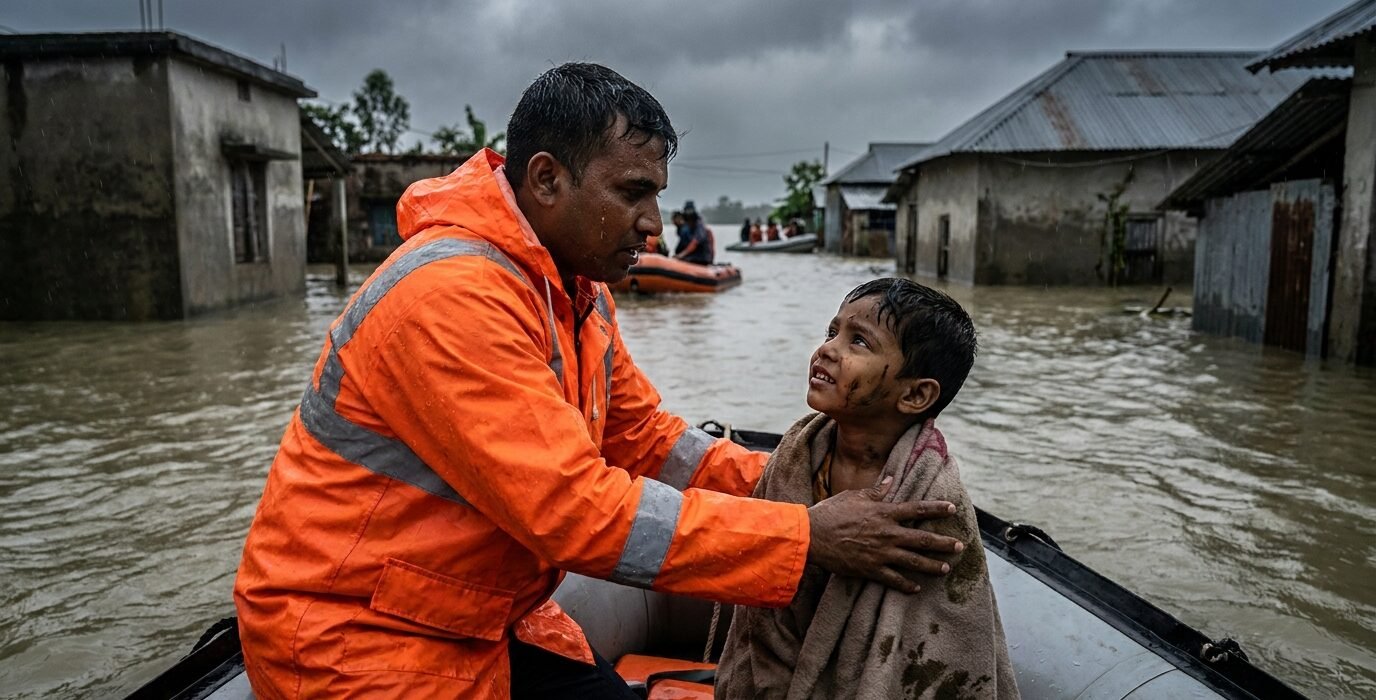
In the chaos of a disaster, heroes don’t wear capes. Sometimes, they wear a simple cotton vest and run a roadside tea stall. Meet Anish Rahman, a 45-year-old chai wallah from a flood-ravaged hamlet near Silchar. His world was his small shack, a perpetually boiling kettle, and the familiar faces who stopped for a glass of sweet, milky tea. He also owned a small, rickety wooden boat, used for odd jobs during the dry season. When the floods came, that boat became an ark.
As the waters surged into his village, Anish didn’t wait for official rescue teams. He knew they were stretched thin, overwhelmed. He saw his elderly neighbour, Mrs. Das, stranded on her rooftop, clutching her pet goat. He saw a young mother with a baby, her home half-submerged, her face a mask of sheer terror. Anish didn’t stop to think. He acted.
He pushed his boat into the swirling currents, navigating through floating debris and submerged fences. His first trip was for Mrs. Das and her goat. The second was for the mother and her child. Then he went back. And again. For 48 hours straight, fuelled by adrenaline and the occasional biscuit shared by those he rescued, Anish paddled. He brought over 30 people from their marooned homes to the relative safety of a concrete school building on higher ground. “The water doesn’t ask if you are rich or poor,” he later told a local reporter, his voice raspy with exhaustion. “We only had each other.”
Anish’s story is not unique. It’s a powerful illustration of a startling truth: disaster response experts estimate that over 80% of initial search and rescue in major floods is carried out not by uniformed professionals, but by ordinary people in the affected community. They are the true first responders. They know the lanes, they know who is old or sick, and they risk their own lives to save a neighbour. They are the hidden infrastructure of India’s resilience.
Beyond the Headlines: The Silent Work of Local Collectives
While individual acts of heroism capture our hearts, the sustained effort of recovery is powered by the quiet, organised strength of community groups. Long after the news cameras leave, these local collectives remain, working tirelessly to piece lives back together. They are the women’s self-help groups (SHGs), the youth clubs, and the local temple or mosque committees. Their work is a living embodiment of seva—selfless service.
Take the women’s SHGs in the Kuttanad region of Kerala, an area devastated by the historic 2018 floods. These groups, originally formed for micro-financing, transformed into powerful disaster relief units overnight. They knew their communities inside and out. They knew which families had a pregnant woman, who was disabled, and who had lost all their rations.
Using their established networks, they set up community kitchens in schools and public halls. Pooling their own resources and coordinating donations, they began cooking thousands of hot meals. A single one of these impromptu kitchens served over 1,500 meals a day, providing not just nutrition but also a sense of normalcy and comfort in a time of utter chaos. They organised the distribution of relief materials, ensuring that aid reached the most marginalised families who might otherwise be overlooked.
This is grassroots disaster management at its finest. It is efficient, empathetic, and built on a foundation of local trust. These groups don’t wait for instructions from a distant capital. They see a need, and they fill it. They are the social fabric that holds a community together when everything else is falling apart.
The Unexpected Tool: How WhatsApp Is Saving Lives
In the high-tech world of disaster response, we imagine satellites and sophisticated government apps. But on the ground, in a flooded village in Uttarakhand, the most powerful life-saving tool is often the one already in everyone’s pocket: WhatsApp.
While official warning systems exist, their alerts can be slow and too general. What people need is hyper-local, real-time information. A group of young people in a village near the banks of the Alaknanda River showed how it’s done. As the river began to swell dangerously, they created a WhatsApp group named “Gaon Bachao” (Save the Village) and added one person from every family. Suddenly, they had a powerful, decentralised information highway.
Young volunteers positioned themselves at various points along the river, sending constant updates: “Water has reached the old temple steps.” “The lower bridge is now submerged. Use the upper path!” “Sharma ji’s house is at risk, someone please check on them.” This simple act was revolutionary. It allowed families to evacuate in an orderly way, directed people to safer routes, and helped coordinate the rescue of the elderly. This network was faster and more specific than any official broadcast. It’s a prime example of jugaad—frugal innovation—applied to saving lives.
With over 500 million users in India, WhatsApp has become an indispensable part of the country’s social infrastructure. During floods, it’s used to share lists of missing people, coordinate relief supplies, and connect doctors offering free tele-consultations with patients in relief camps. The truth is, in a country as vast as India, the most effective technology for disaster response is often not top-down and complex, but bottom-up, simple, and already in the hands of the people.
The Long Road to Recovery: More Than Just a Rescue
The dramatic images of a helicopter airlifting a stranded family or a boat navigating a flooded street dominate the news. But that is just the opening scene. The real, grinding challenge begins when the water recedes, leaving behind a trail of devastation that can take years, even a generation, to overcome.
“Rescue is the first 1%,” says Dr. Anjali Sharma, a disaster management expert at the National Institute of Disaster Management (NIDM). “Recovery is the other 99%. It’s about rebuilding livelihoods, ensuring public health, and addressing deep psychological trauma.” The immediate aftermath is a public health nightmare. Stagnant water becomes a breeding ground for diseases like cholera, typhoid, and dengue. Access to clean drinking water is the most critical need.
Then comes the economic ruin. For a farmer, a flood doesn’t just damage their house; it washes away their entire livelihood. A season’s worth of crops, a year’s income, can be destroyed in a single day. The sludge left behind can render fertile land useless. The economic cost of the 2021 floods in Maharashtra alone was estimated to be over ₹15,000 crores (approximately $2 billion). For an individual family, it is an insurmountable catastrophe.
This is where sustained, intelligent support is crucial. It’s not just about sending old clothes and blankets. It’s about helping communities rebuild in a more resilient way. This means providing farmers with flood-resistant seeds, helping people reconstruct stronger homes, and, critically, offering mental health support. The trauma of losing everything leaves deep, invisible scars. Creating community support systems is a vital, yet often overlooked, part of a true recovery.
A River of Humanity
As the monsoon clouds retreat and the sun bakes the land dry again, the scars of the flood remain. But something else remains, too. The memory of a hand reaching out from a boat. The taste of a hot meal served in a crowded relief camp. The shared comfort in a moment of collective loss. The monsoon may bring a river of destruction, but it also unleashes a river of humanity.
These stories of unsung heroes are more than just feel-good anecdotes. They are a blueprint for survival in an age of climate crisis. A recent report by the Council on Energy, Environment and Water (CEEW) found that 75% of districts in India are now hotspots for extreme climate events. This is our new reality. As floods and cyclones become more frequent and more intense, formal government systems will be increasingly strained.
The true resilience of India will not be found in government reports or large-scale projects alone. It will be found in the social bonds of a village, in the resourcefulness of a women’s self-help group, and in the simple courage of a chai wallah with a boat. It will be found in the spirit of seva and the genius of jugaad. These are the currents that run deeper than any floodwater.
The monsoon will return next year. The rivers will rise again. But so will the people.