It starts with a sound. The screeching, beeping symphony of a dial-up modem, a gateway to a new world. Or maybe it’s a taste: the chalky sweetness of a Phantom cigarette dissolving on your tongue as you play-acted being a film star. For millions of us, the 90s in India wasn’t just a decade; it was the last chapter of a world that feels a universe away from the one we live in now.
Key Takeaways:
- Discover why the 1990s in India was a unique “analogue-digital bridge” era that shaped a generation unlike any other.
- Understand the immense power of Doordarshan and single-channel television in creating a unified national culture.
- Relive the simple, screen-free joys of gully cricket, cassette tapes, and the snacks that defined our school days.
- Learn how the economic liberalisation of 1991 quietly transformed everything from the drinks we bought to the computers in our homes.
- Explore the deep psychological reasons why this specific brand of nostalgia feels so potent and necessary today.
The Sunday Morning Ritual: Doordarshan and a United Nation
Before a thousand channels fought for our attention, there was one. Just one. And it held the entire nation in its thrall. Sunday mornings in 90s India were a sacred ritual, orchestrated by the familiar, soothing tune of Doordarshan.
The day didn’t begin with a smartphone notification, but with the epic title sequence of Mahabharat or Ramayan. In bustling cities like Delhi, the streets would fall silent. The only sound was the booming baritone of Harish Bhimani narrating the cosmic drama, a voice that became the collective conscience of a generation. We gathered not just as families, but as a nation, huddled around our boxy Televista or Onida television sets. The devilish pride of the Onida ad—”Neighbour’s envy, owner’s pride”—was a real, tangible thing.
This was the age of appointment viewing. You couldn’t just binge it. You had to wait. An entire week of anticipation would build for the next episode of Shaktimaan, watching Mukesh Khanna spin into India’s first superhero. The Monday morning schoolyard in Mumbai became a parliament of opinions. Did you see how Byomkesh Bakshi solved the case? Weren’t the stories in Malgudi Days just like our own summer holidays in the village? This shared cultural vocabulary was our very first social network.
The numbers from that time are staggering. Doordarshan’s broadcast of Ramayan commanded a viewership of over 80% of the Indian television-owning public. Think about that. In a country of such immense diversity, it was the last time we were all watching the same story at the same time. It was a form of unity that feels impossible in our fractured media landscape today. It wasn’t just entertainment; it was a national conversation happening in every living room, from Kashmir to Kanyakumari.
The Sound of a Generation: Tapes, Walkmans, and Channel V
Our soundtracks weren’t curated by an algorithm. They were painstakingly built, one song at a time, with a pen, a cassette tape, and a whole lot of patience. The 90s music scene was a physical, tangible thing. It lived in the whirring gears of a two-in-one cassette player and the satisfying hiss of a C90 T-Series tape.
Ask Rohan, who grew up in the suburbs of Bangalore. His prized possession was a shoebox full of cassettes, each with a carefully handwritten label. He’d spend hours sitting by the radio, finger hovering over the record button, trying to perfectly capture the latest Kumar Sanu hit. The ultimate tragedy? The radio jockey talking over the first few seconds of the song. It was a universal pain. The companion to this tragedy was the universal solution: a simple pencil, used to painstakingly wind a tape that had been unspooled and chewed up by the player.
Then came the revolution. The arrival of MTV and Channel V in the mid-90s was like a window being thrown open to a different world. Suddenly, we had faces for the voices. We saw the haunting landscapes in Lucky Ali’s “O Sanam” and danced in our living rooms to Alisha Chinai’s “Made in India.” These weren’t just songs; they were anthems of a newly confident, globalising India. The VJs—Ruby Bhatia, Danny McGill, the incomparable Jaaved Jaaferi on Flashback—were our guides to cool.
This was the golden age of Indipop. It was a genre that was uniquely ours, a blend of Indian sensibilities and Western pop production. In 1996, the Indian music industry was valued at over ₹10 billion, and cassette tapes accounted for more than 90% of all sales. The Walkman wasn’t just a device; it was a bubble of personal freedom, allowing you to walk through the crowded streets of your city with your own private soundtrack. For the first time, our music became truly, personally ours.
Before the Internet: Gully Cricket and Games in the Dust
Long before our thumbs were trained to swipe and tap, they were calloused from spinning a tennis ball on a dusty patch of road. Childhood in the 90s was lived outdoors, in the glorious, unstructured chaos of the neighbourhood “gully” or colony park. The setting sun wasn’t a signal to recharge a device; it was a call from our mothers to come home for dinner.
The rules of gully cricket were more complex and sacred than any ICC regulation, a unique constitution for every street. One-bounce-one-hand-catch was a universal law. Hitting the ball directly into Mrs. Sharma’s first-floor balcony in her Jaipur apartment block? You were out. No arguments. The wicket was a brick, a school bag, or just a chalk drawing on a wall. It was a game of pure innovation and negotiation.
This outdoor life was often fuelled by something we complained about then but cherish now: load shedding. Those scheduled power cuts were a blessing in disguise. As the lights went out and the fans whirred to a stop, the entire neighbourhood would spill out of their homes. We played pithoo (seven stones), a game of frantic energy and surprising accuracy. We climbed trees, flew kites from the rooftops of Old Delhi, and scraped our knees playing kho-kho.
This wasn’t just play; it was community-building in action. We learned to share, to argue, to resolve conflicts, all without adult supervision. A 1990s study on urban childhood in India found that children spent an average of 3-4 hours per day in unstructured outdoor play. That number feels like a fantasy now. It was a time when our social skills were honed not through comments and likes, but through face-to-face interaction in the golden light of the setting sun. The friendships forged in that dust were real and lasting.
The Taste of Nostalgia: From Phantom Cigarettes to Rasna
You can tell the story of 90s India through its flavours. It was a time of simple, explosive tastes that are imprinted on our memories. Our treats didn’t come in artisanal packaging; they came from the glass jars of the local kirana store, the neighbourhood hub run by a familiar uncleji who knew your favourite candy.
Who can forget the thrill of Phantom “sweet cigarettes”? Holding one between your fingers, pretending to be a movie star, the red tip glowing with promise. It was our first taste of harmless rebellion, and it was delicious. Then there was the tangy, mouth-puckering joy of Aam Pachan or the rainbow-coloured discs of Poppins. For one rupee, you could buy a handful of happiness in the form of Kismi toffees or Mango Bite.
Summers were defined by the clinking of glasses filled with Rasna. The “I love you, Rasna” campaign was more than an ad; it was a cultural touchstone. A single packet could be transformed into a large jug of bright orange liquid, the official welcome drink for any guest who visited your home. And for a special treat, there was the fizz of a Gold Spot or the lime rush of Citra—drinks that now evoke a powerful, bittersweet nostalgia.
Here’s a surprising fact: many of these iconic brands, like Gold Spot, vanished precisely because of the new India being born. As economic liberalisation opened the floodgates in the early 90s, global giants like Coca-Cola and Pepsi entered the market, and our local favourites were phased out. Their memory is so potent because their sudden absence created a void. The unorganized confectionery market in India in the mid-90s was estimated to be worth over ₹2,000 crore, a testament to the power of these small, iconic candies that lived in our pockets and our hearts.
The Dawn of a New India: Liberalisation and the First PC
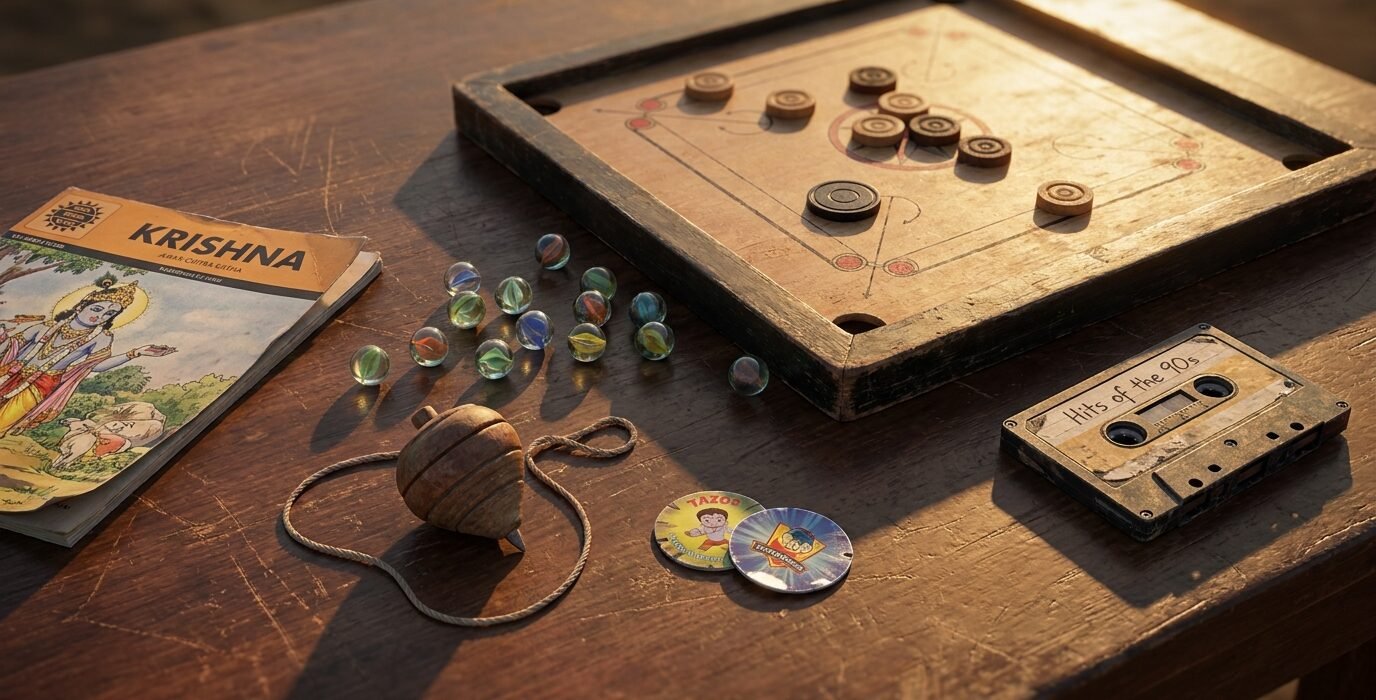
While we were busy playing cricket and trading Tazos we found inside packets of Lays, the country around us was changing at a dizzying speed. The economic reforms of 1991 were not just a headline; they were a quiet revolution that crept into our homes, changing the way we lived, dreamed, and connected to the world. The 90s child was the first witness to this transformation.
This was the decade we became a “bridge generation.” We have clear memories of the analogue world—writing letters on an inland letter card, waiting for a trunk call to connect, looking up information in a physical encyclopedia. But we were also the first to embrace the digital age. The arrival of the first family computer was a momentous occasion. It was a bulky HCL or Zenith machine with a massive CRT monitor that took up half the desk. We marvelled at the magic of MS Paint and spent hours guiding a pixelated hero in Prince of Persia.
Then came the internet. The sound of a VSNL dial-up connection is a core memory for us. That chaotic symphony of screeches and beeps was the sound of a portal opening. It took an eternity to load a single image, but it felt like pure magic. According to government data, internet subscribers in India grew from a mere 15,000 in 1995 to over 1.4 million by the end of 1999. It was a nearly 100-fold increase in just four years, and we were at the forefront of it.
Living through this shift gave us a unique adaptability. We understand the value of patience from the analogue era and the demand for speed from the digital one. This perspective is a hidden superpower. We saw our parents use typewriters and then taught them how to use email. We are fluent in two different worlds, a skill that is incredibly valuable today. We were the beta testers for the new India.
Why We Can’t Let Go: The Ache for Simpler Times
So why do we cling so tightly to these memories? This isn’t just about old TV shows or forgotten candies. This deep, persistent nostalgia for the 90s is a longing for something more profound: a feeling of connection in a world that feels increasingly disconnected.
It was a time of less. Fewer choices, fewer distractions, fewer channels. But in that “less,” we found “more.” The anticipation of waiting a whole week for a new episode created a deeper satisfaction than the empty feeling of binge-watching a season in one night. The effort of creating a mixtape for a friend meant more than sharing a Spotify playlist with a single click. The boredom of a power cut on a summer afternoon forced us to be creative, to invent games, to simply be with our own thoughts.
This nostalgia is for shared experience. In a residential colony in Pune during Diwali, every family would be out, lighting lamps and bursting crackers together. Today, we are more likely to share a picture of our celebration online than share a box of sweets with our actual neighbour. A recent survey found that 78% of Indian millennials feel their childhood was simpler and more connected than that of children today.
The 90s were perhaps the last decade of a truly collective Indian consciousness. Before the internet created our personal echo chambers, we were all tuned into the same frequency. We laughed at the same jokes on Dekh Bhai Dekh, hummed the same “Hamara Bajaj” jingle, and felt the same national pride when Sachin Tendulkar hit a century. We were all on the same page. That is what we are truly nostalgic for: the feeling of being in it together.
The 90s are not just a time period we lived through; they are a feeling we carry inside us. It’s a blueprint for a life built on simple joys and genuine human connection. Before we were linked by fiber optics and 5G, we were connected by shared stories and common ground. And that is a connection that never, ever lags.