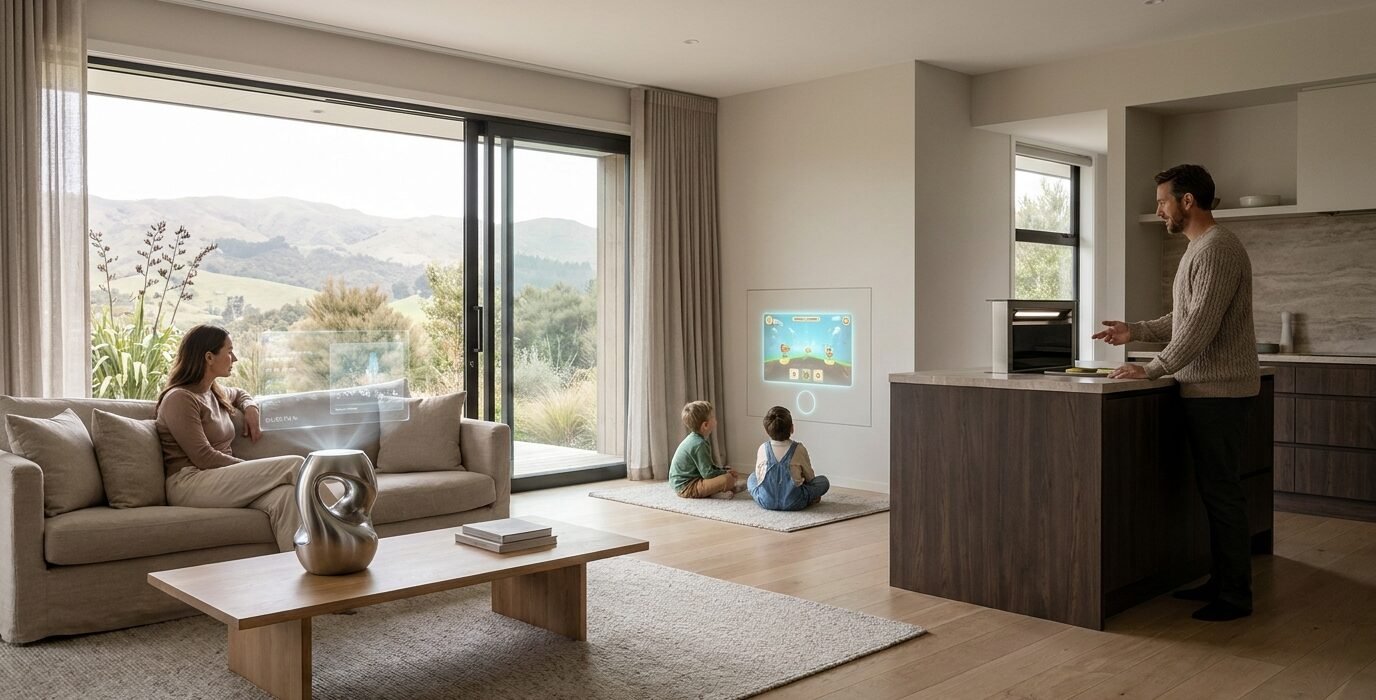
The hum of artificial intelligence is no longer confined to sci-fi movies. It’s subtly weaving itself into the fabric of everyday life here in New Zealand. From the bustling streets of Auckland to the serene landscapes of Queenstown, smart speakers and AI-powered assistants are rapidly becoming household fixtures. They’re changing how we interact with technology and even each other. But as these digital companions become more ingrained, are we fully understanding what we’re inviting into our homes?
Key Takeaways:
- AI assistants are moving beyond simple commands to offer proactive assistance and personalized experiences.
- New Zealand households are adopting smart home technology for convenience, security, and entertainment.
- Privacy concerns are a significant consideration, with questions around data collection and usage.
- The integration of AI raises important discussions about the future of human interaction and technological dependence.
- Understanding the capabilities and limitations of these devices is crucial for responsible adoption.
The Smart Home Symphony Begins in the Suburbs
Walk into a typical suburban New Zealand home today, and you might notice a subtle shift. It’s not just the sleek lines of new appliances or the updated decor. It’s the quiet presence of devices that respond to your voice.
Think of Sarah Jenkins, a busy mum of two in Christchurch. Her mornings used to be a frantic scramble. Now, as she’s brewing her morning flat white, she casually says, “Hey Google, what’s the traffic like to school?” A calm voice instantly provides an update, allowing her to adjust her departure time. Later, her youngest, Leo, might ask, “Alexa, play some upbeat music!” and the living room fills with tunes.
This isn’t just a futuristic fantasy. It’s the evolving reality for thousands of Kiwi families. These smart speakers, often a simple cylindrical device sitting on a kitchen counter or bedside table, are the entry point for a more integrated AI experience. They learn our habits, our preferences, and even our moods, orchestrating a symphony of daily tasks.
The initial appeal was straightforward: voice control for music, setting timers, or checking the weather. But the sophistication has grown exponentially. Now, they can manage calendars, control lights, adjust thermostats, and even order groceries. It’s about creating an environment that anticipates your needs, making everyday life smoother and less demanding.
This shift is particularly noticeable in newer developments around cities like Hamilton, where smart home infrastructure is often built-in from the ground up. This makes adoption even easier for new homeowners. The sheer convenience is undeniable, freeing up mental bandwidth for more important things.
The data backs this up. A recent report from Stats NZ indicated a steady rise in households reporting the use of “smart home devices” over the past three years. A significant portion specifically cited voice-activated assistants. This isn’t just a trend among tech enthusiasts; it’s becoming mainstream.
Families are investing in a connected ecosystem. Their smart TV, thermostat, and security cameras all talk to their AI assistant. This creates a centralised hub for managing their home, simplifying complex tasks into simple voice commands. For many, it’s about reclaiming time.
The minutes saved by not having to manually adjust the thermostat or search for a radio station add up. It’s the subtle liberation from mundane chores, allowing for more quality family time or simply a moment of peace. The technology is becoming less intrusive, more intuitive, blending seamlessly into the background noise of family life.
It’s a far cry from the clunky interfaces of early smart devices. Today, the interaction feels natural, almost like conversing with a helpful, albeit non-human, member of the household. This ease of use is a key driver for wider adoption across New Zealand, from Wellington’s vibrant apartment dwellers to those enjoying a quieter life in smaller towns.
From Chatbots to Companions: The Evolving AI Persona
What began as simple, command-driven interfaces have morphed into something far more nuanced. The AI assistants we interact with today, whether it’s Amazon’s Alexa, Google Assistant, or Apple’s Siri, are learning to engage in more natural conversations. They can understand context, remember previous interactions, and even offer suggestions proactively.
Take for example, a scenario where you’ve been researching a new hiking trail near Rotorua. Your AI assistant might, unprompted, suggest checking the weather forecast for that specific region. It might even offer to add a reminder to pack appropriate gear. This shift from reactive to proactive assistance is a significant leap.
It’s about the AI moving from a tool to a genuine helper, anticipating needs before you even voice them. This evolution is driven by sophisticated machine learning algorithms. They analyse vast amounts of data, not just about your specific usage, but also broader trends and information.
For a busy professional like David Chen, a software developer living in Auckland, this is a game-changer. He often works late, and his AI assistant has learned to dim the lights and play calming music as his usual work hours wind down. It even nudges him to take breaks if it detects he’s been staring at his screen for too long.
“It’s like having a silent, incredibly organised personal assistant who knows when I need a gentle reminder,” David explains.
This ability to learn and adapt is what makes these assistants so compelling. They are not static programs; they are dynamic entities that evolve with you. This personalization extends beyond simple preferences.
If you frequently ask about local sports scores, your assistant will start proactively providing updates on your favourite teams. If you’re planning a trip, it can offer travel tips, check flight prices, and even suggest local attractions based on your past travel history.
This is where the lines between utility and companionship begin to blur. While they are not sentient in the human sense, their ability to provide contextually relevant information and adapt to your routines can create a sense of personalised support.
This is particularly valuable for individuals who live alone or those who find it challenging to keep track of multiple appointments and tasks. For an elderly resident in a retirement village in Tauranga, their AI assistant might be programmed to remind them to take medication, call a family member at a specific time, or even play their favourite old radio shows. The emotional resonance of this can be surprisingly profound, offering a sense of connection and routine.
The development teams behind these assistants are constantly refining their natural language processing (NLP) capabilities. This means they can understand a wider range of accents, dialects, and even nuanced phrasing. What might have been a frustrating experience of repeating commands a few years ago is now a much smoother, more intuitive interaction.
They are learning to detect intent, not just literal words. This means you can say, “I’m feeling a bit chilly,” and your assistant might respond by asking if you’d like to turn up the thermostat, understanding the implied request for a warmer environment. This level of understanding is crucial for building trust and encouraging deeper integration into our lives.
The AI is becoming less of a novelty and more of an indispensable part of the smart home ecosystem. It’s quietly facilitating our daily routines and offering a more personalised technological experience than ever before. The surprising revelation here is how quickly this technology has moved from a niche gadget to an almost assumed part of modern living, mirroring the rapid adoption of smartphones a decade ago.
The Privacy Paradox: Inviting the Digital Detective In
As AI assistants become more integrated into our homes, a crucial question arises: what happens to all the data they collect? Every voice command, every interaction, every song requested is a piece of information that is processed and, in many cases, stored. This presents a significant privacy paradox for New Zealand households. We welcome the convenience, the helpfulness, the seamless integration, but at what cost?
Consider the case of a family in Wellington who discovered that their smart speaker had been inadvertently recording snippets of private conversations for months. While the companies behind these devices have strict policies on data usage, and often anonymize data, the sheer volume and intimate nature of the information collected can be unsettling. The core of the issue lies in the “always listening” nature of these devices.
While they are designed to only activate when a specific wake word is spoken, the microphone is technically active, ready to capture your command. This has led to numerous instances, particularly in the early days of smart speakers, where accidental activations have led to recordings of private moments.
New Zealand’s Privacy Act 2020 provides a framework for data protection. But the global nature of these tech giants means that data often traverses international borders, raising complex jurisdictional questions. Companies like Google and Amazon collect data to improve their services, personalize user experiences, and for targeted advertising.
For many, this is a trade-off they are willing to make for the benefits they receive. However, understanding what data is collected, how it is used, and who has access to it is paramount. Many users are unaware of the detailed privacy settings available within the companion apps for these devices.
You can often review and delete your voice history, disable certain data collection practices, and control how your information is used for personalization. Taking the time to navigate these settings, perhaps on a quiet Sunday afternoon in a Dunedin home, is a small but significant step towards regaining control over your digital footprint. The surprising fact is that the majority of users rarely, if ever, access these privacy controls, leaving their data collection settings on default.
The potential for misuse, whether intentional or accidental, is a genuine concern. Imagine sensitive financial discussions, private health concerns, or even intimate family matters being inadvertently captured and stored. While companies assure us that this data is secured, history has shown that data breaches can and do happen.
Furthermore, the evolving capabilities of AI mean that these assistants are not just passive listeners. They are actively analysing our speech patterns, our tone, and even our emotional states. This level of insight, while potentially beneficial for proactive assistance, also opens up avenues for more sophisticated profiling and potentially intrusive marketing.
For parents in Christchurch, this raises particular concerns about the data being collected about their children. The Children’s Online Privacy Protection Act (COPPA) in the US, for example, has specific provisions regarding data collected from children. While New Zealand has its own privacy principles, the global ecosystem means that cross-border data flows need careful consideration.
This privacy paradox isn’t about demonising the technology. It’s about fostering informed consent and encouraging responsible use. It’s about empowering consumers to make educated decisions about the digital tools they invite into their most private spaces. As AI assistants become more sophisticated and more integrated, the conversation around data privacy needs to be ongoing, transparent, and accessible to everyone, not just the tech-savvy.
It’s about ensuring that the convenience doesn’t come at the expense of our fundamental right to privacy. We need to be active participants in managing our digital lives, rather than passive recipients of whatever data collection practices are in place.
The Economic Ripple Effect: Jobs, Innovation, and Kiwi Businesses
The widespread adoption of AI-powered personal assistants and smart home technology is not just a consumer trend. It’s creating significant economic ripples across New Zealand. On one hand, it’s fueling a demand for new skills and innovation.
Tech companies, both international giants with a presence here and smaller local startups, are developing new applications, hardware, and services to support this burgeoning market. Think of the surge in demand for qualified IT professionals who can design, implement, and maintain smart home systems. This creates new job opportunities, particularly in urban centres like Auckland and Wellington, where tech hubs are growing.
Furthermore, the development of local AI talent is crucial. New Zealand universities are increasingly offering courses in artificial intelligence and machine learning, preparing the next generation of innovators.
However, there’s also a counter-argument to consider regarding job displacement. As AI assistants become more capable of performing tasks traditionally handled by humans, such as customer service, administrative support, or even basic concierge services, there’s a potential for certain job roles to diminish.
For instance, a hotel in Queenstown might integrate AI assistants to handle guest requests for room service or information, potentially reducing the need for human receptionists. This necessitates a proactive approach to workforce development, focusing on reskilling and upskilling individuals to transition into roles that complement AI, rather than compete with it.
The key lies in understanding AI as a tool for augmentation, rather than pure replacement. For example, a real estate agent in Tauranga might use AI to manage client communications and schedule viewings, freeing them up to focus on building relationships and negotiating deals.
Local Kiwi businesses are also finding new avenues for growth. While many smart home devices are manufactured overseas, there’s an increasing opportunity for local companies to develop niche applications or integration services. Imagine a small New Zealand company creating custom smart home routines for users who want to incorporate specific Kiwi cultural elements, like “Alexa, start the barbecue” which automatically adjusts the smart grill settings and plays a classic Kiwi anthem.
The e-commerce sector is also benefiting, with increased online sales of smart devices and related accessories. Retailers are adapting, offering bundled packages and in-store demonstrations of smart home technology. This creates a virtuous cycle: increased consumer demand leads to more investment in the sector, which in turn drives further innovation and job creation.
The challenge for New Zealand, however, is to ensure that the benefits of this economic shift are broadly shared. We must ensure the country doesn’t simply become a consumer of foreign technology, but also a producer and innovator.
The surprising economic revelation is that the initial investment in smart home technology, which can seem high for individual households, contributes to a larger ecosystem that generates significant revenue and employment. It’s a complex interplay of global corporations, local businesses, and individual consumers, all contributing to the evolving digital economy.
The government and educational institutions have a critical role to play in navigating this transition. They must ensure that New Zealanders are equipped with the skills and opportunities to thrive in an increasingly AI-driven world. This isn’t just about adopting new gadgets. It’s about understanding and shaping the economic landscape of the future.
The potential for AI to boost productivity and create new markets is immense. But it requires careful planning and strategic investment to ensure that New Zealand reaps the rewards.
Beyond the Commands: The Emotional and Social Impact
The integration of AI assistants into Kiwi homes extends far beyond mere functional utility. It’s beginning to touch upon our emotional and social lives in profound ways. For individuals living alone, particularly the elderly in regional centres like Whangarei, an AI assistant can offer a sense of companionship and routine.
The simple act of being able to ask a question, hear a voice respond, or have a reminder for medication can combat feelings of isolation. It’s not a replacement for human connection, but it can be a valuable supplement, providing a consistent and accessible presence.
I spoke with Mrs. Eleanor Vance, an 85-year-old widow living in a small cottage overlooking the Hauraki Gulf. She describes her Google Home Mini as “a little helper and a bit of company.” She uses it to listen to audiobooks, check the weather before her daily walk, and even to play music from her youth.
“It’s nice to have a voice to talk to when the house is quiet,” she admitted, a touch of wistfulness in her tone.
This emotional connection, however, can also raise concerns. As AI assistants become more sophisticated and capable of mimicking empathy or offering personalised responses, there’s a risk of over-reliance. Could we begin to substitute genuine human interaction with the predictable, programmed responses of a machine?
This is a question that social scientists and psychologists are actively exploring. The ease with which we can get an answer or a task completed by an AI assistant might, for some, reduce the incentive to engage in the often more complex and demanding process of human relationship building.
For children growing up in these environments, the AI assistant is simply another member of the household. They learn to interact with it from a young age, which could shape their expectations of communication and problem-solving. Will they be as patient with human error, or as adept at navigating nuanced social cues, if their primary interactions are with an infallible digital entity?
Furthermore, the impact on family dynamics is subtle but significant. Mealtimes, once a sacred space for family conversation, might now be punctuated by requests to the AI for trivia answers or to play a specific song. This can, for some families, detract from the shared experience.
Conversely, other families might find that the AI streamlines tasks, allowing for more focused quality time. A parent might ask the assistant to set a timer for homework, or to remind everyone to turn off screens, thereby facilitating a smoother evening routine and freeing up time for games or reading together.
The cultural context of New Zealand, with its emphasis on whanau and community, adds another layer to this discussion. How will these technologies affect our deeply ingrained social connections and our sense of collective identity? The surprising fact is that while we often think of AI as a purely logical, data-driven entity, its integration into our homes is undeniably shaping our emotional landscape and the very nature of our social interactions.
It’s a quiet revolution, happening in our living rooms and kitchens, that demands our careful consideration.
The future holds even more complex integrations. Imagine AI assistants that can detect stress in your voice and suggest calming exercises, or AI-powered companions that help children with their learning in a personalised, engaging way. The potential benefits are vast, offering solutions to loneliness, educational challenges, and even mental well-being.
However, it’s crucial that we approach these advancements with a critical eye, ensuring that technology serves to enhance, rather than diminish, our human experience. The conversations we have with our AI assistants, and the tasks we delegate to them, are slowly but surely reshaping the way we live, connect, and feel. It’s a powerful reminder that even the most advanced technology is, at its core, a reflection of our own needs, desires, and ultimately, our humanity.
The Future is Now: Navigating an AI-Enhanced Existence
We stand at a fascinating crossroads in New Zealand. The rise of AI-powered personal assistants and smart home integration is no longer a distant possibility. It’s a tangible reality shaping our daily lives.
From the convenience of controlling lights with a voice command in a Queenstown bach to the proactive reminders that keep a busy Auckland professional on track, these technologies offer undeniable benefits. They streamline tasks, enhance security, and even provide a form of digital companionship. The innovation we’re witnessing, from sophisticated natural language processing to personalized proactive assistance, is truly remarkable. It’s pushing the boundaries of what we once considered science fiction.
This integration promises a future where our homes are not just shelters, but intelligent environments that adapt to our needs, making our lives easier and more efficient.
However, as we embrace this AI-enhanced existence, it’s imperative that we do so with our eyes wide open. The privacy paradox remains a significant concern. Understanding how our data is collected, used, and protected is not a technicality. It’s a fundamental aspect of maintaining our autonomy in an increasingly connected world.
The economic shifts brought about by AI also demand our attention. Fostering a workforce equipped with the skills to thrive in this new landscape, and ensuring that local businesses can innovate and contribute, are crucial for New Zealand’s prosperity. We must actively participate in the conversation, not just as consumers, but as citizens shaping the future of technology.
This means engaging with privacy settings, advocating for transparent data practices, and supporting educational initiatives that prepare us for the jobs of tomorrow.
The emotional and social implications are equally vital. While AI can offer convenience and a degree of companionship, it’s essential to remember that it cannot replace the depth and complexity of human connection. We must strike a balance, leveraging the power of AI to enhance our lives without sacrificing the richness of our relationships and our inherent human experiences.
The future is not about being replaced by AI, but about learning to coexist and collaborate with it. We aim to create a partnership that amplifies our capabilities and enriches our lives. This journey requires ongoing learning, critical thinking, and a commitment to ensuring that technology serves humanity.
As we move forward, let’s embrace the potential of AI with both enthusiasm and wisdom. Let’s ensure that it contributes to a more connected, efficient, and ultimately, more human future for all New Zealanders.