Key Takeaways
- AI-powered precision farming tools are helping Indian farmers make data-driven decisions, leading to increased yields and reduced waste.
- Adoption is growing, with startups offering affordable AI solutions for everything from soil health monitoring to pest detection.
- Digital literacy and access to reliable internet remain key challenges, but government initiatives and community-led training are making strides.
- The future of Indian agriculture is increasingly intertwined with AI, promising greater efficiency and sustainability for the 2027 harvest season and beyond.
The Smart Farmer’s Toolkit: AI Arrives in the Fields
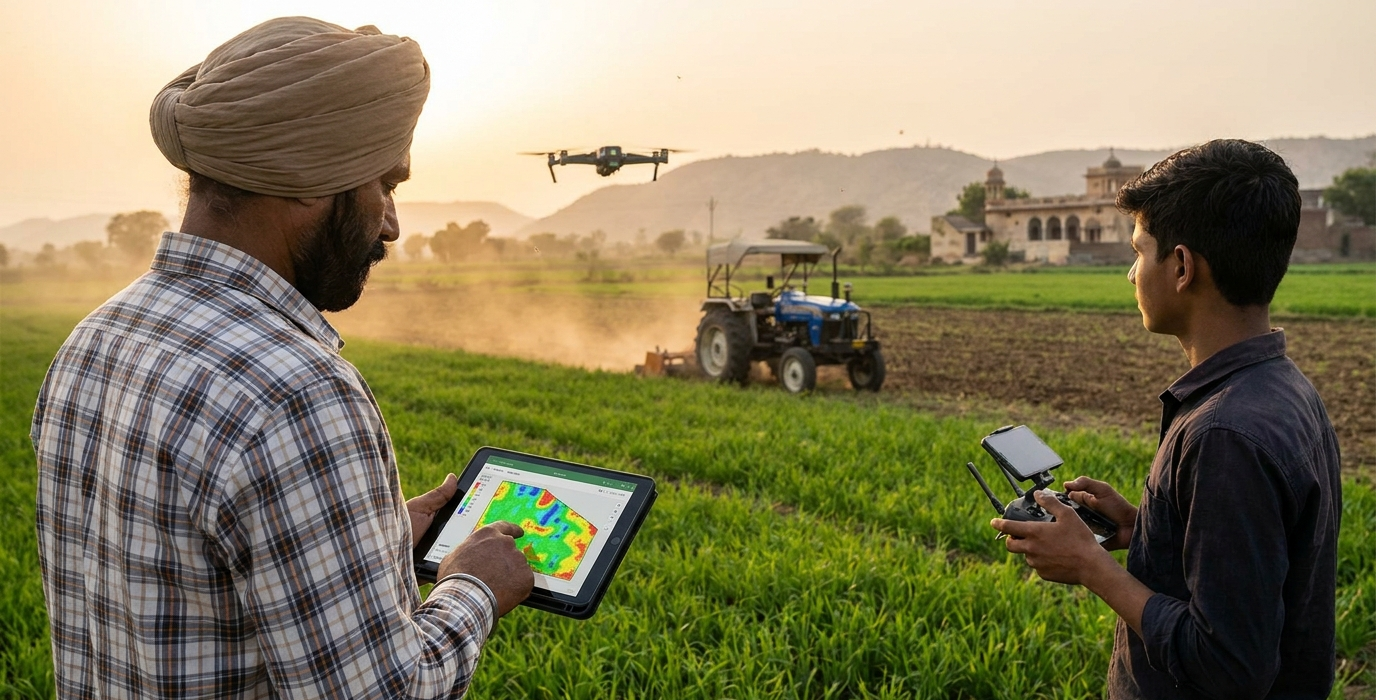
The sun beats down on a field of vibrant green wheat near Hisar, Haryana, but the farmer, Ramesh Singh, isn’t just relying on intuition and experience anymore. He’s got a tablet in his hand, displaying a complex map of his land, colour-coded to reveal subtle variations in soil moisture and nutrient levels. This isn’t science fiction; this is the reality of AI-driven agriculture, rapidly transforming how farmers across India prepare for the 2027 harvest.
For generations, Indian farmers have navigated the unpredictable rhythm of monsoons and seasons. Now, artificial intelligence is offering a powerful new layer of control and foresight. From sophisticated drone imagery analysed by AI to ground-level sensors feeding real-time data, farmers are gaining unprecedented insights into their crops. This allows for precision application of water, fertilisers, and pesticides, targeting only where and when they are needed. The result? Healthier crops, higher yields, and a significant reduction in input costs and environmental impact.
Precision Irrigation: Thirst No More, Waste No Less
Water scarcity is a growing concern, particularly in states like Rajasthan and parts of Telangana. Traditional irrigation methods, often relying on fixed schedules, can lead to over-watering in some areas and under-watering in others. AI is changing this paradigm by enabling hyper-precise irrigation. Systems analyse data from soil moisture sensors, weather forecasts, and even the plant’s physiological state (detected through spectral imaging) to determine the exact water needs of each section of a field.
Companies like cropXcel, a Bengaluru-based startup, are deploying AI-powered irrigation controllers that integrate with existing infrastructure. These systems learn the unique water requirements of different crops and soil types, adjusting water flow automatically. For a farmer in Tamil Nadu growing sugarcane, this means ensuring the crop gets precisely what it needs during critical growth phases, without wasting precious water. This precision not only conserves water but also prevents waterlogging and nutrient leaching, issues that can plague traditional farming practices.
Early Warning Systems: The AI Eye on Pests and Diseases
A sudden pest infestation or a crop disease outbreak can decimate a farmer’s livelihood overnight. Traditional methods of detection often involve manual scouting, which can be time-consuming and may miss early signs. AI-powered image recognition is revolutionising this process. Drones equipped with high-resolution cameras fly over fields, capturing images that are then processed by AI algorithms trained to identify the tell-tale signs of various pests and diseases.
Startups such as AgriSense, operating in Maharashtra and Gujarat, offer services where farmers can upload images of affected plants for rapid AI diagnosis. Even more advanced systems use drones to autonomously patrol fields, flagging suspicious areas for human inspection. This early detection allows for targeted intervention, using pesticides or biological controls only on affected zones, rather than broad-spectrum spraying. This not only saves costs but also reduces the use of harmful chemicals, promoting organic farming principles and protecting beneficial insects. One surprising fact is that AI algorithms can now distinguish between different types of fungal infections with an accuracy rate exceeding 95%, often before visible symptoms appear to the human eye.
Soil Health and Nutrient Management: Feeding the Land, Not Just the Crop
Healthy soil is the foundation of successful agriculture. For years, farmers relied on periodic soil testing at labs, a process that could be slow and expensive. AI is making soil analysis more accessible and dynamic. Advanced sensors, deployed across fields, continuously monitor parameters like pH, nutrient levels (N, P, K), organic matter, and microbial activity. AI algorithms then interpret this vast stream of data to provide actionable insights.
Companies like TerraAI, with pilot projects in Punjab and Uttar Pradesh, are developing AI-driven platforms that recommend precise fertiliser application strategies. Instead of applying a blanket dose, farmers receive guidance on the exact type and quantity of nutrients needed for specific zones, and at optimal times. This prevents over-fertilisation, which can not only be costly but also lead to environmental pollution. Furthermore, AI can predict long-term soil degradation trends and suggest sustainable practices to farmers, such as crop rotation or cover cropping, to maintain soil fertility for future generations. Imagine a farmer in Bihar receiving an alert on their phone, advising them to apply a specific micronutrient to a small patch of land where early signs of deficiency are detected by AI-powered spectral analysis from a drone flyover.
Yield Prediction and Market Readiness: Planning for Profit
Knowing how much you’re likely to harvest is crucial for planning logistics, storage, and marketing. AI is significantly improving the accuracy of crop yield predictions. By analysing historical data, weather patterns, soil conditions, satellite imagery, and growth rates, AI models can forecast yields weeks or even months in advance. This foresight empowers farmers to make better decisions regarding sales and contract farming.
For example, an AI system can predict a bumper crop of onions in Nashik, Maharashtra, weeks before harvest. This information allows farmers to negotiate better prices with wholesalers or explore direct-to-consumer sales channels. Conversely, if a potential shortfall is predicted due to adverse weather, farmers can adjust their expectations and potentially source additional produce if needed. This predictive capability reduces uncertainty and helps stabilise market prices, benefiting both farmers and consumers. It also aids in better resource allocation for post-harvest management, such as ensuring adequate cold storage availability or transportation. One remarkable advancement is the use of AI to analyse the “greenness” of crops via satellite imagery, correlating it with biomass development and ultimately, with yield, with remarkable precision even in diverse agro-climatic zones.
Bridging the Digital Divide: Access and Adoption Challenges
Despite the immense potential, the widespread adoption of AI in Indian agriculture faces hurdles. The most significant is the digital divide. While many farmers are increasingly connected, reliable internet access, especially in remote rural areas, remains a challenge. Furthermore, the cost of advanced AI-enabled hardware, like drones and sophisticated sensors, can be prohibitive for small and marginal farmers.
However, the landscape is rapidly evolving. Government initiatives like the Digital India campaign and various agricultural technology schemes are providing subsidies and training. Startups are increasingly focusing on affordability, offering subscription-based services or pay-as-you-use models for drone imagery and AI analytics. Community-led initiatives, where farmers pool resources and knowledge, are also proving effective. Training programs are crucial, not just on how to use the technology, but on how to interpret the data and integrate it into traditional farming practices. The focus is shifting towards user-friendly interfaces and vernacular language support to ensure that AI tools are accessible to all farmers, regardless of their technological background.
Frequently Asked Questions
What are the biggest benefits of AI in Indian agriculture?
AI offers significant benefits by enabling precision farming, leading to increased crop yields, reduced use of water and chemicals, and improved soil health management. It also provides valuable insights for better crop protection and more accurate yield predictions, ultimately enhancing farmer profitability and sustainability.
Are AI farming tools affordable for small Indian farmers?
While initial costs for some advanced hardware can be high, many AI solutions are becoming more accessible. Startups are offering subscription-based models and pay-as-you-use services. Government subsidies and community-based resource sharing are also making these technologies more viable for small and marginal farmers.
What kind of AI technologies are being used in Indian fields?
Common AI applications include drone-based imaging for pest and disease detection, AI-powered irrigation and fertilisation systems that use sensor data, soil health monitoring platforms, and predictive analytics for yield forecasting. Image recognition and machine learning are core technologies behind many of these tools.
How is the Indian government supporting AI adoption in agriculture?
The government is actively promoting AI in agriculture through schemes like the Digital India initiative, providing subsidies for technology adoption, and funding research and development. They are also focusing on improving rural internet infrastructure and supporting agri-tech startups.
Can AI help Indian farmers adapt to climate change?
Yes, AI plays a crucial role in climate change adaptation. It helps predict weather patterns more accurately, enabling farmers to choose climate-resilient crops and adjust planting schedules. AI also facilitates efficient resource management (water, nutrients), reducing stress on crops during extreme weather events, and supports the development of drought-resistant farming techniques.