Key Takeaways
- AI is significantly improving early disease detection in 2026, making healthcare more proactive.
- Algorithms can now spot subtle patterns in medical images and data that human eyes might miss.
- This technology is enhancing accessibility, especially in remote Indian regions, through telemedicine.
- Costs for AI-driven diagnostics are becoming more competitive, broadening their adoption.
- We’re seeing AI integrated into routine check-ups, shifting focus from treatment to prevention.
The Dawn of Proactive Healthcare: AI’s Diagnostic Revolution
The year 2026 marks a pivotal moment in healthcare, where artificial intelligence is no longer a futuristic concept but a tangible force actively reshaping how we detect and manage diseases. Imagine a world where illnesses are caught not when symptoms become unbearable, but at their earliest, most treatable stages, often before you even feel unwell. This is the promise AI is delivering today, revolutionizing diagnostic capabilities across India and beyond. We are moving from a reactive system, where we treat sickness, to a proactive one, where we actively safeguard wellness.
AI’s strength lies in its ability to process vast amounts of data with unparalleled speed and accuracy. It can analyze medical images like X-rays, MRIs, and CT scans, identifying anomalies that are too subtle for the human eye to discern. Beyond imaging, AI algorithms are trained on massive datasets of patient records, genetic information, and lifestyle factors. This allows them to predict an individual’s risk for developing certain conditions, such as cardiovascular disease or specific cancers, years in advance. This predictive power is a game-changer, enabling timely interventions and personalized treatment plans.
The impact of this early detection cannot be overstated. It translates to better patient outcomes, reduced healthcare costs, and a significant improvement in quality of life. For conditions like diabetic retinopathy, where early detection can prevent blindness, AI-powered screening tools are proving invaluable. Similarly, in the fight against tuberculosis, AI is helping to analyze chest X-rays more efficiently, accelerating diagnosis and treatment initiation, a critical factor in controlling its spread.
Unlocking Hidden Insights: AI in Medical Imaging
Medical imaging has always been a cornerstone of diagnosis, but the sheer volume and complexity of the data generated can be overwhelming for human radiologists. This is where AI steps in, acting as a powerful co-pilot. Sophisticated algorithms are now adept at identifying minute lesions, subtle textural changes, and other indicators of disease that might be missed during a standard review. Think of it as having an infinitely patient, incredibly detail-oriented second pair of eyes, working tirelessly behind the scenes.
Take, for instance, the detection of lung nodules on CT scans. AI models can be trained to differentiate between benign and potentially malignant nodules with remarkable accuracy. This reduces the likelihood of unnecessary biopsies and allows radiologists to focus their attention on the most concerning cases. Similarly, in mammography, AI is assisting in the early detection of breast cancer, flagging suspicious areas that warrant further investigation. This technology isn’t replacing the expertise of human doctors; it’s augmenting it, making their work more efficient and effective.
A surprising fact is how AI is now being trained to detect not just specific diseases, but also subtle indicators of general decline or potential future health issues. For example, certain patterns in retinal scans, analyzed by AI, can hint at an increased risk of cardiovascular problems or neurodegenerative diseases, long before they manifest clinically. This ability to predict risk based on seemingly unrelated visual data highlights the profound depth of AI’s analytical capabilities. We are just scratching the surface of what these imaging tools can reveal.
Bridging the Gap: AI for Rural and Remote Healthcare Access
One of the most significant challenges in healthcare, particularly in a vast country like India, is ensuring equitable access, especially for those in remote and underserved regions. AI-powered diagnostic tools are emerging as a crucial bridge, democratizing access to high-quality healthcare. Telemedicine platforms, integrated with AI, are bringing sophisticated diagnostic capabilities directly to villages and towns far from major medical centers. This means a patient in a remote corner of Himachal Pradesh can have their diagnostic images analyzed by AI, with the results quickly relayed to a specialist in a city like Delhi or Mumbai.
Consider the impact on conditions requiring regular screening. For individuals living miles away from the nearest diagnostic facility, AI-driven mobile screening units equipped with advanced imaging technology can perform initial assessments. The AI can triage cases, flagging those that require immediate attention from a human doctor, who may be miles away but can be consulted remotely. This not only saves patients valuable time and travel expenses but also ensures that critical diagnoses are not delayed due to geographical barriers.
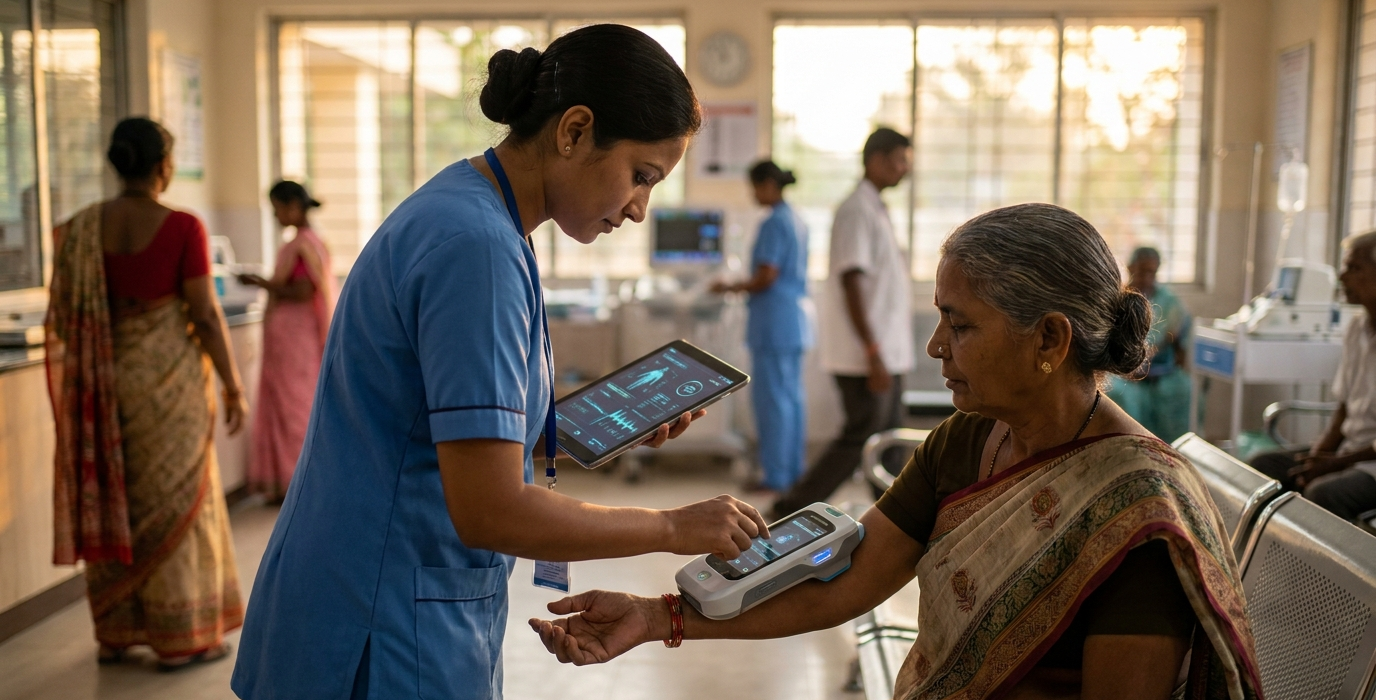
Moreover, AI is being used to develop user-friendly diagnostic interfaces that require less specialized training to operate. This empowers local healthcare workers, like Accredited Social Health Activists (ASHAs), to conduct initial screenings efficiently. The AI then provides an interpretation or flags anomalies for expert review. This distributed model of healthcare delivery is particularly transformative. It’s not just about diagnosing illness; it’s about bringing diagnostic power closer to where people live, fostering a culture of regular health checks. A fascinating development is the use of AI in analyzing audio data for early detection of respiratory illnesses like pneumonia or even certain cardiac conditions, which can be done even with basic smartphone microphones.
The Economic Equation: Cost-Effectiveness and AI Adoption
The perception that advanced medical technology is prohibitively expensive is slowly changing, thanks to the economic efficiencies that AI is bringing to diagnostics. While the initial investment in AI systems can be substantial, the long-term cost savings are significant. Early detection, facilitated by AI, leads to less invasive treatments, shorter hospital stays, and reduced complications – all of which contribute to lower overall healthcare expenditures. For healthcare providers, AI can optimize resource allocation, streamline workflows, and reduce diagnostic turnaround times, leading to greater operational efficiency.
We are observing a trend where AI-powered diagnostic solutions are becoming more accessible, particularly for smaller clinics and hospitals. Cloud-based AI platforms allow smaller entities to leverage powerful diagnostic algorithms without the need for massive on-premise infrastructure. This model democratizes access to cutting-edge technology, enabling a wider range of healthcare facilities to offer advanced diagnostic services. This is crucial for strengthening the healthcare ecosystem across India, from bustling metropolises to Tier-2 and Tier-3 cities.
The competitive landscape is also driving down costs. As more companies develop and refine AI diagnostic tools, innovation accelerates, and prices become more competitive. This creates a virtuous cycle where increased adoption leads to further development and cost reductions. We are also seeing novel business models emerge, such as pay-per-use or subscription-based AI diagnostic services, making these technologies more affordable for a broader spectrum of healthcare providers. The economic argument for AI in diagnostics is becoming increasingly compelling, making it a sound investment for improved patient care.
Beyond the Clinic: AI in Wearables and Personal Health Monitoring
The integration of AI into wearable devices is transforming personal health monitoring, moving diagnostics from the doctor’s office into our daily lives. Smartwatches, fitness trackers, and even smart rings are now equipped with sensors that collect a wealth of physiological data. AI algorithms analyze this continuous stream of information – heart rate, sleep patterns, activity levels, even blood oxygen saturation – to identify subtle deviations from your personal baseline. This allows for the proactive identification of potential health issues before they become serious.
Imagine your smartwatch alerting you to an irregular heart rhythm that could indicate atrial fibrillation, prompting you to consult a doctor. Or consider AI analyzing your sleep data to detect early signs of sleep apnea, a condition that can have serious long-term health consequences if left untreated. These devices are becoming sophisticated personal health guardians, offering continuous, non-intrusive monitoring. This shifts the paradigm from infrequent check-ups to ongoing, data-driven health awareness.
A particularly fascinating development is the use of AI to analyze patterns in voice or even subtle changes in typing speed and accuracy, which can be early indicators of neurological conditions like Parkinson’s or cognitive decline. While these are still evolving areas, the potential for early, non-invasive detection through everyday digital interactions is immense. The data collected by wearables, when analyzed by advanced AI, provides a unique, longitudinal view of an individual’s health, enabling truly personalized and preventative care strategies. We are empowered to take a more active role in managing our own well-being.
The Human Element: AI as a Partner, Not a Replacement
It’s crucial to address the understandable concern that AI might replace human healthcare professionals. In the realm of diagnostics, the reality is far more collaborative. AI excels at pattern recognition, data processing, and tireless analysis, but it lacks the empathy, intuition, and nuanced understanding of human experience that doctors and nurses provide. AI is a powerful tool that augments human capabilities, freeing up clinicians to focus on what they do best: patient care, communication, and complex decision-making.
Think of AI as the incredibly efficient research assistant for a doctor. It can sift through thousands of medical papers, analyze vast datasets of patient outcomes, and highlight potential diagnostic pathways. The doctor then uses their expertise, combined with the AI’s findings and their understanding of the individual patient’s context, to make the final diagnosis and treatment plan. This partnership leads to more accurate, timely, and personalized healthcare. The human touch remains indispensable.
Indeed, the ethical considerations surrounding AI in healthcare are paramount. Ensuring data privacy, algorithmic fairness, and transparency in AI decision-making are ongoing efforts. Regulatory bodies worldwide, including those in India, are working to establish clear guidelines to ensure these technologies are deployed responsibly and ethically. The goal is to harness the power of AI to improve human health and well-being, while always prioritizing patient safety and trust. We are building a future where technology and humanity work hand-in-hand for better health outcomes.
Frequently Asked Questions
How is AI improving early disease detection right now?
In 2026, AI is actively analyzing medical images for subtle signs of cancer, diabetic retinopathy, and other conditions. It also predicts individual risk for diseases like heart disease and diabetes by processing vast patient data sets.
Can AI diagnostics be used in remote Indian villages?
Yes, AI-powered telemedicine platforms are bridging the gap. Mobile screening units and AI-enhanced diagnostic tools allow local health workers to conduct initial assessments, with results reviewed by remote specialists.
Will AI replace my doctor?
No, AI is designed to augment, not replace, healthcare professionals. It handles data analysis and pattern recognition, allowing doctors to focus on patient care, empathy, and complex decision-making.
Are AI diagnostic tools expensive?
While initial investment can be high, AI offers long-term cost savings through early detection and efficient resource use. Cloud-based solutions and competitive markets are making these tools increasingly affordable.
What kind of data does AI use for diagnostics?
AI uses a wide range of data, including medical images (X-rays, MRIs), patient health records, genetic information, lifestyle data from wearables, and even audio data for detecting certain conditions.