Key Takeaways
- AI-powered tutors in India are moving beyond rote learning to offer deep, personalized learning experiences tailored to individual student paces and styles.
- These advanced platforms leverage sophisticated AI to diagnose learning gaps with precision and provide targeted interventions, significantly improving comprehension and retention.
- For educators, AI tutors serve as invaluable assistants, freeing them from repetitive tasks and enabling them to focus on complex pedagogy and student well-being.
- While challenges like digital access and teacher training persist, the transformative potential of AI in democratizing quality education across India is undeniable, promising a future where every child can unlock their full academic potential.
The Dawn of Adaptive Learning: Beyond the One-Size-Fits-All Model
The Indian education landscape, long characterized by a diverse spectrum of learning needs and aspirations, is undergoing a profound transformation. For decades, the traditional classroom model, while effective for many, often struggled to cater to the unique pace and style of every student. Students who grasped concepts quickly might find themselves unchallenged, while those who needed more time could fall behind, creating a widening gap in understanding. Today, however, a new era is dawning, driven by the rapid advancements in Artificial Intelligence, ushering in what many are calling EdTech 3.0. This isn’t just about digital textbooks or online quizzes; we’re talking about intelligent, adaptive learning systems that are fundamentally reshaping how students learn and teachers teach, particularly here in India, a nation deeply invested in its future generations.
These AI-powered tutors are designed to go far beyond simple content delivery. They act as dynamic learning companions, constantly analyzing a student’s interaction with the material. This analysis goes deep, understanding not just *what* a student knows, but *how* they learn best, identifying subtle patterns in their responses, the time taken to solve problems, and even the types of errors they tend to make. This granular insight allows the AI to personalize the learning journey in real-time. Imagine a student in a bustling Chennai neighborhood struggling with algebraic equations. Instead of a generic explanation, an AI tutor might offer a visual approach using examples relevant to their local environment, or perhaps a step-by-step breakdown that pauses at precisely the point where comprehension falters. This level of individualized attention, once a luxury confined to expensive private tutoring, is now becoming accessible to a much wider segment of the Indian student population, promising to democratize quality education like never before.
Unlocking Potential: AI’s Precision in Diagnosing Learning Gaps
One of the most revolutionary aspects of EdTech 3.0 is the AI tutor’s uncanny ability to diagnose learning gaps with remarkable precision. Traditional assessments often provide a broad overview, but identifying the root cause of a student’s difficulty can be a complex and time-consuming task for even the most dedicated teacher. AI, however, can sift through vast amounts of data generated by a student’s engagement with the platform to pinpoint specific areas of misunderstanding. It’s like having a highly skilled diagnostician who can instantly identify the exact mathematical concept, historical event, or scientific principle that is causing confusion.
For instance, an AI tutor might observe that a student consistently makes errors when dealing with fractions, but only when they involve mixed numbers. This isn’t just a note on a report card; the AI can then automatically generate tailored exercises and explanations specifically addressing this nuanced challenge. It might present the concept using relatable analogies, such as dividing a plate of biryani amongst friends, or break down the conversion process into smaller, more digestible steps. This targeted intervention is crucial for effective learning, preventing minor difficulties from escalating into significant obstacles. Furthermore, the AI can adapt the difficulty of subsequent questions based on the student’s performance, ensuring they are consistently challenged but not overwhelmed. This continuous assessment and remediation cycle fosters a sense of mastery and builds confidence, essential components for academic success. We’re seeing this in action in pilot programs across Uttar Pradesh, where students are showing measurable improvements in foundational literacy and numeracy.
Empowering Educators: The AI Co-Pilot in the Classroom
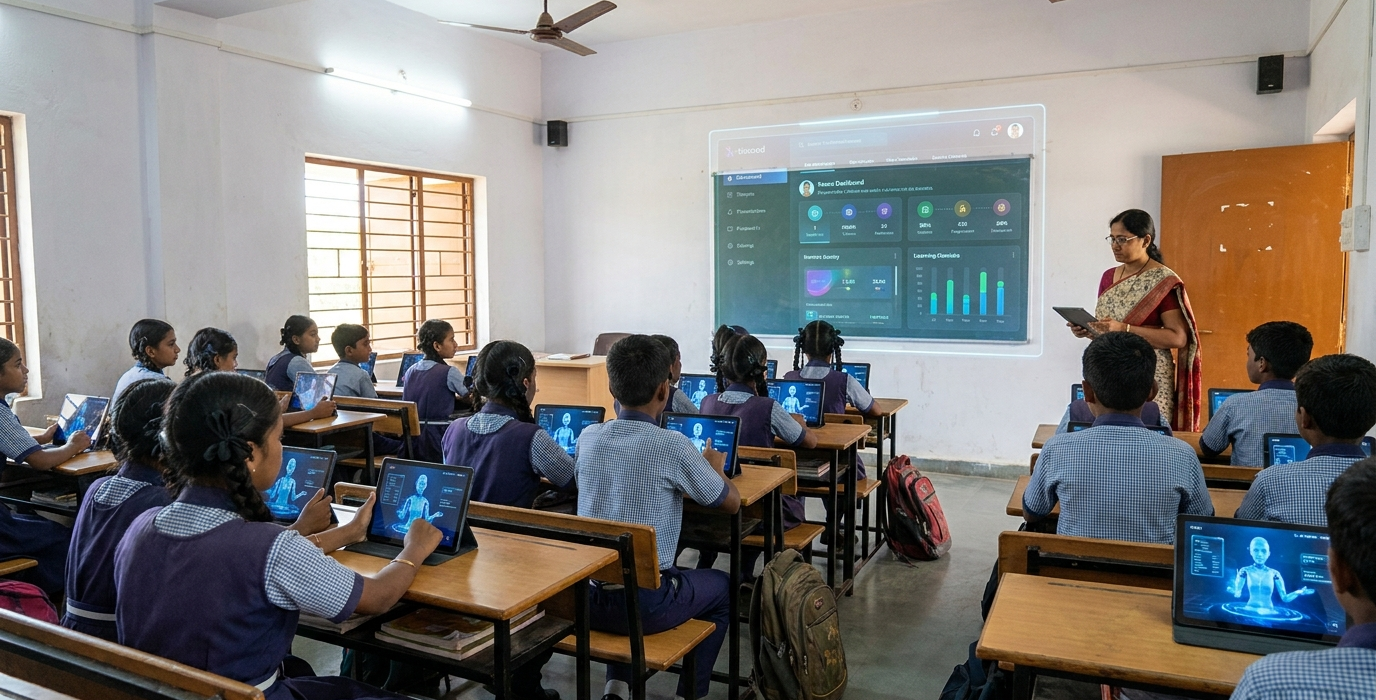
The introduction of AI tutors is not about replacing teachers; rather, it’s about empowering them with sophisticated tools that augment their capabilities and allow them to focus on what they do best: inspiring, mentoring, and guiding students. In the demanding environment of an Indian classroom, where teachers often juggle large class sizes and diverse learning needs, AI can serve as an invaluable co-pilot, automating many of the time-consuming, repetitive tasks that detract from direct student interaction. Think about the hours spent grading homework, preparing individualized practice sheets, or even tracking the progress of each student. AI can handle much of this workload efficiently and accurately.
Consider a scenario in a school in rural Rajasthan. A teacher might be responsible for teaching mathematics to three different grade levels. An AI platform can provide each student with personalized practice problems based on their current level and learning pace, freeing the teacher to spend more one-on-one time with students who require direct support or to design more engaging, project-based learning activities. The AI can also provide teachers with rich analytics and insights into their students’ performance, highlighting trends and identifying those who might be at risk of falling behind. This data-driven approach allows educators to intervene proactively and strategically, offering targeted support where it’s most needed. Moreover, AI can help teachers identify their own professional development needs by highlighting common areas where students struggle, suggesting relevant resources and training. This symbiotic relationship between AI and educators promises to elevate the teaching profession and enhance the overall quality of education delivered across the nation.
Bridging the Divide: Ensuring Access and Equity in the Digital Age
While the potential of AI in education is immense, we cannot ignore the persistent challenges related to digital access and equity, particularly in a country as vast and diverse as India. The promise of personalized AI tutors remains unfulfilled if a significant portion of students lack the necessary devices or reliable internet connectivity. This is a critical hurdle that needs to be addressed proactively to ensure that EdTech 3.0 becomes a tool for democratization, not further stratification. Initiatives by the Indian government, alongside partnerships with private sector players, are crucial in bridging this digital divide.
Efforts are underway to provide subsidized devices, expand broadband infrastructure to remote areas, and develop offline functionalities for AI learning platforms. For instance, projects in remote Arunachal Pradesh are exploring the use of low-bandwidth AI modules that can download content when connectivity is available and operate offline for extended periods. Furthermore, teacher training and digital literacy programs are paramount. Educators need to be equipped not only to use these new technologies but also to understand their pedagogical implications and integrate them effectively into their teaching practices. The success of AI in the classroom hinges on a holistic approach that considers the socio-economic realities of all students and educators. It requires a sustained commitment to ensuring that the benefits of technological advancement are shared equitably, reaching every corner of India and empowering every child with the tools they need to succeed in the 21st century.
The Future of Assessment: Continuous, Formative, and Insightful
The traditional model of high-stakes, summative assessments often serves as a bottleneck, creating anxiety and failing to capture the full spectrum of a student’s learning journey. EdTech 3.0, powered by AI tutors, is ushering in a new paradigm for assessment – one that is continuous, formative, and deeply insightful. Instead of relying solely on end-of-term exams, AI platforms continuously monitor student progress through their interactions with the learning material. Every question answered, every concept reviewed, and every problem solved contributes to a dynamic, evolving profile of the student’s understanding.
This formative assessment approach provides immediate feedback to both the student and the educator. Students receive instant notifications about their performance, along with explanations for any errors, allowing them to correct misunderstandings in real-time. For teachers, the AI generates detailed reports that go beyond simple scores, offering insights into specific areas where students are excelling or struggling. This granular data allows for timely and targeted interventions, preventing small issues from snowballing. For example, an AI tutor might detect that a student is consistently struggling with word problems in physics. It can then alert the teacher and simultaneously provide the student with additional practice exercises focused on decoding and interpreting text in a scientific context. This shift from punitive summative testing to supportive formative assessment fosters a growth mindset among students, encouraging them to view challenges as opportunities for learning rather than sources of failure.
A Surprising Insight: AI’s Role in Nurturing Soft Skills
While the primary focus of AI tutors is often on academic subjects, a less discussed but equally impactful benefit is their potential role in nurturing essential soft skills. Many advanced AI learning platforms are being designed to incorporate elements that encourage critical thinking, problem-solving, and even communication. For instance, an AI tutor can present students with complex, multi-faceted problems that require them to analyze information from various sources, evaluate different approaches, and justify their chosen solutions. This process inherently cultivates critical thinking and analytical skills.
Furthermore, some AI platforms are beginning to incorporate interactive dialogue features where students can engage in simulated discussions with the AI on complex topics. This can help them practice articulating their thoughts, responding to counterarguments, and developing their persuasive abilities. Imagine an AI tutor guiding a student through a debate on a historical event, prompting them to consider different perspectives and build a coherent argument. This not only deepens their understanding of the subject matter but also hones their communication and critical reasoning skills. A surprising fact is that some AI systems are now being trained to provide feedback not just on the accuracy of an answer, but also on the clarity and structure of the student’s written or verbal explanation. This goes beyond mere content mastery, aiming to develop well-rounded individuals prepared for the complexities of higher education and the modern workforce. The integration of these soft skill development elements within AI learning environments represents a significant evolution in educational technology, moving towards a more holistic approach to student development.
Frequently Asked Questions
What is EdTech 3.0?
EdTech 3.0 refers to the latest generation of educational technology that leverages advanced Artificial Intelligence to provide highly personalized, adaptive, and interactive learning experiences, moving beyond basic digital tools to truly transform the learning process.
How are AI tutors different from traditional online learning platforms?
Unlike static online platforms, AI tutors dynamically adapt to each student’s unique pace, style, and learning gaps. They offer real-time feedback, personalized interventions, and deeper diagnostics of understanding, providing a level of individual attention rarely found in traditional settings.
Will AI tutors replace human teachers in India?
No, AI tutors are designed to complement, not replace, human teachers. They act as assistants, automating routine tasks and providing data-driven insights, allowing educators to focus more on mentoring, complex pedagogy, and fostering a supportive learning environment.
What are the biggest challenges to widespread AI tutor adoption in India?
The primary challenges include ensuring equitable digital access and reliable internet connectivity across all regions, alongside the critical need for comprehensive teacher training to effectively integrate these new technologies into the classroom.