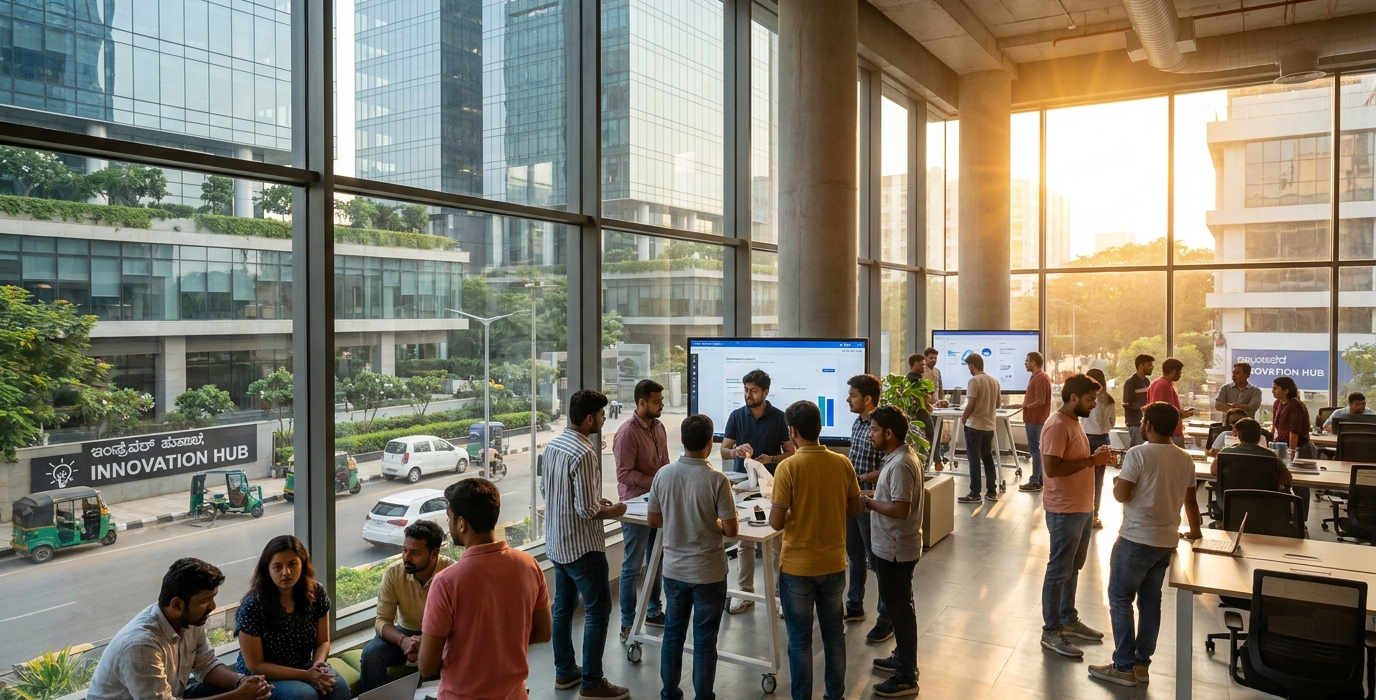
Key Takeaways
- Bengaluru’s startup ecosystem in 2026 is witnessing an unprecedented surge, driven by AI integration and deep tech advancements, especially in areas like quantum computing and biotech.
- Seed and Series A funding rounds are showing robust activity, with a particular focus on sustainable tech and ed-tech solutions catering to India’s growing digital native population.
- The government’s continued support through initiatives like the Startup India Seed Fund Scheme and revised tax incentives is playing a crucial role in fostering innovation and reducing early-stage risk.
- Despite global economic headwinds, Bengaluru remains a magnet for venture capital, attracting significant foreign investment, with a growing trend of ‘super angel’ investors emerging from successful homegrown startups.
Bengaluru 2026: A Nexus of AI and Deep Tech Revolution
As we navigate the latter half of 2026, Bengaluru, India’s undisputed Silicon Valley, continues to pulsate with an energy that’s palpable. This year marks a significant inflection point, not just for the city, but for the global tech landscape. The relentless march of Artificial Intelligence (AI) is no longer a distant promise; it’s woven into the very fabric of new ventures emerging from this vibrant ecosystem. We’re seeing AI not merely as a feature, but as a foundational technology, powering everything from hyper-personalized education platforms to sophisticated climate modeling tools.
Beyond AI, deep tech is carving out a substantial niche. Startups are pushing boundaries in fields like quantum computing, where early-stage research is translating into tangible applications for secure communications and complex problem-solving. Biotechnology is another hotbed, with innovations in personalized medicine and sustainable agriculture poised to address some of India’s most pressing challenges. The sheer volume of patent filings and the increasing number of successful proof-of-concept projects underscore this deep tech renaissance.
The AI Integration Imperative
What’s particularly striking in 2026 is the pervasive nature of AI integration. It’s not confined to the AI-specific startups; rather, established companies and nascent ventures alike are leveraging AI to optimize operations, enhance customer experiences, and unlock new revenue streams. Generative AI, in particular, has moved beyond novelty to become a critical tool for content creation, code generation, and even scientific discovery. We’re observing a shift from simply adopting AI to fundamentally rethinking business models around its capabilities.
The impact is visible across sectors. E-commerce platforms are using AI for predictive analytics to anticipate consumer needs with uncanny accuracy, while FinTech companies are deploying AI-powered fraud detection systems that are more robust than ever before. Even traditional industries, from manufacturing to healthcare, are finding innovative ways to embed AI, leading to increased efficiency and novel service offerings. This widespread adoption signals a maturity in the ecosystem’s understanding and application of this transformative technology.
Funding Flows: Seed Stage Optimism Amidst Global Caution
The funding landscape in Bengaluru for 2026 presents a picture of cautious optimism, particularly at the early stages. While mega-rounds for late-stage companies might be subject to global economic fluctuations, the seed and Series A funding rounds are displaying remarkable resilience and growth. This indicates a strong underlying belief in the innovative potential brewing within the city’s startup community.
Venture capitalists are actively seeking out disruptive ideas, with a clear preference for startups that address tangible market needs or offer sustainable solutions. We’re seeing a significant influx of capital into sectors that promise long-term impact, such as renewable energy tech, agritech, and health-tech. The emphasis is on founders with a deep understanding of their domain and a clear roadmap for scalable growth, supported by robust technological foundations.
Sustainable Tech Takes Center Stage
A defining trend of 2026 is the undeniable rise of sustainable technology. Startups focused on clean energy, waste management, water conservation, and sustainable materials are not just attracting capital; they’re also garnering significant public and governmental support. This isn’t just about environmental consciousness; it’s about identifying lucrative market opportunities that align with global sustainability goals and India’s own commitments.
Companies developing advanced battery technologies for electric vehicles, innovative solutions for plastic recycling, or smart grids for efficient energy distribution are finding eager investors. The Indian government’s push towards net-zero emissions and its focus on a circular economy are further catalyzing this sector. This convergence of purpose and profit is making sustainability a highly attractive investment thesis for Bengaluru’s VCs.
Government Initiatives: Catalysts for a Thriving Ecosystem
The Indian government, through its various policy interventions and funding schemes, continues to play a pivotal role in nurturing Bengaluru’s startup ecosystem. Initiatives like the Startup India Seed Fund Scheme remain a critical lifeline for early-stage ventures, providing the much-needed initial capital to validate ideas and build prototypes. The ongoing refinement of tax incentives and regulatory frameworks also contributes to making India a more attractive destination for entrepreneurs and investors alike.
Beyond direct funding, the government’s focus on building incubation centers, fostering industry-academia collaboration, and streamlining the ease of doing business has created a more conducive environment for startups to flourish. The establishment of dedicated technology parks and innovation hubs across the country, with Bengaluru often serving as the pilot, further solidifies this supportive infrastructure. These consistent policy nudges are crucial for de-risking early-stage ventures and encouraging ambitious innovation.
The ‘Startup India’ Momentum
The momentum generated by the ‘Startup India’ initiative is clearly palpable in 2026. More than just a program, it has evolved into a national ethos, encouraging a generation of young Indians to pursue entrepreneurship. The simplified registration processes and the recognition of innovative startups as key drivers of economic growth have fostered a culture of innovation that extends far beyond the metropolitan hubs.
We are also seeing a more proactive approach from government bodies in engaging with the startup community, seeking feedback, and adapting policies to address emerging challenges. This collaborative spirit ensures that the ecosystem remains dynamic and responsive to the evolving needs of entrepreneurs. The long-term vision is clear: to position India as a global leader in innovation and technology, with Bengaluru at its vanguard.
Venture Capital: Bengaluru’s Enduring Magnet
Despite global economic uncertainties, Bengaluru continues to exert a powerful gravitational pull on venture capital. The city remains the primary destination for both domestic and international investors looking to tap into India’s burgeoning digital economy and its rapidly growing pool of tech talent. The presence of established venture capital firms, alongside a growing number of angel networks, creates a vibrant funding ecosystem.
Foreign direct investment into Bengaluru’s startup scene has seen a notable uptick in 2026, with global VCs recognizing the long-term growth potential and the increasing maturity of Indian startups. This influx of capital is not only fueling expansion but also bringing in global best practices in corporate governance, strategic planning, and market expansion. The city’s ability to attract such diverse and substantial investment underscores its status as a premier investment destination.
The Rise of the ‘Super Angel’
An interesting development we’re witnessing in 2026 is the emergence and increasing influence of ‘super angel’ investors. These are typically successful founders or early employees of well-known tech companies who have exited their ventures and are now reinvesting their capital and expertise back into the ecosystem. Their deep operational experience and intimate understanding of the startup journey make them invaluable partners for nascent companies.
These super angels often invest larger sums than traditional angels and provide crucial mentorship, strategic guidance, and access to their extensive networks. Their presence signifies a maturing ecosystem where experienced entrepreneurs are actively contributing to the next wave of innovation. This creates a virtuous cycle of knowledge transfer and capital investment, further strengthening Bengaluru’s position as a hub for entrepreneurial success.
Deep Tech Frontiers: Quantum, Biotech, and Beyond
The 2026 landscape in Bengaluru is increasingly defined by its foray into cutting-edge deep tech domains. While AI dominates headlines, significant advancements are being made in areas that promise to redefine industries in the coming decade. Quantum computing, once a theoretical pursuit, is now seeing the emergence of startups developing practical applications for complex computational problems.
These companies are focusing on areas like drug discovery, materials science, and financial modeling, where quantum algorithms can offer exponential speed-ups over classical computing. The potential for breakthroughs in these fields is immense, attracting specialized talent and early-stage investment. This signifies a shift from incremental improvements to fundamental technological leaps being driven from within India.
Biotech and Health-Tech Innovations
Biotechnology and health-tech are also experiencing a surge of innovation. Startups are leveraging AI and advanced data analytics to accelerate drug discovery, develop personalized treatment plans, and improve diagnostic accuracy. The focus is on making healthcare more accessible, affordable, and effective for a diverse population.
Beyond therapeutics, there’s a growing interest in med-tech devices, digital health platforms, and even synthetic biology applications. The challenges of a large, diverse population with varying healthcare needs provide a fertile ground for these innovations to be tested and scaled. This sector is not only attracting significant investment but also holds the promise of profoundly improving public health outcomes.
The Talent Pool: A Double-Edged Sword
Bengaluru’s reputation as a technology hub is intrinsically linked to its vast and talented workforce. In 2026, the city continues to attract top-tier engineering, design, and research talent from across India and even internationally. The sheer density of skilled professionals, coupled with a strong academic pipeline from institutions like the Indian Institute of Science (IISc) and the Indian Institutes of Technology (IITs), remains a significant draw for startups.
However, this abundance of talent also presents a challenge: intense competition for skilled individuals. Startups are finding themselves in a constant race to attract and retain top performers, often leading to escalating salary demands and creative benefits packages. The ability to build a strong company culture and offer meaningful growth opportunities is becoming as crucial as compensation in securing and keeping the best minds.
Nurturing Specialized Skills
The evolving nature of technology demands an equally evolving talent pool. We’re seeing a growing need for specialists in areas like quantum physics, advanced AI algorithms, cybersecurity, and synthetic biology. The traditional engineering graduate is no longer sufficient; companies are actively seeking individuals with specialized master’s and doctoral degrees, or those with proven track records in niche domains.
This has spurred a greater emphasis on upskilling and reskilling initiatives, both within companies and through educational institutions. Partnerships between industry and academia are becoming more critical than ever, ensuring that the curriculum aligns with the demands of emerging technologies. The success of Bengaluru’s deep tech ambitions hinges on its ability to cultivate and retain this highly specialized talent.
Navigating the Challenges: Global Headwinds and Local Realities
While the outlook for Bengaluru’s startup ecosystem in 2026 remains overwhelmingly positive, it’s crucial to acknowledge the challenges. Global economic headwinds, including inflation and geopolitical uncertainties, can indirectly impact investor sentiment and consumer spending, even in a robust market like India. This necessitates a strategic approach to fundraising and careful financial management for startups.
Locally, the infrastructure, while rapidly improving, can still pose challenges, particularly in terms of traffic congestion and the availability of affordable office spaces in prime locations. Furthermore, regulatory changes, though often designed to be supportive, can sometimes introduce complexities that startups need to navigate. Maintaining agility and adaptability in the face of these dynamic conditions is key to sustained success.
The Importance of Resilience and Adaptability
The startups that are poised for long-term success in 2026 are those that demonstrate exceptional resilience and adaptability. They are not afraid to pivot when market conditions change, to iterate on their products based on customer feedback, and to build lean, efficient operations. This proactive approach to challenges allows them to weather storms and emerge stronger.
“The true test of a startup in 2026 isn’t just about the innovation it brings, but its capacity to evolve and endure. Bengaluru’s ecosystem is proving its mettle by fostering that very resilience.”
The culture of learning from failure, a hallmark of successful startup ecosystems, is deeply ingrained in Bengaluru. This acceptance of setbacks as learning opportunities rather than dead ends empowers entrepreneurs to take calculated risks and push the boundaries of what’s possible. It’s this spirit that will continue to drive the city’s innovation engine forward.
Frequently Asked Questions
What are the most promising sectors for startups in Bengaluru in 2026?
The most promising sectors include Artificial Intelligence (AI) and Machine Learning, Deep Tech (Quantum Computing, Biotech), Sustainable Technology (Clean Energy, Waste Management), HealthTech, EdTech, and FinTech. These areas are driven by significant market demand, technological advancements, and supportive government policies.
How has the funding landscape for seed-stage startups changed in Bengaluru in 2026?
Seed and Series A funding rounds are showing robust activity in 2026, with investors showing a strong appetite for innovative deep tech and sustainable solutions. While late-stage funding can be influenced by global trends, early-stage capital remains accessible for well-vetted business plans.
What government initiatives are currently supporting startups in Bengaluru?
Key initiatives include the Startup India Seed Fund Scheme, various tax incentives and exemptions, incubation programs, and efforts to simplify regulatory compliance. The government’s continued focus on fostering innovation through programs like ‘Digital India’ also plays a crucial role.
Is it still a good time to start a tech company in Bengaluru?
Yes, 2026 presents an opportune time. The ecosystem is mature, with access to talent, funding, and a supportive government. However, success requires a strong understanding of market needs, a robust technological foundation, and the ability to navigate competitive pressures.
What are the biggest challenges facing startups in Bengaluru in 2026?
Key challenges include intense competition for talent, rising operational costs (especially for premium office spaces), navigating evolving regulations, and the indirect impact of global economic uncertainties on investor sentiment and consumer spending.