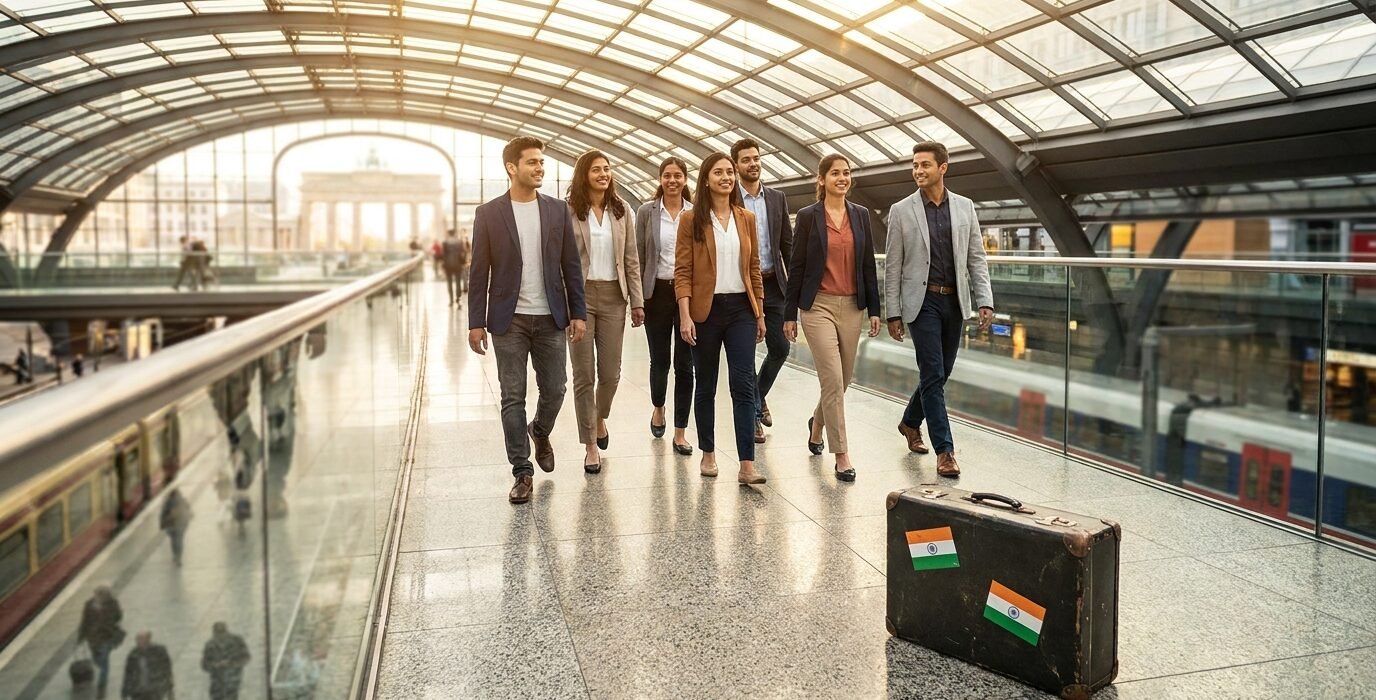
The hum of conversation in a Munich café is a familiar sound. It’s a blend of German, English, and languages from across the globe. Among them, you might catch the distinct cadence of Hindi or Punjabi. These are the voices of a new wave of Indian professionals and students. They are charting a course for Germany. This nation is increasingly recognized as a land of opportunity. It’s for those seeking skilled careers and quality education. Their journey is driven by ambition. It’s a quest for excellence. It’s a belief in a future forged in the heart of Europe.
Key Takeaways:
- Germany’s dual vocational training system is a major draw for Indian students seeking practical, job-ready skills.
- Indian professionals are attracted by Germany’s robust economy, high quality of life, and demand for skilled labor, particularly in engineering and IT.
- Navigating visa processes, language barriers, and cultural differences are significant challenges for newcomers.
- German industries are benefiting from the influx of Indian talent, filling critical skill gaps and fostering innovation.
- The long-term integration of these professionals is crucial for both their success and Germany’s economic future.
The Allure of the Dual System: From Classroom to Career in Berlin
Imagine a student, perhaps Rohan from Chandigarh, standing at a crossroads. He’s brilliant. Top of his class in engineering. But the traditional Indian university path feels a little too theoretical. It’s a bit disconnected from the shop floor. He hears whispers of Germany. Not just any Germany. But a system that marries classroom learning with hands-on apprenticeship. This is the famed Duale Ausbildung, the dual vocational training system.
In cities like Berlin, renowned technical institutes offer programs. Students spend half their week in a classroom absorbing theory. The other half is spent actively working in a company. Rohan learns about industrial automation. Not just from textbooks. He learns by actually programming robots at a manufacturing plant in Brandenburg.
His internship isn’t just a line on his resume. It’s real work. With real responsibilities. He earns a stipend. This isn’t just education. It’s an accelerated pathway to a secure career. Companies like Siemens, a giant in the electronics and electrical engineering sector, actively recruit from these programs. They need engineers who understand the intricacies of production lines. They need those who can troubleshoot complex machinery. The dual system provides precisely that. It’s a stark contrast to the often purely academic focus in India. There, the gap between university education and industry needs can be a chasm. For young Indians like Rohan, this offers a tangible, practical route to employability. It’s a chance to build a career from the ground up with direct industry relevance. The system’s success is palpable. High employment rates for its graduates make it an undeniable magnet for ambitious Indian youth.
[Related: Exploring the Future of Skilled Trades in India]
Beyond Academia: The Pull of a Stable Economy and a High Quality of Life
It’s not just about vocational training. For established Indian professionals, the migration to Germany is also a calculated move. It’s a move towards stability. And a superior quality of life. Think of Priya, a software engineer from Bangalore. She felt the pressure of a hyper-competitive job market. She experienced the uncertainty of contract roles.
She looked at Germany. Specifically at cities like Hamburg. It’s known for its thriving tech scene. It has an international outlook. The German economy, despite global fluctuations, has remained remarkably resilient. It’s built on a foundation of strong manufacturing. Advanced engineering. And a burgeoning IT sector. This translates into job security. And better compensation packages. Priya found herself drawn to opportunities in Germany’s automotive industry. This sector is heavily investing in software for electric vehicles and autonomous driving. Companies like Volkswagen and BMW are actively seeking skilled professionals. They need them to drive their digital transformation.
Beyond the career prospects, the appeal is deeply personal. The German healthcare system is world-class. It’s accessible and affordable. Public transportation is efficient and reliable. It makes navigating cities like Frankfurt easy. The work-life balance is a significant factor. Overtime is generally compensated. The emphasis on leisure time and family is a welcome change. Many are accustomed to longer, more demanding work hours in India. Even the availability of green spaces. And the general safety of cities contribute to a higher perceived quality of life. This holistic package – a stable career, excellent social infrastructure, and a healthier lifestyle – makes Germany a compelling destination. The perception isn’t just about jobs. It’s about building a sustainable, fulfilling life.
Navigating the Labyrinth: Visas, Language, and Cultural Shifts
The dream of a German future isn’t without its hurdles. For many, the first significant obstacle is the visa application process. It can be a complex web of paperwork. Proof of funds. Official appointments. It often requires patience. And meticulous attention to detail. A young graduate applying for a student visa to pursue a Master’s in Mechanical Engineering in Stuttgart might spend months gathering necessary documents. They ensure their translated transcripts and financial guarantees meet the stringent requirements of the German embassy.
Then there’s the language. While many Germans, particularly in business and academia, speak excellent English, fluency in German is often key. It’s essential for deeper integration and career advancement. Learning German is a commitment. It often involves intensive language courses. These can be costly and time-consuming. It’s not just about ordering a “Kaffee” or asking for directions. It’s about understanding nuanced conversations in the workplace. Grasping cultural subtext. And feeling truly at home.
The cultural shift itself can be profound. Germans are often perceived as direct and reserved. This is a contrast to the more outwardly expressive communication styles common in India. Building friendships. Understanding social etiquette. Adapting to different norms around punctuality and personal space require conscious effort. An anecdote shared by a group of Indian IT professionals in Cologne spoke of their initial surprise. There was a lack of casual small talk in office meetings. Discussions often got straight to the point. They had to learn to adjust their communication style. Becoming more concise and task-oriented. This process of adaptation isn’t always smooth. But the rewards of successful integration are immense. They open doors to both professional success and a rich personal life.
The German Industry’s Gain: Filling Skill Gaps with Indian Ingenuity
Germany’s industrial backbone, while strong, has faced a persistent challenge: a shortage of skilled labor. Decades of low birth rates and an aging population mean many vital sectors struggle to find qualified workers. This is where the influx of Indian talent becomes not just beneficial, but essential. Consider the automotive sector again. With the rapid transition to electric mobility, there’s an insatiable demand for engineers. They specialize in battery technology, software development, and electrical systems. Indian graduates, often equipped with strong theoretical knowledge and a willingness to adapt, are stepping into these roles. They bring fresh perspectives. And a different approach to problem-solving, which can be invaluable.
A study by the German Economic Institute (IW) highlighted that migration, particularly of skilled workers, is crucial for Germany. It helps maintain economic competitiveness. It offsets demographic decline. Companies in the engineering and manufacturing hubs of Bavaria and Baden-Württemberg are actively recruiting from India. They are not just filling vacancies. They are bringing in individuals with specialized skills. Often in areas where local talent is scarce. This isn’t just about numbers. It’s about bringing in a diverse pool of talent that can foster innovation. Indian professionals often bring a different approach to project management. And a strong work ethic, complementing the existing German workforce. The challenges of integration are real. But German companies are increasingly investing in onboarding programs. These address language support and cultural orientation. They recognize that investing in their new employees is an investment in their own future. The partnership is mutually beneficial. German industries gain crucial expertise. Indian professionals find pathways to fulfilling careers.
A Home Away From Home: Building Communities and Futures in Germany
The journey of an Indian professional or student in Germany is more than just about career advancement or academic pursuits. It’s about building a life. Finding a sense of belonging. Creating a home away from home. In cities like Frankfurt, known for its international finance sector, you’ll find vibrant Indian communities. They offer a crucial support network. These communities organize cultural events. They celebrate festivals like Diwali and Holi. They provide a familiar space. Newcomers can connect with others who understand their experiences.
Think of the comfort a newly arrived student, perhaps from a bustling city like Chennai, might find at a local Indian Association event. They can share familiar food and conversations in their mother tongue. This sense of community is vital for mental well-being. It helps combat feelings of isolation that can arise during the initial stages of relocation. Furthermore, these communities act as informal knowledge hubs. They share advice on navigating local bureaucracy. Finding accommodation. Understanding the nuances of German society.
Beyond the Indian diaspora, there’s a growing effort within German society to embrace multiculturalism. Initiatives in cities like Stuttgart aim to foster better integration. They offer language exchange programs and cultural workshops. These bridge divides and build understanding. The long-term success of this talent migration hinges on creating an environment. Indian professionals feel welcomed, respected, and empowered to contribute fully. When they can thrive both professionally and personally, they not only enrich their own lives. They also contribute significantly to the social and economic fabric of Germany. The seeds of a truly integrated society are being sown. One shared experience at a time.
The Long View: Sustaining the Talent Flow and Mutual Growth
The migration of Indian professionals and students to Germany is more than a transient trend. It represents a strategic alignment of needs and opportunities. Germany requires skilled labor to fuel its innovation-driven economy. It needs to address demographic challenges. India, with its vast young population and growing pool of educated individuals, seeks global opportunities for its talent. The success of this migration hinges on sustained efforts from both sides.
Germany must continue to streamline its immigration policies. It must make it easier for skilled workers to enter and contribute. Investing in language training and cultural integration programs is paramount for long-term retention. For Indian aspirants, a realistic understanding of the challenges is key. Coupled with a commitment to learning and adaptation. The narrative is shifting. It’s moving from simply seeking jobs to building careers and contributing to a new society.
As more Indians establish themselves in Germany, they become ambassadors. They share their positive experiences. They encourage further talent flow. The counter-flow of knowledge and cultural exchange also enriches India. It brings back new ideas and perspectives. This is not just about economic exchange. It’s about building bridges between two diverse and dynamic cultures. The future looks promising. Both nations are poised to benefit from this deepening connection. It fosters a partnership built on shared ambition and mutual respect.