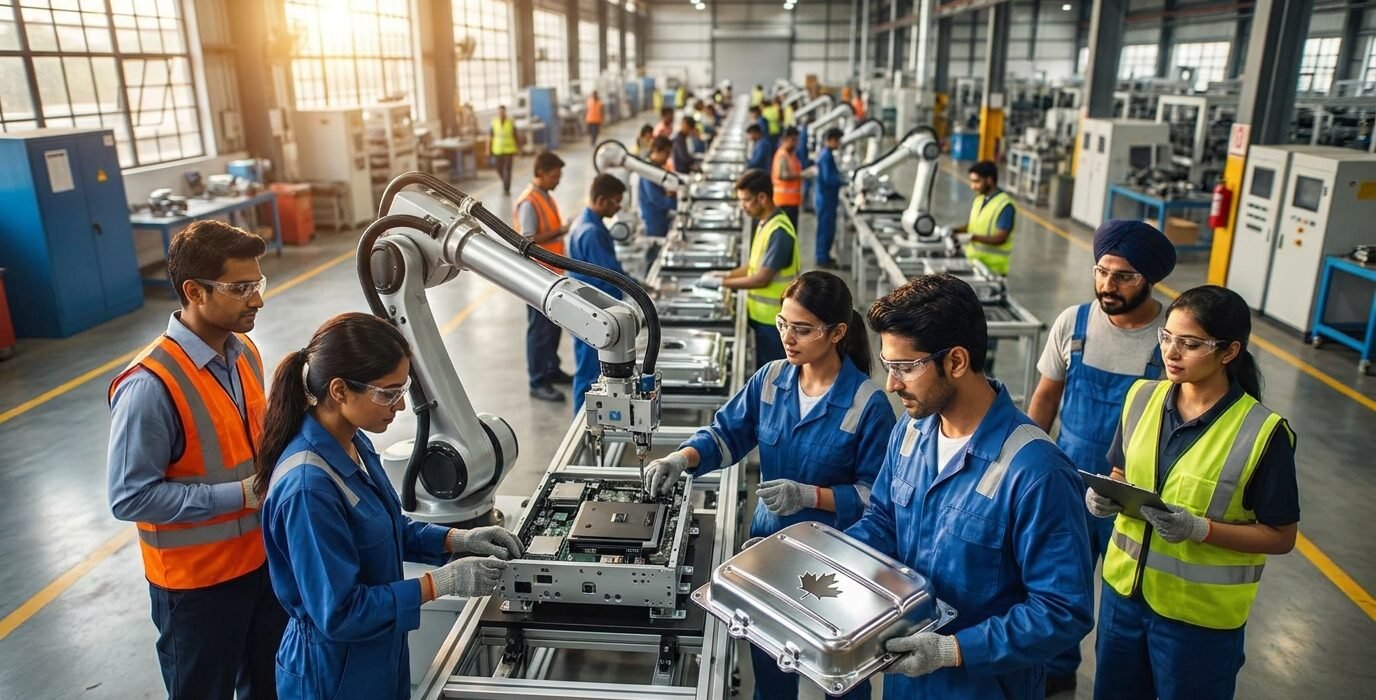
Canada’s maple syrup flows freely, a sweet symbol of its enduring economic ties. But what happens when a nation as vast and ambitious as India starts brewing its own industrial revolution? The “Make in India” initiative, launched in 2014, isn’t just a domestic policy; it’s a global invitation. Canadian manufacturers are increasingly looking east, seeking to understand if this seismic shift in India’s economic landscape presents their next great export opportunity. We’re talking about more than just selling goods. We’re exploring a potential future where collaboration, innovation, and shared growth redefine what it means for Canadian businesses to thrive on the world stage.
Key Takeaways:
- The “Make in India” policy aims to boost domestic manufacturing, but it also creates significant opportunities for foreign partners, including Canadian firms.
- Sectors like automotive, aerospace, and advanced manufacturing in Canada are well-positioned to benefit from India’s industrial growth.
- Navigating India’s regulatory environment and understanding local market nuances are crucial for Canadian exporters.
- Increased collaboration can lead to cost efficiencies, access to new markets, and technological advancements for both nations.
- The long-term success hinges on sustained policy support in India and proactive engagement from Canadian businesses.
The Promise of a Billion-Plus Consumers: India’s Shifting Industrial Landscape
Imagine Delhi’s bustling Chandni Chowk, a sensory explosion of spices, textiles, and human energy. Now, picture that same vibrant spirit being channeled into advanced industrial parks, state-of-the-art research facilities, and factories churning out sophisticated components. This is the vision behind “Make in India.” Launched by Prime Minister Narendra Modi, the initiative is a comprehensive strategy designed to transform India into a global manufacturing hub.
It’s not just about creating jobs. It’s about fostering innovation, attracting foreign investment, and ensuring that the products bearing the “Made in India” label are competitive on the world stage. For Canada, a nation with a strong tradition in advanced manufacturing and a keen eye for global markets, this presents a compelling narrative. The sheer scale of India’s domestic market, with its burgeoning middle class and increasing disposable income, is an undeniable draw. Companies that can tap into this demand, or supply the necessary components and expertise to meet it, stand to gain immensely.
The policy offers incentives for manufacturing. It aims to simplify business regulations and promotes investment in key sectors. This isn’t just about exporting finished goods. It’s about becoming a crucial part of India’s own production chain, a partner in its industrial ascendancy. We’re witnessing a fundamental shift. India, once primarily seen as a market for services and IT, is now actively positioning itself as a powerhouse for tangible goods. This evolution demands a fresh perspective from Canadian businesses, moving beyond traditional trade relationships to explore deeper, more integrated partnerships. The potential for growth is staggering, but so are the complexities of engaging with such a dynamic and rapidly evolving economy.
Automotive Dreams and Aerospace Aspirations: Where Canada Shines
When we talk about Canadian manufacturing prowess, two sectors immediately come to the forefront: automotive and aerospace. Think of the sophisticated engineering that goes into a Canadian-built Bombardier jet or the intricate components that power a General Motors vehicle assembled in Oshawa. These are industries built on precision, rigorous quality control, and a deep understanding of complex supply chains. Now, consider India’s own ambitious plans for its automotive sector, which is already one of the largest in the world and poised for further expansion, especially in electric vehicles. “Make in India” has a specific focus on boosting local production, encouraging the use of advanced technologies, and developing a robust ecosystem for parts and components.
This is where Canadian companies, with their established expertise in areas like advanced materials, precision tooling, and electric powertrain technology, can find fertile ground. The Canadian Commercial Corporation, for instance, has been actively exploring avenues to facilitate trade and investment, recognizing the immense potential. Similarly, India’s burgeoning aerospace sector, driven by both defense modernization and a growing civilian aviation market, presents another significant opportunity. Canadian firms are world-leaders in aircraft manufacturing, avionics, and specialized aerospace components. The prospect of supplying these critical parts to Indian manufacturers or collaborating on research and development projects is a tangible outcome of the “Make in India” push.
It’s about more than just selling existing products. It’s about co-developing solutions tailored to India’s unique needs and leveraging Canada’s technological edge. This symbiotic relationship, where Canadian innovation meets Indian manufacturing scale, is the core of the opportunity. The potential to transfer knowledge, establish joint ventures, and create a more resilient global supply chain for these critical industries is immense. We are not just looking at a market; we are looking at a partnership in innovation.
Navigating the Labyrinth: Challenges and Opportunities in India
Let’s be frank: doing business in India, while rewarding, is not without its challenges. The sheer size and diversity of the country, coupled with its intricate regulatory framework, can be daunting for any foreign entity. For a Canadian business accustomed to a relatively streamlined regulatory environment, understanding and adapting to India’s legal and bureaucratic landscape is paramount. The “Make in India” initiative has made strides in simplifying processes, but navigating permits, licenses, and compliance requirements still demands significant diligence. We often hear stories from Canadian exporters about the time it takes to get approvals or the nuances of local tax structures.
However, these challenges are precisely what create opportunities for those who are prepared. Companies that invest in understanding the local context, build strong relationships with Indian partners, and employ local expertise are the ones that tend to succeed. For instance, businesses that have successfully established manufacturing or assembly units in India often highlight the importance of having a dedicated team on the ground, fluent in both business and local customs. The government’s efforts to improve ease of doing business, such as the introduction of the Goods and Services Tax (GST) and digital initiatives like India’s Unified Payments Interface (UPI) for seamless transactions, have certainly smoothed the path.
Yet, the journey requires patience, persistence, and a willingness to adapt. The rewards, however, can be substantial. Access to a vast, growing consumer base, a skilled and increasingly educated workforce, and the potential to become a key player in a rapidly developing economy are powerful motivators. It’s a testament to the resilience and adaptability of Canadian businesses that so many are willing to take on this challenge. The key lies in viewing these hurdles not as roadblocks, but as stepping stones to deeper integration and long-term success in one of the world’s most dynamic markets.
The Unexpected Advantage: How “Make in India” Spurs Canadian Innovation
It might seem counter-intuitive, but the “Make in India” initiative, designed to boost India’s own manufacturing capabilities, can paradoxically spur significant innovation within Canada. When Canadian companies are tasked with meeting the specific demands of the Indian market – whether it’s adapting products for different climatic conditions, integrating technologies for cost-sensitive applications, or developing sustainable manufacturing processes to meet India’s environmental goals – they are pushed to think outside their usual boxes. This often leads to the development of new materials, more efficient production methods, and entirely novel product designs that can then be leveraged back in Canadian and global markets.
Consider the automotive sector. India’s push for electric vehicles and fuel-efficient technologies, driven by both environmental concerns and energy security, is forcing Canadian auto parts manufacturers to innovate rapidly. They might develop lighter, stronger composite materials to improve battery range or design more robust cooling systems for high-temperature climates. These innovations don’t stay confined to India. They become part of the global R&D portfolio of Canadian firms. Similarly, in aerospace, the need to adhere to India’s stringent quality standards and potentially develop customized avionics for specific Indian aircraft programs encourages Canadian engineers to refine their existing technologies and explore new frontiers.
The pressure to compete on cost while maintaining high quality in India necessitates leaner, more agile manufacturing processes. This can lead to breakthroughs in automation, artificial intelligence for quality control, and advanced robotics. All of which enhance the competitiveness of Canadian manufacturing overall. The unexpected benefit here is that “Make in India” acts as a powerful catalyst, forcing Canadian industries to push the boundaries of their own technological capabilities, ultimately making them stronger and more resilient on a global scale. This isn’t just about exporting; it’s about co-creating the future of manufacturing.
Beyond Exports: The Rise of Joint Ventures and Technology Transfer
The true potential of “Make in India” for Canada extends far beyond simply exporting finished goods. The policy actively encourages foreign direct investment and the establishment of joint ventures, creating a more profound and mutually beneficial economic relationship. This is where Canadian companies with deep technological expertise and a strong research and development base can truly shine. Imagine a Canadian aerospace firm partnering with an Indian conglomerate to establish a state-of-the-art manufacturing facility in Bengaluru, not just to produce existing components but to co-develop next-generation aircraft systems.
This type of collaboration allows Canadian companies to leverage India’s cost-effective manufacturing capabilities and access its vast talent pool, while simultaneously transferring critical technology and intellectual property. The benefits are manifold. For Canadian businesses, joint ventures can provide a more direct and secure entry into the Indian market, mitigating some of the risks associated with direct exports. They also allow for greater customization of products to meet local demand, fostering stronger customer relationships. For India, these partnerships bring much-needed foreign investment, advanced technology, and high-skilled employment opportunities, accelerating its industrial development.
We’ve seen this model work effectively in other sectors, and the “Make in India” initiative provides a clear policy framework and governmental support to facilitate such arrangements. The transfer of knowledge is not a one-way street. Canadian firms often gain invaluable insights into emerging market needs and innovative solutions developed by their Indian counterparts. This cross-pollination of ideas and technologies is what truly drives long-term economic growth and competitiveness for both nations, creating a robust, integrated supply chain that benefits everyone involved. It’s a sophisticated dance of mutual growth.
A Shared Future Forged in Factories and Innovation Hubs
The narrative of “Make in India” is still unfolding, and its ultimate impact on Canadian manufacturing exports and collaboration will be written in the coming years. What is clear, however, is that this ambitious Indian initiative is not merely an inward-looking policy. It is a powerful magnet attracting global industrial players. For Canada, with its advanced technological capabilities, particularly in sectors like automotive, aerospace, and advanced machinery, the opportunities are substantial. The potential for increased exports, the establishment of joint ventures, and the crucial transfer of technology represent a significant avenue for economic growth.
But success will depend on more than just recognizing the opportunity. It requires a proactive, strategic approach from Canadian businesses. This means investing time and resources to understand the Indian market, building strong partnerships with Indian entities, and adapting to local business environments. It also means leveraging government support mechanisms, such as trade missions and export financing, to navigate the complexities of international trade. The Indian government’s continued commitment to improving the ease of doing business, alongside its focus on innovation and sustainability, will be critical factors in sustaining this momentum. As India continues its journey to becoming a global manufacturing powerhouse, Canadian industry has a unique chance to be not just a supplier, but a vital partner in this transformation. The shared future forged in these factories and innovation hubs could very well be a story of unprecedented economic prosperity for both nations, a testament to what can be achieved when ambition meets collaboration on a global scale.