Key Takeaways
- By 2026, India’s 5G rollout is significantly impacting sectors like healthcare, agriculture, and manufacturing, moving beyond basic faster downloads.
- New applications leveraging 5G’s low latency and high bandwidth are emerging, from remote surgery assistance in tier-2 cities to precision farming powered by IoT.
- Challenges remain, including infrastructure expansion to rural areas and developing a skilled workforce for advanced 5G applications.
- The focus is shifting from consumer speed to enterprise solutions, with businesses actively exploring 5G for operational efficiency and innovation.
The 5G Revolution: More Than Just Speed in India (2026)
As we navigate 2026, India’s 5G journey is evolving at a remarkable pace. It’s no longer just about faster downloads or smoother video streaming, though those benefits are certainly present. The true revolution lies in how this advanced connectivity is reshaping entire industries, unlocking potential that was previously confined to science fiction. From the bustling metropolises to the farmlands of Punjab, 5G is weaving a new digital tapestry, driving efficiency, innovation, and a better quality of life.
We are witnessing a paradigm shift. Telecom operators, having laid significant groundwork, are now focusing on monetizing their investments through enterprise solutions. This strategic pivot is crucial, as it moves 5G from a consumer-centric upgrade to a foundational technology for national development. The implications are far-reaching, promising to bridge digital divides and empower communities in ways we are only beginning to comprehend.
Consider the sheer scale of India’s digital transformation. With a young, tech-savvy population and a government committed to digital India, the adoption curve for 5G-enabled services is steep. This isn’t just about keeping pace; it’s about leapfrogging, creating new economic opportunities, and solidifying India’s position on the global technological stage. The conversation has moved beyond “when will 5G arrive?” to “how can we best harness its power?”
Healthcare’s Digital Pulse: Remote Care and Precision Medicine
In 2026, the healthcare sector is one of the most profound beneficiaries of India’s 5G expansion. Beyond faster access to patient records, we’re seeing the rise of telemedicine platforms with real-time, high-definition video consultations, allowing specialists in Mumbai to connect seamlessly with patients in remote villages of Himachal Pradesh. This drastically reduces the need for long-distance travel, a significant barrier to healthcare access for many.
One of the most exciting advancements is in remote surgical assistance. Imagine a seasoned surgeon in Delhi guiding a local practitioner through a complex procedure in a tier-2 city hospital using augmented reality (AR) overlays enabled by 5G’s ultra-low latency. This technology can provide critical real-time data and visual guidance, democratizing access to specialized surgical expertise.
Furthermore, 5G is powering the next generation of medical devices and diagnostics. Wearable health trackers and IoT-enabled medical equipment can now transmit vast amounts of patient data continuously and reliably to healthcare providers. This allows for proactive monitoring, early detection of anomalies, and personalized treatment plans, moving India towards a more preventative and precision-based healthcare model. A surprising fact: by the end of 2026, it’s estimated that over 150 hospitals across India will have established dedicated 5G networks for internal operations and advanced telemedicine capabilities.
Agriculture Transformed: Smart Farming and Rural Empowerment
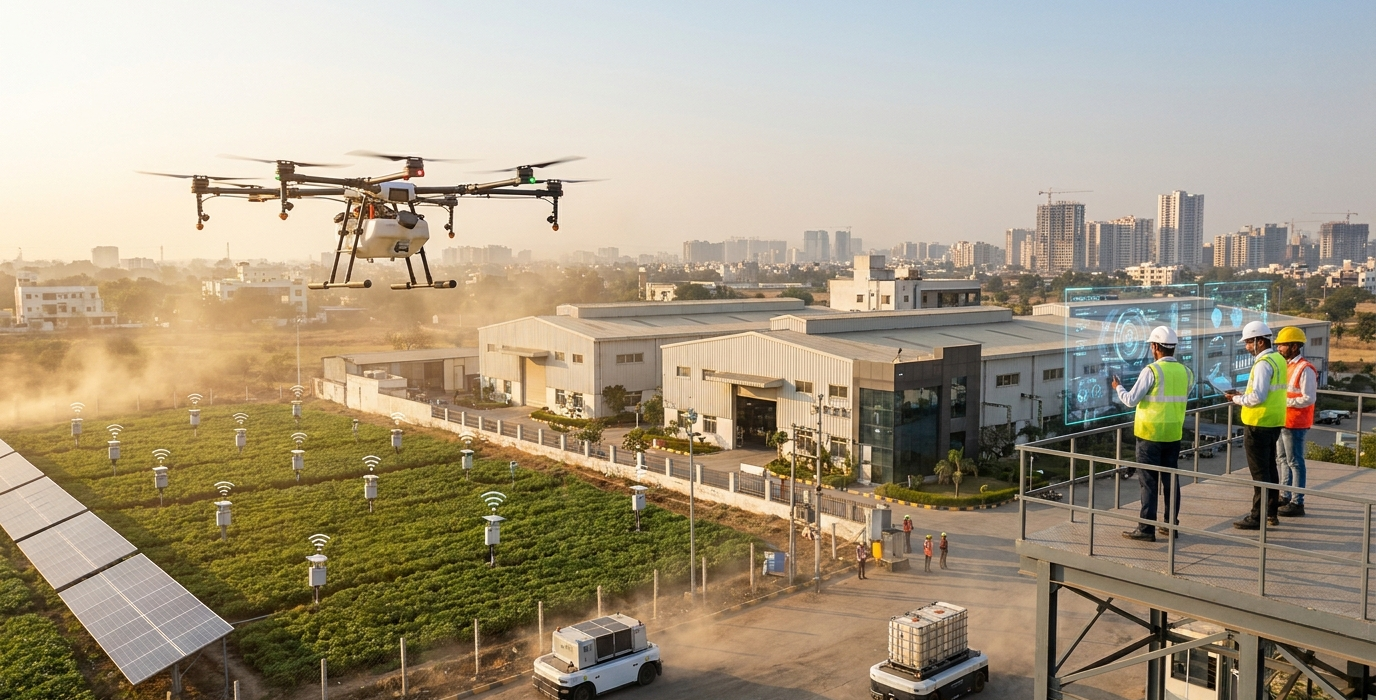
The agricultural heartlands of India are also experiencing a significant 5G-driven transformation. For farmers in states like Uttar Pradesh and Karnataka, this technology is moving beyond basic mobile connectivity to deliver tangible improvements in crop yields and resource management. Precision agriculture, powered by a network of IoT sensors, is becoming a reality.
Farmers can now deploy sensors that monitor soil moisture, nutrient levels, and weather patterns in real-time. This data, transmitted instantly over 5G, allows for highly targeted irrigation and fertilization, optimizing resource use and reducing wastage. Drones equipped with multispectral cameras, guided by 5G, can provide detailed crop health assessments, identifying disease outbreaks or pest infestations far earlier than traditional methods. This proactive approach is crucial for safeguarding harvests.
Beyond the fields, 5G is also enhancing market access and supply chain efficiency. Farmers can use high-definition video to showcase their produce to buyers in distant cities, potentially fetching better prices. The ability to track produce from farm to fork in real-time, thanks to 5G-enabled supply chain solutions, ensures freshness and reduces spoilage. A fascinating development is the emergence of AI-powered crop advisory services delivered via 5G-enabled kiosks in remote villages, offering personalized advice based on local conditions and global best practices.
Manufacturing Leaps Forward: Automation and the Smart Factory
In the industrial corridors of Gujarat and Maharashtra, 5G is the backbone of the smart factory revolution. The enhanced low latency and massive device connectivity offered by 5G are enabling unprecedented levels of automation and real-time monitoring within manufacturing plants. This translates directly into increased productivity, improved safety, and greater flexibility in production.
We’re seeing extensive use of wireless-connected robots and automated guided vehicles (AGVs) that can navigate factory floors with precision and adapt to changing layouts instantly, all orchestrated by the 5G network. This eliminates the need for cumbersome wired infrastructure, allowing for more dynamic and efficient factory operations. The ability to connect thousands of sensors and machines simultaneously is crucial for achieving true operational intelligence.
Predictive maintenance is another game-changer. By collecting and analyzing vast amounts of data from machinery in real-time, 5G-enabled systems can predict potential equipment failures before they occur. This minimizes costly downtime and extends the lifespan of expensive machinery. Furthermore, 5G is facilitating the adoption of AR and VR for training, remote assistance, and quality control, making manufacturing processes safer and more efficient. A surprising fact: by late 2026, over 30% of new manufacturing facilities being commissioned in India are designed from the ground up with 5G infrastructure as a core component.
The Future of Retail and Logistics: Enhanced Customer Experience and Efficiency
The retail and logistics sectors are also being profoundly reshaped by 5G in 2026. For consumers, this means a more immersive and personalized shopping experience, whether online or in-store. High-bandwidth 5G enables seamless streaming of high-definition product videos, AR-powered virtual try-ons from the comfort of your home, and interactive in-store displays that offer detailed product information on demand.
In logistics, 5G is revolutionizing tracking and supply chain visibility. Real-time location tracking of goods, even in complex urban environments or vast warehouses, is now possible with remarkable accuracy. This allows businesses to optimize delivery routes, minimize transit times, and provide customers with precise, up-to-the-minute updates on their orders. The reduction in delivery errors and delays is substantial.
Edge computing, powered by 5G, is also enhancing warehouse operations. Smart inventory management systems can now process data locally, enabling faster decision-making for stock replenishment and order fulfillment. This efficiency trickles down to the end consumer through faster deliveries and improved service. We are also seeing pilots for autonomous delivery vehicles in select urban areas, leveraging 5G for navigation and communication.
Bridging the Digital Divide: 5G’s Role in Education and Governance
Beyond commercial applications, 5G is poised to play a crucial role in bridging India’s digital divide, particularly in education and governance. In 2026, we are seeing the acceleration of initiatives to bring high-speed internet to rural schools and community centers across the country. This connectivity opens up a world of educational resources that were previously inaccessible.
Imagine students in a village near the Western Ghats participating in live virtual classes taught by educators from a top institution in Delhi, or accessing interactive e-learning modules with high-quality video content. 5G’s reliability and speed make these experiences not just possible, but seamless and engaging. This democratizes access to quality education, irrespective of geographical location.
In governance, 5G is enhancing the delivery of public services. Digital public infrastructure can be made more robust and responsive. For instance, citizens can access government services through interactive kiosks with high-definition video interfaces, enabling more complex queries and resolutions. The ability to deploy smart city technologies, such as intelligent traffic management and public safety monitoring systems, is also significantly boosted by 5G’s capabilities. A surprising fact: by the end of 2026, over 50,000 ‘Digital India’ community centers are expected to be upgraded with 5G connectivity, significantly expanding their reach and functionality.
Challenges and the Road Ahead
While the transformative power of 5G in India is undeniable in 2026, we must acknowledge the challenges that lie ahead. The sheer geographic diversity and population density of India present a monumental task for nationwide infrastructure deployment. Ensuring equitable access, particularly in remote and underserved regions, remains a significant hurdle.
The development of a skilled workforce capable of designing, deploying, and managing advanced 5G applications is another critical area. India needs a robust pipeline of engineers, data scientists, and technicians with expertise in areas like IoT, AI, and network security. Without this human capital, the full potential of 5G will remain untapped.
Furthermore, the cost of devices that can fully leverage 5G capabilities needs to become more accessible to the broader population. While 5G plans are becoming competitive, the upfront investment in compatible smartphones and other devices can still be a barrier for many. We also need to ensure robust cybersecurity measures are in place to protect the vast amounts of data that will be generated and transmitted over these networks.
“The true value of 5G in India by 2026 is not in the gigabits per second, but in the millions of lives it can improve through enhanced healthcare, smarter agriculture, and more efficient industries.”
Frequently Asked Questions
Will 5G truly reach all of India by 2026?
While significant progress is being made, nationwide coverage across every remote village might not be fully achieved by 2026. However, major urban centers and district headquarters are well-covered, with ongoing efforts to expand into tier-2 and tier-3 cities and surrounding rural areas. The focus is on strategic deployment for critical services.
What are the main industries benefiting most from 5G in India right now?
The most significant beneficiaries in 2026 are healthcare (telemedicine, remote diagnostics), agriculture (precision farming, IoT), and manufacturing (automation, smart factories). These sectors are leveraging 5G’s low latency and high bandwidth for immediate operational improvements and innovative solutions.
Is 5G impacting everyday Indian consumers yet, beyond speed?
Yes, beyond speed, consumers are starting to experience enhanced quality in video streaming, gaming, and real-time communication applications. The groundwork is also being laid for AR/VR experiences and more sophisticated connected home devices, though widespread adoption of these latter applications is still evolving.
What are the biggest challenges for India’s 5G rollout in the coming years?
The primary challenges include expanding infrastructure to remote areas, developing a skilled workforce for advanced applications, ensuring affordability of 5G-enabled devices, and implementing robust cybersecurity measures to protect the growing digital ecosystem.