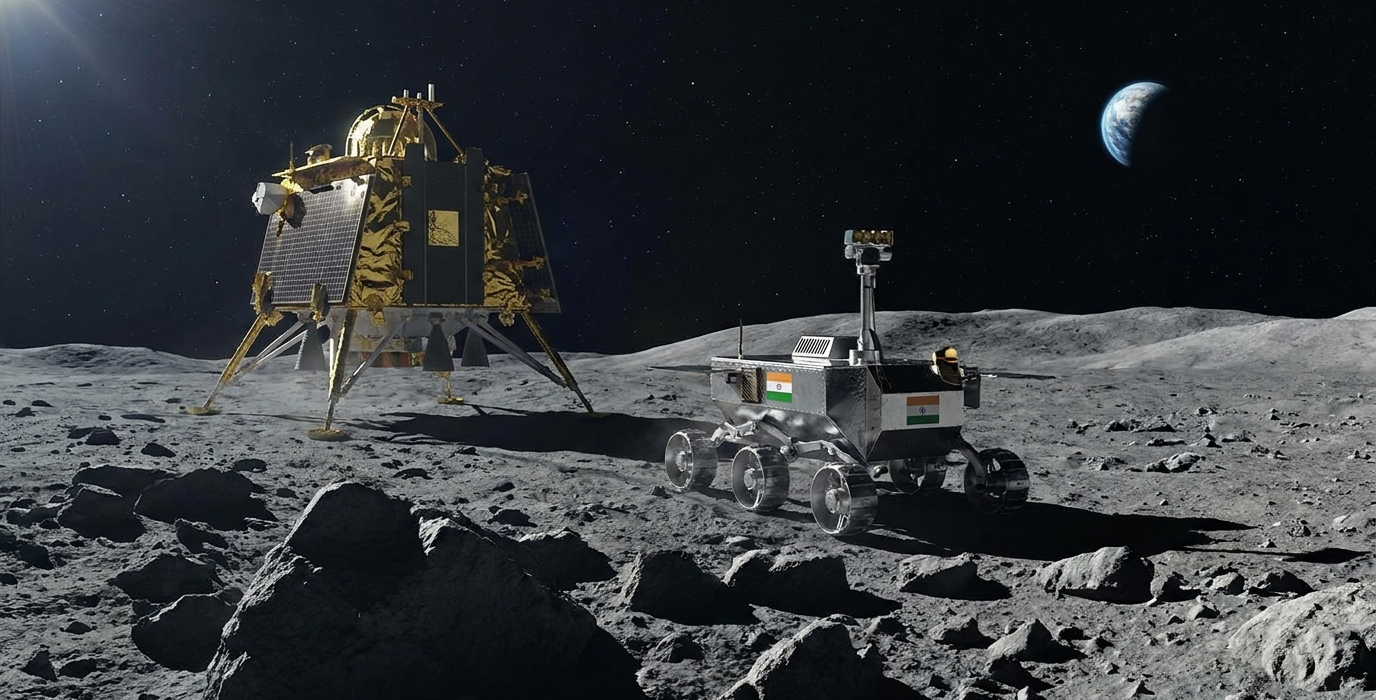
Key Takeaways
- The Chandrayaan-4 mission, slated for a 2027 launch, aims to bring back lunar samples for unprecedented scientific analysis.
- ISRO is focusing on advanced robotics and precision landing technology, building on Chandrayaan-3’s success.
- International collaboration is a cornerstone, with potential partnerships being explored with agencies like NASA and ESA.
- The mission’s success could unlock deeper insights into the Moon’s formation and potential for resource utilization.
Chandrayaan-4: India’s Ambitious Lunar Sample Return Mission
India’s space odyssey continues with renewed vigour as the Indian Space Research Organisation (ISRO) gears up for its most ambitious lunar mission yet: Chandrayaan-4. Building on the monumental success of Chandrayaan-3, which achieved a soft landing near the Moon’s south pole, Chandrayaan-4 is designed not just to explore, but to bring a piece of the Moon back to Earth. This sample return mission, targeted for a 2027 launch, represents a significant leap forward in India’s capabilities in deep space exploration.
The primary objective is to collect pristine lunar regolith and rock samples from scientifically interesting locations, potentially including areas never before visited by humans or robotic missions. These samples will then be transported back to Earth for detailed analysis in sophisticated laboratories. Such an endeavour requires an entirely new suite of technologies and meticulous planning, pushing the boundaries of what ISRO has achieved previously.
The mission’s complexity means it’s not just a repeat of previous successes, but a significant upgrade in our ability to interact with celestial bodies. The challenges are immense, from ensuring a precise landing on a specific target site to the intricate process of excavating and storing samples, and finally, achieving a successful ascent from the lunar surface and a safe re-entry into Earth’s atmosphere. The stakes are high, but so is the potential scientific reward.
Precision Landing and Advanced Robotics: The Technological Backbone
The success of Chandrayaan-4 hinges critically on its ability to perform a highly precise landing. Unlike Chandrayaan-3, which targeted a broad region, Chandrayaan-4 will need to land within a few meters of a pre-determined sampling site. This demands advancements in autonomous navigation, hazard detection, and fine-tuned retro-rocket firing. ISRO scientists are working on sophisticated algorithms and sensor fusion to ensure pinpoint accuracy, even in challenging lunar terrains.
Accompanying the lander will be an advanced robotic arm and a drill capable of excavating samples from varying depths. This is not merely about scooping up loose dust; the mission aims to retrieve core samples that can reveal the Moon’s geological history. The robotic systems must be robust enough to operate in the harsh lunar environment, with extreme temperature variations and abrasive dust. The design considerations include miniaturisation and power efficiency, crucial for a mission of this scope.
Furthermore, Chandrayaan-4 will likely feature a small ascent vehicle. This component is critical for lifting off from the lunar surface after sample collection, rendezvousing with an orbiter, and transferring the precious cargo. Developing an indigenous ascent stage capable of lunar launch is a significant technological hurdle that ISRO is actively addressing. The precision required for a lunar ascent and subsequent orbital manoeuvre is a testament to the growing maturity of India’s space program.
Scientific Objectives: Unlocking Lunar Secrets
The scientific motivations behind Chandrayaan-4 are profound. By returning lunar samples to Earth, scientists will gain access to analytical tools far more sophisticated than any that can be sent to the Moon. This will allow for incredibly detailed studies of the Moon’s composition, its formation history, and its relationship with Earth. For decades, missions from various nations have collected samples, but each new sample provides fresh insights and helps refine our understanding of planetary science.
One of the key targets for sample collection will be the lunar poles, particularly the permanently shadowed regions. These areas are believed to harbour significant amounts of water ice, a crucial resource for future lunar bases and human exploration. Understanding the origin and distribution of this ice, and its geological context, is a primary goal. The samples will help answer questions about whether this water is of cometary origin, volcanic outgassing, or a combination of factors.
Beyond water ice, Chandrayaan-4 aims to probe the Moon’s internal structure and its early geological evolution. By analysing different rock types and mineral compositions, scientists can piece together the timeline of volcanic activity, impact events, and the Moon’s differentiation into core, mantle, and crust. This mission could provide definitive answers to long-standing questions about the Giant Impact Hypothesis and the early conditions of the inner solar system. A surprising fact is that the Apollo missions, while successful, only collected samples from specific equatorial regions, leaving vast areas and their unique geological histories largely unexplored by sample return efforts.
International Collaboration: A Global Endeavour
ISRO has consistently advocated for international cooperation in space exploration, and Chandrayaan-4 is set to be a prime example of this philosophy. While the core mission architecture and development will be led by India, ISRO is actively engaging with international space agencies to explore collaborative opportunities. These partnerships can range from sharing scientific data and expertise to potentially integrating payloads or even components of the mission.
Discussions are underway with agencies like NASA (National Aeronautics and Space Administration) and ESA (European Space Agency). These collaborations can bring valuable resources, technological expertise, and diverse scientific perspectives. For instance, a joint scientific payload could enhance the mission’s data-gathering capabilities, while shared launch facilities or communication networks could optimise operational efficiency. It’s envisioned that these partnerships will not only benefit Chandrayaan-4 but also pave the way for future joint ventures in space.
The spirit of collaboration is crucial for large-scale space missions, which are inherently complex and resource-intensive. By pooling resources and knowledge, nations can achieve more than they could individually. This fosters a sense of shared progress and responsibility in humanity’s quest to understand the cosmos. The inclusion of international partners also ensures that the scientific returns are analysed by a global community, enriching our collective knowledge. A less-known aspect of ISRO’s outreach is its ongoing dialogue with private aerospace companies, exploring how their innovative technologies can be integrated into future lunar missions.
Challenges and Opportunities for India’s Space Sector
Chandrayaan-4 presents a formidable set of challenges for ISRO and the broader Indian space ecosystem. Mastering lunar ascent and sample return is a complex engineering feat that requires robust testing and validation. The development of new propulsion systems, life support for any potential biological samples (though not currently planned), and precise trajectory calculations for Earth re-entry are all critical areas of focus. The programme will necessitate significant investment in research and development, as well as advanced manufacturing capabilities.
However, these challenges are also immense opportunities for growth. The mission will drive innovation across multiple sectors, from materials science and robotics to software engineering and mission control. It will also create high-skilled jobs and foster a new generation of scientists and engineers. The successful execution of Chandrayaan-4 will further solidify India’s position as a leading spacefaring nation, capable of undertaking complex, multi-stage missions.
The economic implications are also significant. India’s burgeoning space sector is already attracting private investment, and a successful sample return mission will undoubtedly boost this trend. It could lead to the development of new commercial applications, such as lunar resource prospecting or even advanced space logistics. The mission is not just about scientific discovery; it’s about building a sustainable and prosperous space economy for India. Indeed, ISRO’s vision extends beyond Chandrayaan-4, with preliminary studies for missions to Mars, Venus, and even the asteroid belt already underway.
The Road Ahead: Beyond Chandrayaan-4
Chandrayaan-4 is not an end goal but a crucial stepping stone in ISRO’s long-term vision for lunar exploration and beyond. The technologies developed for this mission will be foundational for future endeavours, including potential human missions to the Moon and even Mars. The experience gained in precision landing, autonomous operations, and complex orbital manoeuvres will be invaluable as India sets its sights on more ambitious destinations.
Looking further ahead, ISRO is reportedly exploring concepts for a sustained lunar presence, which could involve establishing a research outpost or participating in international efforts to build a lunar base. The ability to conduct in-situ resource utilisation (ISRU), such as extracting water or oxygen from lunar regolith, will be paramount for such long-term sustainability. Chandrayaan-4’s sample analysis could provide critical data for planning these future ISRU activities.
The success of Chandrayaan-4 will undoubtedly inspire a new generation of Indians, much like the Apollo missions inspired Americans and the early successes of ISRO inspired many across India. It will demonstrate that with dedication, innovation, and a clear vision, even the most challenging scientific and engineering goals are within reach. The mission embodies India’s spirit of ‘Atmanirbhar Bharat’ (self-reliant India) in the realm of cutting-edge technology and exploration, showcasing its potential to contribute significantly to global scientific progress. One remarkable aspect of ISRO’s future planning is the continuous re-evaluation of mission parameters based on real-time data from ongoing missions, a flexible approach that ensures optimal scientific returns.
Frequently Asked Questions
When is Chandrayaan-4 scheduled to launch?
The Chandrayaan-4 mission is currently targeted for a launch in 2027. ISRO is working diligently to meet this timeline, but as with any complex space mission, exact dates can be subject to change based on technological readiness and testing.
What is the primary goal of Chandrayaan-4?
The primary goal of Chandrayaan-4 is to achieve a lunar sample return. This means collecting lunar rocks and regolith and bringing them back to Earth for detailed scientific analysis, which offers far greater analytical capabilities than on-site instruments.
Will Chandrayaan-4 carry any international payloads?
ISRO is actively exploring international collaborations for Chandrayaan-4. While the core mission will be Indian-led, there are ongoing discussions about integrating scientific instruments or technologies from partner space agencies like NASA and ESA.
What scientific questions will Chandrayaan-4 help answer?
The mission aims to shed light on the Moon’s formation and evolution, the origin and distribution of water ice in polar regions, and the early history of the solar system. The returned samples will allow for unprecedented studies of lunar geology and composition.
How does Chandrayaan-4 differ from Chandrayaan-3?
While Chandrayaan-3 focused on a soft landing and in-situ exploration, Chandrayaan-4 is a sample return mission. This requires significantly more advanced technologies, including a lunar ascent vehicle and precise sample collection and transfer capabilities, going beyond the exploratory scope of its predecessor.