In an era where our screens dictate the rhythm of our professional and personal lives, the ancient practice of Yoga offers a surprisingly modern solution to digital eye strain. By integrating targeted ocular movements into your daily routine, you can effectively counteract the fatigue caused by hours of staring at pixels.
Key Takeaways
- Yoga for the eyes, or Trataka, helps improve focus and lubrication through rhythmic muscle movement.
- Consistent practice can reduce symptoms of Computer Vision Syndrome, which affects millions of urban professionals.
- Simple techniques like Palming and Blinking can be performed anywhere in under five minutes.
- Digital strain is cumulative; incorporating these habits between meetings is essential for long-term retinal health.
Understanding the Mechanics of Digital Eye Strain
Digital eye strain, clinically referred to as Computer Vision Syndrome, is the 2026 reality for anyone spending over six hours in front of a monitor. When you focus on a screen, your blink rate drops significantly, often by half or more, leading to dry, irritated eyes. This phenomenon is exacerbated by the blue light emissions and the constant micro-adjustments your ciliary muscles must make to keep text sharp.
The American Optometric Association highlights that prolonged screen time forces the eyes to maintain a fixed focal length, which can lead to spasms of the focusing muscle. In India, where work-from-home models and high-intensity academic schedules are common in hubs like Bengaluru and Gurgaon, the prevalence of these symptoms is reaching record highs. By recognizing that these symptoms are physical responses to environmental stress, you can begin to treat them with the same discipline you apply to physical exercise.
Yoga exercises for the eyes work by stretching the extraocular muscles—the six muscles responsible for controlling your eye movement. Just as you stretch your hamstrings after a run, your eyes require a cool-down phase after a long day of intense visual processing. These movements encourage better blood circulation to the ocular region and stimulate the lacrimal glands to produce moisture naturally.
Technique One: The Art of Palming
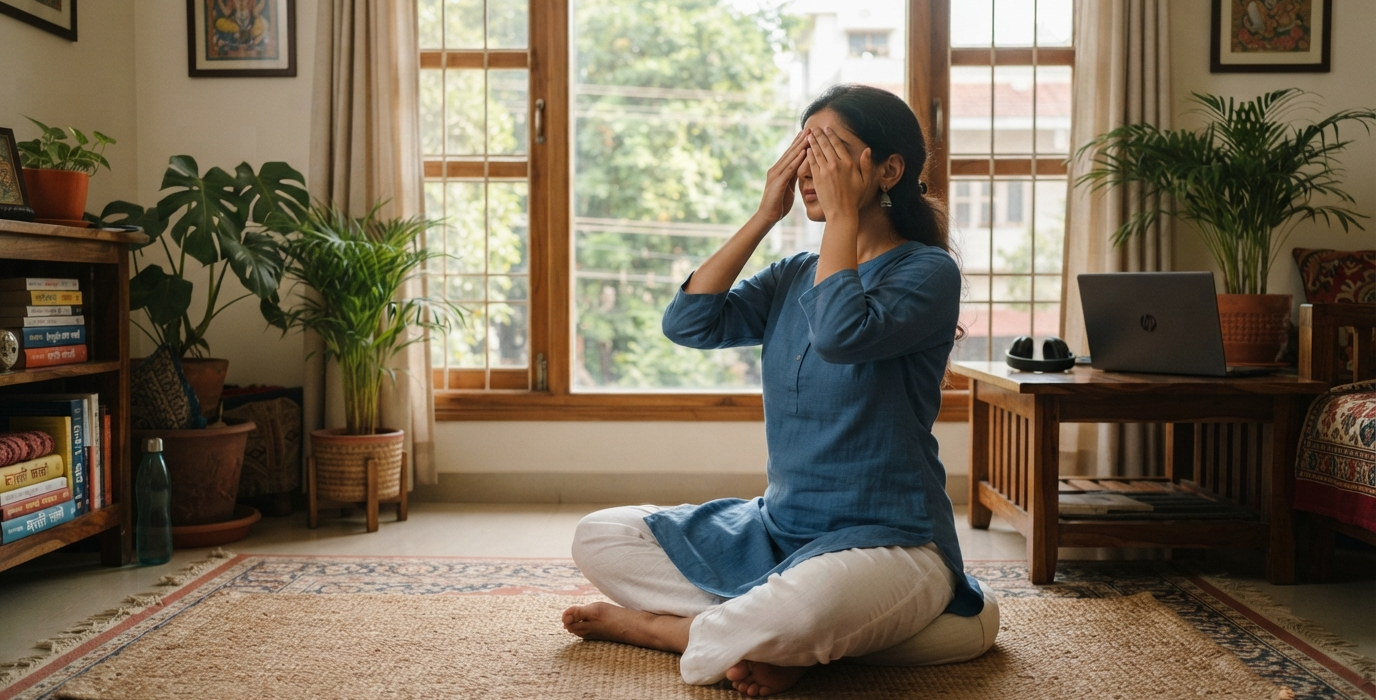
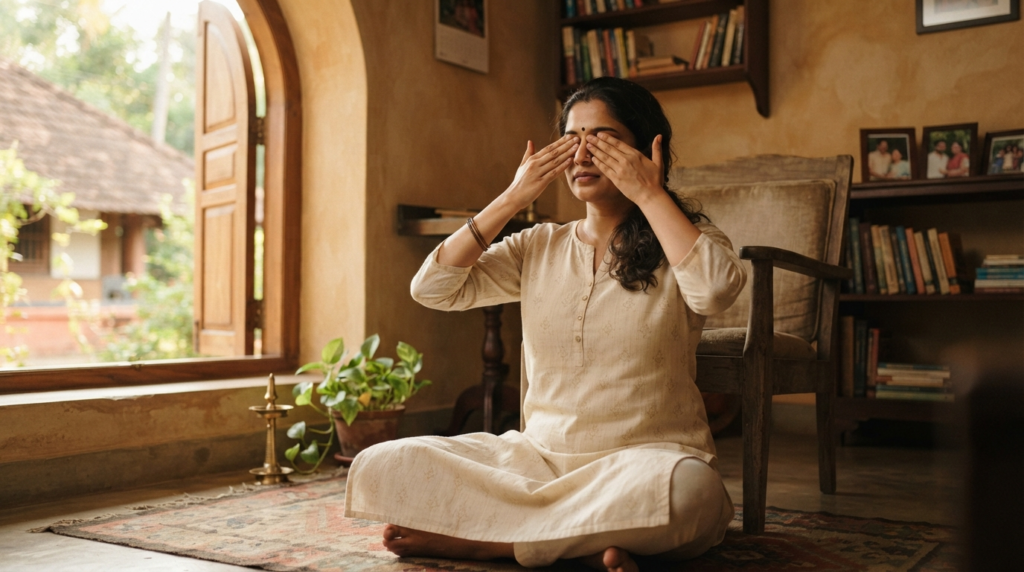
Palming is perhaps the most restorative practice you can introduce into your workday. This simple technique relies on the principle of heat transfer and sensory deprivation to soothe the optic nerves. To perform it, sit comfortably, close your eyes, and rub your palms together vigorously until you feel significant warmth generated by the friction.
Gently place your cupped palms over your closed eyes without applying direct pressure to the eyeballs themselves. The goal is to create a complete seal against the light while allowing the warmth to penetrate the eyelids. Breathe deeply for one to two minutes, focusing on the darkness and the radiant heat.
This practice provides an immediate sense of relief, signaling to the brain that it is time to shift from a sympathetic (fight-or-flight) state to a parasympathetic (rest-and-digest) one. When you remove your hands and open your eyes, you will notice a sharper clarity and a reduction in the “grit” sensation often felt after a long afternoon. It is a discreet practice that can be performed in a quiet corner of your office or even during a brief transit break in a Delhi Metro carriage.
Technique Two: Trataka and Focused Gaze
Trataka, or candle gazing, is a traditional Hatha Yoga practice that enhances concentration and clears the visual field. While the traditional method involves staring at a candle flame in a dark room, a modified version for the modern office involves picking a stationary object at eye level. This exercise trains the eyes to maintain a steady focus without the constant twitching associated with scanning screens.
Begin by selecting a small, non-moving object about an arm’s length away. Stare at it without blinking for as long as you comfortably can, until your eyes begin to water slightly. This process naturally cleanses the surface of the eye and stimulates the tear ducts, which is a surprisingly effective way to combat the dryness caused by air-conditioned office environments.
The Ministry of Ayush acknowledges that such cleansing practices are part of a broader set of yogic kriyas aimed at purifying the body and sharpening the senses. Once your eyes feel the urge to blink, close them tightly for a moment, then relax your face. Repeat this cycle three times to strengthen the eye muscles and improve your overall visual endurance during long reading sessions.
Comparative Guide: Routine Exercises for Daily Relief
Integrating these exercises into your day does not require a gym membership or hours of time. The following table compares common techniques based on their primary function and the environment best suited for their execution.
| Technique | Primary Benefit | Recommended Frequency | Ideal Setting |
|---|---|---|---|
| Palming | Deep Relaxation | Every 2 hours | Anywhere |
| Trataka | Focus & Cleansing | Once daily | Quiet/Dimmed room |
| Eye Rolling | Muscle Flexibility | Every 60 minutes | At your desk |
| Blinking | Moisture Retention | Every 20 minutes | While working |
For the best results, consistency is far more important than intensity. You do not need to perform these for 30 minutes; two minutes of mindful movement is better than an hour of sporadic, forced effort. Remember that your eyes are muscles; they respond to consistent, low-impact training.
Addressing the Digital Gap: Blinking and Rolling
One of the most overlooked aspects of eye health is the conscious blink. In the digital age, we suffer from “screen stare,” where our eyes remain wide open for prolonged periods. To correct this, follow the 20-20-20 rule: every 20 minutes, look at something 20 feet away for 20 seconds, and blink consciously ten times.
Eye rolling is another essential movement for those who spend their day scanning spreadsheets or complex code. By slowly rotating your eyes in a wide clockwise circle and then counter-clockwise, you stretch the muscles that remain static while looking at a monitor. This prevents the muscles from becoming “locked” in a single position, which can lead to headaches radiating from the temples.
Did you know that humans blink about 66% less often when reading or typing on a digital screen compared to reading physical paper? This biological discrepancy is a primary driver of ocular inflammation. By making blinking a conscious habit, you can bridge this gap and provide your eyes with the lubrication they require to function optimally throughout the workday.

Long-term Habits for Ocular Wellness
Yoga is not a cure-all, but it is a powerful tool when paired with good ergonomics. Ensure your monitor is at arm’s length and that the top of the screen is at or slightly below your eye level to prevent neck strain. The World Health Organization emphasizes that the environment in which you work is just as critical as the exercises you perform to mitigate health risks.
Hydration plays a significant role in eye health as well. If your body is dehydrated, your eyes will be the first to suffer from reduced tear production. Incorporate a balanced diet rich in leafy greens, such as spinach and fenugreek, which are abundant in Indian markets and contain essential nutrients like lutein and zeaxanthin.
Finally, consider the lighting in your workspace. Avoid working in total darkness with only a screen for illumination, as this causes significant pupil dilation and strain. Soft, ambient lighting that matches the brightness of your monitor will help maintain a consistent level of comfort for your visual system.
Frequently Asked Questions
Can eye yoga actually improve my vision prescription?
While yoga can significantly reduce symptoms of strain and fatigue, it is not a medically proven method to reverse refractive errors like myopia or astigmatism. It is best viewed as a way to maintain eye health and comfort rather than a replacement for corrective lenses.
How soon will I notice a difference in my eye comfort?
Most people report an immediate reduction in the “heavy” feeling around their eyes after a single session of palming. For sustained benefits in reducing chronic digital eye strain, you should aim to practice these routines consistently for at least two to four weeks.
Is it safe to do eye exercises while wearing contact lenses?
Yes, it is generally safe, but ensure your hands are perfectly clean before touching your face or eyes. If you feel any irritation during the movements, stop immediately, remove your lenses, and consult your optometrist to ensure your lenses are not contributing to the dryness.
Should I consult a doctor before starting these exercises?
If you have a history of retinal detachment, glaucoma, or recent ocular surgery, you must consult your ophthalmologist before beginning any eye exercises. These movements, while gentle, should always be performed within the limits of medical advice provided for your specific condition.