Key Takeaways
- Mumbai’s rooftop farms are transforming urban landscapes, offering fresh produce and combating the heat island effect.
- These initiatives range from individual balcony gardens to large-scale community projects, accessible to various income levels.
- Key challenges include water management, pest control, and ensuring structural integrity, with innovative solutions emerging.
- The movement fosters community engagement, promotes healthier diets, and contributes to a more sustainable urban future for India.
Rooftops Bloom: Mumbai’s Green Revolution Takes Flight
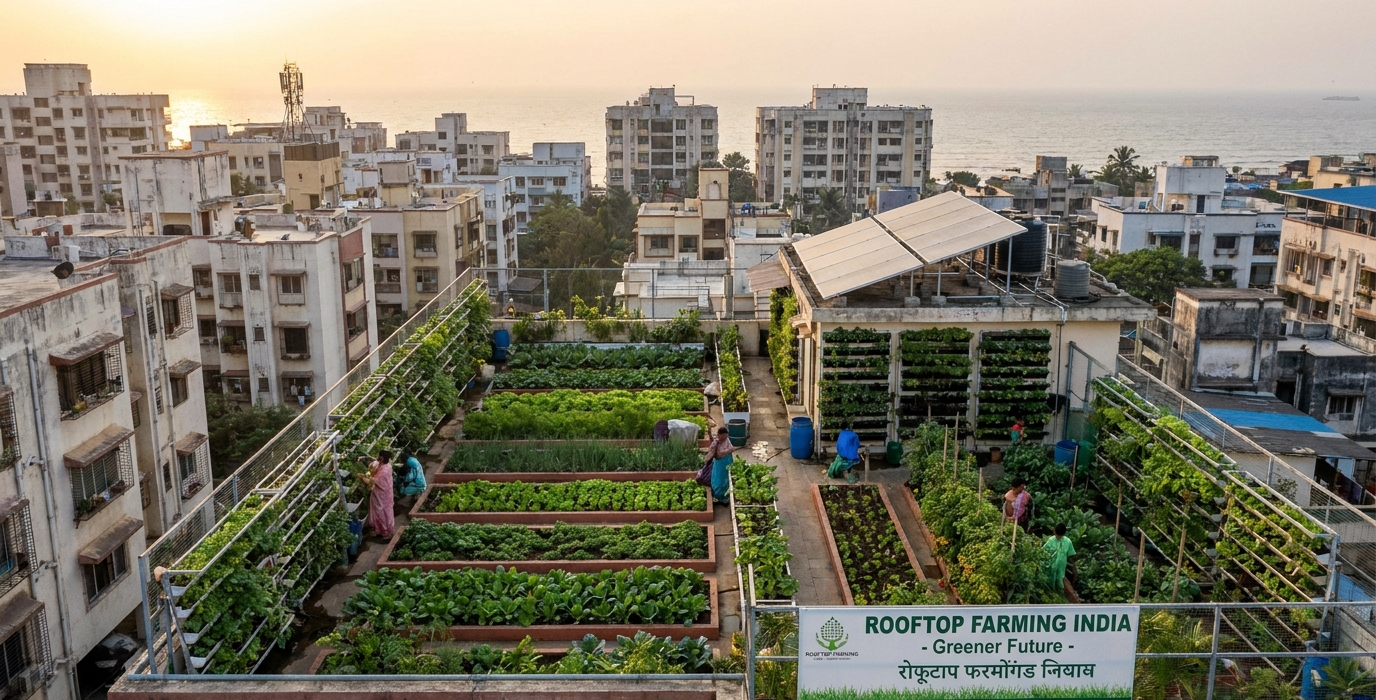
Imagine stepping onto your Mumbai terrace, not to escape the monsoon humidity, but to harvest fresh tomatoes, crisp lettuce, and fragrant herbs. This isn’t a utopian dream; it’s the burgeoning reality for thousands of Mumbaikars. In a city synonymous with concrete jungles and relentless urban sprawl, a quiet revolution is taking root – quite literally – on its rooftops. From the bustling heart of South Mumbai to the sprawling suburbs of Thane and beyond, innovative urban agriculture initiatives are transforming barren, sun-baked spaces into vibrant, productive oases. These aren’t just aesthetic enhancements; they represent a crucial step towards a more sustainable, resilient, and healthier future for India’s financial capital. We’re witnessing a paradigm shift where balconies, terraces, and even forgotten building tops are being reimagined as sources of fresh, local food. This movement is more than just growing plants; it’s about cultivating community, reclaiming urban spaces, and fostering a deeper connection with our food.
The impetus for this green surge is multifaceted. Rising food prices, concerns about pesticide residues, and a growing awareness of environmental degradation are driving individuals and communities to seek local, sustainable solutions. Mumbai, with its dense population and limited land availability, is a prime candidate for such innovative farming methods. The sheer scale of the challenge – feeding millions in a congested metropolis – necessitates out-of-the-box thinking. Rooftop farming offers a compelling answer, turning a perceived disadvantage (lack of ground space) into a unique advantage. These initiatives are not confined to the wealthy; a surprising diversity of participants, from apartment dwellers with modest balconies to large housing societies and even corporate offices, are embracing the practice. The vision is clear: to integrate food production seamlessly into the urban fabric, making fresh produce more accessible and reducing our collective environmental footprint.
From Balconies to Buzzing Hubs: Diverse Farming Models Emerge
The beauty of Mumbai’s rooftop farming movement lies in its incredible diversity, catering to a wide spectrum of needs and capabilities. At the most personal level, we see individual balcony gardens, where residents, armed with pots, grow bags, and a little soil, cultivate their own small patches of green. These are often started with a few herbs like mint and coriander, essential for Indian kitchens, and quickly expand to include cherry tomatoes, chilies, and leafy greens. Many find immense satisfaction in the simple act of nurturing life and enjoying the freshest possible ingredients. These personal gardens not only provide a therapeutic escape from city stress but also offer a tangible connection to the food they consume.
Moving beyond individual efforts, community rooftop farms are becoming increasingly popular. Housing societies are dedicating communal terrace spaces to collaborative gardening projects. These initiatives often involve shared resources, knowledge exchange, and a collective harvest. Such projects foster a strong sense of community, breaking down social barriers as neighbours work side-by-side, sharing tips on pest control or the best time to sow monsoon vegetables. It’s a powerful way to build social capital alongside edible harvests. We’re also seeing institutional and commercial ventures, with restaurants and hotels establishing rooftop gardens to supply their kitchens with hyper-local, organic produce, reducing their supply chain costs and environmental impact. Some even offer “farm-to-table” dining experiences, showcasing the bounty from their own rooftops.
One surprising fact is the significant role of vertical farming techniques being adapted for rooftops. While often associated with indoor, climate-controlled environments, compact vertical systems, using hydroponics or aeroponics, are being ingeniously integrated into rooftop setups. This maximizes growing space in limited areas, allowing for higher yields of produce like spinach and strawberries, even in dense urban settings. These are not just hobbyist pursuits; they are becoming sophisticated, scalable models for urban food security.
Overcoming the Hurdles: Water, Pests, and Structural Strength
While the vision of a green Mumbai is inspiring, the practicalities of rooftop farming present unique challenges. Water management is perhaps the most critical. Mumbai’s monsoon, while plentiful, is seasonal, and consistent watering is essential for healthy plant growth. Many early adopters struggled with water scarcity during dry spells. However, ingenious solutions are emerging. Rainwater harvesting systems are being integrated into rooftop farm designs, collecting and storing precious monsoon water for use during drier months. Drip irrigation systems are also becoming standard, delivering water directly to plant roots with minimal wastage.
Another significant concern is pest and disease control. In an urban environment, pests can be tenacious. Traditional chemical pesticides are often avoided by urban farmers due to health concerns and the desire for organic produce. Instead, a focus on integrated pest management (IPM) is prevalent. This includes promoting beneficial insects, using natural repellents derived from neem or garlic, and employing physical barriers. Companion planting – strategically placing certain plants together to deter pests – is also a widely adopted technique. For instance, marigolds are often planted alongside vegetables to ward off nematodes.
Finally, the structural integrity of buildings is a paramount consideration. A rooftop farm, especially a large one with soil and irrigation systems, can add significant weight. Reputable urban farming initiatives always begin with a structural assessment by qualified engineers. This ensures that the building can safely support the load. Lightweight growing mediums like coco peat and perlite are often used instead of heavy soil. Advanced waterproofing and drainage systems are also essential to prevent water damage to the building structure. These are not minor details; they are foundational to the long-term success and safety of any rooftop farming project.
The Sweet Taste of Community and Sustainability
The impact of rooftop farming extends far beyond the harvest. It is fostering a palpable sense of community engagement. Projects like the ones flourishing in Navi Mumbai’s Koparkhairane or on terraces in Bandra encourage neighbours to connect, collaborate, and share knowledge. These shared spaces become hubs for learning and socializing, often organizing workshops on composting, seed saving, and organic gardening techniques. Children are increasingly involved, learning firsthand about where their food comes from and developing a lifelong appreciation for nature.
This movement also champions healthier diets. By providing easy access to fresh, nutrient-rich produce, rooftop farms empower individuals to make healthier food choices. The reduction in food miles means that produce is consumed at its peak freshness, retaining more vitamins and minerals. Furthermore, the knowledge that the food is grown without harmful pesticides offers peace of mind. Families are rediscovering forgotten vegetables and experimenting with new varieties, enriching their culinary experiences.
On a broader scale, these green spaces contribute significantly to urban sustainability. They help mitigate the urban heat island effect by providing shade and releasing moisture through evapotranspiration, thereby cooling the surrounding environment. Rooftop farms can also improve air quality by absorbing pollutants and producing oxygen. Moreover, they promote waste reduction through composting organic kitchen waste, turning a potential problem into valuable fertilizer. This circular economy approach is vital for creating resilient cities capable of withstanding environmental challenges. A surprising fact is that some of these urban farms are now experimenting with growing native medicinal plants, recognized for their therapeutic properties, further enhancing the well-being of the community.
Innovations in Technology and Resource Management
The drive for efficiency and sustainability in Mumbai’s rooftop farms has spurred remarkable technological adoption. Smart irrigation systems, often powered by solar energy, are becoming increasingly common. These systems use sensors to monitor soil moisture levels and weather patterns, automatically delivering the precise amount of water needed at the optimal time, thus conserving water significantly. This is a crucial adaptation for a city facing both water scarcity and unpredictable rainfall.
Hydroponic and aeroponic systems are also gaining traction, particularly for high-value crops like leafy greens and strawberries. These soilless methods can increase yields by up to 70% compared to traditional soil-based farming and use up to 90% less water. While the initial setup cost can be higher, the efficiency and productivity often justify the investment, especially for commercial ventures and community projects looking to maximize their output in limited spaces. We’re seeing innovative adaptations of these systems, like modular vertical towers that can be easily assembled and disassembled on rooftops, offering flexibility.
Another area of innovation is composting solutions. Many rooftop farms are establishing on-site composting facilities, turning kitchen scraps and garden waste into nutrient-rich compost. This not only reduces the amount of waste sent to landfills but also provides a free, high-quality fertilizer for the crops. Various composting methods are employed, from simple vermicomposting (using worms) to more advanced Bokashi systems that ferment organic waste. The goal is a closed-loop system where waste is transformed into a valuable resource, further enhancing the sustainability of these urban farms. These technologies are democratizing access to advanced farming methods, making them more accessible to a broader range of Mumbaikars.
| Feature | Individual Balcony Garden | Community Rooftop Farm | Commercial Rooftop Farm |
|---|---|---|---|
| Scale | Small (pots, grow bags) | Medium (shared society space) | Large (dedicated commercial area) |
| Investment | Low (DIY, minimal tools) | Moderate (shared costs, tools) | High (technology, infrastructure) |
| Primary Goal | Personal consumption, hobby | Community food security, social engagement | Profit, hyper-local produce supply |
| Technical Expertise | Basic gardening knowledge | Shared knowledge, workshops | Professional horticulturalists, engineers |
| Water Management | Manual watering, small tanks | Rainwater harvesting, drip irrigation | Automated smart irrigation, advanced filtration |
| Pest Control | Natural repellents, manual removal | Integrated Pest Management (IPM) | IPM, sometimes organic-certified biological controls |
The Future is Green: Scaling Up and Policy Support
The momentum behind Mumbai’s rooftop farms is undeniable, but for this movement to truly transform the city, scaling up and robust policy support are crucial. Currently, many initiatives are driven by passionate individuals and community groups working with limited resources. To reach its full potential, there needs to be greater integration with urban planning and municipal policies. This could involve incentives for building owners to allocate space for rooftop farming, streamlined permitting processes, and access to subsidized resources like water and quality seeds.
Educational programs are also vital for broader adoption. Many Mumbaikars are interested in urban farming but lack the knowledge or confidence to start. Initiatives like workshops conducted by organizations such as the Urban Farmers Collective of Mumbai are invaluable. These programs demystify the process, covering everything from basic soil preparation to advanced hydroponics. Furthermore, fostering partnerships between urban farms and local restaurants, schools, and hospitals can create stable markets for produce, making farming more economically viable for participants.
The economic potential of rooftop agriculture is also an area ripe for exploration. Beyond direct sales, there’s scope for businesses offering installation, maintenance, and consulting services. Imagine a future where rooftop farms are as commonplace as balconies, contributing significantly to the local economy and food security. A truly surprising insight is that some of these rooftop farms are now exploring the cultivation of specialty mushrooms, a high-value crop that thrives in controlled, often indoor-like, conditions that can be replicated on shaded rooftops, adding another layer of diversity to urban food production. The vision is ambitious, but the green shoots of change are already firmly planted.
Frequently Asked Questions
What are the basic requirements to start a rooftop farm?
You’ll need adequate sunlight (at least 6-8 hours a day), a structurally sound rooftop that can bear weight, access to water, and basic gardening supplies like pots, soil, and seeds. For larger farms, professional structural assessment is essential.
Is rooftop farming expensive to set up?
It can range from very affordable for a small balcony garden to quite expensive for large-scale hydroponic systems. Starting small with pots and soil is a cost-effective way to begin, with costs increasing for advanced technology and infrastructure.
How do I manage water supply for a rooftop farm in Mumbai?
Consider rainwater harvesting systems to collect monsoon water, and use efficient drip irrigation to minimize water usage. For dry periods, water tanks can be used. Planning your planting schedule around water availability is also key.
What kind of crops grow best on Mumbai rooftops?
Leafy greens (spinach, lettuce), herbs (mint, coriander, basil), tomatoes, chilies, brinjal (eggplant), and okra generally thrive. Certain fruits like strawberries and passion fruit can also be successful. Choose varieties suited to the local climate and your available space.
Are there any government schemes supporting urban farming in India?
While specific schemes vary, the Indian government and various state governments are increasingly promoting urban agriculture through initiatives focused on food security, sustainable development, and employment generation. It’s advisable to check with your local municipal corporation and agricultural departments for current programs and subsidies.