Key Takeaways
- India is poised to become a global leader in AI-driven personalized medicine by 2026, with significant advancements in diagnostics and treatment tailoring.
- Genomic sequencing, powered by AI, is becoming more accessible, enabling treatments that account for individual genetic predispositions and drug responses.
- AI is revolutionising drug discovery and repurposing, accelerating the development of novel therapies and making existing ones more effective for diverse Indian populations.
- Remote patient monitoring and AI-powered telehealth are expanding healthcare access, particularly in Tier 2 and Tier 3 cities, addressing geographical disparities.
AI’s Precision Strike: Tailoring Treatments for Every Indian
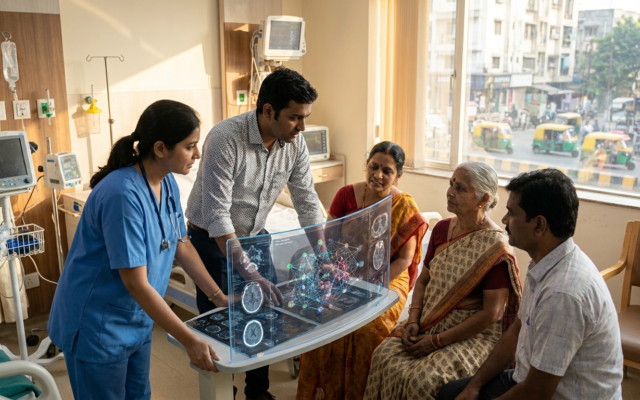
The landscape of healthcare in India is undergoing a seismic shift, driven by the burgeoning power of Artificial Intelligence (AI). By 2026, we are witnessing an era where medicine is no longer a one-size-fits-all prescription, but a meticulously crafted regimen designed for *you*. This isn’t science fiction; it’s the reality of AI-powered personalized medicine taking root across the subcontinent. Imagine treatments that don’t just target a disease, but the unique biological blueprint of an individual. This is the promise AI is delivering, from bustling metropolises like Bengaluru to remote villages in the Himalayas.
AI algorithms are now capable of sifting through vast datasets – patient histories, genetic information, lifestyle factors, and environmental exposures – to predict disease risk with unprecedented accuracy. This predictive power allows for proactive interventions, shifting the focus from treating illness to preventing it. For instance, AI models can identify individuals at high risk for conditions like diabetes or cardiovascular disease based on subtle patterns invisible to the human eye. Early detection means better outcomes, fewer complications, and ultimately, a healthier population.
The implications for chronic disease management are profound. Conditions that once required lifelong, generalized treatment plans can now be fine-tuned. AI can monitor a patient’s response to medication in real-time, suggesting adjustments to dosage or type of drug based on continuous data streams. This dynamic approach ensures optimal efficacy while minimizing side effects. We are moving towards a healthcare system that learns and adapts with each individual, making treatment journeys smoother and more effective than ever before.
Genomics: Unlocking Your Unique Health Code
At the heart of personalized medicine lies the revolution in genomic sequencing. Historically, the cost and complexity of understanding our DNA made widespread application a distant dream. However, AI has dramatically accelerated this process, making genomic data not just accessible but actionable. By 2026, AI-powered bioinformatics platforms are becoming standard tools for oncologists, cardiologists, and even general practitioners. These systems can analyze a patient’s genetic makeup to predict their susceptibility to certain diseases and, crucially, their likely response to various medications.
Consider the fight against cancer. Traditionally, chemotherapy regimens were based on the type of cancer and the patient’s general profile. Now, AI can analyze the genetic mutations within a tumor, identifying specific targets for therapy. This allows for the selection of drugs that are most likely to be effective, often leading to better remission rates and fewer debilitating side effects. It’s a far cry from the broad-stroke approaches of the past.
This genomic insight extends beyond cancer. For instance, AI can predict how efficiently an individual might metabolize certain drugs, helping doctors choose the right dosage from the outset. This is particularly relevant in India, where genetic variations can influence drug efficacy across diverse populations. By understanding these nuances, we can avoid trial-and-error prescribing, saving precious time, reducing patient suffering, and lowering healthcare costs. The ability to decode our unique genetic script is transforming how we approach health and well-being.
Drug Discovery and Repurposing: AI’s Speed and Smarts
The pharmaceutical industry has long grappled with the immense time and cost involved in bringing new drugs to market. AI is dramatically reshaping this landscape by accelerating both the discovery of novel compounds and the repurposing of existing ones for new applications. By 2026, AI is not just a supporting tool; it’s a driving force in the research and development pipeline. Machine learning models can analyze millions of molecular structures, predict their potential efficacy and safety, and identify promising drug candidates in a fraction of the time previously required.
One of the most exciting applications of AI in this domain is drug repurposing. Instead of starting from scratch, AI can scan existing approved drugs, looking for compounds that might be effective against different diseases. This significantly reduces the development timeline and regulatory hurdles, as much of the safety data is already available. For rare diseases or emerging epidemics, this can be a game-changer, offering faster access to potential treatments. Imagine a drug approved for hypertension showing promise against a novel viral strain – AI can uncover these connections.
Furthermore, AI is enhancing our understanding of disease mechanisms at a molecular level. By processing complex biological data, AI can identify new therapeutic targets that were previously unknown. This opens up entirely new avenues for drug development. The speed at which AI can process and learn from vast scientific literature and experimental data is truly transformative. It allows researchers to focus on the most promising avenues, leading to a more efficient and impactful R&D process. The pipeline for new and improved medicines is flowing faster than ever.
A Surprising Fact: AI’s Role in Identifying Neglected Tropical Diseases
An often-overlooked but critical application of AI in drug discovery is its potential to identify novel treatments for Neglected Tropical Diseases (NTDs). These diseases disproportionately affect impoverished communities in tropical and subtropical regions, often lacking robust research funding. AI algorithms, by analyzing existing molecular libraries and disease pathways, are now being employed to find cost-effective drug candidates for diseases like leishmaniasis or lymphatic filariasis. This represents a significant leap in global health equity, using advanced technology to address diseases that have historically been under-resourced.
Telehealth and Remote Monitoring: Healthcare Without Borders
The reach of advanced healthcare has historically been limited by geography. However, AI-powered telehealth and remote patient monitoring are breaking down these barriers, ensuring that quality medical care is accessible to more Indians than ever before by 2026. For individuals living in Tier 2 and Tier 3 cities, or in remote rural areas, accessing specialist care can be a significant challenge. AI is bridging this gap, bringing expert medical advice and continuous health monitoring directly to their homes.
AI-driven chatbots and virtual health assistants are becoming the first point of contact for many, providing preliminary diagnoses, answering common health queries, and guiding patients towards appropriate care. These systems are available 24/7, offering immediate support and reducing the burden on healthcare facilities. They are trained on vast medical knowledge bases, ensuring accuracy and reliability. The ability for these AI assistants to communicate in multiple Indian languages further enhances their accessibility and utility.
Remote patient monitoring devices, integrated with AI analytics, are revolutionizing the management of chronic conditions. Wearable sensors can track vital signs like heart rate, blood pressure, and glucose levels, sending this data to healthcare providers in real-time. AI algorithms analyze these streams of data, identifying subtle changes that might indicate a worsening condition or the need for intervention. This allows for proactive adjustments to treatment plans, preventing hospitalizations and improving patient outcomes. Imagine a scenario where a cardiac patient in a remote Rajasthani village receives an alert, prompting a telehealth consultation before a critical event occurs.
Bridging the Divide: AI in Rural Healthcare
The impact of AI-powered telehealth is particularly transformative in rural India. For example, AI-enabled diagnostic tools are being deployed in primary health centers to assist local doctors in identifying conditions like diabetic retinopathy or certain types of cancer through image analysis. This not only augments the capabilities of rural healthcare professionals but also provides access to diagnostic accuracy previously only available in major urban hospitals. It’s a powerful tool for decentralizing healthcare expertise and ensuring that no one is left behind due to their location.
AI in Diagnostics: Seeing What the Eye Cannot
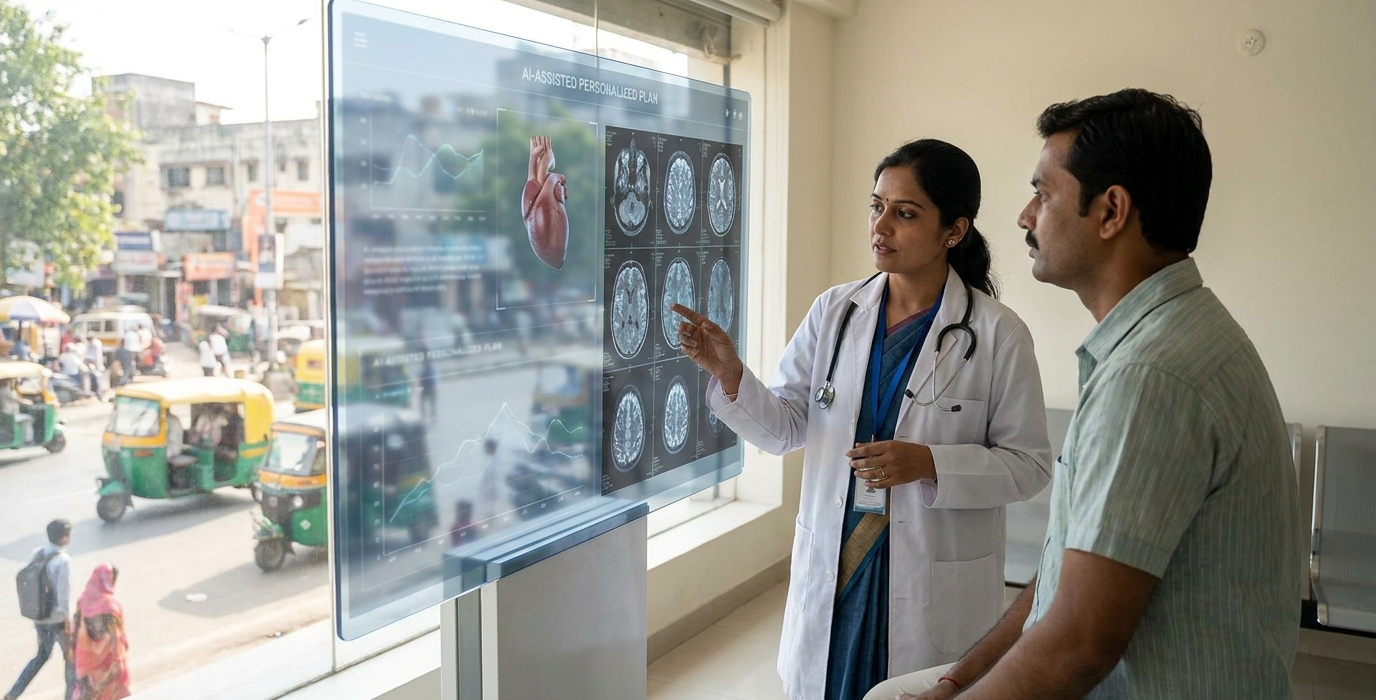
AI’s ability to analyze complex medical images with superhuman accuracy is a cornerstone of personalized medicine in 2026. From X-rays and CT scans to microscopic pathology slides, AI algorithms are enhancing diagnostic capabilities, leading to earlier and more precise disease detection. This not only improves patient outcomes but also streamlines workflows for radiologists and pathologists, allowing them to focus on more complex cases. The integration of AI into diagnostic imaging is no longer a futuristic concept; it’s a present-day reality transforming medical practice.
In radiology, AI models are trained on millions of medical images to identify anomalies that might be missed by the human eye. They can flag suspicious lesions in mammograms, detect subtle signs of pneumonia in chest X-rays, or identify early indicators of stroke in CT scans. This ‘second opinion’ from an AI can significantly reduce diagnostic errors and speed up the reporting process. For patients, this translates to faster diagnoses and quicker initiation of treatment.
Pathology is another area where AI is making significant strides. Analyzing tissue samples under a microscope is a meticulous and time-consuming process. AI can automate the counting of cells, identify cancerous formations, and even grade tumor aggressiveness with remarkable speed and consistency. This is particularly valuable in oncology, where precise tumor grading is crucial for determining the most effective treatment strategy. The consistency of AI analysis also helps to standardize diagnostic interpretations across different institutions.
A Surprising Fact: AI’s Role in Early Detection of Rare Genetic Disorders
Beyond common ailments, AI is proving invaluable in the early detection of rare genetic disorders. By analyzing patterns in facial features, developmental milestones, and even vocalizations in infants, AI algorithms are now capable of identifying potential genetic syndromes much earlier than traditional methods. This allows for prompt genetic counseling and early intervention, significantly improving the quality of life for affected children and their families. Such applications are crucial in a country like India with its vast and diverse population.
Ethical Considerations and Data Privacy in the Age of AI
As AI becomes increasingly integral to healthcare, addressing ethical considerations and ensuring robust data privacy are paramount. The vast amounts of sensitive personal health information processed by AI systems require stringent security measures and transparent governance. By 2026, we are seeing a concerted effort from regulatory bodies, healthcare providers, and technology developers in India to establish clear guidelines and safeguards. This ensures that the benefits of AI in medicine are realized responsibly and equitably.
One of the primary concerns is data security. Health data is highly sensitive, and any breach can have severe consequences for individuals. Robust encryption, secure cloud storage solutions, and strict access controls are essential. Furthermore, ensuring that AI models are trained on diverse datasets is critical to avoid algorithmic bias. If AI is primarily trained on data from one demographic, its performance might be suboptimal or even discriminatory for other groups. This is especially important in India, with its rich tapestry of ethnicities and genetic backgrounds.
Transparency in AI decision-making is another key ethical imperative. While AI can provide powerful insights, it’s crucial for healthcare professionals to understand how these insights are generated. This allows them to critically evaluate AI recommendations and maintain ultimate responsibility for patient care. The concept of “explainable AI” (XAI) is gaining traction, aiming to make AI algorithms more interpretable. Patients also have a right to know how their data is being used and to have control over it.
“The future of healthcare lies not in replacing human expertise with AI, but in augmenting it. AI is the powerful lens that allows us to see more, understand deeper, and act faster, ultimately empowering both clinicians and patients.”
Building Trust: The Path Forward
Building patient trust is fundamental. This involves clear communication about how AI is being used in their care, the benefits it offers, and the measures taken to protect their privacy. Education for both healthcare professionals and the public on the capabilities and limitations of AI in medicine is crucial. As we move forward, a collaborative approach involving policymakers, technology innovators, medical professionals, and patient advocacy groups will be essential to navigate the ethical complexities and ensure that AI serves humanity’s best interests in healthcare.
Frequently Asked Questions
What is personalized medicine in the context of AI by 2026?
Personalized medicine, powered by AI by 2026, refers to healthcare approaches that tailor medical treatment to the individual characteristics of each patient, considering their genetic makeup, lifestyle, and environmental factors. AI analyzes vast datasets to predict disease risk, optimize drug selection and dosage, and create highly customized treatment plans.
How is AI improving drug discovery in India?
In India, AI is significantly accelerating drug discovery and repurposing by analyzing complex biological data, predicting molecular interactions, and identifying potential drug candidates much faster than traditional methods. This is leading to more efficient development of new therapies and making existing drugs suitable for new applications, with a focus on diseases prevalent in the Indian subcontinent.
Will AI replace doctors in India?
No, AI is not expected to replace doctors in India. Instead, it acts as a powerful tool to augment their capabilities. AI assists doctors with diagnostics, treatment planning, and data analysis, freeing them up to focus on patient care, complex decision-making, and the human element of medicine.
What are the main privacy concerns with AI in Indian healthcare?
The primary privacy concerns revolve around the security of sensitive patient health data processed by AI systems. Ensuring robust data encryption, secure storage, and stringent access controls is crucial. Additionally, there are concerns about algorithmic bias and the need for transparency in how AI makes decisions affecting patient care.