Key Takeaways
- Artificial intelligence is revolutionizing Indian healthcare, particularly in diagnostic accuracy and speed.
- AI-powered tools are becoming accessible for early detection of critical diseases like cancer and diabetic retinopathy, even in remote areas.
- The integration of AI is enhancing radiologists’ and pathologists’ capabilities, leading to faster, more precise diagnoses.
- Challenges remain in data privacy, regulatory frameworks, and equitable access to these advanced technologies across India.
The Dawn of AI-Powered Diagnostics: A New Era for Indian Healthcare
Imagine a future where diseases are caught not when symptoms become unbearable, but when they are microscopic whispers, easily silenced. This future is no longer science fiction; it’s rapidly unfolding in India’s healthcare landscape, powered by the transformative force of Artificial Intelligence (AI). For decades, diagnostic processes have relied heavily on human interpretation, prone to fatigue, subjectivity, and the sheer volume of data. Now, AI algorithms are stepping in, trained on vast datasets of medical imagery and patient records, offering unprecedented levels of accuracy and speed. We’re talking about systems that can detect subtle anomalies invisible to the human eye, flag potential issues with remarkable precision, and significantly reduce the time it takes to get a diagnosis.
This isn’t just about incremental improvements; it’s a paradigm shift. AI is augmenting the skills of our dedicated medical professionals, not replacing them. Think of it as giving our doctors and technicians super-powered vision and an encyclopedic memory. This collaboration is crucial for a country like India, with its diverse population, vast geographical spread, and varying levels of healthcare infrastructure. The potential to democratize access to high-quality diagnostics, especially in Tier 2 and Tier 3 cities, and even remote villages, is immense. This article delves into how AI is reshaping diagnostics, the specific applications making waves, and what it means for you and your family.
Unlocking Early Detection: AI’s Precision in Disease Identification
One of the most significant impacts of AI in Indian healthcare is its prowess in early disease detection. Consider the silent menace of cancer. AI algorithms, trained on thousands of mammograms and CT scans, can now identify suspicious lesions with a level of detail that surpasses human capacity in many instances. These systems can highlight areas that warrant a closer look, reducing the risk of missed diagnoses and enabling treatment to begin at its most curable stages. This is particularly vital for cancers like breast, lung, and cervical cancer, where early intervention dramatically improves survival rates.
Beyond cancer, AI is making remarkable strides in ophthalmology. Diabetic retinopathy, a leading cause of blindness, can be detected early through AI analysis of retinal images. This is a game-changer for India, which has a large diabetic population. Imagine a small clinic in rural Rajasthan equipped with a fundus camera and an AI software. This setup could provide screening for diabetic retinopathy, a service previously only available in major urban centres. The algorithm can swiftly process the images, identifying early signs of the disease and alerting the patient and their physician to seek specialist care. This proactive approach can save sight for millions.
Radiology and Pathology: AI as a Radiologist’s and Pathologist’s Best Friend
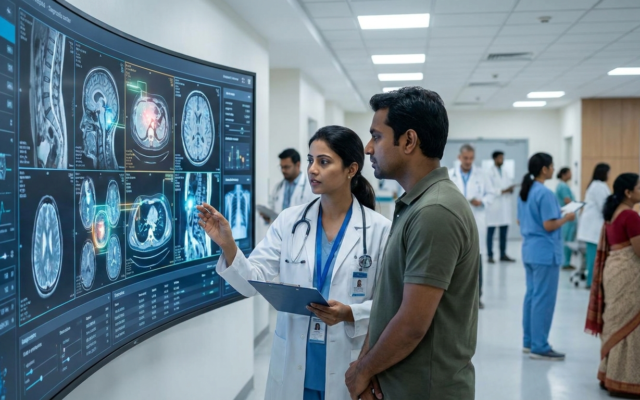
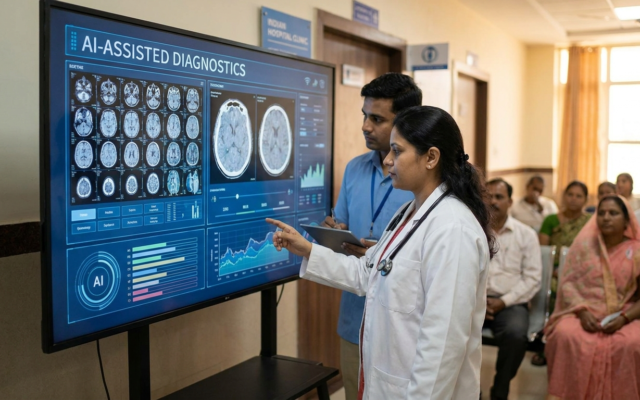
Radiologists and pathologists are at the forefront of diagnostic medicine, interpreting complex images and tissue samples. AI is proving to be an invaluable assistant, enhancing their efficiency and accuracy. For radiologists, AI tools can automatically segment organs, measure lesions, and highlight areas of concern on X-rays, CT scans, and MRIs. This frees up their time from repetitive tasks, allowing them to focus on complex cases and critical decision-making. The sheer volume of scans generated daily can be overwhelming, and AI acts as a tireless first pass, flagging potential abnormalities with high sensitivity.
In pathology, AI is revolutionizing the analysis of tissue slides. Pathologists traditionally examine biopsies under a microscope, a process that is meticulous and time-consuming. AI algorithms can now scan digital pathology slides, identifying cancerous cells, quantifying tumor characteristics, and even predicting treatment response. This not only speeds up diagnosis but also brings a new level of objectivity to the field. For instance, in prostate cancer grading, AI can provide more consistent and reproducible assessments than manual methods. This enhanced precision is critical for guiding treatment decisions and ensuring patients receive the most appropriate care.
The integration of AI in diagnostics is not about replacing human expertise, but about augmenting it. It’s about building a powerful partnership that can elevate the standard of care for every Indian.
Bridging the Urban-Rural Divide: AI’s Reach into Remote Healthcare
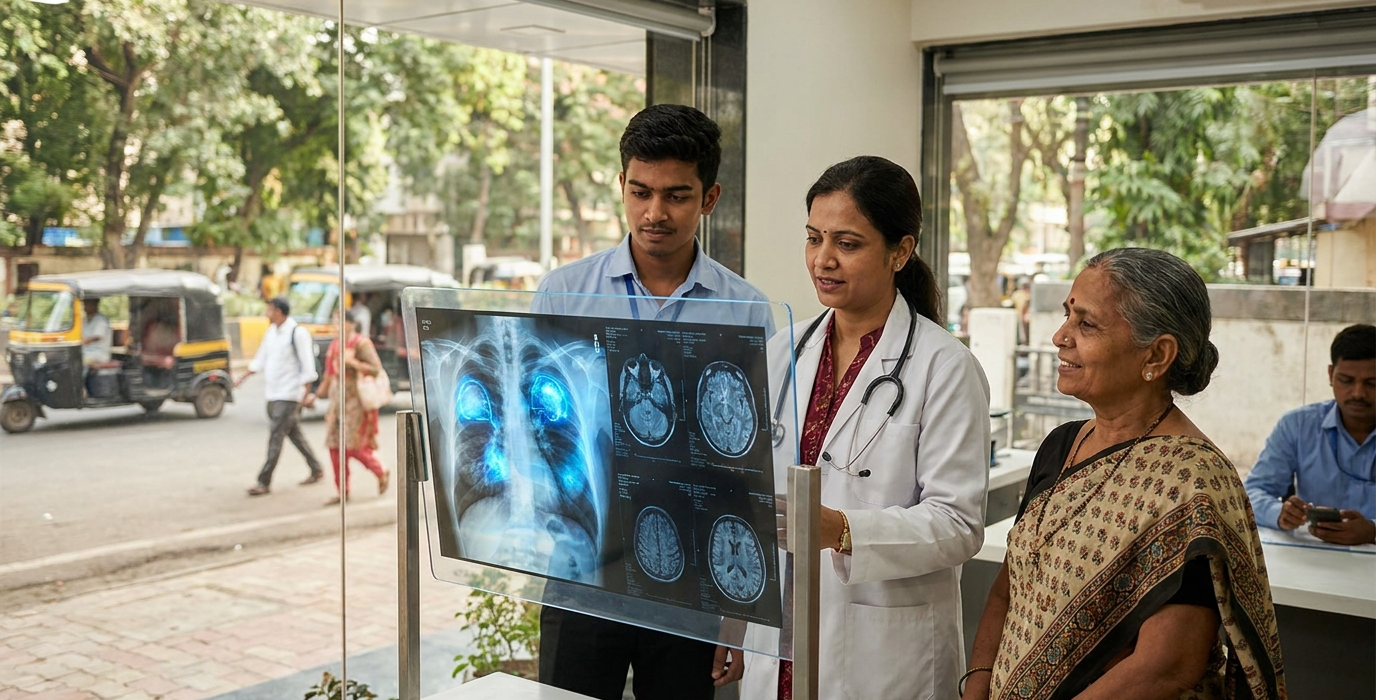
One of the most compelling promises of AI in Indian healthcare is its potential to bridge the persistent urban-rural divide in medical access. For individuals living in remote villages, accessing specialist diagnostic services often means undertaking arduous and expensive journeys to distant cities. AI-powered diagnostic tools, particularly those leveraging cloud computing and portable imaging devices, can bring sophisticated analysis directly to these underserved communities. A basic health worker in a village can use a portable ultrasound machine connected to an AI platform that provides an initial interpretation of findings, flagging critical conditions for further review by a remote specialist.
This democratisation of diagnostics is a significant step towards equitable healthcare. Consider the case of tuberculosis (TB) detection. AI can analyze chest X-rays for signs of TB with remarkable accuracy, even in settings where experienced radiologists are scarce. This allows for faster screening and quicker initiation of treatment, crucial in combating the spread of infectious diseases. We’re also seeing AI-powered tools for ECG analysis that can be used by primary healthcare providers, allowing for early detection of cardiac abnormalities without the need for immediate access to a cardiologist. This technology extends the reach of advanced medical insights far beyond the confines of major hospitals.
The Data Challenge and the Rise of Secure AI Platforms
The effectiveness of AI in diagnostics hinges on access to large, high-quality, and diverse datasets. For AI models to be robust and reliable, they need to be trained on a wide spectrum of medical images and patient data representing India’s rich diversity. This presents a significant challenge, as historical medical records are often fragmented, digitized inconsistently, or not readily available. Furthermore, concerns around data privacy and security are paramount. Patients need to be assured that their sensitive health information is protected.
This is where the development of secure, privacy-preserving AI platforms becomes crucial. Companies and research institutions are now focusing on federated learning models, where AI algorithms are trained on data locally without the data ever leaving its original source. This approach ensures that patient privacy is maintained while still allowing for the development of powerful AI diagnostic tools. Additionally, regulatory bodies are working to establish clear guidelines for data governance and AI deployment in healthcare, building trust and ensuring ethical practices. The aim is to create a framework where data can be leveraged responsibly to improve health outcomes for all.
Navigating the Future: Challenges and Opportunities Ahead
While the trajectory of AI in Indian diagnostics is undeniably exciting, we must also acknowledge the hurdles that lie ahead. The initial cost of implementing AI systems can be substantial, posing a barrier for smaller healthcare facilities. Training healthcare professionals to effectively use and interpret AI-driven insights is another critical aspect. We need comprehensive training programs that integrate AI into medical education and ongoing professional development. Furthermore, establishing robust regulatory frameworks that ensure the safety, efficacy, and ethical deployment of AI in healthcare is an ongoing process.
Despite these challenges, the opportunities presented by AI are immense. We are on the cusp of a healthcare revolution where timely, accurate, and accessible diagnostics are within reach for more people than ever before. As AI technology matures and becomes more cost-effective, we can expect to see its widespread adoption across various specialties. The focus will increasingly shift towards predictive diagnostics, where AI can identify individuals at high risk for certain diseases even before symptoms manifest. This proactive approach promises to transform healthcare from a reactive system to a truly preventative one, making a tangible difference in the lives of millions across India and beyond.
Frequently Asked Questions
How is AI improving diagnostic accuracy in Indian hospitals?
AI algorithms analyze medical images (like X-rays, CT scans, MRIs) and pathology slides with incredible detail, often identifying subtle anomalies that human eyes might miss. This leads to earlier and more precise detection of diseases like cancer and diabetic retinopathy.
Can AI help diagnose diseases in remote areas of India?
Yes, AI-powered diagnostic tools can be integrated with portable medical devices and cloud platforms. This allows basic health workers in remote villages to perform initial screenings and get AI-driven interpretations, extending specialized diagnostic capabilities to underserved regions.
Will AI replace doctors and radiologists?
No, the current focus is on AI as an assistant. AI tools augment the capabilities of doctors and radiologists by handling repetitive tasks, highlighting potential issues, and providing data-driven insights, allowing human experts to focus on complex cases and patient care.
What are the biggest challenges to AI adoption in Indian healthcare?
Key challenges include the high initial cost of AI systems, the need for comprehensive training for healthcare professionals, ensuring data privacy and security, and establishing clear regulatory guidelines for AI deployment.
Are AI diagnostic tools already available in India?
Yes, several AI-powered diagnostic solutions are being deployed and piloted across India, particularly in areas like radiology, pathology, and ophthalmology. Their availability is growing, with a focus on improving accessibility and affordability.