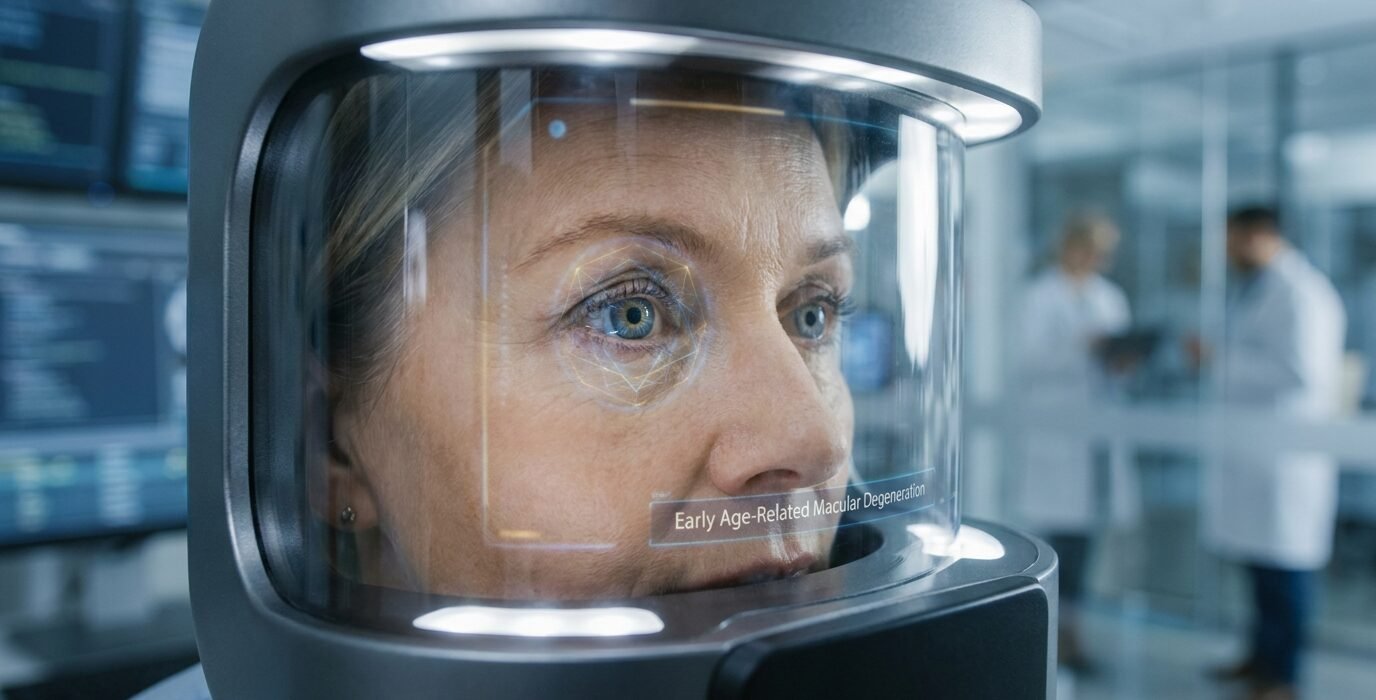
Imagine waking up tomorrow and realizing the world is a little blurrier. For millions, this isn’t a distant fear; it’s a slow, creeping reality. A common eye disease, often silent in its early stages, robs people of their sight before they even know it’s there. But what if technology could offer a different future? What if an artificial intelligence, trained on thousands of Dutch eyes, could spot the first whispers of trouble long before a human eye could?
Key Takeaways:
- A new AI diagnostic tool, developed in the Netherlands, can detect early signs of a common eye disease with remarkable accuracy.
- This AI analyzes retinal scans, identifying subtle patterns invisible to the human eye.
- The technology promises to speed up diagnosis, reduce healthcare burdens, and preserve vision for many.
- Early detection is crucial for effective treatment and preventing irreversible sight loss.
- The study highlights the growing role of AI in revolutionizing medical diagnostics.
The Silent Thief of Sight: Understanding Age-Related Macular Degeneration
The Netherlands, a nation known for its innovation and picturesque landscapes, is also a hotbed for medical research. Here, in the quiet labs of academic hospitals, a battle is being waged against a formidable adversary: Age-Related Macular Degeneration (AMD). This is not just a minor inconvenience; it’s a leading cause of irreversible vision loss in people over 60 worldwide.
Think of your central vision – the sharp, detailed sight you use to read a book, recognize faces, or enjoy the intricate beauty of a Delft tile. AMD attacks this very core of your vision. It’s a cruel disease.
It’s cruel because, in its early stages, it often presents no symptoms. You might feel fine, see well enough for most daily tasks, and have no inkling of the damage progressing behind your eyes. The macula, a tiny part of your retina responsible for that sharp central vision, begins to deteriorate. This deterioration can be subtle. It’s marked by the accumulation of drusen – small yellowish deposits under the retina – or changes in the retinal pigment epithelium.
These are the silent harbingers of a disease that, if left unchecked, can lead to significant vision impairment. Everyday activities become incredibly challenging. Imagine the frustration of not being able to read your favorite Dutch newspaper or enjoy the vibrant colors of a tulip field.
The current diagnostic process for AMD typically involves regular eye exams with an ophthalmologist. During these exams, specialists use tools like ophthalmoscopes to look directly at the retina. They assess its health and look for those tell-tale signs of drusen or other abnormalities. Optical Coherence Tomography (OCT) scans are also a cornerstone. These provide cross-sectional images of the retina’s layers.
While these methods are effective, they rely on the keen, experienced eye of a human specialist. In busy clinics, especially in densely populated areas like Randstad, the sheer volume of patients can lead to long waiting lists. This delay can be critical. Every month that passes without diagnosis means precious vision is potentially being lost. The window for effective treatment narrows. This is precisely where the promise of artificial intelligence begins to shine. It offers a potential paradigm shift in how we approach this insidious disease.
A Glimpse into the Future: The AI’s Diagnostic Prowess
This is where the groundbreaking Dutch study enters the picture. Researchers, working tirelessly at institutions like the University Medical Center Utrecht, have developed an AI-powered tool. It can identify the early signs of AMD with astonishing precision. It often surpasses human capabilities in spotting the subtlest indicators.
Think of it as a super-powered detective for your eyes. This AI doesn’t just see what’s there; it understands the complex relationships between different features within a retinal scan.
The technology is built upon deep learning algorithms. This is a sophisticated branch of artificial intelligence. These algorithms are trained on massive datasets. In this case, it’s thousands upon thousands of high-resolution retinal images.
During the training phase, the AI is shown countless examples of healthy retinas. It also sees retinas showing various stages of AMD. It learns to recognize patterns, textures, and anomalies. These are incredibly difficult for the human eye to discern, especially in the earliest, most ambiguous stages. These patterns can include the precise size, shape, and distribution of drusen. They also include subtle changes in the retinal layers that precede visible damage.
Professor Annelies van Dijk, a lead researcher on the project, explained during a recent interview at a tech symposium in Amsterdam, “We fed the AI an enormous library of retinal images. It learned to identify microscopic irregularities, almost like finding a needle in a haystack. What takes a trained ophthalmologist minutes of careful examination, the AI can analyze in seconds, consistently and without fatigue.”
This speed and consistency are revolutionary. Imagine a world where every eye exam includes an instant AI analysis. It flags potential concerns for immediate specialist review. This could dramatically shorten the time from initial screening to definitive diagnosis. It’s not about replacing doctors. It’s about augmenting their abilities. It provides them with an incredibly powerful tool. This enhances patient care and, crucially, preserves vision. The implications for public health are immense. It could save sight for countless individuals across the Netherlands and beyond.
The Science Behind the Sight: How the AI Works
Let’s peel back the curtain a bit further. Let’s understand the intricate mechanisms at play. The AI’s brilliance lies in its ability to process and interpret complex visual data. It does this far beyond human capacity. When a retinal scan, usually captured by a fundus camera or an OCT device, is fed into the system, the AI doesn’t just look at individual pixels.
It analyzes the entire image holistically. It dissects it into layers. It identifies subtle topographical variations and textural differences. It’s akin to a master cartographer studying a landscape. They don’t just look at individual trees. They understand the flow of rivers, the contours of hills, and the subtle geological formations that tell a story.
One of the key advancements is the AI’s ability to quantify changes. Instead of a doctor subjectively describing drusen as “small” or “medium,” the AI can precisely measure their diameter, density, and location. It can detect minute thinning or thickening of retinal layers. It can identify changes in the choroidal vasculature. It can spot the presence of subtle exudates that might be missed by the human eye under normal examination conditions.
This quantitative analysis provides objective data. This allows for more precise staging of the disease. It enables more accurate prediction of its progression. This precision is vital. AMD treatment strategies often depend on the specific stage and characteristics of the disease.
The algorithm is a form of convolutional neural network (CNN). This is a type of AI particularly well-suited for image recognition tasks. These networks are structured in layers. Each layer learns to detect progressively more complex features. The initial layers might identify simple edges and curves. Deeper layers learn to recognize entire structures like blood vessels. They also recognize the distinct pattern of drusen clusters. The researchers meticulously fine-tuned these networks. They employed techniques like transfer learning. Knowledge gained from analyzing other types of images is applied to the retinal scan data. This not only speeds up the training process but also enhances the AI’s robustness. It’s a remarkable feat. It combines computational power and biological understanding. It was born from collaboration between computer scientists and ophthalmologists in Dutch research centers.
From Lab Bench to Bedside: Real-World Impact and Challenges
The transition from a successful research project to widespread clinical adoption is rarely smooth. This AI tool is no exception. While the results from the Dutch study are incredibly promising, demonstrating a significant improvement in early detection rates, there are practical hurdles to overcome.
Think about how a new medicine goes through rigorous trials before it reaches pharmacies. Similarly, this AI needs to be integrated into existing healthcare workflows. This can be complex and time-consuming.
One of the immediate benefits, however, is the potential to alleviate the burden on ophthalmology departments. With an aging population in countries like the Netherlands, the demand for eye care services is steadily increasing. An AI system that can pre-screen retinal images, flagging those that require urgent attention, could revolutionize patient triage.
This means patients at high risk of AMD could be seen sooner. Those with healthy eyes might not need as frequent follow-ups. This frees up valuable specialist time. Dr. Hans van der Berg, a practicing ophthalmologist in Rotterdam, shared his thoughts: “If this AI can reliably identify early cases, it’s a game-changer. We spend so much time looking for subtle signs. Having a tool that does the heavy lifting of initial detection would allow us to focus our expertise on treatment planning and complex cases.”
However, several challenges remain. Cost of implementation is a significant factor. Hospitals and clinics will need to invest in the necessary hardware and software. They will also need to provide training for staff. Furthermore, regulatory approval is a complex process. It ensures the AI tool is safe, effective, and meets stringent healthcare standards. There’s also the question of data privacy and security. Handling sensitive patient data requires robust safeguards. And while the AI is trained on Dutch datasets, ensuring its accuracy across diverse ethnic populations might require further validation. The promise is immense, but careful planning and execution are key to realizing its full potential.
A Surprising Revelation: The AI’s Unforeseen Discoveries
During the extensive training and validation phases of the AI, researchers stumbled upon something quite remarkable. Beyond its intended purpose of detecting AMD, the AI began to identify subtle anomalies in a small percentage of retinal scans. These anomalies didn’t fit the typical AMD profile. They pointed towards other, less common but equally important, retinal conditions. These conditions were also in their nascent stages.
One such discovery involved identifying early signs of diabetic retinopathy. This is a complication of diabetes that can also lead to blindness.
This was a surprising revelation. The AI, designed to be a specialist in one area, was exhibiting a broader diagnostic capability. It was like a highly trained detective, looking for a specific type of clue. Suddenly, they notice signs of an entirely different crime. Professor van Dijk elaborated, “We trained it to find AMD, but its deep learning architecture allowed it to generalize. It recognized patterns of vascular changes and cellular abnormalities that are common to several retinal diseases, even if the specific manifestations differ. It’s a testament to the power of unsupervised learning; the AI found correlations we hadn’t explicitly programmed it to look for.”
This unforeseen capability has opened up exciting new avenues for research. The team is now exploring how to adapt and refine the AI. They aim to make it a more comprehensive diagnostic tool for a wider range of eye conditions. Imagine a single scan being analyzed by an AI. It can simultaneously flag potential AMD, diabetic retinopathy, glaucoma, and even early signs of neurological conditions that manifest in the eye. This would be a monumental leap forward in preventative eye care. It underscores a crucial point: artificial intelligence in medicine is not just about automating existing tasks. It’s about uncovering new knowledge. It reveals insights that human observation alone might miss. This accidental discovery highlights the true transformative potential of AI. It’s not just to do things faster, but to help us see things we never knew were there.
Preserving Vision, Enhancing Lives: The Broader Significance
The development of this AI-powered diagnostic tool is more than just a technological advancement. It’s a beacon of hope for countless individuals. AMD affects not only the individual but also their families and caregivers. The loss of independence, the inability to engage in hobbies, and the emotional toll of declining vision can be devastating.
By enabling earlier and more accurate diagnosis, this technology has the power to significantly improve quality of life. Consider the impact on everyday activities. Being able to read, recognize loved ones’ faces clearly, and maintain an active social life are fundamental to well-being. For an elderly person in a Dutch village like Giethoorn, known for its tranquil canals and picturesque scenery, maintaining good vision is essential. It’s vital for navigating their surroundings and enjoying the beauty of their community.
Early intervention for AMD can help preserve these precious abilities. It allows individuals to live more fulfilling and independent lives. The economic implications are also substantial. It reduces the long-term costs associated with vision loss. These include increased need for home care and social support services.
Moreover, this project exemplifies the collaborative spirit within the Dutch healthcare and technology sectors. It demonstrates how interdisciplinary teamwork can lead to innovations. This involves bringing together experts from computer science, medicine, and engineering. These innovations have a profound positive impact on society. As AI continues to evolve, its integration into healthcare is inevitable. This Dutch study provides a compelling case for its responsible and effective deployment. It ensures that technology serves humanity. It does this by enhancing our ability to see, to understand, and to live better lives. The future of eye care, it seems, is getting a lot clearer. This is thanks to the tireless efforts of researchers and the power of intelligent machines.