Key Takeaways
- AI-powered insights are helping Indian farmers optimise water usage, leading to significant savings and improved crop health.
- Precision pest and disease detection through AI reduces crop loss and the need for broad-spectrum pesticides.
- AI tools are providing real-time market intelligence, enabling farmers to fetch better prices for their produce.
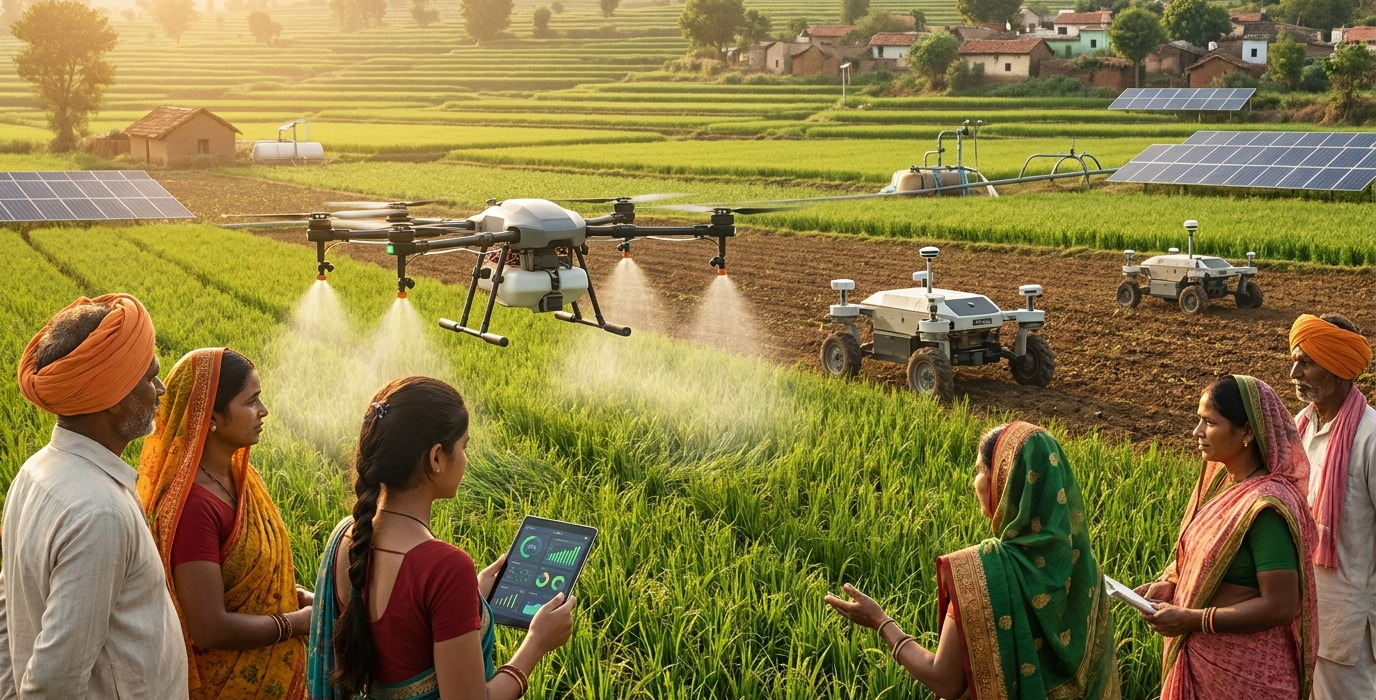
- Drones and sensors integrated with AI are automating tasks like soil analysis and targeted fertilisation, boosting efficiency.
The Dawn of the AI Kisaan: Revolutionising Indian Farmland
The image of the Indian farmer, often depicted in sepia tones, is rapidly evolving. We’re witnessing a quiet revolution sweeping across our nation’s vast farmlands, one powered not by bullock carts, but by artificial intelligence. For decades, farmers have relied on traditional wisdom and gut instinct. Now, sophisticated algorithms and cutting-edge technology are augmenting that knowledge, promising to transform how we cultivate our food. This isn’t a distant future; it’s happening now, in fields from Punjab’s golden wheat to Kerala’s verdant spice plantations.
We’re talking about a paradigm shift from guesswork to data-driven decision-making. AI is becoming the farmer’s new best friend, offering insights that were once the exclusive domain of agricultural scientists. Imagine knowing precisely how much water your crops need, down to the individual plant, or identifying a subtle fungal infection before it decimates your harvest. This is the tangible impact AI is already delivering, empowering farmers to achieve higher yields, reduce waste, and improve their livelihoods. The potential for this technology to secure India’s food future and uplift its agricultural backbone is immense.
Precision Irrigation: Every Drop Counts
Water scarcity is a recurring challenge for Indian agriculture, exacerbated by unpredictable monsoons and rising temperatures. Traditional irrigation methods, often relying on fixed schedules or visual cues, can lead to both over-watering and under-watering. This is where AI steps in, offering a lifeline through precision irrigation systems. These systems utilise a network of sensors deployed across the fields, collecting real-time data on soil moisture levels, humidity, temperature, and even the specific needs of different crop varieties.
These sensors, often placed strategically in fields in districts like Latur in Maharashtra, known for its water stress, transmit data to AI-powered platforms. These platforms then analyse the information, factoring in weather forecasts and crop growth stages. The result is a precisely calculated irrigation schedule, delivered only when and where it’s needed. This intelligent approach dramatically reduces water consumption, with some studies showing savings of up to 30-40% compared to conventional methods. Moreover, by ensuring crops receive the optimal amount of water, plant health improves, leading to better growth and higher quality produce.
AI-Driven Water Management in Action
Consider a farmer in Rajasthan, where water is a precious commodity. Instead of irrigating a large paddy field based on a general schedule, an AI system might direct water only to specific sections where soil moisture has dropped below a critical threshold. This targeted approach not only conserves water but also prevents issues like waterlogging and nutrient runoff, which can harm the environment and reduce crop productivity. The system can even learn from past data, identifying patterns to predict future water needs more accurately. This granular control is a game-changer, especially for small and marginal farmers who often bear the brunt of water shortages.
Early Detection: The Sentinel of the Fields
Crop diseases and pest infestations are the bane of every farmer’s existence. A single outbreak can wipe out an entire season’s earnings. Historically, farmers relied on visual inspection, often detecting problems only when they had become widespread and difficult to manage. AI, however, is changing this by acting as an early warning system, a vigilant sentinel for the fields. Through advanced image recognition and machine learning algorithms, AI can identify the tell-tale signs of diseases and pests far earlier and with greater accuracy than the human eye.
This is achieved through various means, including drone-mounted cameras and even smartphone applications. Farmers can upload high-resolution images of affected plants, and AI algorithms analyse these images for specific patterns, colours, and textures indicative of particular ailments. For instance, a subtle discolouration on a brinjal leaf, barely visible to the untrained eye, can be flagged by an AI system as an early sign of blight. This allows for swift intervention, often with targeted treatments, minimizing the need for broad-spectrum pesticides, which are not only costly but also harmful to beneficial insects and the environment.
Beyond Visuals: Unlocking Deeper Insights
Beyond visual detection, AI can also analyse data from soil sensors and weather patterns to predict the likelihood of certain diseases emerging. For example, a combination of high humidity and specific temperature ranges might signal an increased risk of fungal infections. The AI system can then alert the farmer, recommending preventative measures. This proactive approach is significantly more effective and economical than reactive treatments. Farmers in the coffee plantations of Coorg, Karnataka, are increasingly using such AI tools to combat leaf rust, a persistent threat.
“AI is not replacing the farmer; it’s empowering them with knowledge. It’s like giving them superpowers to understand their fields better than ever before.”
Advertisement300×250 / native
Optimising Soil Health and Fertilisation
Healthy soil is the foundation of a bountiful harvest. However, soil composition can vary significantly even within a single farm, affecting nutrient availability and crop performance. Traditional soil testing methods are often time-consuming and provide a snapshot of conditions at a single point in time. AI, coupled with advanced sensor technology, is revolutionising soil management by enabling dynamic and precise fertilisation strategies.
Sensors, whether embedded in the soil, mounted on tractors, or carried by drones, continuously monitor crucial parameters like pH levels, organic matter content, and the availability of essential nutrients such as nitrogen, phosphorus, and potassium. AI algorithms process this data, creating detailed maps of soil health across the entire farm. These maps highlight areas that are nutrient-deficient or require specific amendments. This allows for variable rate application of fertilisers and other soil conditioners, meaning farmers can apply inputs only where they are needed and in the exact quantities required.
Smart Fertilisation for Smarter Yields
This precision approach has multiple benefits. Firstly, it drastically reduces the overuse of fertilisers, which is not only a significant cost for farmers but also a major contributor to environmental pollution through runoff into water bodies. Secondly, by ensuring that each part of the field receives the precise nutrients it needs, crop growth is optimised, leading to increased yields and improved produce quality. For example, a farmer growing sugarcane in Uttar Pradesh can use AI-generated soil maps to apply nitrogen fertiliser only to the specific zones that show a deficiency, rather than broadcast fertilising the entire field. This not only saves money but also ensures that the sugarcane stalks are healthier and yield more juice. We are seeing AI-driven solutions that even recommend the type of organic manure best suited for specific soil profiles.
Predictive Analytics for Market Readiness
The journey from farm to fork doesn’t end with a successful harvest. Farmers often face the challenge of unpredictable market prices and demand. This can lead to distress sales or produce going to waste. AI is now extending its reach beyond the fields, offering powerful predictive analytics that help farmers make informed decisions about when and where to sell their produce for the best possible returns.
These AI systems analyse a vast array of data points, including historical price trends, current market demand, weather patterns that might affect supply, and even global commodity futures. By processing this information, they can forecast price fluctuations and identify optimal selling windows. This allows farmers to better plan their harvesting and storage, potentially holding back produce when prices are low and selling when they are expected to rise. This predictive capability is particularly valuable for perishable goods, where timing is everything.
Leveraging AI for Fairer Prices
Imagine a farmer in Gujarat, ready to sell their bumper crop of cumin. Instead of accepting the first offer, an AI-powered platform can provide insights into current demand across various wholesale markets in India, suggesting which market is likely to offer the most competitive price. Some advanced systems can even connect farmers directly with bulk buyers and food processing companies, bypassing intermediaries and ensuring a larger share of the profit reaches the farmer. A surprising fact: AI is now being used to predict the optimal time to harvest certain fruits to coincide with peak festival demand, thereby fetching premium prices for farmers in states like Tamil Nadu during celebrations like Pongal.
Automating Labor and Enhancing Efficiency
The agricultural sector faces a significant challenge with labour shortages and the increasing cost of manual labour. AI-powered automation is stepping in to bridge this gap, making farming operations more efficient and less labour-intensive. This includes the use of autonomous tractors, robotic harvesters, and sophisticated drone technology that can perform a multitude of tasks.
Drones, in particular, are proving to be incredibly versatile. Equipped with high-resolution cameras and sensors, they can conduct aerial surveys of fields, providing detailed data on crop health, weed infestation, and irrigation needs. This data is then processed by AI algorithms to create actionable insights. For instance, a drone can identify areas with significant weed growth, allowing for targeted herbicide application, thereby reducing chemical usage and labour costs associated with manual weeding.
Robotics on the Farm: A New Era of Mechanisation
Beyond drones, we’re seeing the emergence of robots designed for specific agricultural tasks. From automated weeding robots that meticulously remove unwanted plants to robotic harvesters capable of gently picking delicate fruits like strawberries, these machines are transforming farm operations. While the initial investment can be substantial, the long-term benefits in terms of reduced labour costs, increased precision, and improved operational efficiency are significant. Farmers in the apple orchards of Himachal Pradesh are exploring robotic solutions for pruning and selective fruit picking, tasks that are traditionally labour-intensive and require skilled workers. This wave of automation promises to make farming a more sustainable and economically viable profession for the next generation.
Frequently Asked Questions
What are the biggest benefits of AI in Indian agriculture?
The key benefits include optimised resource management (water, fertilisers), early detection and prevention of crop diseases and pests, improved yields and produce quality, and better market price realisation through predictive analytics.
Are AI tools affordable for small Indian farmers?
While some advanced AI solutions require significant investment, many accessible and affordable mobile-based apps and subscription services are emerging. Government initiatives and farmer cooperatives are also playing a role in making these technologies more accessible.
How does AI help with water conservation in Indian farms?
AI-powered precision irrigation systems analyse real-time soil moisture data and weather patterns to deliver water only when and where it’s needed, drastically reducing wastage compared to traditional methods.
Can AI predict market prices for crops?
Yes, AI can analyse historical data, current demand, and weather forecasts to predict market price fluctuations, helping farmers make informed decisions about selling their produce.
What are the limitations of AI in Indian agriculture?
Challenges include the initial cost of technology, the need for digital literacy and training, reliable internet connectivity in rural areas, and the integration of AI with existing farming practices. Overcoming these will be crucial for widespread adoption.