The smell of eucalyptus and woodsmoke is an ingrained part of the Australian summer. For many, it’s a nostalgic scent. A reminder of barbecues and outdoor living. But for too many, it’s also the precursor to terror. The acrid perfume of encroaching danger.
This past decade has seen bushfires become not just a seasonal hazard. They’ve become a defining, devastating force in Australian life. We’ve watched landscapes turn to ash. Communities have teetered on the brink.
Yet, amidst the smoke and the fear, a different kind of spark is igniting across the continent. Australian ingenuity, powered by artificial intelligence, is stepping onto the front lines.
Key Takeaways:
- Australian tech startups are developing sophisticated AI models to predict and mitigate bushfire risks.
- These AI solutions go beyond traditional weather forecasting, analyzing a complex web of environmental factors.
- Beyond fire, AI is revolutionising sustainable agriculture, addressing challenges like water scarcity and pest management in Australia.
- The country’s vast, unique ecosystems present specific challenges that local AI innovation is uniquely positioned to solve.
- These technologies offer a hopeful new chapter in Australia’s fight against climate-related environmental crises.
The Digital Watchtower Over Our Eucalypts
For decades, bushfire prediction in Australia relied on a combination of weather forecasts, ground observations, and the deep, often intuitive, knowledge of experienced firefighters. While this has served us well, the sheer scale and ferocity of recent fire seasons, like the Black Summer of 2019-2020, highlighted the limitations of these methods.
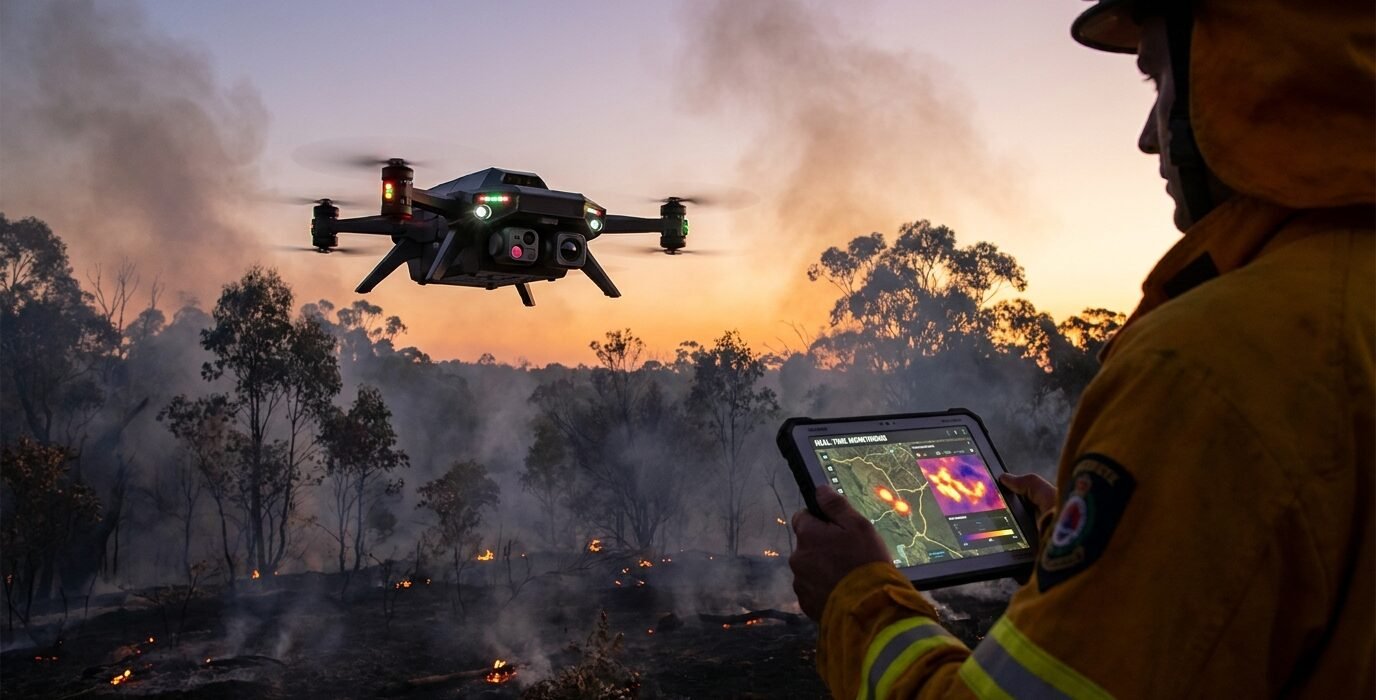
That’s where companies like Fireball, a Sydney-based startup, are stepping in. They’re building what feels like a digital watchtower. A network of AI-powered sensors and predictive analytics that can see danger long before it’s visible to the naked eye.
Imagine a system that doesn’t just look at temperature and wind speed. It also considers the moisture content of undergrowth down to the leaf level. It tracks the dryness of the soil. And it detects subtle changes in vegetation health through satellite imagery. This is the reality Fireball is creating.
Their algorithms are trained on decades of historical fire data. This is combined with real-time environmental readings from across Australia. They can identify areas with an exceptionally high probability of ignition. This isn’t just for the next few days, but weeks in advance.
This allows for proactive measures. Think targeted fuel reduction burns or increased surveillance in high-risk zones. This potentially saves precious time and resources.
The sheer complexity of Australia’s varied terrain, from the dense rainforests of Queensland to the arid scrub of the Outback, presents a unique challenge. AI offers the computational power to process these intricate variables at a scale previously unimaginable.
One of their early pilot projects in the Blue Mountains, a region historically vulnerable to fires, showed a significant increase in early detection accuracy compared to traditional methods. This is more than just an app. It’s a sophisticated nervous system for our environment.
From Satellite Eyes to Farmers’ Fields: Greening the Outback
The challenges facing Australian agriculture are as vast and varied as the continent itself. Water scarcity in the Murray-Darling Basin is a constant worry. The ever-present threat of invasive pests like the cane toad looms large. And adapting to unpredictable weather patterns demands innovative solutions.
This is where a company like Agri-Sense, an agricultural tech firm with roots in Perth, Western Australia, is making waves. They are using AI to empower farmers. They are transforming how we grow food in this often-harsh environment.
Agri-Sense isn’t just about drones spraying fertiliser. It’s about a deep, intelligent understanding of every plant and every patch of soil. They deploy networks of sensors across farms. These measure everything from soil moisture and nutrient levels to ambient temperature and humidity.
This data is then fed into their AI platform. It can identify subtle signs of stress in crops long before they become visible to the human eye. A farmer might receive an alert. Perhaps a specific section of their wheat field, near the town of Geraldton, is showing early signs of nitrogen deficiency. Or a particular quadrant is at higher risk of a fungal outbreak due to micro-climatic conditions.
The AI can then recommend precise interventions. This could be applying a targeted amount of fertiliser only where it’s needed. Or adjusting irrigation schedules on a plant-by-plant basis. This granular approach drastically reduces waste of water, fertilisers, and pesticides. It leads to both environmental sustainability and significant cost savings for the farmer.
I spoke with Sarah Jenkins, a third-generation sheep and grain farmer from Narromine in New South Wales. She has been trialling Agri-Sense’s system. “Before, you were guessing a lot, relying on experience,” she told me. “Now, it feels like I have an extra pair of eyes. And they’re incredibly smart eyes. We’ve already cut our water usage by 15% this season, just by understanding exactly when and where to water. It’s not about replacing the farmer; it’s about giving us the best tools to do our job better and more responsibly.”
This kind of data-driven precision farming is crucial for Australia’s agricultural future. It ensures we can continue to feed ourselves and the world. All while minimising our environmental footprint.
Decoding the Red Dust: AI’s Role in Biodiversity Monitoring
Australia’s unique biodiversity is a global treasure. But it’s also incredibly fragile. And increasingly under threat. From the iconic kangaroo to the enigmatic platypus, countless species face unprecedented pressure. Habitat loss, climate change, and invasive species are major culprits.
Traditional methods of monitoring these populations, like manual surveys, are often time-consuming and expensive. They can also be disruptive to the very animals they aim to study.
Enter companies like Bio-Scan AI. This is a collaborative initiative involving researchers from universities in Melbourne and Brisbane. They are using artificial intelligence to develop non-invasive methods for tracking and understanding wildlife populations. This spans vast and often inaccessible areas.
Their work involves analysing images and audio recordings. These are collected by a network of remote sensors and camera traps. These are scattered throughout national parks and conservation areas. The AI algorithms are trained to recognise individual animals. They identify species. They even detect signs of disease or stress from behaviour and physical characteristics.
Imagine an AI that can distinguish between individual koalas in the eucalyptus forests of Victoria. It does this based on their unique ear notches or nose prints. Or an algorithm that can identify the distinct calls of endangered frog species in the wetlands near Kakadu National Park.
This technology allows conservationists to gather detailed population data. This is done with minimal disturbance to the animals. Furthermore, Bio-Scan AI is using AI to map habitat suitability. They predict how changing environmental conditions might impact species distribution.
For instance, they are modelling how rising sea levels might affect shorebird nesting sites. This is along the coast of Queensland. Or how increased drought frequency could push certain marsupial populations further inland.
A recent study published by the University of Queensland, utilising Bio-Scan AI’s data, revealed a significant finding. Their AI-powered acoustic monitoring system could detect over 90% of bird species present in a given area. This is a significant improvement in efficiency and accuracy compared to human observers.
This ability to gain a comprehensive and real-time understanding of our wildlife is critical. It’s essential for developing effective conservation strategies. It ensures the survival of Australia’s natural heritage for generations to come.
The Unexpected Ally: AI in Drought Resilience
Drought is a recurring nightmare for Australia. The vast, semi-arid interior, coupled with increasingly erratic rainfall patterns driven by climate change, means water scarcity is inevitable. It’s not a question of if, but when.
For communities like those in regional South Australia, grappling with prolonged dry spells, the fight for water security is a daily reality. Traditional approaches to drought management often involve reactive measures. Think water restrictions or emergency fodder drops. These can be costly and only partially effective.
However, a new wave of AI-driven solutions is emerging. They offer proactive and sophisticated tools for drought resilience. Companies like Aqua-Predict, based in Adelaide, are developing AI models. These go far beyond simple rainfall forecasts.
They integrate a complex array of data. This includes historical weather patterns. It incorporates soil moisture readings from remote sensing satellites. Vegetation health indicators are included. Even predictions of El Niño and La Niña cycles are analysed. The goal is to create highly accurate, long-term forecasts of water availability at a regional level.
This allows governments and water authorities to make more informed decisions. Decisions about water allocation, infrastructure investment, and the implementation of water-saving technologies. For instance, Aqua-Predict’s system can forecast the likelihood of significant groundwater depletion in a particular basin. This allows for earlier implementation of water conservation measures. It also facilitates the exploration of alternative water sources.
I recently spoke with Dr. Evelyn Reed, a climatologist who collaborates with Aqua-Predict. She highlighted a surprising insight: “We discovered that by analysing subtle changes in atmospheric pressure patterns months in advance, our AI could predict the severity of an upcoming drought with an accuracy that surprised even us. It’s not magic; it’s about finding correlations in vast datasets that humans simply can’t process. This predictive power allows for a shift from crisis management to proactive adaptation, which is absolutely vital for Australia’s future.”
This proactive approach, enabled by AI, means communities can better prepare for dry periods. They can invest in water-efficient farming practices. Ultimately, they can build greater resilience against the inevitable cycles of drought that define so much of the Australian landscape.
From Waste to Wonder: AI in the Circular Economy
Australia, like many developed nations, faces a growing challenge with waste management. Landfills are overflowing. The linear model of “take-make-dispose” is increasingly unsustainable. The push towards a circular economy, where resources are reused and recycled as much as possible, is gaining momentum.
Artificial intelligence is proving to be a powerful catalyst in this transition. It optimises processes and identifies new opportunities for resource recovery. Consider a company like Re-Cycle AI, a Melbourne-based startup focused on revolutionising the recycling industry.
They are deploying AI-powered sorting systems in material recovery facilities (MRFs) across the country. Traditional MRFs often rely on manual sorting or older, less precise automated systems. This leads to contamination and reduced recovery rates.
Re-Cycle AI’s system uses high-speed cameras, advanced sensors, and machine learning algorithms. It identifies and sorts different types of materials – plastics, metals, paper, and glass – with incredible accuracy. The AI can even differentiate between various grades of plastic. This is a crucial step in enabling higher-value recycling.
This means more materials are successfully diverted from landfill. They can be fed back into manufacturing processes. A surprising revelation from their work in a facility near Brisbane was the AI’s ability to identify previously unrecoverable composite materials. This opened up new avenues for their reprocessing.
Beyond sorting, AI is also being used to optimise logistics in waste collection. It predicts optimal routes for collection trucks. This minimises fuel consumption and reduces emissions. Furthermore, AI is enabling the design of products that are inherently more circular. It analyses material lifecycles and suggests design modifications. These modifications make products easier to disassemble, repair, and recycle.
This intelligent approach to waste management is not just about tidier cities. It’s about fundamentally rethinking our relationship with resources. It turns what was once discarded into valuable commodities. It creates a more sustainable future for Australia.
The Australian Edge: Local Solutions for Global Problems
The narrative of AI in environmental solutions often focuses on Silicon Valley giants or European research institutions. However, Australia’s unique geographical, ecological, and climatic conditions necessitate a localized approach to innovation. Companies like the ones we’ve discussed aren’t just applying existing AI models. They are developing bespoke solutions tailored to the specific challenges faced here.
The sheer scale of the continent, the intensity of its sun, the prevalence of unique flora and fauna, and the specific risks posed by bushfires and droughts all require Australian minds to craft the answers. This local expertise, combined with cutting-edge AI, is proving to be a potent force.
The impact extends beyond environmental protection. It’s about building economic resilience and creating new industries. The development and deployment of these AI technologies are generating high-skilled jobs. They foster a culture of innovation. We’re seeing a generation of young Australians who are not just tech-savvy but also deeply committed to finding solutions. Solutions for the environmental challenges that will shape their future.
The stories emerging from Perth, Sydney, Melbourne, Adelaide, and Brisbane are not just about algorithms and data. They are about people. They are about farmers like Sarah Jenkins, who are embracing new technologies to secure their livelihoods and protect the land they steward. They are about scientists and engineers working tirelessly to build a more sustainable future. A future for a continent that is both breathtakingly beautiful and profoundly vulnerable.
This is the Australian edge. Using advanced technology to solve uniquely Australian problems. With implications that ripple far beyond our shores.
The relentless march of climate change presents a formidable challenge. One that can feel overwhelming. Yet, in the quiet hum of servers and the sharp focus of AI algorithms, Australia is discovering potent new allies. This isn’t about replacing human effort but augmenting it. It’s about providing our dedicated firefighters, farmers, and conservationists with tools of unprecedented power.
The scent of eucalyptus is still there. A reminder of what we stand to lose. But now, it’s also mingling with the subtle, hopeful aroma of innovation. A testament to human ingenuity finding new ways to protect the land we call home.