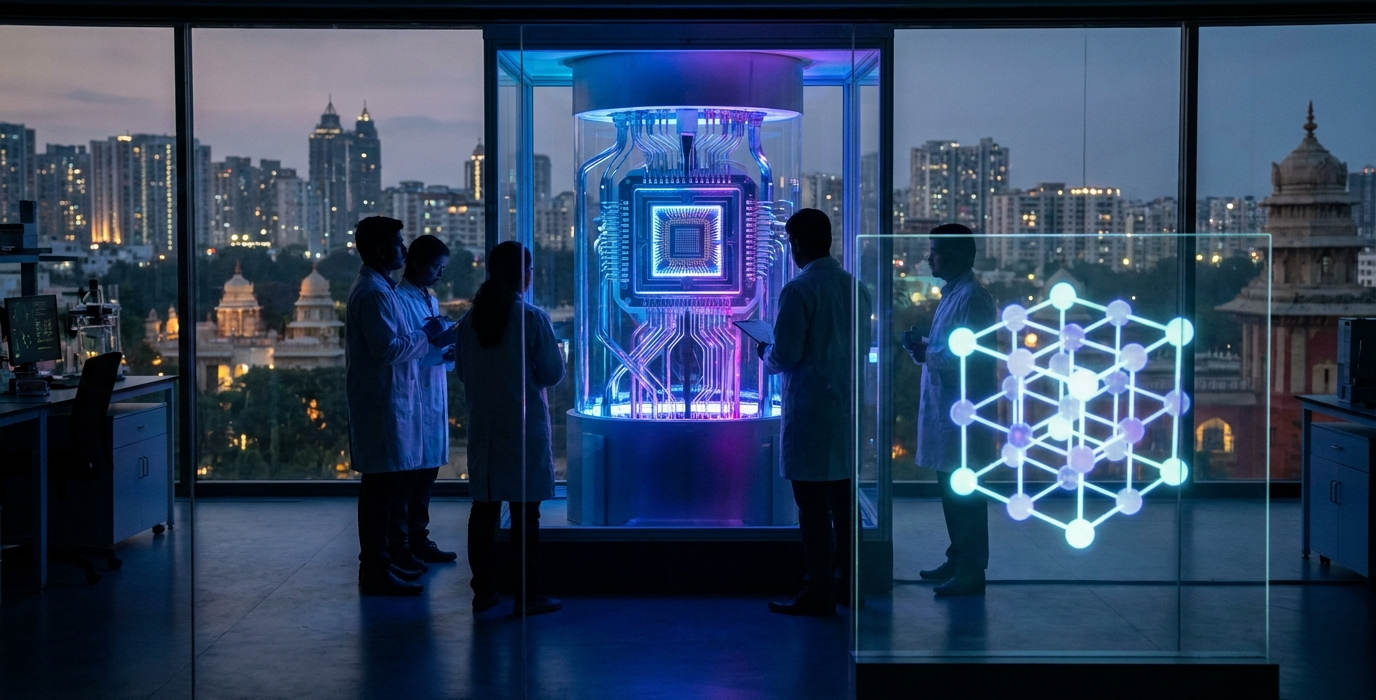
Key Takeaways
- Quantum computing isn’t science fiction; it’s a rapidly evolving reality with the potential to revolutionize industries from medicine to finance.
- India is strategically positioning itself to be a global player in quantum technologies, fostering research and development through significant investments and academic collaborations.
- Understanding the core principles of quantum computing can demystify its complex nature and highlight its tangible applications for everyday life and national progress.
- While challenges remain, the nation’s commitment to building a quantum ecosystem suggests a future where India leads in harnessing this transformative power.
The Dawn of the Quantum Age: What It Means for India
Imagine a computer so powerful it could design life-saving drugs in weeks, optimize complex supply chains overnight, or crack encryption that currently secures our digital world. This isn’t a scene from a futuristic movie; this is the promise of quantum computing, and India is stepping onto the global stage to harness its immense potential. As of 3 August 2026, the conversation around quantum technology has moved from academic labs into strategic national planning, with India actively investing in research, infrastructure, and talent development.
This shift signifies a crucial moment for our nation. Quantum computing operates on principles of quantum mechanics, allowing it to perform calculations far beyond the capabilities of even the most powerful supercomputers today. We’re talking about a paradigm shift, not just an incremental upgrade. The implications for sectors like pharmaceuticals, materials science, artificial intelligence, and cybersecurity are profound, and India’s proactive approach suggests we are poised to be not just a consumer, but a leader in this technological revolution.
India’s Strategic Quantum Push: From Labs to National Priority
The Indian government, recognizing the disruptive potential of quantum technologies, has made them a cornerstone of its future innovation strategy. The National Quantum Mission, launched with substantial funding, is actively driving research and development across universities, research institutions, and burgeoning startups. This mission is not merely about theoretical breakthroughs; it’s about building a robust ecosystem that can translate quantum science into practical applications.
Institutions like the Indian Institute of Science (IISc) in Bengaluru, the Tata Institute of Fundamental Research (TIFR) in Mumbai, and the Indian Institutes of Technology (IITs) are at the forefront, establishing dedicated quantum computing research centres. These hubs are fostering collaboration between physicists, computer scientists, mathematicians, and engineers, creating a multidisciplinary approach essential for tackling the complexities of quantum systems. We’re also seeing a rise in quantum startups, encouraged by government grants and venture capital interest, signalling a vibrant commercialisation pathway.
A Surprising Fact: The Quantum Advantage in Materials Science
One of the most exciting, yet often overlooked, applications lies in materials science. Quantum computers can simulate molecular interactions with unprecedented accuracy. This means we could design novel materials with specific properties—think lighter, stronger alloys for aerospace, more efficient catalysts for clean energy, or even superconductors that operate at room temperature. India’s rich history in metallurgy and chemical engineering provides a strong foundation to excel in this domain, potentially leading to breakthroughs that benefit everything from sustainable energy solutions to advanced manufacturing.
Demystifying Quantum Computing: The ‘Qubit’ Revolution
At its heart, quantum computing is about harnessing the peculiar rules of quantum mechanics. Unlike classical computers that use bits representing either 0 or 1, quantum computers use ‘qubits’. Qubits can exist in a superposition of both 0 and 1 simultaneously, and can be entangled with other qubits, meaning their fates are linked even when separated. This ability to represent and process information exponentially more effectively is what gives quantum computers their immense power.
Imagine trying to find the best route for a delivery network with thousands of potential paths. A classical computer would test them one by one, or use approximations. A quantum computer, using superposition and entanglement, can explore a vast number of possibilities concurrently. This parallel processing capability is what unlocks its potential for solving problems that are intractable for even the most powerful supercomputers today. For India, this means faster drug discovery, more sophisticated financial modelling, and the ability to analyse complex datasets that are currently beyond our reach.
The Power of Entanglement
Entanglement is often described as Einstein’s “spooky action at a distance.” When two qubits are entangled, measuring the state of one instantaneously influences the state of the other, regardless of the distance between them. This interconnectedness is a fundamental resource for quantum computation, enabling complex algorithms and secure communication protocols. Understanding this non-intuitive phenomenon is key to grasping the quantum advantage.
Real-World Applications: Beyond the Hype
While the prospect of a universal quantum computer is still some years away, the applications of current and near-term quantum devices are already starting to emerge. For India, this translates into tangible benefits across critical sectors. In pharmaceuticals, quantum simulations can drastically speed up the process of drug discovery and development. Instead of years of trial and error in labs, we could accurately predict how molecules will interact, leading to faster development of treatments for diseases and personalized medicine tailored to individual genetic makeup.
The financial sector stands to gain immensely. Quantum algorithms can revolutionize risk assessment, portfolio optimization, and fraud detection, leading to more stable and efficient markets. In logistics and supply chain management, optimizing routes and resource allocation for a country as vast and diverse as India presents an enormous computational challenge that quantum computing is well-suited to address. Even in agriculture, quantum-enhanced AI could lead to more precise crop management and resource utilization, boosting food security.
“Quantum computing is not just about faster calculations; it’s about fundamentally new ways of solving problems. India’s investment in this field positions us to lead the next wave of technological innovation.”
A Surprising Fact: Quantum Cybersecurity
While quantum computers pose a threat to current encryption methods (a challenge India is also actively researching solutions for), they also offer a path to an even more secure future. Quantum Key Distribution (QKD) uses the principles of quantum mechanics to create unbreakable encryption keys. Any attempt to intercept the key will inevitably disturb the quantum state, alerting the users to the intrusion. India’s focus on both developing quantum computing power and securing its digital infrastructure against it demonstrates a mature and forward-thinking approach.
India’s Quantum Ecosystem: Nurturing Talent and Innovation
Building a quantum future requires more than just cutting-edge hardware; it demands a skilled workforce and a supportive environment for innovation. India is actively addressing this by enhancing its educational curricula to include quantum information science, quantum physics, and quantum engineering. Universities are introducing specialized courses and degrees, ensuring that the next generation of scientists and engineers are quantum-ready. This focus on education is crucial for developing the human capital needed to drive the quantum revolution.
Furthermore, the government is facilitating collaborations between academia and industry through initiatives like the Quantum Enablement Science and Technology (QuEST) program. This fosters an environment where research breakthroughs can be translated into commercial products and services. Incubators and accelerators are emerging, providing startups with the resources, mentorship, and funding they need to develop quantum solutions. We are witnessing the deliberate cultivation of a vibrant ecosystem designed to nurture both fundamental research and practical application, positioning India as a global hub for quantum innovation.
The Path Ahead: Challenges and Opportunities
The journey into the quantum era is not without its hurdles. Building stable, scalable quantum computers is an immense engineering challenge. Qubits are notoriously fragile and susceptible to noise from their environment, requiring sophisticated error correction techniques. Developing practical quantum algorithms that can outperform classical ones for specific problems is also an ongoing area of research. The investment required is substantial, and the timeline for widespread adoption remains uncertain.
However, the opportunities far outweigh the challenges. For India, mastering quantum technologies could mean leapfrogging established economies in key strategic areas. It presents a chance to enhance national security, drive economic growth, and address some of the world’s most pressing challenges, from climate change to global health. By investing now, fostering collaboration, and nurturing talent, India is not just preparing for the future; it is actively building it. The nation’s commitment is clear: to harness the power of the quantum realm for progress and prosperity, both domestically and on the global stage.
Frequently Asked Questions
What is the difference between a classical computer and a quantum computer?
Classical computers use bits that are either 0 or 1. Quantum computers use qubits, which can be 0, 1, or both simultaneously (superposition), and can be linked to other qubits (entanglement). This allows quantum computers to perform vastly more complex calculations much faster for certain types of problems.
When will quantum computers be widely available?
While specialized quantum computers exist today and are being used for research, widespread commercial availability for everyday tasks is still some years away. Experts estimate it could be another decade or more before they become as common as classical computers are now, but significant progress is being made annually.
How is India investing in quantum technology?
India has launched a significant National Quantum Mission with substantial funding. This mission supports research and development in universities and institutions, fosters quantum startups, and aims to build a comprehensive quantum ecosystem, including education and infrastructure development.
Will quantum computers make my current passwords insecure?
Yes, powerful quantum computers could eventually break many of the encryption methods used today. However, researchers worldwide, including in India, are developing quantum-resistant encryption algorithms and technologies like Quantum Key Distribution (QKD) to ensure future digital security.