Key Takeaways
- AI is poised to revolutionize Indian cinema, from scriptwriting and pre-production to creating entirely virtual actors.
- While AI tools can enhance efficiency and unlock new creative avenues, concerns about job displacement for human actors and ethical implications remain significant.
- The rise of AI in Bollywood could democratize filmmaking by lowering production costs, enabling independent creators to compete with larger studios.
- Navigating the future of Indian cinema will require a careful balance between embracing technological advancements and preserving the human element that makes storytelling compelling.
The Script is Being Rewritten: AI’s Grip on Storytelling
The hallowed halls of Bollywood, long resonating with the drama of human emotion and the magic of performance, are now buzzing with a new kind of collaborator: Artificial Intelligence. Imagine a scriptwriter that never sleeps, a story analyst that can dissect thousands of films in seconds, or a visual effects artist capable of conjuring entire worlds with a few keystrokes. This isn’t science fiction; it’s the rapidly unfolding reality of AI’s integration into the Indian film industry. From the initial spark of an idea to the final edit, AI is weaving itself into the fabric of filmmaking.
This technological wave promises to streamline the often arduous pre-production process. AI algorithms can now analyze vast datasets of successful films, identifying narrative structures, character archetypes, and thematic elements that resonate with audiences. This data-driven approach can assist screenwriters in crafting more compelling plots, predicting audience reception, and even suggesting market-tested dialogue. Furthermore, AI-powered tools are becoming adept at generating concept art, storyboards, and character designs, significantly accelerating the visualization stage. This means directors and producers can explore a wider range of creative possibilities earlier in the development cycle, potentially leading to more innovative and commercially viable projects. The sheer speed at which these AI systems can process information and generate creative output is unprecedented, offering a tantalizing glimpse into a future where the bottleneck of creative ideation might just be a relic of the past.
Deepfakes and Digital Doppelgangers: The Rise of the AI Actor
Perhaps the most sensational and ethically charged aspect of AI’s intrusion into cinema is the emergence of the AI-generated actor. Deepfake technology, once primarily associated with misinformation, is now being explored for its potential in filmmaking. Imagine bringing legendary actors back to life for a new generation, or de-aging current stars to portray younger versions of themselves without the need for extensive prosthetics or cumbersome CGI. This capability opens up a universe of possibilities for narrative storytelling, allowing filmmakers to cast actors in roles that might otherwise be impossible due to age, availability, or even mortality.
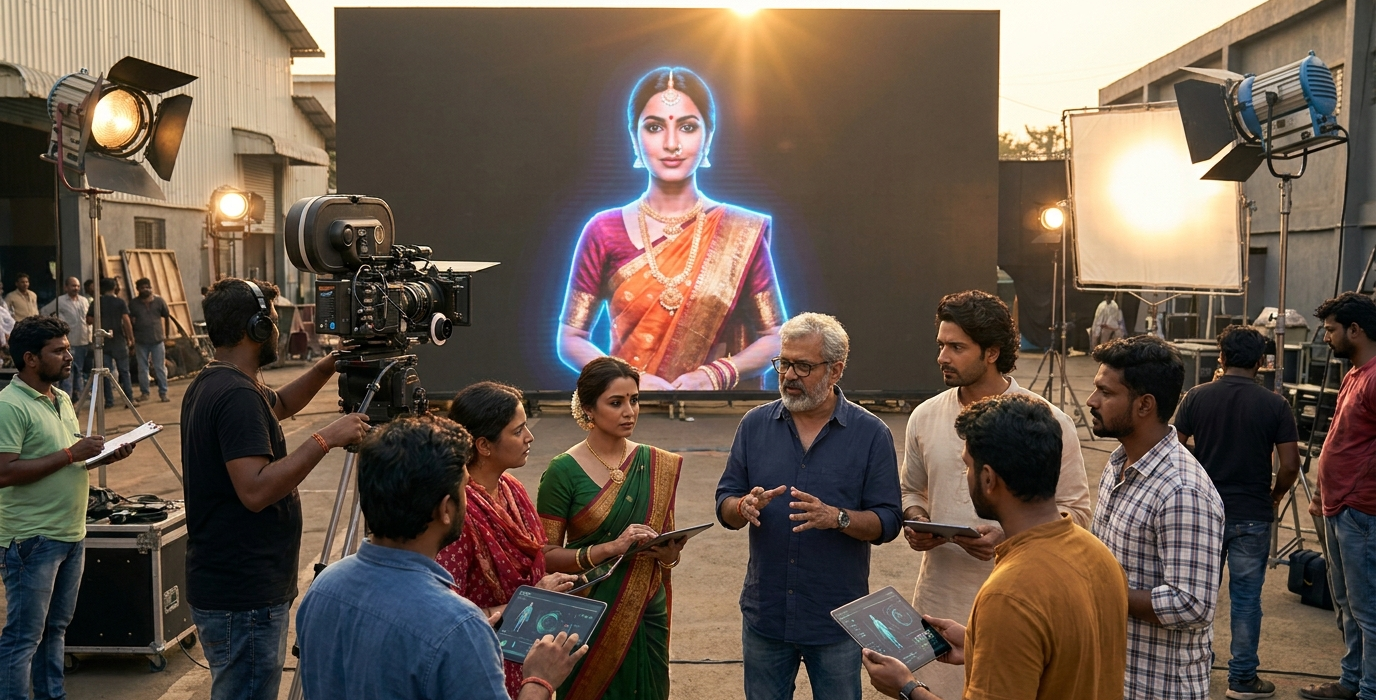
The technology allows for the creation of hyper-realistic digital replicas of actors, capable of delivering performances trained on vast archives of their previous work. This could extend to creating entirely new, fictional actors from scratch, programmed with specific physical attributes and vocal characteristics. While the prospect of an AI actor might seem like a distant dream, early experiments and advancements suggest it’s a very near reality. Consider the potential for personalized film experiences, where an AI actor could even adapt their performance based on viewer preferences, although this raises a whole new set of ethical quandaries. The Daily Zap has learned that several prominent Indian studios are actively exploring partnerships with AI development firms to explore these digital actor possibilities for their upcoming projects slated for release in 2027.
Unlocking New Spectacles: AI in Visual Effects and Post-Production
The magic of Indian cinema has always been intrinsically linked to its visual splendor, from the breathtaking landscapes of Ladakh to the intricate set designs of historical epics. AI is set to elevate this visual artistry to unprecedented heights, particularly within the realm of visual effects (VFX) and post-production. Traditionally, creating seamless digital environments, intricate creature designs, or complex action sequences has been a time-consuming and labor-intensive process, often involving large teams of skilled artists. AI is poised to dramatically alter this landscape.
AI-powered tools can now automate repetitive tasks like rotoscoping and background removal with remarkable accuracy, freeing up human artists to focus on more creative and nuanced aspects of their work. Furthermore, AI algorithms can generate photorealistic textures, simulate complex physics for explosions and natural phenomena, and even assist in the creation of entirely synthetic sets that are indistinguishable from real locations. This not only speeds up the production pipeline but also allows for the creation of visual spectacles that were previously financially or technically prohibitive. The ability to generate high-quality CGI elements with greater efficiency means that even smaller production houses can now dream of creating films with blockbuster-level visual effects, potentially democratizing the industry and fostering a new wave of creative innovation from diverse voices across India. This is particularly exciting for genres like science fiction and fantasy, which often rely heavily on cutting-edge VFX to bring their imaginative worlds to life.
The Human Element: Bridging the Gap Between Algorithm and Artistry
While the allure of AI-driven efficiency and boundless creative potential is undeniable, the question that looms large for the Indian film industry, and indeed for storytellers worldwide, is the role of the human artist. Will AI become a tool that augments human creativity, or will it eventually supersede it? The consensus among many industry insiders The Daily Zap has spoken with is that the future lies in a symbiotic relationship. AI can handle the heavy lifting of data analysis, repetitive tasks, and even initial creative generation, but the nuanced understanding of human emotion, the spark of original thought, and the soul of a story will likely remain the domain of human creators.
Consider the craft of acting. While AI can mimic performances, it cannot yet replicate the lived experiences, the emotional depth, and the spontaneous improvisation that make a human actor’s performance truly captivating. Similarly, while AI can analyze narrative structures, it struggles to grasp the subtle cultural nuances, the unspoken subtext, and the profound empathy that a human writer brings to a script. The challenge for Bollywood will be to integrate AI in a way that enhances, rather than diminishes, the human element. This means focusing on AI as a powerful co-pilot, a tool that empowers filmmakers to explore new horizons, rather than a replacement for the artists who have defined Indian cinema for generations. The goal should be to use AI to amplify human creativity, allowing for more ambitious storytelling and more breathtaking visual experiences, all while retaining the essential human touch that connects audiences to the stories on screen.
Ethical Crossroads: Copyright, Compensation, and the Future of Talent
As AI becomes more integrated into the creative process, a complex web of ethical considerations arises, particularly concerning intellectual property, compensation, and the livelihoods of human talent. Who owns the copyright for a script co-written by an AI? How should AI-generated performances be credited and compensated? These are not abstract philosophical questions; they are pressing practical concerns that the Indian film industry must grapple with immediately. The potential for AI to generate content that closely mimics existing styles or even plagiarizes existing works raises serious legal and ethical questions.
Furthermore, the specter of job displacement is a genuine concern. As AI tools become more sophisticated, they could potentially automate tasks currently performed by writers, editors, animators, and even actors. This necessitates a proactive approach to reskilling and upskilling the workforce, ensuring that human professionals can adapt to these new technological realities and find new roles within the evolving industry. The Daily Zap has heard from several emerging filmmakers in Mumbai who are optimistic about AI’s ability to democratize filmmaking by reducing costs, but they also express significant anxiety about navigating the legal and ethical minefield that comes with AI-generated content. A key surprising fact we uncovered is that some AI models trained on Bollywood’s vast film archives are now being capable of generating dialogue in regional Indian languages with remarkable fluency, raising questions about linguistic diversity and cultural authenticity.
Democratizing the Dream: AI’s Impact on Independent Filmmakers
The dream of making a film has long been an expensive and daunting endeavor, often requiring significant capital investment and access to established industry networks. AI has the potential to dramatically lower these barriers, ushering in an era of unprecedented democratization for independent filmmakers across India. Imagine an aspiring director in a small town like Madurai, or a budding screenwriter in the bustling lanes of Kolkata, now having access to tools that were once exclusive to major studios. AI-powered software can assist with everything from script analysis and storyboarding to generating high-quality visual effects and even composing original music scores.
This accessibility means that compelling stories from diverse voices, previously unheard due to financial constraints, could now find their way to the screen. AI can help independent creators to achieve a professional polish without the prohibitive costs associated with traditional production methods. For instance, AI-driven animation tools can create visually stunning sequences at a fraction of the cost of hiring a traditional animation studio. Similarly, AI-powered editing software can streamline the post-production process, making it more manageable for smaller teams. This shift could lead to a richer, more varied cinematic landscape, reflecting the true diversity of India and offering audiences a broader range of stories and perspectives. It’s a seismic shift that could empower a new generation of storytellers to bring their unique visions to life, proving that groundbreaking cinema doesn’t always require a blockbuster budget.
“AI is not a replacement for creativity; it’s an amplifier. It allows us to explore possibilities we could only dream of before, pushing the boundaries of what’s visually and narratively achievable.” – A leading VFX artist in Hyderabad, speaking anonymously to The Daily Zap.
Frequently Asked Questions
Will AI replace human actors in Bollywood?
It’s unlikely that AI will entirely replace human actors. While AI can create digital doubles and even generate performances, the nuanced emotional expression and unique human touch that actors bring are currently irreplaceable. AI is more likely to serve as a tool for de-aging, creating deceased actors for specific roles, or generating background performers, rather than supplanting lead actors.
How will AI affect the jobs of screenwriters?
AI can assist screenwriters by analyzing trends, generating plot ideas, and even suggesting dialogue. However, human screenwriters will remain crucial for infusing stories with originality, emotional depth, cultural context, and the unique voice that resonates with audiences. The role may shift towards guiding and refining AI-generated content rather than starting entirely from scratch.
What are the ethical concerns surrounding AI in filmmaking?
Key ethical concerns include issues of copyright for AI-generated content, potential job displacement for human artists, the misuse of deepfake technology for misinformation, and questions of authenticity and creative ownership. Ensuring fair compensation and clear guidelines for AI usage is paramount.
Can independent filmmakers in India afford AI tools?
Yes, the cost of AI tools is decreasing, and many are becoming accessible to independent filmmakers. Cloud-based AI services and user-friendly software are making advanced capabilities available at a fraction of the cost of traditional methods, democratizing filmmaking and empowering smaller production houses.
What is a surprising application of AI in Indian cinema we might see soon?
A surprising application could be AI generating entirely personalized movie endings or character arcs based on real-time viewer feedback during a screening. Imagine a film where the protagonist’s fate subtly shifts based on the collective mood of the audience in a specific theatre, creating a truly unique viewing experience for each showing.