Key Takeaways
- AI-powered precision farming is enabling Indian farmers to drastically improve crop yields and reduce waste by tailoring interventions to specific field conditions.
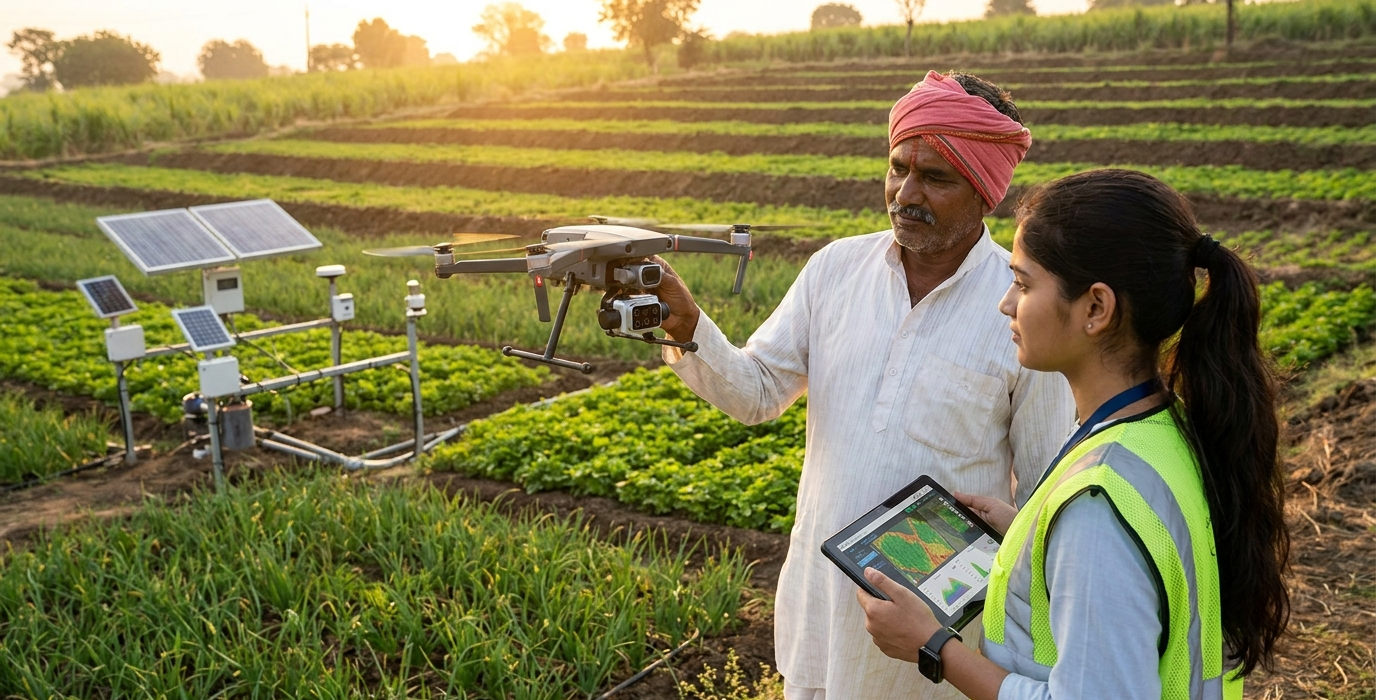
- Smart sensors and drone technology, integrated with AI analytics, provide real-time data on soil health, pest infestation, and water needs, allowing for targeted resource management.
- The adoption of AI is not just about technology; it’s about empowering farmers with knowledge and decision-making tools, fostering greater resilience against climate change and market fluctuations.
- From early disease detection in tea estates in Darjeeling to optimising irrigation in the arid regions of Rajasthan, AI’s impact is diverse and geographically widespread across India.
Precision Farming Takes Root: AI Cultivating Smarter Fields
The Indian agricultural landscape, a tapestry woven with centuries of tradition, is now being re-imagined by the threads of artificial intelligence. In 2026, we’re witnessing a profound shift from traditional, often weather-dependent farming to a hyper-efficient, data-driven approach known as precision agriculture. This isn’t about replacing the farmer; it’s about equipping them with an unparalleled level of insight and control. Imagine a farmer in Punjab, no longer guessing about the exact water needs of a particular patch of wheat, but receiving precise instructions from an AI system based on real-time soil moisture readings and weather forecasts.
This is the promise of AI in agriculture, a promise that’s rapidly becoming reality. By leveraging AI-powered sensors, drones, and advanced analytics, farmers can now monitor their fields with an unprecedented level of detail. These technologies can detect subtle variations in soil nutrient levels, identify the earliest signs of pest or disease infestation, and even predict optimal harvest times with remarkable accuracy. The result is a dramatic reduction in resource wastage – water, fertilisers, pesticides – leading to not only increased yields but also significant cost savings and a more sustainable farming ecosystem. We are moving towards an era where every plant, every square metre of land, is understood and cared for with scientific precision.
Drones and Data: The Eyes in the Sky for Indian Crops
The humble drone, once a novelty, has transformed into an indispensable tool in the arsenal of the modern Indian farmer, all thanks to the intelligence of AI. These flying machines, equipped with high-resolution cameras and multispectral sensors, are now the vigilant eyes that survey vast farmlands, capturing data that would be impossible to gather manually. This data, ranging from crop health indices to topographical maps, is then fed into sophisticated AI algorithms for analysis. These algorithms can process this information at speeds and with an accuracy that human eyes simply cannot match.
Consider the sprawling tea estates of Darjeeling. Here, AI-powered drones can meticulously scan for early signs of blight or pest infestations, identifying affected areas with pinpoint accuracy. This allows estate managers to apply treatments only where needed, drastically reducing the use of chemicals and preserving the delicate flavour profile of the tea. Similarly, in the arid plains of Rajasthan, drones can map soil moisture levels across vast tracts, guiding irrigation systems to deliver water precisely where and when it’s most needed. This prevents over-watering, a common problem in water-scarce regions, and ensures that precious water resources are used with maximum efficiency. The insights provided by these AI-driven aerial surveys are fundamentally changing how we manage crops, moving us towards a more proactive and less reactive approach to cultivation.
Early Warning Systems: AI as the Farmer’s Shield
One of the most critical contributions of AI to Indian agriculture in 2026 is its role as an early warning system. Crop diseases and pest outbreaks can devastate harvests overnight, leading to immense financial hardship for farmers. AI, however, provides a powerful shield against these threats. By analysing vast datasets that include historical weather patterns, soil conditions, and the spread of known pathogens, AI models can predict the likelihood of outbreaks with remarkable foresight.
Imagine a scenario in Maharashtra where an AI system, monitoring local weather data and satellite imagery of neighbouring farms, flags a high probability of a fungal infection due to recent humidity spikes. The system can then alert farmers in the region, recommending specific preventive measures or early treatment protocols. This proactive approach allows farmers to intervene *before* the disease takes hold, saving their crops and their livelihoods. This is a significant departure from traditional methods where farmers often only realised a problem existed when the damage was already substantial. Furthermore, AI can identify unusual patterns in crop behaviour, such as stunted growth or discolouration, which might indicate underlying issues like nutrient deficiencies or early-stage infections, often before they are visible to the naked eye. This predictive power is revolutionising crop protection, transforming it from a reactive battle into a strategic defence.
Optimising Resources: Water, Fertiliser, and Beyond
The efficient allocation of resources is paramount for both profitability and sustainability in agriculture. AI is proving to be a game-changer in this domain, enabling farmers to optimise the use of water, fertilisers, and even labour. In the fertile plains of Haryana, where irrigation is crucial for wheat and rice cultivation, AI-powered systems are analysing soil moisture sensors, weather forecasts, and crop growth stages to determine the exact amount of water needed for each section of a field. This prevents water wastage and ensures crops receive optimal hydration, leading to improved yields and reduced energy consumption from pumping.
The application of fertilisers is another area where AI is making a significant impact. Instead of blanket application across entire fields, AI algorithms can analyse soil test data and crop requirements to recommend precise fertiliser dosages for specific zones within a field. This not only reduces the amount of fertiliser used, thereby cutting costs and minimising environmental pollution from runoff, but also ensures that crops receive the exact nutrients they need for healthy growth. We are seeing AI-powered robotic systems, guided by these algorithms, precisely applying fertilisers or even micro-nutrients, a level of customisation previously unimaginable. This intelligent resource management is key to making Indian agriculture more resilient and profitable.
AI and the Smallholder Farmer: Bridging the Digital Divide
A common concern regarding advanced technology like AI is its accessibility for smallholder farmers, who form the backbone of Indian agriculture. However, innovative approaches are actively bridging this digital divide. Many AI-powered agricultural solutions are now being developed as user-friendly mobile applications, accessible even on basic smartphones. These apps provide simple, actionable advice based on complex AI analyses, eliminating the need for farmers to be tech experts.
For instance, a farmer in a remote village in Bihar can use an app to upload a photo of a diseased plant. The AI within the app can then identify the ailment and suggest appropriate organic or chemical treatments, along with precise application instructions. Companies are also developing community-based AI platforms, where data from multiple farms can be aggregated and analysed, providing collective insights and shared benefits. Furthermore, government initiatives and agricultural cooperatives are playing a crucial role in providing training and access to these AI tools, often subsidising their costs. The goal is to ensure that the benefits of AI in agriculture are not confined to large corporations but are democratised, empowering every farmer, regardless of their landholding size or technological literacy, to farm smarter and more sustainably.
The Future Harvest: Climate Resilience and Enhanced Livelihoods
Looking ahead, the integration of AI into Indian agriculture promises a future harvest that is not only more abundant but also more resilient. Climate change presents significant challenges, with erratic rainfall, rising temperatures, and increased frequency of extreme weather events. AI-powered predictive analytics can help farmers anticipate these changes and adapt their practices accordingly. For example, AI can identify crop varieties best suited to predicted future climate conditions or advise on optimal planting schedules to mitigate the impact of monsoon delays.
Beyond yield improvements, AI is also poised to enhance the livelihoods of farmers. By reducing input costs, minimising crop losses, and improving market access through data-driven insights into demand and pricing, AI contributes directly to the economic well-being of farming communities. We are seeing AI-powered platforms that connect farmers directly with consumers or food processing companies, cutting out intermediaries and ensuring fairer prices. The combination of increased efficiency, reduced risk, and improved market intelligence fostered by AI is creating a more robust and sustainable agricultural sector, vital for India’s food security and the prosperity of its millions of farmers.
Frequently Asked Questions
What is precision farming?
Precision farming, powered by AI, involves using technology and data to manage crops and livestock at a granular level. It allows for tailored interventions based on specific field conditions, such as precise watering or fertiliser application, leading to increased efficiency and reduced waste.
How can AI help detect crop diseases early?
AI algorithms can analyse data from sensors, drones, and satellite imagery to identify subtle patterns and anomalies in plant health that may indicate the early stages of disease or pest infestation, often before they are visible to the human eye. This allows for timely intervention and prevention of widespread damage.
Is AI technology accessible for small farmers in India?
Yes, increasingly so. Many AI agricultural tools are now available as user-friendly mobile apps and community platforms. Initiatives by government and agricultural organizations are also making these technologies more accessible through training and subsidies.
What are the environmental benefits of AI in agriculture?
AI helps reduce the overuse of water, fertilisers, and pesticides by enabling precise application based on real-time needs. This minimises water wastage, prevents soil and water pollution from chemical runoff, and promotes a more sustainable agricultural ecosystem.