Key Takeaways
- Artificial intelligence is revolutionizing Indian healthcare, offering faster, more accurate diagnoses and personalized treatment plans.
- AI-powered tools are helping to bridge the gap in remote and rural healthcare access, bringing specialist insights to underserved areas.
- While promising, the integration of AI in Indian hospitals faces challenges related to data privacy, regulatory frameworks, and the need for skilled human oversight.
- The future of Indian medicine will likely involve a synergistic relationship between human doctors and AI, enhancing overall patient outcomes and efficiency.
The AI Revolution: A New Dawn for Indian Medicine
Imagine a world where serious illnesses are detected with unprecedented speed and accuracy, where treatment plans are tailored to your unique genetic makeup, and where even in the remotest corners of India, world-class medical expertise is accessible. This isn’t a distant dream; it’s the reality that Artificial Intelligence (AI) is rapidly ushering into Indian healthcare. Today, in 2026, the integration of AI is moving beyond pilot projects and into the mainstream, promising to reshape how we experience healthcare.
From bustling metros like Delhi and Mumbai to villages in Rajasthan and Kerala, AI-powered solutions are beginning to make a tangible difference. These technologies are not here to replace our beloved doctors, but to empower them, acting as sophisticated assistants that can process vast amounts of data, identify subtle patterns, and offer insights that might otherwise be missed. We are witnessing a fundamental shift, where the synergy between human empathy and machine intelligence is creating a more effective, accessible, and personalized healthcare ecosystem for all Indians.
AI’s Diagnostic Prowess: Seeing the Unseen
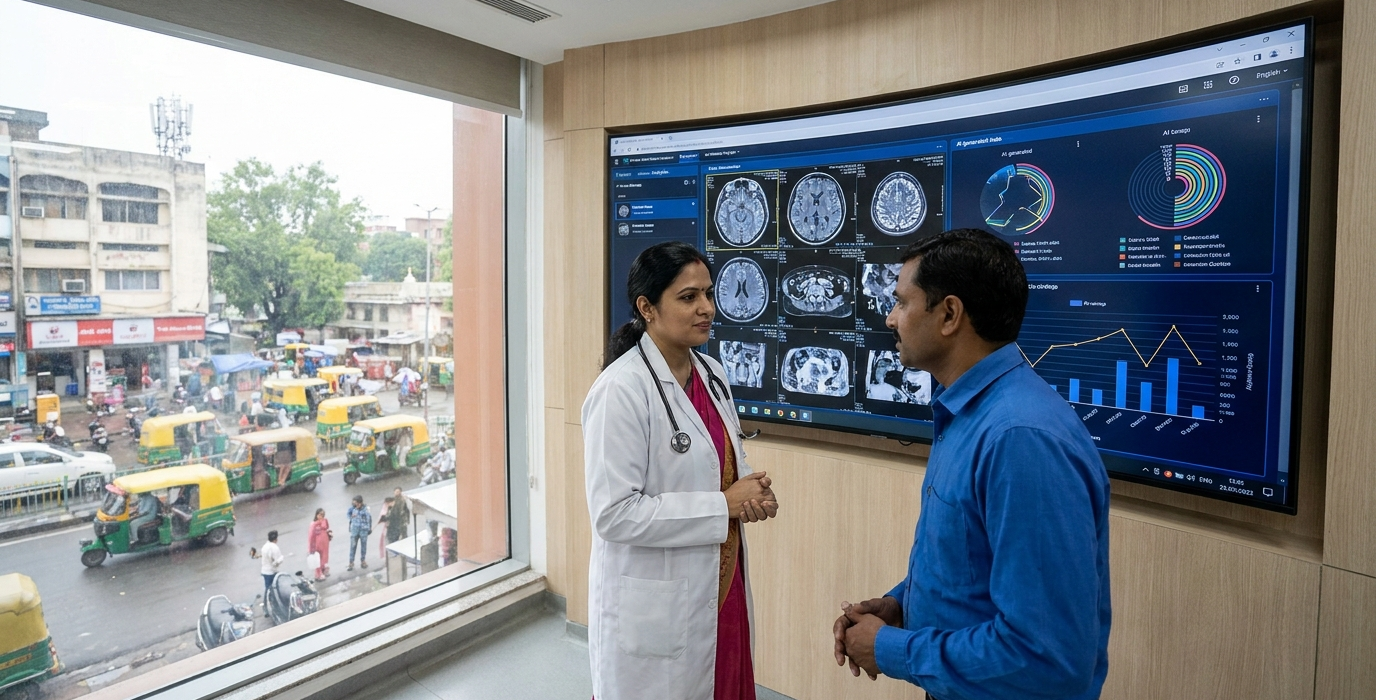
One of the most significant impacts of AI in Indian healthcare is its transformative role in diagnostics. Medical imaging, in particular, has seen a seismic shift. AI algorithms can now analyze X-rays, CT scans, and MRIs with remarkable speed and precision, often identifying anomalies that the human eye might overlook, especially after long hours of continuous work. For instance, AI models trained on vast datasets of retinal scans are proving exceptionally adept at detecting early signs of diabetic retinopathy, a leading cause of blindness in India, often before symptoms manifest.
Consider the sheer volume of diagnostic tests performed daily across India. AI can sift through this data, flagging critical cases for immediate attention. This is especially crucial in specialties like radiology and pathology, where workload can be immense. Projects in Bangalore and Hyderabad are already showcasing AI’s ability to reduce the time taken for preliminary readings, allowing radiologists and pathologists to focus on complex cases and patient consultations. This not only speeds up diagnosis but also potentially lowers the risk of misdiagnosis, leading to earlier intervention and better patient outcomes.
The Power of Early Detection
The ability of AI to detect subtle markers of disease at its nascent stage is a game-changer. Early detection of cancers, cardiovascular diseases, and neurological disorders dramatically increases the chances of successful treatment and long-term recovery. AI is proving to be a powerful ally in this fight, offering a level of detail and consistency that is difficult for even the most experienced human practitioners to maintain consistently.
Bridging the Healthcare Divide: AI for Rural India
India’s vast geography presents a significant challenge when it comes to equitable healthcare access. Millions live in remote rural areas, far from specialized medical facilities and skilled practitioners. AI is emerging as a critical tool to bridge this divide, bringing advanced diagnostic capabilities and expert medical advice directly to these underserved communities. Telemedicine platforms, now enhanced with AI, are allowing primary healthcare workers in villages across Uttar Pradesh and Bihar to consult with specialists located thousands of kilometers away.
Imagine a community health worker in a remote Rajasthan village using an AI-powered app to analyze a patient’s skin lesion. The app can instantly identify potential signs of skin cancer and suggest the urgency of referral. Similarly, AI-driven chatbots are providing basic health advice and triaging patients, freeing up doctors’ time for those who truly need in-person care. This democratizes healthcare, ensuring that geographical location is no longer an insurmountable barrier to receiving timely and appropriate medical attention.
AI-Powered Telemedicine
The integration of AI into telemedicine is a significant leap forward. AI can help analyze patient-reported symptoms, medical history, and even vital signs captured through wearable devices, providing a more comprehensive picture to the remote physician. This enhances the effectiveness of virtual consultations, making them more akin to an in-person visit. We are seeing AI assist in analyzing cough sounds for respiratory illnesses and even interpreting ECG readings remotely, bringing specialist care to the doorstep.
A surprising fact: AI systems are being developed that can analyze a person’s gait and posture through video to detect early signs of Parkinson’s disease, a condition that affects a significant portion of the elderly population in India. This technology could allow for early screening in rural areas with minimal equipment.
Personalized Medicine: Tailoring Treatments with AI
The era of one-size-fits-all medicine is rapidly fading, and AI is at the forefront of this revolution in personalized healthcare. By analyzing an individual’s genetic data, lifestyle, medical history, and even environmental factors, AI algorithms can predict their susceptibility to certain diseases and tailor treatment plans for maximum efficacy and minimal side effects. This precision medicine approach promises to transform the treatment of complex conditions like cancer and chronic diseases.
In hospitals across Chennai and Kolkata, AI platforms are assisting oncologists in selecting the most effective chemotherapy regimens based on the specific genetic mutations of a patient’s tumor. This not only improves treatment outcomes but also avoids the trial-and-error that can be both costly and debilitating for patients. The ability of AI to process and interpret vast genomic datasets is unlocking new possibilities in drug discovery and development, leading to more targeted and effective therapies.
Predictive Analytics for Disease Management
Beyond diagnosis and treatment selection, AI is also being used for predictive analytics in disease management. By monitoring patient data continuously, AI can identify individuals at high risk of developing complications or experiencing adverse events. This allows healthcare providers to intervene proactively, preventing hospitalizations and improving overall patient well-being. For conditions like diabetes and heart disease, AI can predict the likelihood of exacerbations, enabling timely adjustments to medication or lifestyle advice.
The Human Element: Collaboration, Not Replacement
A common concern surrounding AI in healthcare is the fear of job displacement for medical professionals. However, the consensus among leading healthcare institutions and AI developers is that AI is poised to augment, not replace, human doctors. The empathy, intuition, and complex decision-making skills of a human physician remain irreplaceable. Instead, AI will serve as a powerful co-pilot, handling data-intensive tasks and providing insights that enable doctors to focus on what they do best: caring for patients.
Think of it as a highly advanced assistant. AI can meticulously analyze thousands of research papers to identify the latest treatment protocols, freeing up the doctor to spend more time discussing options with the patient and their family. In emergency situations, AI can quickly process vital signs and patient history to alert the medical team to critical changes, allowing for faster and more informed responses. This collaborative approach enhances efficiency and improves the quality of care delivered.
AI: Enhancing Physician Capabilities
The integration of AI tools can significantly enhance a physician’s capabilities. For example, AI-powered virtual assistants can help manage patient appointments, track medication adherence, and even generate preliminary medical reports, reducing the administrative burden on doctors. This allows them to dedicate more time to direct patient interaction, building stronger doctor-patient relationships and improving patient satisfaction. The future of medicine in India is one where human expertise is amplified by intelligent technology.
Navigating the Challenges: Data, Ethics, and Regulation
While the promise of AI in Indian healthcare is immense, its widespread adoption is not without its hurdles. Data privacy and security are paramount concerns. The vast amounts of sensitive patient data required to train and operate AI systems must be handled with the utmost care and adherence to stringent regulations. India is actively developing its digital personal data protection frameworks, and their effective implementation will be critical for building trust.
Another significant challenge is the need for robust regulatory frameworks to govern the development, validation, and deployment of AI medical devices and software. Ensuring the safety, efficacy, and ethical use of these technologies requires clear guidelines and oversight. Furthermore, there’s a crucial need for upskilling healthcare professionals to effectively utilize and interpret AI-driven insights. We must invest in training programs to equip doctors, nurses, and technicians with the necessary skills to work alongside AI.
The Regulatory Landscape
The Indian government, through bodies like the National Health Authority and the Ministry of Electronics and Information Technology, is actively working on creating a conducive environment for AI in healthcare. However, the pace of technological advancement often outstrips regulatory development. Striking the right balance between fostering innovation and ensuring patient safety is a delicate act that requires continuous dialogue between technology providers, healthcare institutions, and policymakers.
A surprising fact: India has a unique opportunity to develop AI healthcare solutions that are not just technologically advanced but also culturally sensitive, addressing the specific needs and beliefs of its diverse population. This includes developing AI that can communicate in multiple regional languages and understand diverse health practices.
“AI is not a magic wand that will instantly solve all our healthcare woes. It is a powerful tool that, when wielded responsibly and ethically, can amplify the capabilities of our dedicated healthcare professionals, making quality medical care more accessible and effective for every Indian.”
The Future of AI in Indian Healthcare
Looking ahead, the trajectory of AI in Indian healthcare is undeniably upward. We can anticipate AI playing an even more significant role in areas such as drug discovery, personalized preventive care, and even robotic-assisted surgery. The continuous advancements in machine learning and natural language processing will lead to more sophisticated diagnostic tools and intuitive patient interfaces. The potential for AI to democratize access to high-quality healthcare across India is immense, promising a future where geographical and economic barriers are significantly reduced.
The focus will increasingly be on creating explainable AI (XAI), where the decision-making process of AI algorithms is transparent and understandable to clinicians. This will build greater trust and facilitate smoother integration into clinical workflows. As we move forward, the collaborative spirit between human intelligence and artificial intelligence will define the next chapter of Indian medicine, ensuring that technology serves humanity’s most fundamental need: health and well-being.
Frequently Asked Questions
How is AI currently being used in Indian hospitals?
AI is currently being used for tasks such as analyzing medical images (X-rays, CT scans) for early disease detection, predicting patient outcomes, automating administrative tasks, and powering telemedicine platforms to extend reach to remote areas.
Will AI replace doctors in India?
No, the general consensus is that AI will augment rather than replace doctors. AI will handle data-intensive tasks, allowing doctors to focus more on patient interaction, complex decision-making, and providing empathetic care.
What are the biggest challenges to AI adoption in Indian healthcare?
Key challenges include ensuring data privacy and security, establishing clear regulatory frameworks, the high cost of implementation, and the need for training healthcare professionals to effectively use AI tools.
Can AI help with healthcare access in rural India?
Yes, AI is a crucial tool for bridging the healthcare gap. AI-powered telemedicine and diagnostic tools can bring specialist expertise and preliminary diagnoses to remote areas, significantly improving access to care.