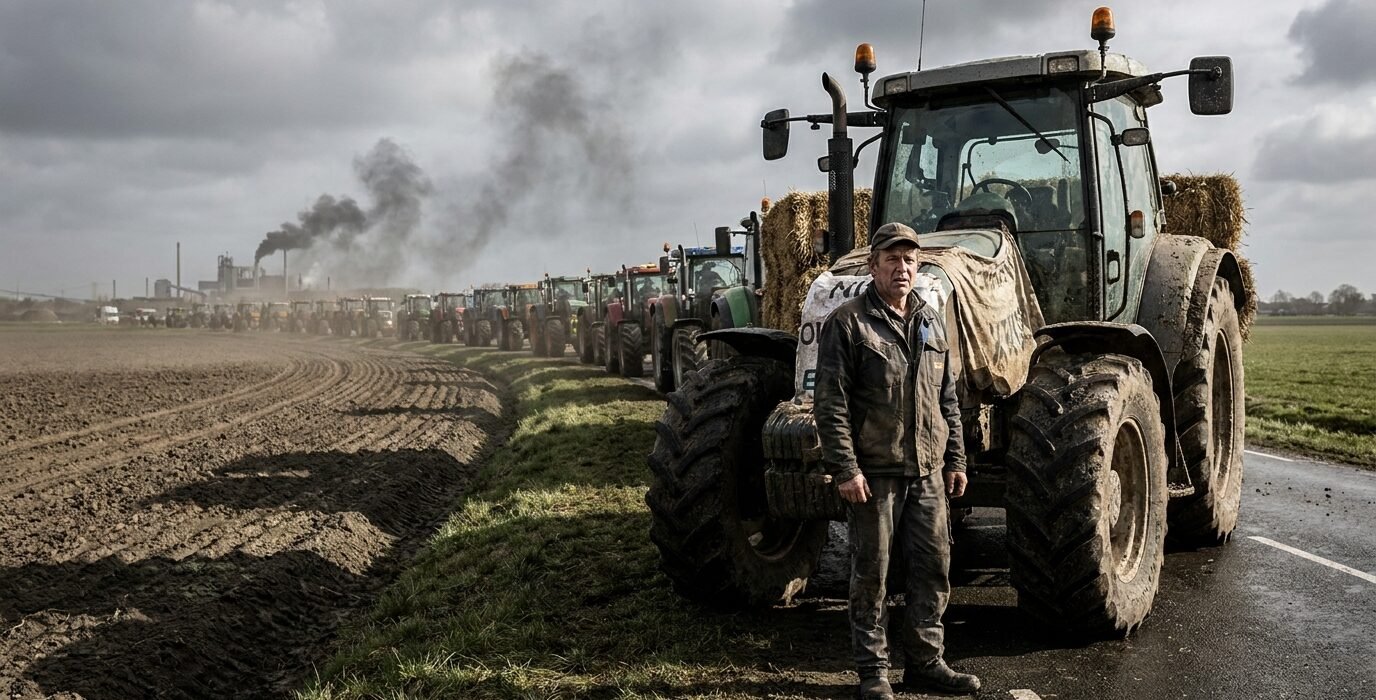
The smell of freshly cut hay usually signifies prosperity in the Netherlands. Now, it’s often mixed with the acrid scent of diesel fuel. Frustration simmers. Farmers, whose families have worked this fertile land for generations, are staring down an uncertain future. Their tractors, once symbols of productivity, have become powerful protest tools. They blockade highways and ports. Tremors reach far beyond the windmills and tulip fields.
This isn’t just a local dispute. The Netherlands is an agricultural superpower. It’s a leading exporter of food products worldwide. When its farmers are in distress, the world feels it. Fresh produce graces supermarket shelves in Mumbai. Dairy ingredients land in your morning coffee. Dutch innovation and output play a crucial, often unseen, role.
The current standoff is fueled by ambitious nitrogen reduction targets. It’s more than just a domestic policy debate. It’s a potential harbinger of global food supply chain disruptions. It’s a stark reminder. The balance between environmental stewardship and economic survival is delicate.
Key Takeaways:
- Dutch farmers are protesting stringent environmental regulations, particularly nitrogen reduction targets, which they argue threaten their livelihoods.
- The Netherlands is a major global agricultural exporter, making these protests consequential for international food supply chains.
- The economic fallout is significant, impacting farmers’ businesses, related industries, and the Dutch economy.
- Potential long-term consequences include shifts in global food production, increased prices, and a re-evaluation of agricultural sustainability practices.
- The protests highlight the complex interplay between environmental policy, food security, and the socio-economic realities of farming communities.
The Unfolding Crisis in the Dutch Countryside
The picturesque Dutch landscape, a patchwork of vibrant green pastures and meticulously managed fields, belies a brewing storm. For months, the low hum of agricultural machinery has been replaced by the defiant roar of tractor engines. This sound is now synonymous with protest across the Netherlands.
At the heart of this unrest lies a government mandate. It aims to drastically reduce nitrogen emissions. The proposed measures include potential land buyouts. They also involve significant operational restrictions. These have sent shockwaves through the farming community.
Many see these policies as an existential threat. They view them not as a path to sustainability. They are seen as a deliberate dismantling of their way of life.
Consider the sheer scale of Dutch agriculture. This small nation consistently ranks among the top agricultural exporters globally. It often outperforms much larger countries. Its expertise in greenhouse technology is world-renowned. Dairy farming innovation is also key. Horticultural prowess shines.
Companies in cities like Wageningen are at the forefront. This area is often called the “Food Valley.” It’s a hub for agricultural research and development. Yet, the very practices that propelled this success are now under intense scrutiny. Intensive livestock farming, particularly, is a major contributor to nitrogen pollution.
The government’s stated goal is ambitious. It wants to halve nitrogen emissions by 2030. This target requires significant adjustments. For many farmers, these adjustments are unachievable.
The protests began in areas like Friesland and Gelderland. They have escalated. Farmers are blocking distribution centers. Highways are also being targeted. This disrupts the flow of goods. It affects both domestic and international trade.
The economic implications are immediate. They are also far-reaching. It affects not just the farmers. It impacts the intricate network of suppliers. It touches processors and export markets. All rely on Dutch agricultural output.
The emotional toll on these farming families is palpable. We spoke with Marjolein. She is a third-generation dairy farmer near Utrecht. Her family has weathered economic downturns for decades. They have adapted to changing agricultural landscapes.
“This is different,” she explained. Her voice was tinged with weariness. It went beyond physical exhaustion. “They are talking about taking our land,” she said. “About making it impossible for us to continue.”
“Our identity is tied to this soil,” Marjolein continued. “What are we supposed to do then?” Her concern is echoed by thousands. The protests have become a focal point. They represent a broader anxiety about the future of farming in the Netherlands.
The proposed solutions aim for environmental protection. Yet, many perceive them as a forced exodus. It feels like a top-down decree. It disregards decades of dedication. It ignores the investment these families have poured into their farms.
The visual of tractors surrounding government buildings is striking. Tractors lining up at ports is another enduring image. These have become symbols of this deep-seated conflict.
Global Ripples: When Dutch Fields Go Quiet
The Netherlands might be a relatively small country. But its agricultural footprint is colossal. Its dairy products are found in breakfast cereals across continents. Its vegetables are a staple in kitchens from Berlin to Bangkok. Its flower exports bring color to homes worldwide.
This export-driven industry is a significant contributor to the Dutch economy. Any disruption to its operations has a cascading effect. This effect reaches far beyond its borders. When Dutch farmers protest, it’s not just about local regulations. It’s about the intricate, interconnected web of global food supply chains.
Consider the impact on fresh produce markets. The Netherlands is a leading exporter of tomatoes, peppers, and cucumbers. These are often grown in its highly efficient greenhouses. These shipments are time-sensitive.
Blockades at ports like Rotterdam are problematic. Rotterdam is one of Europe’s busiest. Blockades at key distribution hubs also cause issues. Perishable goods either spoil. Or they fail to reach their destinations on time.
This creates shortages. It leads to price hikes for consumers in importing countries. For instance, a disruption in Dutch tomato exports could directly impact availability. It affects the cost of this common ingredient in European supermarkets. This, by extension, impacts markets that rely on those European supply chains.
The Netherlands exports billions of euros worth of agricultural products annually. A significant portion of this trade relies on smooth, predictable logistics.
Even seemingly niche products have a global reach. Dutch cheese, for example, is a highly sought-after commodity. The country’s expertise in dairy farming and cheese production is well-known. Its products are integral to global cheese markets.
Disruptions to milk supply or processing facilities can affect availability. Specific Dutch cheese varieties might become scarce internationally. This impacts not only consumers. It also affects restaurants and retailers. They have come to rely on these consistent, high-quality imports.
The economic fallout isn’t just about lost sales. It’s about damaged reputations. It’s about the potential for importing countries to seek out alternative sources. These alternatives might be less sustainable.
A study by Rabobank, a prominent agricultural bank, highlighted a key point. The Dutch agricultural sector contributes significantly to the national GDP. Prolonged disruptions could have a measurable negative impact on economic growth.
The interconnectedness is clear. A protest in a Dutch field can echo in a grocery aisle thousands of kilometers away. This is a stark illustration of globalization’s dual-edged sword.
The Economic Fallout: More Than Just Farmer’s Fields
The protests are not merely a symbolic stand. They are inflicting tangible economic damage. This damage occurs on multiple levels. For the farmers themselves, the uncertainty breeds a paralyzing fear.
Many are struggling to meet loan payments. They find it hard to purchase essential supplies. This includes feed and fertilizer. They cannot invest in the future of their farms. The government’s proposed solutions offer little solace.
Voluntary buyouts and relocation schemes are on the table. However, many farmers deem the compensation packages insufficient. They do not cover the true value of their land. They do not compensate for the loss of their generational businesses. The psychological burden is immense. It’s the potential loss of heritage. It’s the loss of livelihood. It’s the loss of connection to the land.
Beyond the farm gate, the ripple effect is substantial. The agricultural sector is a significant employer in the Netherlands. The crisis impacts a vast network of related industries. This includes companies that manufacture farm equipment. It encompasses producers of animal feed. Suppliers of fertilizers and pesticides are affected. Veterinary services are also impacted.
As farmers face financial strain, their spending decreases. This leads to reduced demand. It can result in job losses in these supporting sectors. Moreover, food processing plants face challenges. They rely on a steady supply of raw materials from Dutch farms.
If milk processing facilities receive less milk, for example, it directly impacts production. This affects cheese, butter, and other dairy products. Potential shortages and price increases for consumers are likely outcomes.
The logistics and transportation sector is another casualty. Highways blocked by tractors cause problems. Ports experiencing slowdowns mean goods aren’t moving efficiently. This leads to increased transportation costs. It causes delays in delivery. The risk of spoilage for perishable goods rises.
For an export-oriented nation like the Netherlands, this disruption to its trade routes is particularly damaging. The reputation of the Netherlands as a reliable supplier is at stake. International buyers, faced with consistent delays and uncertainty, may seek alternative sourcing options. This could further diminish the long-term economic prospects for Dutch agriculture.
A recent analysis by the Dutch Central Bank indicated a significant economic impact. The cost of supply chain disruptions and lost export revenue could run into billions of euros. This is a considerable sum for a nation of its size. The narrative often focuses on the farmers. But the economic consequences extend deep into the fabric of the Dutch economy. They affect businesses and individuals far removed from the protest lines.
The Nitrogen Conundrum: A Scientific and Social Tightrope
At the core of the Dutch farmer protests lies a complex challenge. It’s both scientific and social: the ubiquitous presence of nitrogen and its environmental impact. Nitrogen is essential for plant growth. It becomes a pollutant when present in excessive amounts in the environment.
In the Netherlands, intensive livestock farming is a major factor. Cattle and pig farming, in particular, generate large quantities of manure. This manure is a significant source of ammonia. Ammonia is then converted into nitrogen oxides in the atmosphere.
These nitrogen compounds contribute to acid rain. They damage sensitive ecosystems. This happens through eutrophication, or excess nutrient enrichment. They can also harm biodiversity. The European Court of Justice has ruled on this. It stated that the Netherlands has failed to adequately protect nature areas from nitrogen deposition. This led to the stringent new regulations.
The government’s proposed solutions are ambitious. They aim to reduce nitrogen emissions by 50% by 2030. There are specific targets for areas near nature reserves. This involves measures such as reducing livestock numbers. It also includes promoting more sustainable farming practices. In some cases, it offers to buy out farms in vulnerable areas.
However, these measures are deeply controversial. Farmers argue that the scientific models used are flawed. They believe the burden of reduction is disproportionately placed on them. Meanwhile, industrial polluters face less stringent rules. They point to decades of evolving practices. The current regulations seem to disregard this progress.
The debate often becomes polarized. Environmental advocates emphasize the urgent need to protect fragile ecosystems. The Veluwe National Park is one example. Farmers, on the other hand, emphasize their right to earn a living. They want to continue their ancestral profession.
One surprising revelation in this ongoing debate is the sheer intensity of agricultural activity. This occurs in such a small landmass. The Netherlands has one of the highest densities of livestock in the world. This concentration, while a testament to agricultural efficiency, inevitably leads to significant environmental pressures.
The scientific consensus is clear. Nitrogen pollution is a serious environmental issue. But the political and social challenge lies in finding solutions. These solutions must be both environmentally effective and economically viable for the farming community.
The proposed land buyouts, for example, are intended to reduce emissions. However, many see them as forced displacement. The situation highlights a global dilemma. How do we balance the increasing demand for food with the imperative to protect the planet? This is especially true in densely populated and agriculturally intensive regions.
The ongoing negotiations and protests are a stark illustration. They show the difficulty in navigating this scientific and social tightrope.
Expert Perspectives: Navigating a Sustainable Future
The complexities of the Dutch farmer protests have attracted significant attention. Agricultural economists, environmental scientists, and policy experts are weighing in. Their insights offer a broader perspective. They shed light on the challenges and potential pathways forward.
Many experts agree on one point. The need for reducing nitrogen emissions is scientifically sound. However, the current approach is perceived as overly punitive. It lacks nuanced, long-term solutions.
Dr. Annelies van der Steen, an agricultural policy analyst at Wageningen University, notes, “The government’s targets are ambitious, perhaps too ambitious without adequate investment in transition support.” She adds, “We need to see a clear roadmap that supports farmers in adapting, rather than simply forcing them out.”
One key aspect often highlighted is the need for innovation. Technological adoption is also crucial. While the Netherlands is a leader in agricultural technology, the pace of adoption for certain sustainable practices needs acceleration. This includes more efficient manure processing. Precision farming techniques that minimize fertilizer use are also important. The development of alternative feed for livestock that can reduce nitrogen excretion is another area.
However, these innovations require significant investment. This presents a considerable hurdle. Many farmers are already facing financial pressures. “We cannot expect farmers to bear the full cost of this transition alone,” states agricultural economist Professor David Jansen. “There needs to be substantial public and private investment in research, development, and the implementation of these new technologies. This includes subsidies, tax incentives, and accessible financing.”
Furthermore, there’s a growing recognition that the issue is not solely about Dutch farmers. The global demand for food, particularly meat and dairy products, drives intensive agricultural practices worldwide. The Netherlands, as a major exporter, plays a role in this global demand. Therefore, a truly sustainable solution might require a broader international conversation. This conversation should focus on consumption patterns and the global food system.
Some experts suggest a more collaborative approach. This involves farmers in the policy-making process from the outset. Such an approach could lead to more pragmatic and effective solutions. “When farmers feel heard and are part of the solution, you get better outcomes,” observes a community mediator. This mediator has been involved in local discussions.
The challenge lies in bridging the gap. This gap exists between scientific imperatives, economic realities, and the deep-seated cultural and emotional ties farmers have to their land. The path forward is likely to involve a combination of targeted regulation. It will require robust financial support. Technological advancement is key. And a fundamental rethinking of our relationship with food production is necessary.
The Long Shadow: Reshaping Global Agriculture
The protests by Dutch farmers, born out of a specific national policy, cast a long shadow. This shadow has potentially global implications for agriculture and food security. The Netherlands’ position as a food-exporting powerhouse means any significant disruption to its production capacity inevitably sends ripples through international markets.
If the current trajectory continues, we might witness a slow but steady shift in global agricultural production patterns. Countries that can meet stringent environmental standards could see increased investment. Those with less rigorous regulations might also attract more production. This could lead to a diversification of global food sources.
This diversification might seem positive. But it raises questions about food sovereignty. It also raises concerns about the potential for increased reliance on fewer, perhaps less sustainable, agricultural hubs.
The economic consequences are likely to be felt in rising food prices. As Dutch farmers scale back production or face increased operational costs due to new regulations, the global supply of certain commodities could tighten. This scarcity, coupled with ongoing geopolitical uncertainties and climate-related disruptions, could contribute to a sustained increase in food prices worldwide.
For consumers, especially those in lower-income brackets globally, this translates to a greater burden on household budgets. The affordability of nutritious food could become an even more pressing concern. We’ve already seen instances where shortages of specific Dutch produce have led to price hikes in neighboring European countries. Imagine this effect on a larger, global scale.
Moreover, the Netherlands’ leadership in agricultural innovation could be significantly impacted. If its most productive and experienced farmers are forced out of the industry, the transfer of knowledge could falter. The development of cutting-edge sustainable practices might also slow. This would be a loss not only for the Netherlands. It would be a loss for the global agricultural community. This community seeks solutions for feeding a growing population sustainably.
The protests serve as a potent case study. They offer lessons for other nations grappling with similar environmental challenges in their agricultural sectors. They highlight the critical need for policy frameworks. These frameworks must be both environmentally sound and socially just. They must ensure that the transition to sustainable agriculture does not leave entire communities behind.
The enduring image of tractors on highways is a powerful reminder. It highlights the human element in this complex equation. It underscores the profound interconnectedness of our global food systems.
The Dutch farmer protests are more than just a domestic dispute. They are a significant event that has drawn global attention. The courage and determination of these farmers, standing up for their livelihoods, are undeniable. Yet, the wider implications for global food supply chains and the Dutch agricultural export business are a serious concern. As the situation continues to unfold, the world watches. It hopes for a resolution that balances environmental imperatives with the fundamental need for food security and the preservation of agricultural heritage.