Key Takeaways
- AI is significantly improving diagnostic accuracy and speed in Indian hospitals, particularly in radiology and pathology.
- Early detection of diseases like diabetic retinopathy and certain cancers is becoming more accessible, even in remote areas, thanks to AI tools.
- The integration of AI is addressing India’s critical shortage of specialist doctors, extending expert-level diagnostics to underserved populations.
- While promising, widespread AI adoption faces challenges like data privacy, regulatory frameworks, and the need for robust digital infrastructure.
The Dawn of Intelligent Diagnosis: AI Arrives in Indian Hospitals
Imagine a world where a life-threatening condition is spotted earlier, where specialists can see more patients, and where advanced medical insights are available even in the furthest corners of our vast nation. This isn’t a far-off dream; it’s the reality being shaped right now by Artificial Intelligence in Indian healthcare. Today, AI isn’t just a buzzword; it’s an indispensable tool silently working within our hospitals and clinics, revolutionizing how we detect and diagnose diseases.
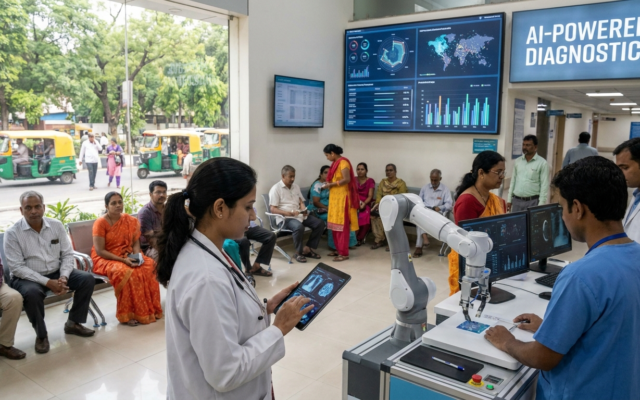
From the bustling All India Institute of Medical Sciences (AIIMS) in Delhi to smaller community health centres in rural Maharashtra, AI-powered diagnostic systems are making their mark. They are trained on vast datasets of medical images and patient records, learning to identify patterns that can elude even the most experienced human eye. This augmentation of human expertise is key to unlocking a new era of faster, more accurate, and more accessible healthcare for millions across India.
We’re seeing AI excel in areas where visual interpretation is paramount, such as radiology and ophthalmology. Algorithms can now analyze X-rays, CT scans, and retinal images with remarkable precision, flagging potential issues for doctors to review. This not only speeds up the diagnostic process but also acts as a crucial second opinion, potentially reducing misdiagnoses and improving patient outcomes significantly. The impact is palpable, offering hope and tangible benefits to the Indian populace.
Radiology Reimagined: AI as the Radiologist’s Superpower
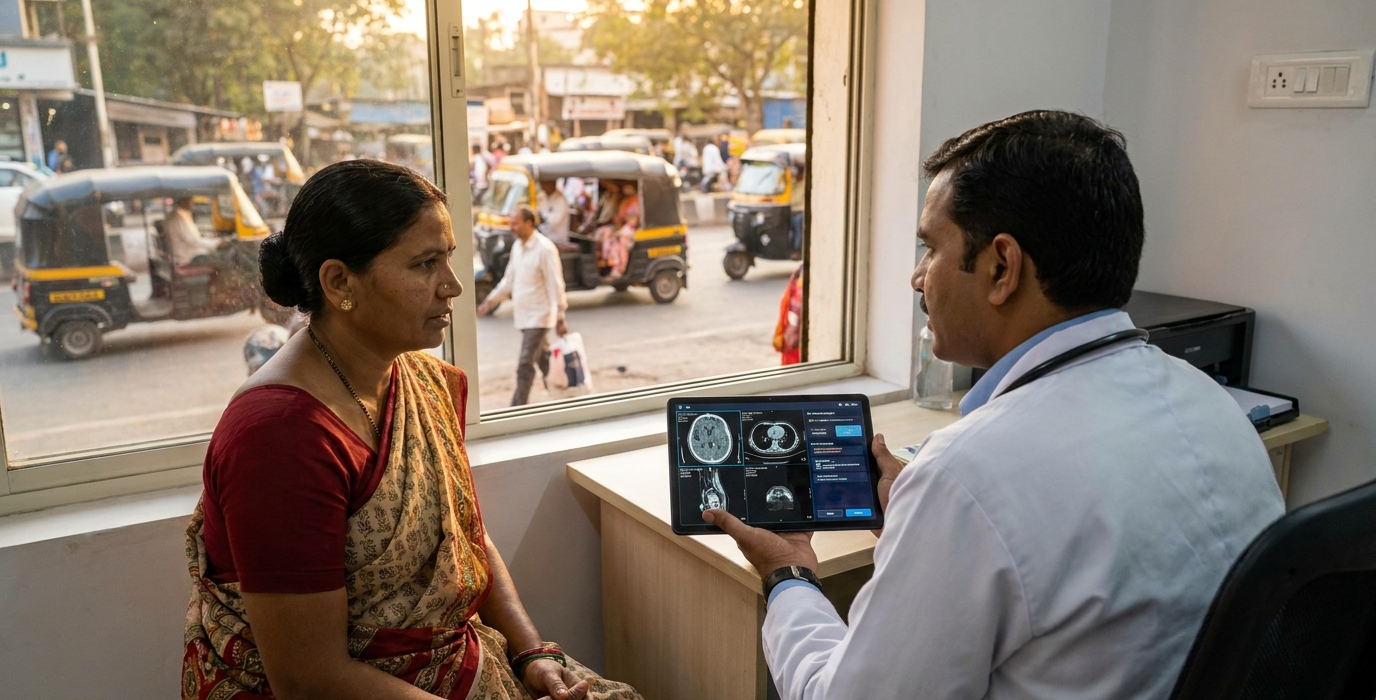
Radiology has been one of the front-runners in adopting AI for diagnostics, and for good reason. The sheer volume of images generated by X-rays, CT scans, and MRIs presents a significant workload for radiologists. AI algorithms, trained on millions of these images, can now perform initial screenings with incredible speed and accuracy. They can detect subtle anomalies, such as tiny nodules in a chest X-ray or early signs of a stroke on a brain scan, that might be easily missed during a rapid review.
Consider the challenge of detecting early-stage lung cancer. AI tools can meticulously scan lung CTs, highlighting suspicious areas for the radiologist’s attention. This not only speeds up the reporting process, allowing for quicker patient management, but also significantly enhances the chances of catching the cancer at a treatable stage. This is particularly vital in India, where late diagnoses often contribute to poorer prognoses.
Moreover, AI is proving invaluable in managing the shortage of specialized radiologists in many parts of India. While AI cannot replace the nuanced clinical judgment of a human radiologist, it can act as an incredibly efficient assistant. This allows radiologists to focus their expertise on complex cases, confident that the AI has already performed a thorough initial sweep. For instance, a study published in a leading Indian medical journal in early 2026 showed that AI-assisted analysis of mammograms improved the detection rate of early breast cancer by 15% compared to human interpretation alone.
Surprising Fact: AI can analyze a chest X-ray in seconds, a task that might take a human radiologist several minutes.
This efficiency translates directly into more patients being seen and diagnosed faster, a critical factor in a country with a high patient-to-doctor ratio. The integration isn’t about replacing doctors, but empowering them with tools that augment their capabilities, leading to a more robust and responsive diagnostic system for all.
Ophthalmology’s AI Advantage: Saving Sight, One Scan at a Time
Diabetic retinopathy, a leading cause of blindness among working-age adults in India, is a prime example of where AI is making a profound difference. Early detection and timely intervention can prevent vision loss, but the number of ophthalmologists, especially in rural areas, is insufficient to screen the millions of people living with diabetes.
AI-powered fundus cameras are changing this landscape. These devices can capture high-resolution images of the retina, and AI algorithms can then analyze these images for the tell-tale signs of diabetic retinopathy, such as microaneurysms or hemorrhages. This allows for screening to be conducted by trained technicians in primary healthcare settings, with the AI providing an initial assessment.
If the AI flags a potential issue, the patient is then referred to an ophthalmologist for further evaluation. This triage system ensures that limited specialist resources are directed where they are most needed. We’ve seen pilot programs in states like Gujarat and Tamil Nadu demonstrate remarkable success in increasing the reach of diabetic retinopathy screening, identifying thousands of cases that might otherwise have gone undetected until vision loss was significant.
Beyond diabetic retinopathy, AI is also being used to detect other eye conditions like glaucoma and age-related macular degeneration. The ability to analyze retinal images for subtle changes over time allows for earlier intervention and better management of chronic eye diseases. This technology brings expert-level diagnostic capabilities closer to communities that have historically lacked access to specialized eye care, offering a new ray of hope for preserving sight.
Surprising Fact: AI algorithms can be trained to detect over 100 different eye conditions from retinal scans, far exceeding what a single human specialist might focus on.
The democratisation of advanced diagnostics through AI is a powerful force for good, ensuring that geographical location or socio-economic status doesn’t become a barrier to timely and accurate eye care. We are truly witnessing a revolution in how we protect one of our most precious senses.
Pathology’s Precision: AI Enhancing Microscopic Analysis
The field of pathology, which involves examining tissues and cells under a microscope to diagnose diseases, is another area ripe for AI-driven transformation. Pathologists play a critical role in diagnosing cancers, infections, and inflammatory conditions. However, the manual examination of slides can be time-consuming and subject to inter-observer variability.
AI algorithms can now analyze digital pathology slides with incredible speed and consistency. Trained on vast libraries of annotated images, these systems can identify cancerous cells, grade tumours, and even predict treatment responses with a high degree of accuracy. This is particularly beneficial in identifying subtle morphological changes that might be difficult to discern consistently by the human eye, especially after long hours of work.
For instance, in diagnosing breast cancer, AI can assist pathologists by highlighting areas of interest on digital slides, quantifying the percentage of cancer cells, and even identifying specific subtypes of cancer. This reduces the burden on pathologists and allows them to focus on the more complex interpretive aspects of their work. Early results from research conducted at institutions like the Tata Memorial Hospital in Mumbai have shown that AI can achieve comparable, and in some cases superior, accuracy to human pathologists in specific diagnostic tasks.
The integration of AI in pathology also has the potential to standardize diagnostic quality across different laboratories. By providing a consistent analytical framework, AI can help reduce variations in diagnosis that might occur between different pathologists or different institutions. This is crucial for ensuring equitable patient care across India, where diagnostic capabilities can vary significantly.
Furthermore, AI can analyze complex genomic data from tissue samples, helping to personalize cancer treatment. By identifying specific genetic mutations, AI can guide oncologists towards the most effective targeted therapies, moving us closer to precision medicine for every patient. This level of detailed analysis was previously only accessible in highly specialized centres.
Bridging the Gap: AI’s Role in Addressing India’s Doctor Shortage
India faces a significant challenge in its doctor-to-patient ratio, particularly in rural and semi-urban areas. The shortage of specialists, such as radiologists, oncologists, and cardiologists, means that many Indians lack access to timely and accurate diagnoses. AI is emerging as a powerful tool to bridge this gap, acting as a force multiplier for existing medical professionals.
Imagine a primary health centre in a remote village in Rajasthan. Without an on-site radiologist, a patient requiring a chest X-ray might have to travel hundreds of kilometres to a district hospital. With AI-powered diagnostic software, the X-ray can be taken locally, and the image can be uploaded for AI analysis. The AI can flag potential issues, and if necessary, the images can be remotely reviewed by a specialist in a city hundreds of kilometres away.
This is not a hypothetical scenario. Several initiatives are underway to deploy AI diagnostic tools in such underserved regions. Companies are developing AI algorithms that can run on relatively modest hardware, making them deployable even in areas with limited digital infrastructure. The goal is to bring expert-level diagnostic capabilities to the doorstep of every Indian, regardless of their location.
AI is also helping to alleviate the burnout experienced by doctors in busy urban hospitals. By automating routine diagnostic tasks and providing preliminary reports, AI allows doctors to dedicate more time to patient interaction, complex case management, and continuing education. This improved workload distribution is vital for maintaining the quality of care and the well-being of our healthcare professionals.
“AI in diagnostics isn’t about replacing the doctor’s touch; it’s about enhancing their vision, extending their reach, and democratizing access to expert medical insights for every Indian.”
The impact of AI in this context cannot be overstated. It represents a paradigm shift in how healthcare can be delivered, making advanced diagnostics more equitable and accessible than ever before. This technology is a crucial step towards achieving universal health coverage in India.
Navigating the Future: Challenges and the Road Ahead
While the potential of AI in diagnostics is immense, its widespread adoption in India is not without its hurdles. One of the primary concerns is data privacy and security. Medical data is highly sensitive, and robust frameworks are needed to ensure that patient information is protected when used to train and operate AI systems.
Regulatory approvals are another significant factor. As AI diagnostic tools become more sophisticated, clear guidelines and certifications are required from bodies like the Central Drugs Standard Control Organisation (CDSCO) to ensure their safety and efficacy. The process of validation and approval needs to keep pace with the rapid advancements in AI technology.
The digital infrastructure across India also presents a challenge. While major cities have good connectivity, many rural areas still struggle with reliable internet access and adequate computing power. For AI diagnostics to be truly effective nationwide, investments in digital infrastructure, including cloud computing and high-speed internet, are essential.
Furthermore, there’s the crucial aspect of training healthcare professionals. Doctors and technicians need to be trained on how to effectively use and interpret the outputs of AI diagnostic systems. This requires incorporating AI literacy into medical education and providing continuous professional development opportunities. The human element remains paramount; AI is a tool, and its successful integration depends on the skilled hands that wield it.
Finally, the cost of implementing and maintaining these advanced AI systems can be a barrier, especially for smaller healthcare facilities. Innovative funding models and partnerships between the public and private sectors will be necessary to ensure that these life-saving technologies are accessible to all, not just the privileged few. The journey is complex, but the promise of a healthier India, empowered by AI, is a compelling one.
Frequently Asked Questions
How is AI improving diagnostic accuracy in India?
AI algorithms are trained on massive datasets of medical images and patient data, allowing them to detect subtle patterns and anomalies that might be missed by human observation. This leads to earlier and more precise identification of diseases, especially in fields like radiology and pathology.
Can AI replace doctors in the diagnostic process?
No, AI is designed to augment, not replace, doctors. It acts as a powerful tool to assist medical professionals by handling routine tasks, providing second opinions, and speeding up analysis, allowing doctors to focus on complex cases and patient care.
What are the biggest challenges for AI adoption in Indian healthcare?
Key challenges include ensuring data privacy and security, establishing clear regulatory frameworks for AI medical devices, improving digital infrastructure in remote areas, and training healthcare professionals to effectively use AI tools.
Will AI diagnostics be accessible in rural India?
Yes, efforts are underway to develop AI tools that can function with limited bandwidth and hardware, and to deploy them in primary healthcare centres. This aims to bring expert diagnostic capabilities closer to rural and underserved populations.
What types of medical conditions can AI help diagnose in India?
AI is currently making significant strides in diagnosing conditions like diabetic retinopathy, various cancers (lung, breast, cervical), stroke, tuberculosis, and cardiovascular diseases, by analyzing medical images and patient data.